Joachim Mehr
1945–1964
Joachim Mehr, a 19-year-old carpenter from Prenzlauer Berg, was shot dead on 3 December 1964 at the barbed-wire fence near Bergfelde, after he had already been wounded and had given up his escape.
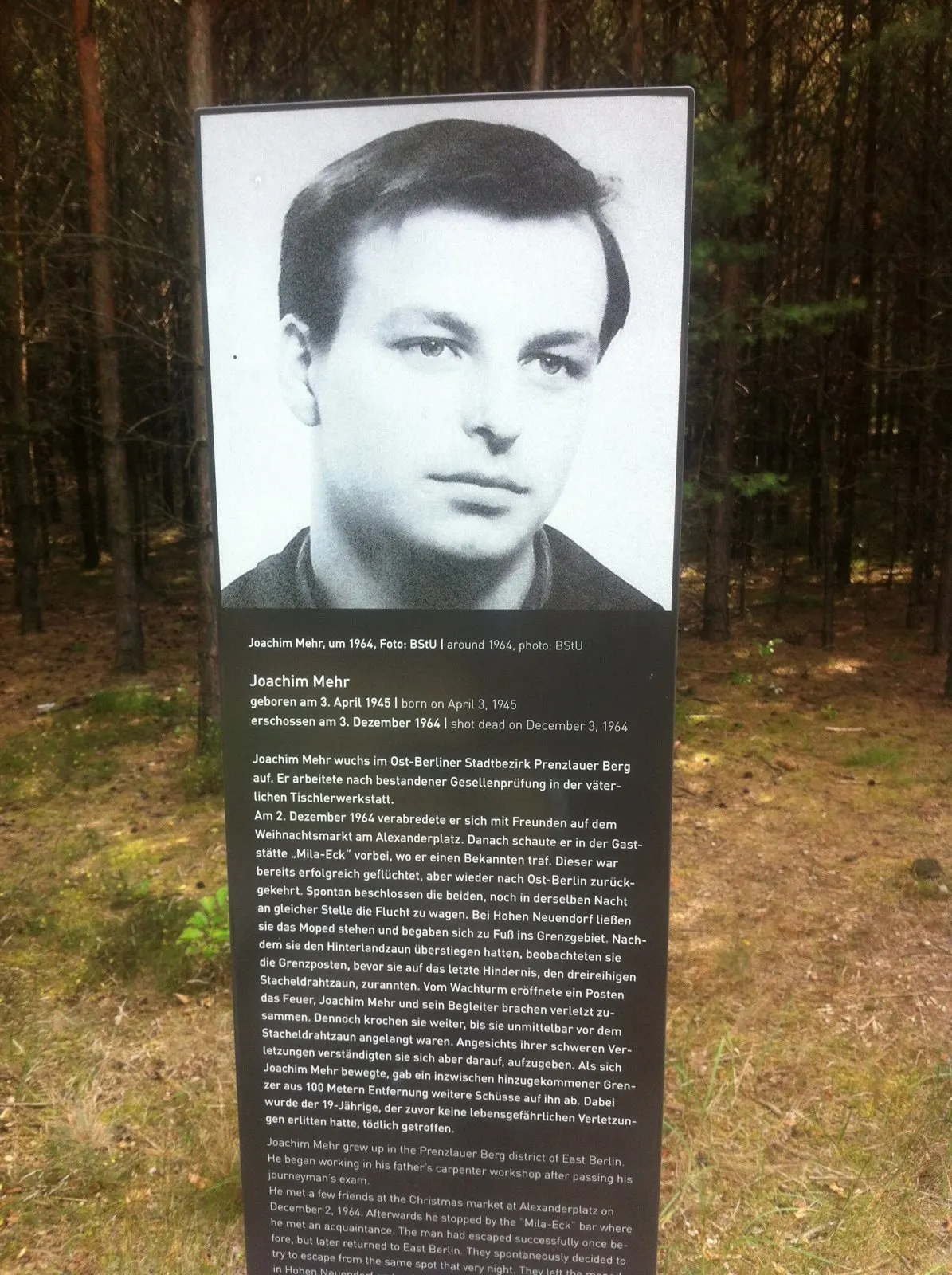

Joachim Mehr was born on 3 April 1945 in Belgard, Pomerania, the second child of his family. He spent his childhood in East Berlin's Prenzlauer Berg. His father, a master carpenter, ran his own workshop, and Joachim chose the same trade: after an apprenticeship in a state-run firm and his final exam, he went to work in his father's workshop. At 18 he moved into his own flat on Sonnenburger Strasse, though he still ate his meals at his parents' home. The Stasi later found no sign of western influence or of any wish to leave in the young man.
On 2 December 1964, his father later told the Stasi, Joachim worked until 5 p.m. as usual and had dinner with his parents. He then went to the Christmas market at Alexanderplatz with friends, among them his girlfriend. After taking her home he called in at the 'Mila-Eck' bar, where he met Hans-Jürgen K., the older brother of a good friend. K. had escaped to the West in 1962 and later come back to East Berlin, and he described how he had got out at the edge of the city. The two decided to go there that same night; K. later told the Stasi it had been a spontaneous decision made at his suggestion.
When the bar closed they rode a moped to Hohen Neuendorf, on the edge of the West Berlin district of Frohnau, and continued on foot to the border between Hohen Neuendorf and Bergfelde, where the brightly lit strip ran right through the middle of the woods. They climbed the inner fence, watched the guards for a while from the shadows, and then ran for the last barrier, three rows of barbed wire.
As emerged at the trial in 1994, two soldiers in a watchtower 160 metres away had seen them, and the guard leader opened fire. Both young men were wounded and fell just short of the fence. They crawled on to the wire but then decided to give up. A non-commissioned officer on a checking patrol then arrived; although the two were lying on the ground caught in the barbed wire only 100 metres from him, he fired more shots at Joachim Mehr because he moved. Until then Joachim's wounds had not been life-threatening; now he was fatally hit. According to West Berlin police and press reports, a customs patrol in Frohnau heard bursts of fire and saw flares at 2:20 a.m.; smoke canisters set off beyond the fences hid what happened next as the two were carried away. Hans-Jürgen K. was taken to hospital with bullet wounds in both legs. Joachim Mehr, aged 19, died on the spot. According to the border troops' report written that day, the soldiers involved in stopping the escape were promoted or commended by order of their commander.
His parents were told nothing during the investigation. When they learned he was dead, they were made to sign a statement that he had died of injuries resulting from a border violation he had himself committed, and to pretend he had died in a traffic accident. Even with a lawyer they were not allowed to see his body, and when his father would not accept this, he was summoned to a talk with the public prosecutor in charge and questioned by the Stasi. Despite this pressure, the parents announced his death in a local newspaper as a tragic accident. He was buried on 30 December 1964 in the municipal cemetery in Berlin-Weissensee. Hans-Jürgen K., permanently injured, was sentenced in August 1965 to three years in a penitentiary.
On 27 September 1994 the Potsdam Regional Court found the former non-commissioned officer guilty of manslaughter and gave him a suspended sentence of 18 months in prison. The guard leader who fired first received the same sentence for attempted manslaughter on two counts. Memorial columns to Joachim Mehr, Willi Born and Rolf-Dieter Kabelitz stand by the Berlin Wall Trail near Utestrasse.
Sources
This profile is a summary written for this site from the biography in source 1, which also gives the full account with archival references. Facts taken from other sources are listed below with what they support.
- Christine Brecht, “Joachim Mehr”, biography in Chronik der Mauer, Federal Agency for Civic Education, Centre for Contemporary History Potsdam and Deutschlandradio. Accessed 23 September 2026. Read online. The biography from which this profile was written, and the source of the dates and place of death.
- German version of the same biography. Accessed 23 September 2026. Read online.
- Report of the West Berlin police on the presumed escape attempt of two NVA members in uniform, 3 December 1964 (Polizeihistorische Sammlung/Der Polizeipräsident in Berlin), transcript in Chronik der Mauer. Accessed 5 October 2026. Read online. Source for: the bursts of fire and flares seen by customs officers at about 2.20 a.m., and the smoke canisters under whose cover the two were carried away.
- Report of the East German border troops (Grenzregiment 36) on the prevention of a border breach with use of firearms, 3 December 1964 (BArch, VA-07/6012, Bl. 198-200), transcript in Chronik der Mauer. Accessed 5 October 2026. Read online. Source for: his date of birth, that the guard leader fired and both men fell just short of the wire, Hans-Jürgen K.'s leg wounds, and the promotions or commendations.
- “Berliner Mauerweg: Von Hohen Neuendorf nach Hermsdorf”, Berlin.de. Accessed 5 October 2026. Read online. Source for: the escape attempt near Bergfelde on 3 December 1964, the guards' promotions, and the memorial columns near Utestrasse.
- Stiftung Berliner Mauer, “Karte der Erinnerungsorte” (map of places of remembrance), entry “Erinnerungsstele für R. Kabelitz, W. Born und J. Mehr”. Accessed 5 October 2026. Read online. Source for: the place of the memorial to him, Willi Born and Rolf-Dieter Kabelitz near Utestrasse.
- Hans-Hermann Hertle and Maria Nooke (eds.), The Victims at the Berlin Wall, 1961–1989: A Biographical Handbook. Centre for Contemporary History Potsdam and Berlin Wall Foundation, Berlin 2011. The printed handbook from which the online biography is taken.
- Hans-Hermann Hertle and Maria Nooke, “140 Victims at the Berlin Wall, 1961–1989” (list), Centre for Contemporary History Potsdam and Berlin Wall Foundation, August 2017. PDF. Used to cross-check names and dates.
- Hans-Hermann Hertle and Maria Nooke, “The Victims at the Berlin Wall, 1961–1989: Findings of a Research Project”, August 2017. PDF. Source of the classification into escapees, people with no intent to escape, and border soldiers.
Corrections
This profile was corrected on 24 and 28 September and 3 and 5 October 2026. Each round of corrections is described in the corrections log:
-
: Court outcomes checked against the German originals
- Corrected the 1994 verdict: the Potsdam Regional Court (not district court) sentenced the former non-commissioned officer to 18 months in prison, suspended on probation, not “18 months' probation”.
- : All profiles and articles cross-checked against the German originals
- : Every profile checked against all the sources
- : Independent sources added for the other 88 profiles
Further reading
Image credits
- Memorial stele for Joachim Mehr on the Berlin Wall Trail near Frohnau, photographed in 2014. Josef Papi, CC BY-SA 4.0, Wikimedia Commons.
Cite this page
“Joachim Mehr”, Victims of the Berlin Wall, Berlin Experiences. https://victimsofthewall.com/victims/mehr-joachim/
Map
The pin position is based on the place of death described in source 1. Base map © OpenStreetMap contributors; course of the Wall in 1989 from Geoportal Berlin (dl-de/zero-2.0). Accessed 23 September 2026.