Franciszek Piesik
1942–1967
Franciszek Piesik, a 24-year-old welder and painter from Poland, died on 17 October 1967 while trying to reach West Berlin across the Nieder Neuendorf Lake from Hennigsdorf; his body was recovered from the lake eleven days later.
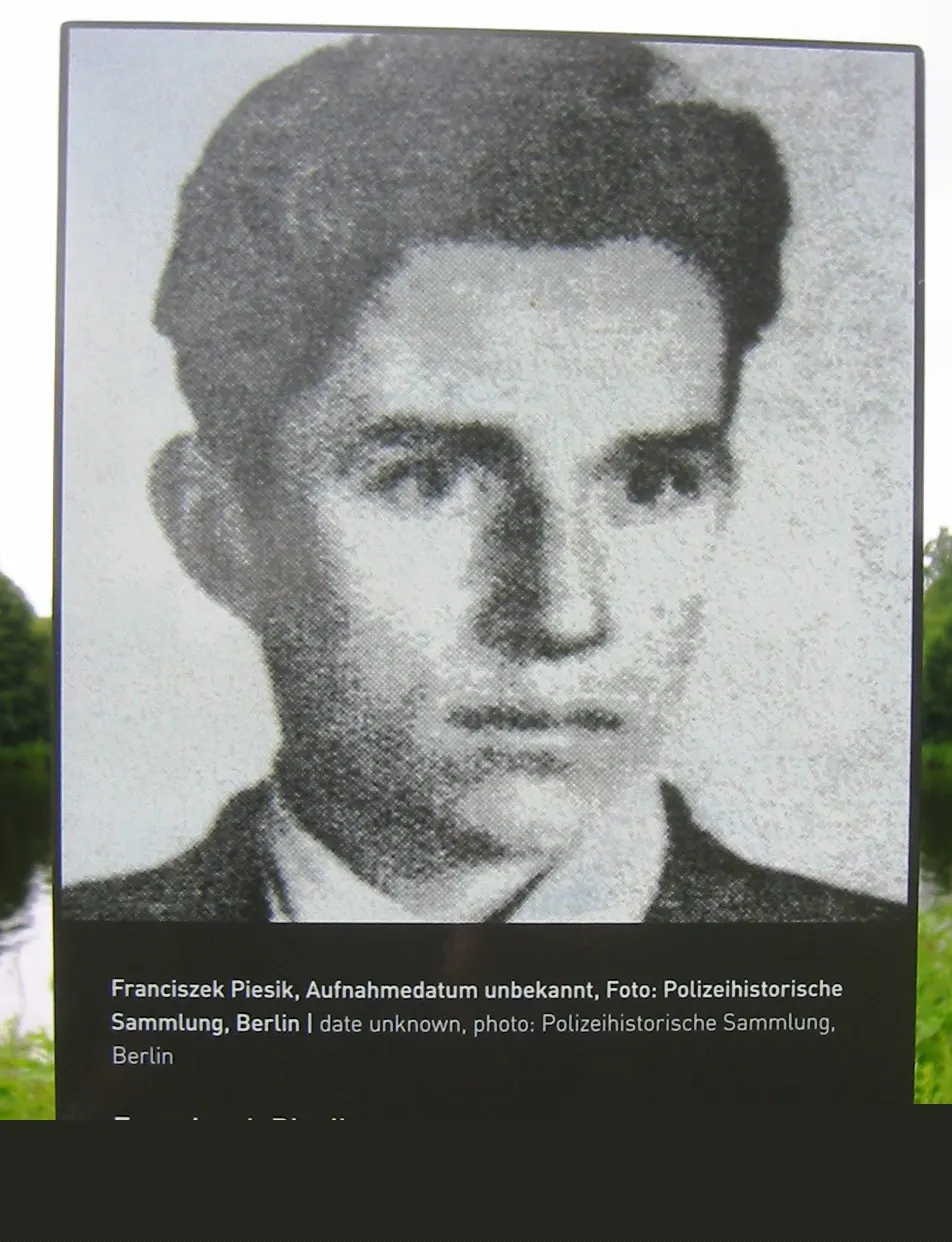

Franciszek Piesik was born on 23 November 1942 and grew up in a large family in Widuchowa on the Oder, right on Poland's border with East Germany. In the early 1960s he worked in inland shipping, on a dredger among other things, and in timber rafting. He later settled in Bromberg, married and had a daughter. A young woman who saw him shortly before he left Poland described him as having blue eyes, curly black hair and a tattoo of a long-haired girl on his left forearm.
He was self-assured and willing to take risks. He had twice been convicted and sent to prison, once for leaving his army unit without permission and once for breaking into a bar. By early 1967 he was free and working as a welder and painter at the Bromberg Metal Works. On 30 September 1967 he told his wife he was going to Widuchowa to visit his sick mother.
But he did not stay there long; he took jobs near the border using a false school certificate, and visited his brothers Leon and Ryszard on the dredger 'Neptun' at Bielinek. On the night of Saturday 14 October he insisted on sleeping aboard; around midnight he was gone, along with the dredger's rowboat, which was found at dawn on the East German bank. He managed to reach the area around Berlin unnoticed, and when he turned up near Hennigsdorf on 17 October he was carrying side-cutters and sketches of the border line in that area.
In the early evening of 17 October 1967 he stole a motorboat near Hennigsdorf and headed south, probably aiming to round a headland separating the canal from the Nieder Neuendorf Lake. The border ran down the middle of the water, with Heiligensee in West Berlin on the far side. Border guards spotted the boat. The accounts differ on what happened next: a Polish border officer, citing an East German colleague, wrote that he jumped into the water when ordered to stop and left his clothes behind, while another report says he reached the marshy headland and left his belongings there. Either way, he had to abandon his plan and try to swim across the lake. It was already the third day of his escape, the autumn weather was cool, and the water was little more than ten degrees. Whether he drowned from cold and exhaustion, or hid in the reeds and died there, is not known.
Reports that shots were fired were quickly denied, and West Berlin police were not aware of any firing. The border guards at first believed he had got away. On 28 October his body was recovered from the West Berlin side of the lake; the autopsy found no sign of external force. In Poland his relatives were repeatedly questioned and their homes searched, and in spring 1968 his wife was told his fate was unknown. Fingerprints that the Polish side supplied to the West Berlin police in mid-January 1968 confirmed his identity, and nearly half a year after his death he was buried in the Heiligensee cemetery, in the district he had hoped to reach. Because the grave fees went unpaid, the grave was cleared after a few years.
Why he left Poland remains unclear. He had corresponded with people in Essen and Düsseldorf and had probably meant to visit relatives in Essen. Whether marriage difficulties, his mother's need for medicine unavailable in Poland, or simply the wish to live freely played a part will probably never be known.



Read more
Sources
This profile is a summary written for this site. Every fact in it is taken from source 1, which also gives the full account with archival references.
- Translation: Miriamne Fields, “Franciszek Piesik”, biography in Chronik der Mauer, Federal Agency for Civic Education, Centre for Contemporary History Potsdam and Deutschlandradio. Accessed 23 September 2026. Read online. Basis for every fact in this profile, including the dates and place of death.
- German version of the same biography. Accessed 23 September 2026. Read online.
- Hans-Hermann Hertle and Maria Nooke (eds.), The Victims at the Berlin Wall, 1961–1989: A Biographical Handbook. Centre for Contemporary History Potsdam and Berlin Wall Foundation, Berlin 2011. The printed handbook from which the online biography is taken.
- Hans-Hermann Hertle and Maria Nooke, “140 Victims at the Berlin Wall, 1961–1989” (list), Centre for Contemporary History Potsdam and Berlin Wall Foundation, August 2017. PDF. Used to cross-check names and dates.
- Hans-Hermann Hertle and Maria Nooke, “The Victims at the Berlin Wall, 1961–1989: Findings of a Research Project”, August 2017. PDF. Source of the classification into escapees, people with no intent to escape, and border soldiers.
Further reading
Image credits
- Franciszek Piesik (photo: Polizeihistorische Sammlung, Berlin), photographed from a "Chronik der Mauer" information stele on the Havel in Hennigsdorf. Assenmacher, CC BY-SA 3.0, Wikimedia Commons.
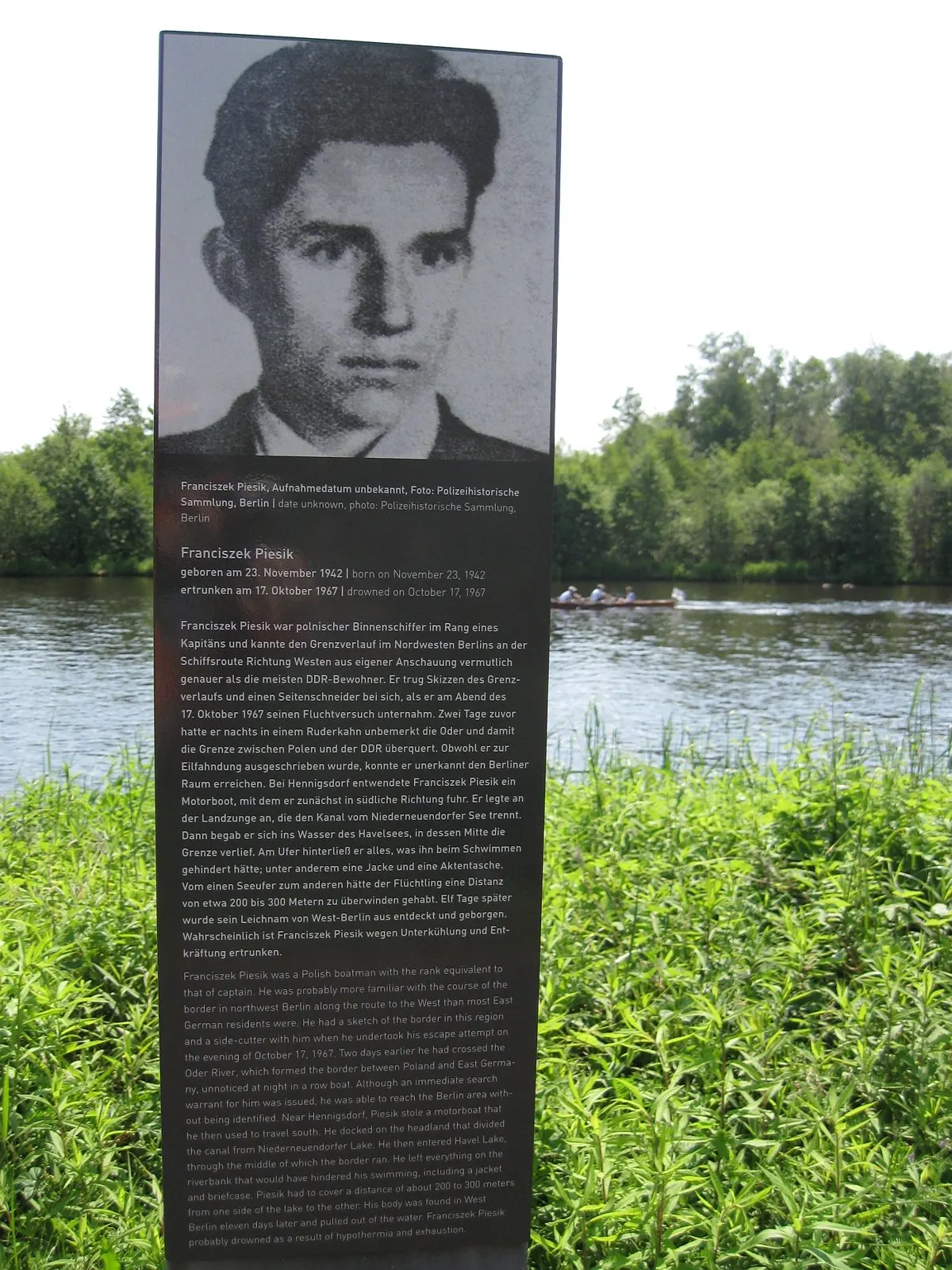
- Memorial panel for Franciszek Piesik on the Havel in Hennigsdorf, photographed in 2013. Christian Gering, CC BY-SA 3.0, Wikimedia Commons.
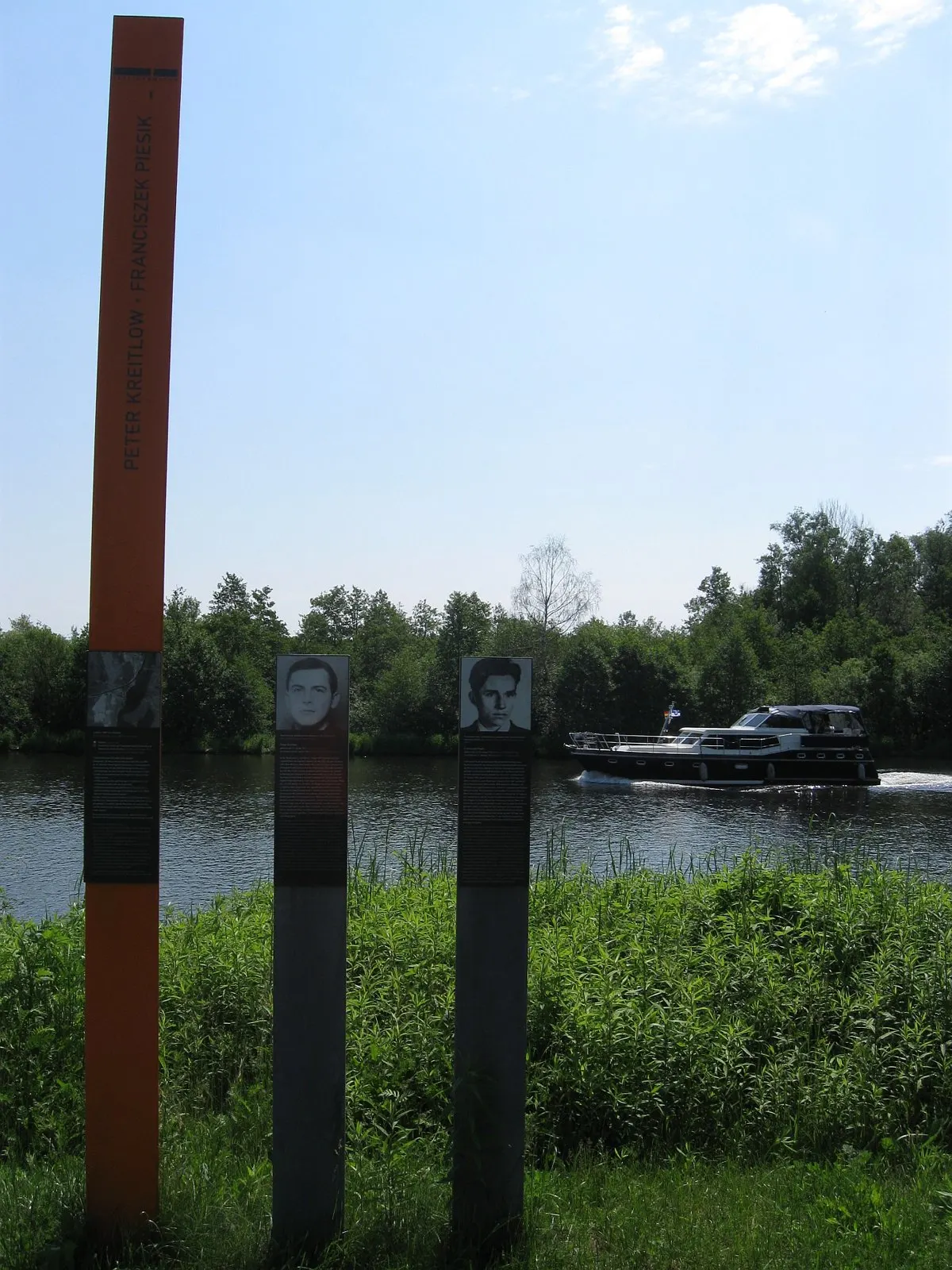
- Memorial columns for Peter Kreitlow and Franciszek Piesik on the Havel in Hennigsdorf, photographed in 2013. Christian Gering, CC BY-SA 3.0, Wikimedia Commons.
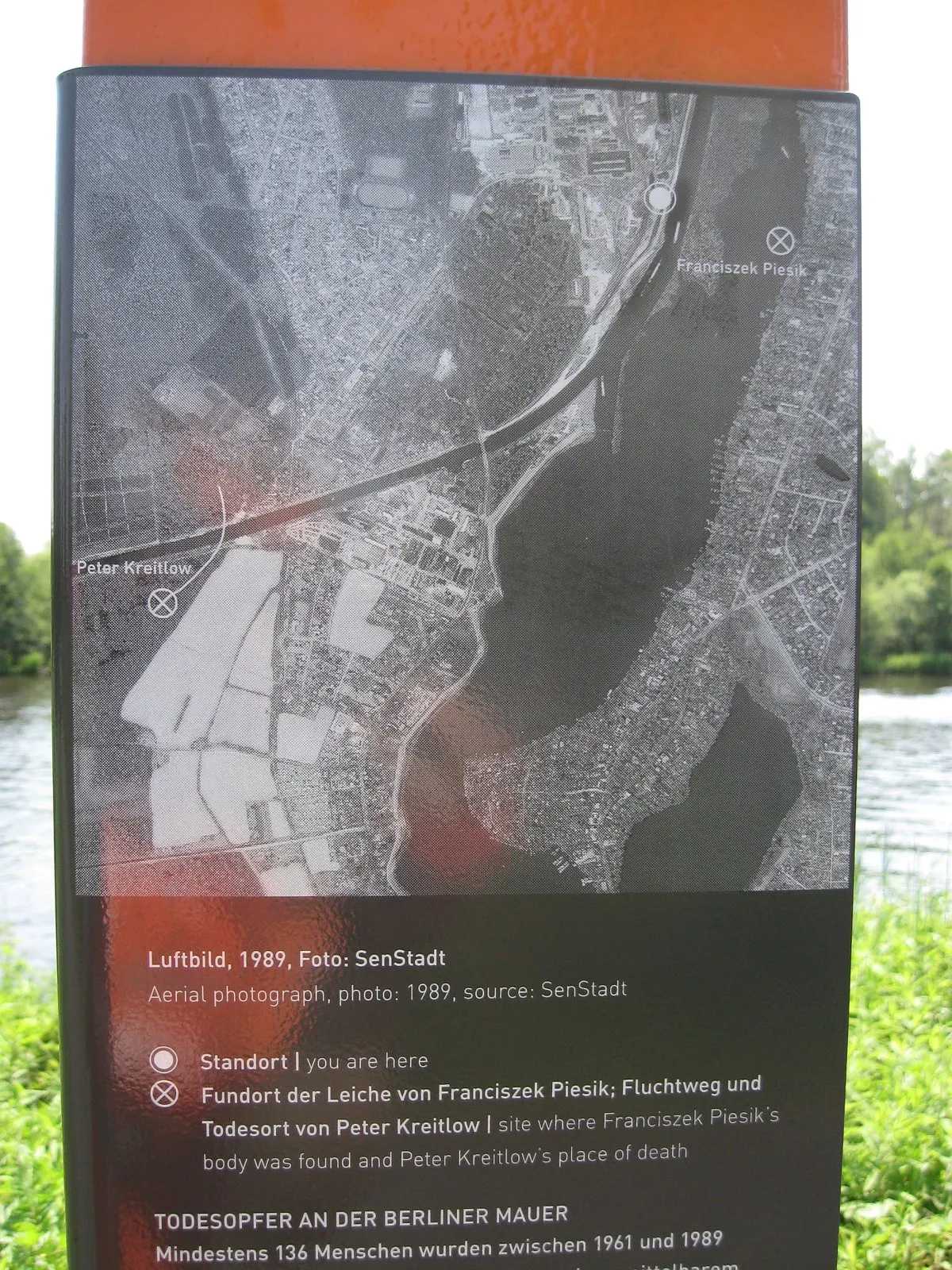
- Panel at the Hennigsdorf memorial with a 1989 aerial photograph marking where Franciszek Piesik's body was found and Peter Kreitlow's escape route and place of death. Christian Gering, CC BY-SA 3.0, Wikimedia Commons.
Cite this page
“Franciszek Piesik”, Victims of the Berlin Wall, Berlin Experiences. https://victimsofthewall.com/victims/piesik-franciszek/
Map
The pin position is based on the place of death described in source 1. Base map © OpenStreetMap contributors; course of the Wall in 1989 from Geoportal Berlin (dl-de/zero-2.0). Accessed 23 September 2026.