Christel Wehage
1946–1970
Eckhard Wehage, 21, and his wife Christel, 23, took their own lives on 10 March 1970 at Berlin-Schönefeld airport after their attempt to divert an East German airliner to the West failed.
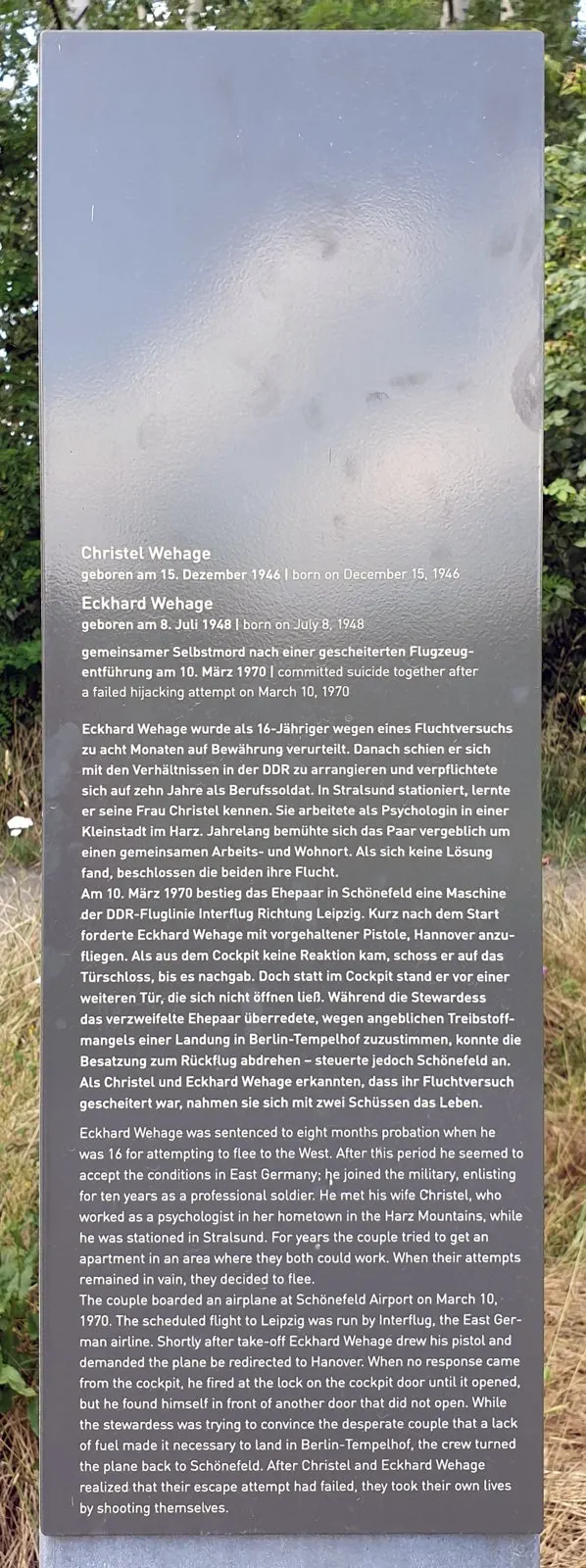

Eckhard Wehage was born on 8 July 1948 in Berssel. As a 14-year-old he tried with a friend to leave by boat across the Baltic Sea, but before they could set off the two drew suspicion; on 10 May 1963 the People's Police arrested them in Grevesmühlen and sent them back to their parents. On 21 August of the same year he tried again, alone, planning to go by train to Czechoslovakia, and was arrested in Adorf in the Vogtland. This time he was charged with fleeing the republic, and on 18 October 1963 the youth criminal chamber of the Halberstadt district court gave the 15-year-old a suspended eight-month prison sentence.
After this he appeared to have accepted his situation. From 1967 he served in the East German navy, the Volksmarine, having signed up as a professional soldier for ten years; he trained at the non-commissioned officers' school in Stralsund and then served as chief boatswain on a minesweeper. During this time he met Christel Zinke from Wolmirstedt, born on 15 December 1946, who worked at the district hospital in her home town; the Federal Archives describe her as a physiotherapist, while the research project's biography calls her a psychotherapist.
They married soon afterwards and hoped to start a family, but they could not choose where to live or work. For years they tried to obtain a shared flat in a place where both could be employed. In their farewell letters to their parents they explained that only with children would they have had a chance of a flat, after an indefinite wait, but that under such uncertain circumstances they could not afford to have children; that, they wrote, would only make the dilemma greater. In the spring of 1970, when their hopes for a flat were dashed, they decided to escape by hijacking an aircraft. Eckhard took two pistols and ammunition from his unit's armoury before a short leave.
After a flight to Dresden on 9 March was cancelled, they booked a flight to Leipzig for the next day and spent the night at the Schönefeld airport hotel, where they wrote their farewell letters to their parents. In his, Eckhard wrote that if their plan failed, he and Christel would end their lives. Just before 8 o'clock on 10 March 1970 they boarded an Interflug AN-24 with 15 other passengers.
Soon after take-off Eckhard, holding his pistol, told the stewardess to have the pilots fly to Hanover. She signalled an emergency to the cockpit in code. When the cockpit did not respond, he fired at the lock of a door until it opened, but a second door, to the cockpit itself, could not be forced. Shots were also fired at that door, and according to the Stasi's report to the party leadership the captain was slightly wounded. While the stewardess persuaded the desperate couple to agree to a landing at Tempelhof instead of Hanover because of a supposed lack of fuel, the crew, who could watch what was happening through the door's peephole, turned back. Seconds before touchdown a surprised passenger called out that they were back in Schönefeld. Realising their attempt had failed, Christel and Eckhard returned to their seats while the plane landed, and then took their own lives.
The Stasi placed both sets of parents under surveillance and put them under pressure to help hide the truth: relatives, friends and colleagues were to be told that the couple had been killed when their service car hit a tree on an icy road on the way to view a flat in Rostock. Rumours linking their deaths to the failed hijacking nevertheless persisted. On 26 March 1970 the Stasi minister personally awarded the crew the NVA Merit Medal in gold. After cremation in East Berlin, Christel and Eckhard were buried in Magdeburg with close family present; their urns were later moved to Magdeburg's West Cemetery. A former schoolfriend of Christel said she had been horrified and sad that this young life had ended in this way. An investigation opened by the Berlin public prosecutor in 1996 was discontinued in June 1997, because there was no indication of any criminal act on the part of the East German authorities.
Christel Wehage died together with Eckhard Wehage. Their story is told on both profiles.


Sources
This profile is a summary written for this site from the biography in source 1, which also gives the full account with archival references. Facts taken from other sources are listed below with what they support.
- Martin Ahrends/Udo Baron, “Christel Wehage and Eckhard Wehage”, biography in Chronik der Mauer, Federal Agency for Civic Education, Centre for Contemporary History Potsdam and Deutschlandradio. Accessed 23 September 2026. Read online. The biography from which this profile was written, and the source of the dates and place of death.
- German version of the same biography. Accessed 23 September 2026. Read online.
- “Tödliche Flugzeugentführung”, online feature, Federal Archives (Bundesarchiv), Stasi Records Archive. Accessed 29 September 2026. Read online. Source for: that she was a physiotherapist, and the pressure the Stasi put on the parents.
- Stasi (MfS, ZAIG) report to the party leadership on the attempted escape by force, 10 March 1970, Stasi-Mediathek. Accessed 29 September 2026. Read online. Source for: the shots at the cockpit door and the captain’s slight wound.
- Sven Felix Kellerhoff, “Flugzeugentführung: Die DDR sprach von ‚Banditen‘”, Die Welt, 10 March 2020. Accessed 29 September 2026. Read online. Source for: the shots at the cockpit door.
- Hans-Hermann Hertle and Maria Nooke (eds.), The Victims at the Berlin Wall, 1961–1989: A Biographical Handbook. Centre for Contemporary History Potsdam and Berlin Wall Foundation, Berlin 2011. The printed handbook from which the online biography is taken.
- Hans-Hermann Hertle and Maria Nooke, “140 Victims at the Berlin Wall, 1961–1989” (list), Centre for Contemporary History Potsdam and Berlin Wall Foundation, August 2017. PDF. Used to cross-check names and dates.
- Hans-Hermann Hertle and Maria Nooke, “The Victims at the Berlin Wall, 1961–1989: Findings of a Research Project”, August 2017. PDF. Source of the classification into escapees, people with no intent to escape, and border soldiers.
Corrections
This profile was corrected on 24, 28 and 29 September and 3 October 2026. Each round of corrections is described in the corrections log:
-
: Court outcomes checked against the German originals
- Corrected Eckhard Wehage's earlier sentence as a 15-year-old: an eight-month prison sentence on probation, not “eight months' probation”.
- Corrected the legal term: the investigation opened in 1996 was discontinued in June 1997, not “dismissed”.
- : All profiles and articles cross-checked against the German originals
-
: Corrections from the research for the book
- Disclosed a conflict on Christel Wehage's profession: the Federal Archives describe her as a physiotherapist, while the research project's biography calls her a psychotherapist; the profile had called her a psychotherapist.
- : Every profile checked against all the sources
Image credits
- Memorial stele for Christel and Eckhard Wehage in the Landschaftspark Rudow-Altglienicke, Berlin, photographed in 2019. OTFW, Berlin, CC BY-SA 3.0, Wikimedia Commons.
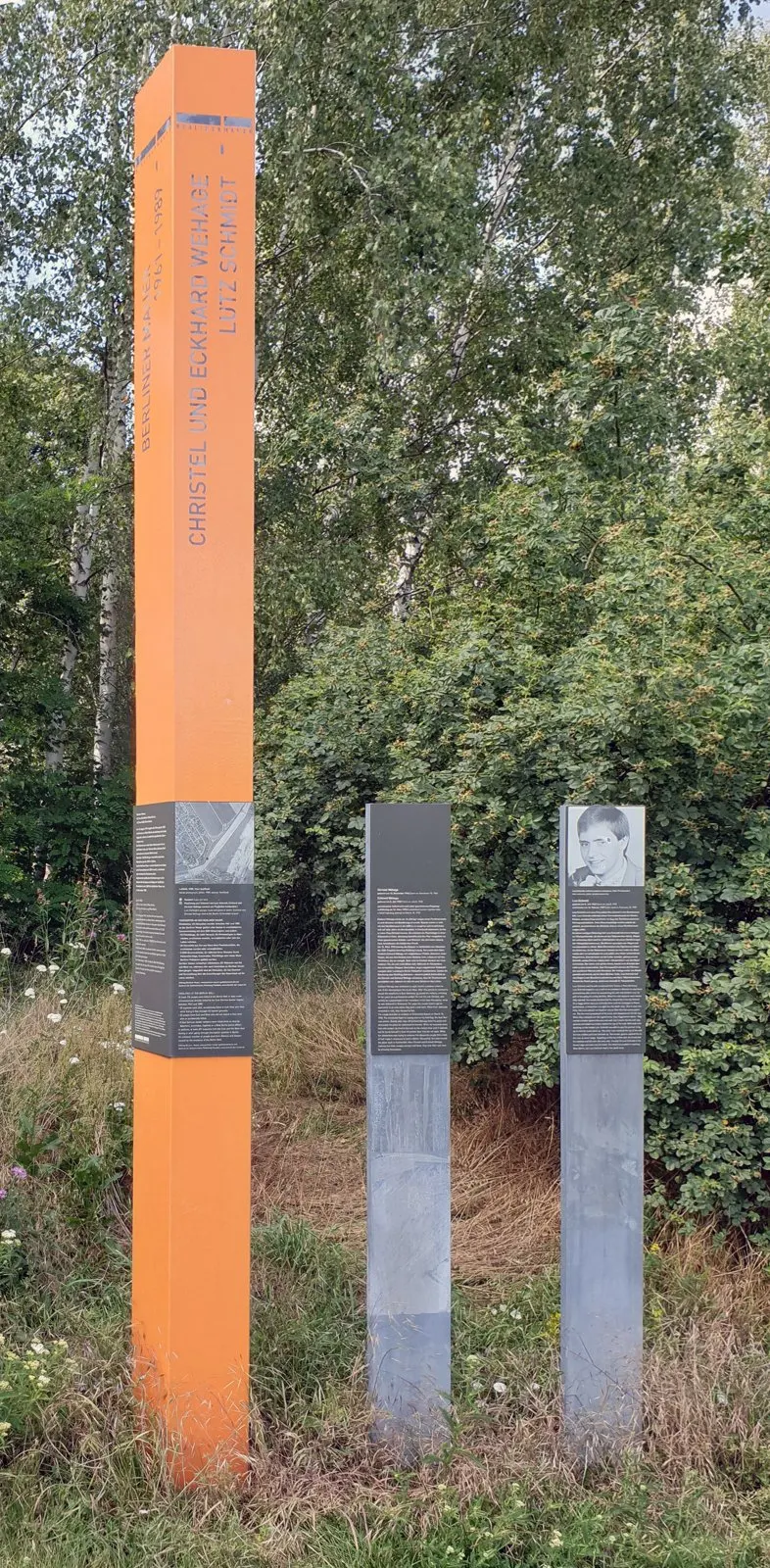
- Memorial for Christel and Eckhard Wehage and Lutz Schmidt in the Landschaftspark Rudow-Altglienicke, Berlin, photographed in 2019. OTFW, Berlin, CC BY-SA 3.0, Wikimedia Commons.
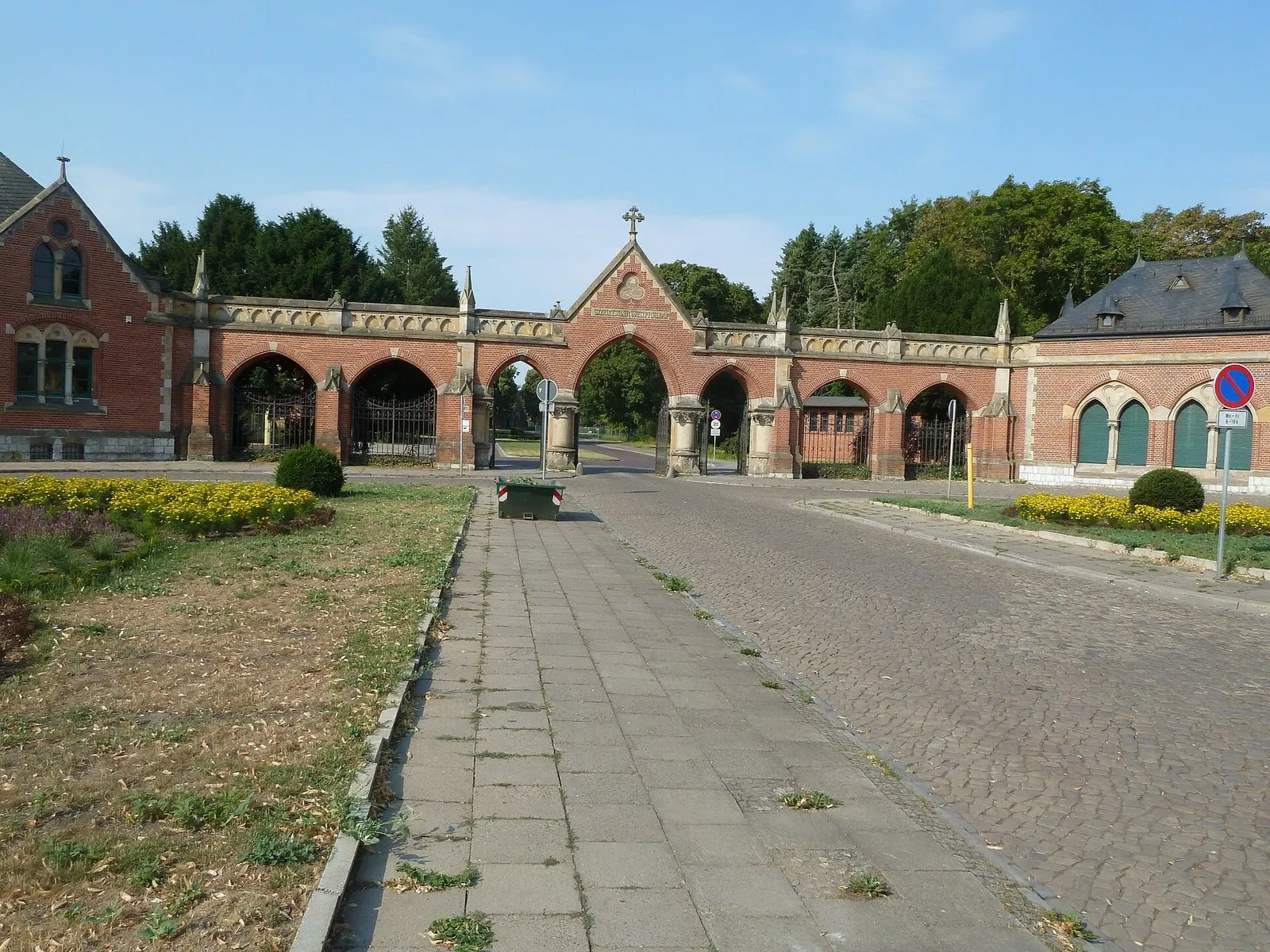
- Main entrance of the West Cemetery (Westfriedhof) in Magdeburg, where Christel and Eckhard Wehage are buried. Brewer Bob, CC BY-SA 4.0, Wikimedia Commons.
Cite this page
“Christel Wehage”, Victims of the Berlin Wall, Berlin Experiences. https://victimsofthewall.com/victims/wehage-christel/
Map
The pin position is based on the place of death described in source 1. Base map © OpenStreetMap contributors; course of the Wall in 1989 from Geoportal Berlin (dl-de/zero-2.0). Accessed 23 September 2026.