Hermann Döbler
1922–1965
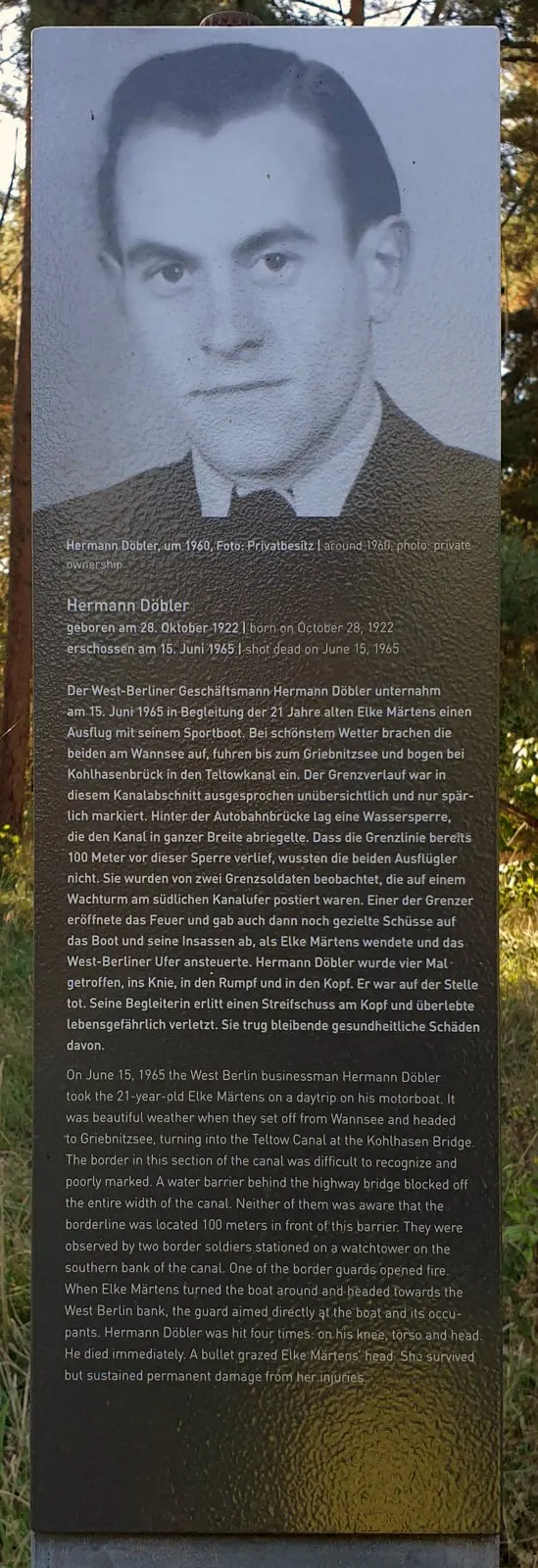
Hermann Döbler, a 42-year-old West Berlin businessman, was shot dead by an East German border guard on 15 June 1965 during a motorboat trip on the Teltow Canal near Dreilinden, after unknowingly crossing the poorly marked border line in the water.
_Hermann_D%C3%B6bler2.jpg)
Hermann Döbler was born on 28 October 1922 in Roderbeck, a small village in the then Pomeranian district of Greifenhagen, south of Stettin. Conscripted into the Wehrmacht at 18, he was in Berlin when the Second World War ended. With nothing and no trade, he found lodgings in the eastern part of the city, worked as a messenger and clerk, and soon became a successful independent businessman.
In 1949 he met his future wife, Irene, in Görlitz; they married a year later and had three children. She remembered how quickly his charm had won her over. In the mid-1950s, with her active support, he built up a haulage firm in Eberswalde; the couple later ran their own car repair workshop in Karlshorst. The business prospered, and they saw no reason to leave East Germany, not even after he was sentenced in 1958 to six months in prison for spontaneously helping a teenage girl flee to West Berlin.
From 1960 he also ran a block of garages on Rothenburgstrasse in Steglitz, spending more and more time in the West while his wife ran the Karlshorst business. He was at his West Berlin address when the Wall went up on 13 August 1961, cutting him off from his family. He sent money and parcels and met his wife and children at the border, and in May 1962 organised their escape in a truck. After a few weeks in the West, his wife concluded that the marriage was over and returned to East Germany with the children. They divorced in May 1965, but he kept in touch with his children by letter and provided for their maintenance.
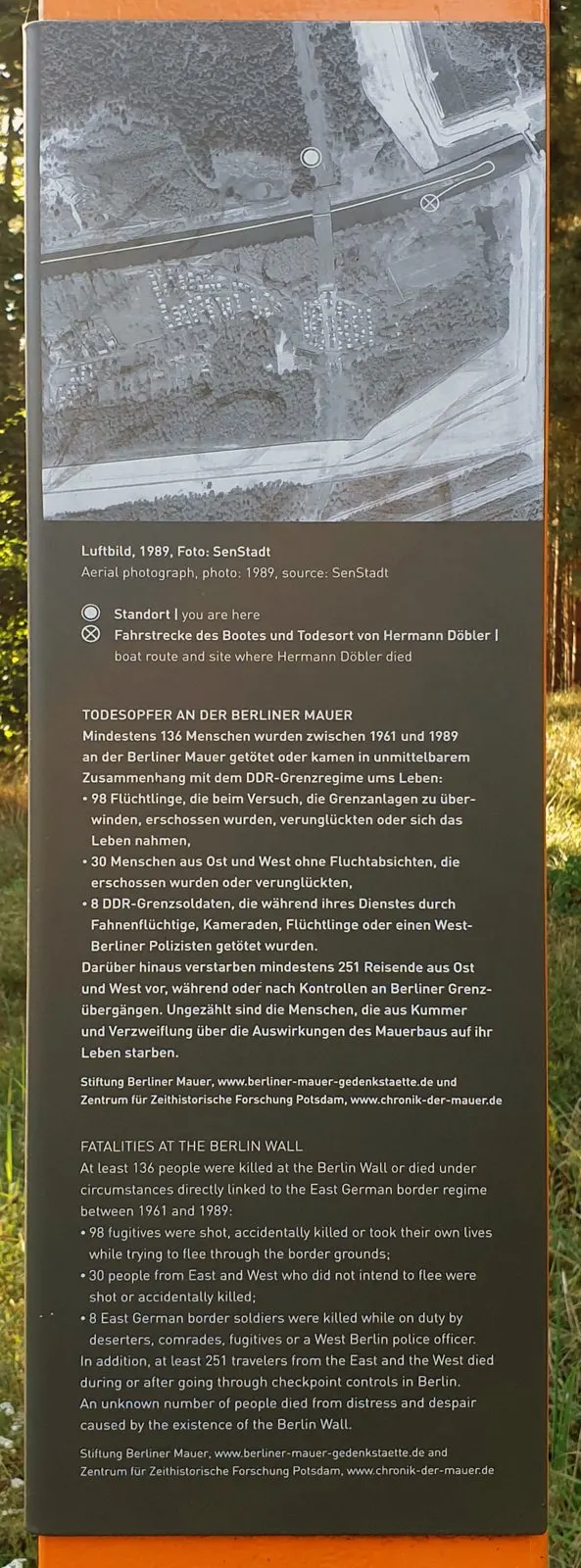
On 15 June 1965, a fine day, he invited 21-year-old Elke Märtens on a trip in his open motorboat. They set off from the Wannsee, travelled along the Havel as far as the Griebnitzsee and at Kohlhasenbrück turned into the Teltow Canal, where parts of the water belonged to East Germany and the border line was hard to see and poorly marked. According to what Elke Märtens told the West Berlin police at the time, she was at the helm as they passed under the motorway bridge leading to the Dreilinden crossing. Beyond the bridge she noticed a barrier closing off the whole width of the canal and pointed it out to him, but he told her she could safely carry on as far as the barrier. Neither of them, she said, knew that the border line lay 100 metres before it.
Two border soldiers watched them from a tower on the southern bank. The guards allegedly felt provoked by the pair, possibly because they waved to them. One of the guards opened fire at once and kept firing aimed shots at the boat and its occupants even when Elke Märtens turned and headed for the West Berlin bank. Hermann Döbler was hit four times and died in the boat. Elke Märtens was grazed on the head and taken to a West Berlin hospital in critical condition; she survived, but with lasting injuries.
The shooting was unanimously condemned in the West; Mayor Willy Brandt called it cold-blooded murder. More than 1,000 people paid their last respects when he was buried on 22 June 1965 at the municipal cemetery on Bergstrasse in Steglitz. In East Germany the Stasi organised a smear campaign against him, and his children, living in the East, suffered badly from the public hostility; their teachers even presented their father to the whole class as a criminal.
After the collapse of East Germany, the guard who fired, the soldier who stood beside him without shooting and the platoon leader who had given the two guards their duty orders that day had to answer for the shooting. Satisfied that the man who fired had acted intentionally, the Berlin Regional Court found him guilty of murder in conjunction with attempted murder and sentenced him to six years in prison, one of the heaviest sentences ever given to a border guard.

_Hermann_D%C3%B6bler3.jpg)
Read more
Also died on the outer ring between Berlin-Zehlendorf and Potsdam
- Horst Plischke 19 November 1962
Sources
This profile is a summary written for this site. Every fact in it is taken from source 1, which also gives the full account with archival references.
- Christine Brecht, “Hermann Döbler”, biography in Chronik der Mauer, Federal Agency for Civic Education, Centre for Contemporary History Potsdam and Deutschlandradio. Accessed 23 September 2026. Read online. Basis for every fact in this profile, including the dates and place of death.
- German version of the same biography. Accessed 23 September 2026. Read online.
- Hans-Hermann Hertle and Maria Nooke (eds.), The Victims at the Berlin Wall, 1961–1989: A Biographical Handbook. Centre for Contemporary History Potsdam and Berlin Wall Foundation, Berlin 2011. The printed handbook from which the online biography is taken.
- Hans-Hermann Hertle and Maria Nooke, “140 Victims at the Berlin Wall, 1961–1989” (list), Centre for Contemporary History Potsdam and Berlin Wall Foundation, August 2017. PDF. Used to cross-check names and dates.
- Hans-Hermann Hertle and Maria Nooke, “The Victims at the Berlin Wall, 1961–1989: Findings of a Research Project”, August 2017. PDF. Source of the classification into escapees, people with no intent to escape, and border soldiers.
Further reading
Image credits
- Memorial panel for Hermann Döbler at the Teltowkanalbrücke near Kleinmachnow, with his photograph, photographed in 2023. OTFW, Berlin, CC BY-SA 3.0, Wikimedia Commons.
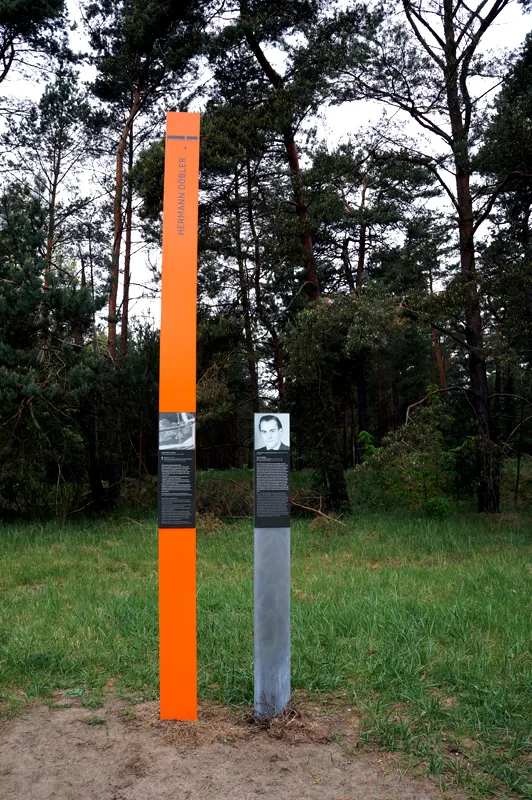
- Memorial column for Hermann Döbler near Kleinmachnow, photographed in 2012. Anszu, CC BY-SA 3.0, Wikimedia Commons.
- Map panel at the Teltowkanalbrücke marking the boat route and place of death of Hermann Döbler. OTFW, Berlin, CC BY-SA 3.0, Wikimedia Commons.
Cite this page
“Hermann Döbler”, Victims of the Berlin Wall, Berlin Experiences. https://victimsofthewall.com/victims/doebler-hermann/
Map
The pin position is based on the place of death described in source 1. Base map © OpenStreetMap contributors; course of the Wall in 1989 from Geoportal Berlin (dl-de/zero-2.0). Accessed 23 September 2026.