Peter Hauptmann
1939–1965
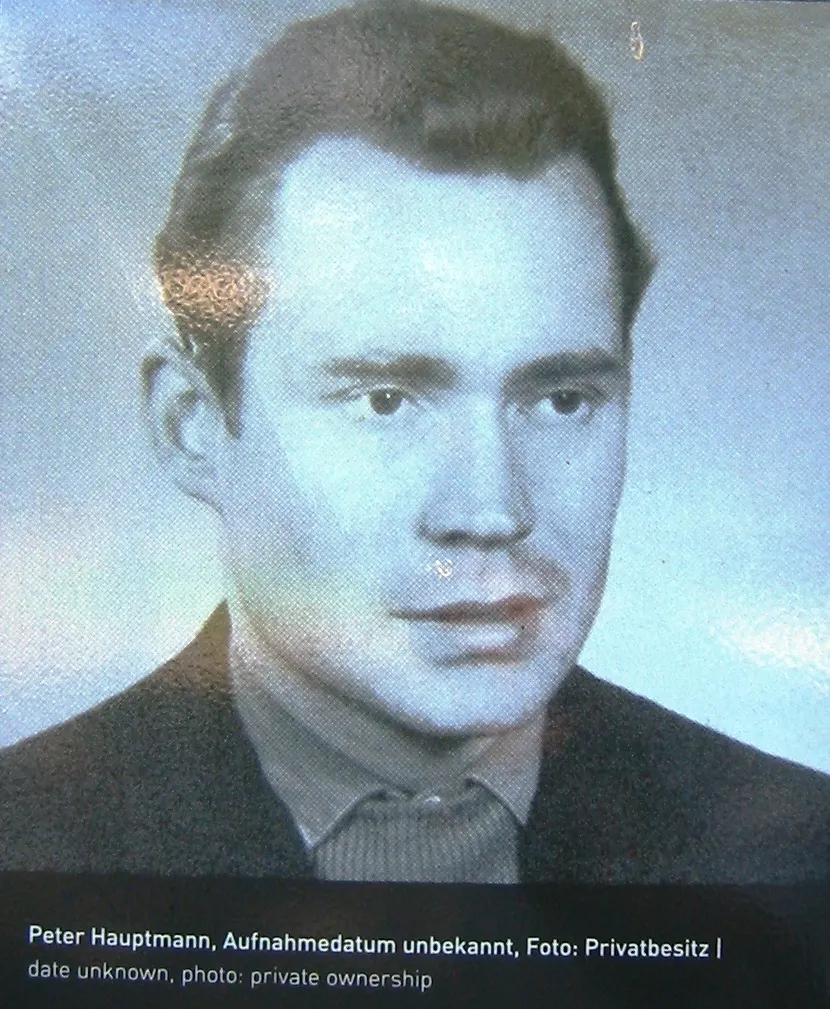
Peter Hauptmann, a 26-year-old driller and father of four who lived in the border area of Potsdam-Babelsberg, was shot by a border guard outside his home on 24 April 1965 during a dispute over identity checks, and died on 3 May 1965.
.jpg)
Peter Hauptmann was born on 20 March 1939 in Gittersee near Dresden. He lived with his wife and their four children on Stahnsdorfer Strasse in Potsdam-Babelsberg, a street inside the border area. For many years he had served in the Bereitschaftspolizei (the barracked police units), and later with the People's Police and the customs service. His repeated refusals to hand over his identity card had already led to serious disputes, and when he threatened to hit a guard, he was arrested and dismissed; afterwards he changed jobs often before finding work as a driller for a company near Teltow.
Living in the border zone meant constant checks. Guards who knew him as a resident would sometimes greet him and wave him through, but the next day young recruits might be on duty and he would have to show his papers again to enter or leave his own home. Perhaps because he had been a policeman himself, he did not want to be treated as a possible border violator, and he repeatedly refused to show his card.
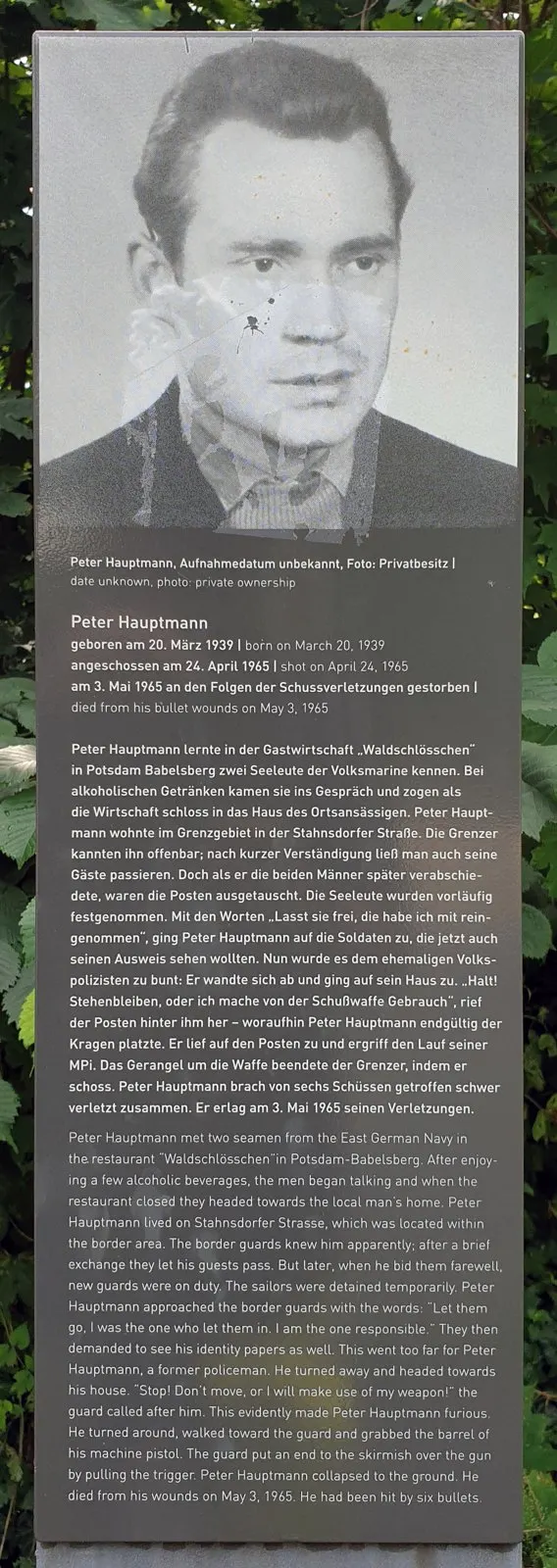
On the warm evening of Saturday 24 April 1965 he met two East German navy seamen in the "Waldschlösschen" restaurant in Babelsberg; they were in the area on a sightseeing weekend. After closing time the three went back to his house. They apparently met guards who knew him and were let through; presumably it was agreed that the guests would leave before the change of guard, but they stayed too long. When he saw his guests off after 3 a.m., new guards were on duty; they checked the seamen's papers and held them because they had no pass for the border area. Peter Hauptmann protested that he had brought them in and was responsible, whereupon the guards demanded his papers too and, although they were valid, told him that he was also to be detained.
He turned to walk back to his house. A guard ordered him to stop and threatened to shoot. Peter Hauptmann turned, went towards the guard and seized the barrel of his machine pistol, and the two struggled. The guard ended the struggle by firing two short bursts, aimed at him from only a few steps away; he later claimed that he had first fired a warning shot. Peter Hauptmann fell, gravely wounded. His wife, startled by the shots, ran out with towels to help dress his wound. With the ambulance slow to come, guards took him by military truck to the Drewitz Army Hospital, where he underwent surgery that night.
On 28 April he was moved to the clinic in Berlin-Buch, where his right kidney was removed. When his left kidney also stopped working, he died early on 3 May 1965. Doctors in Buch told his wife that he had lost too much blood because help had come too late. According to medical information that the Stasi kept secret, he had been wounded by six shots, the fatal one in his back. His wife, who had heard no single warning shot, only a series of shots, and found him lying face down, believed he had been shot from behind; doctors at the army hospital had confirmed a shot in the back to her.
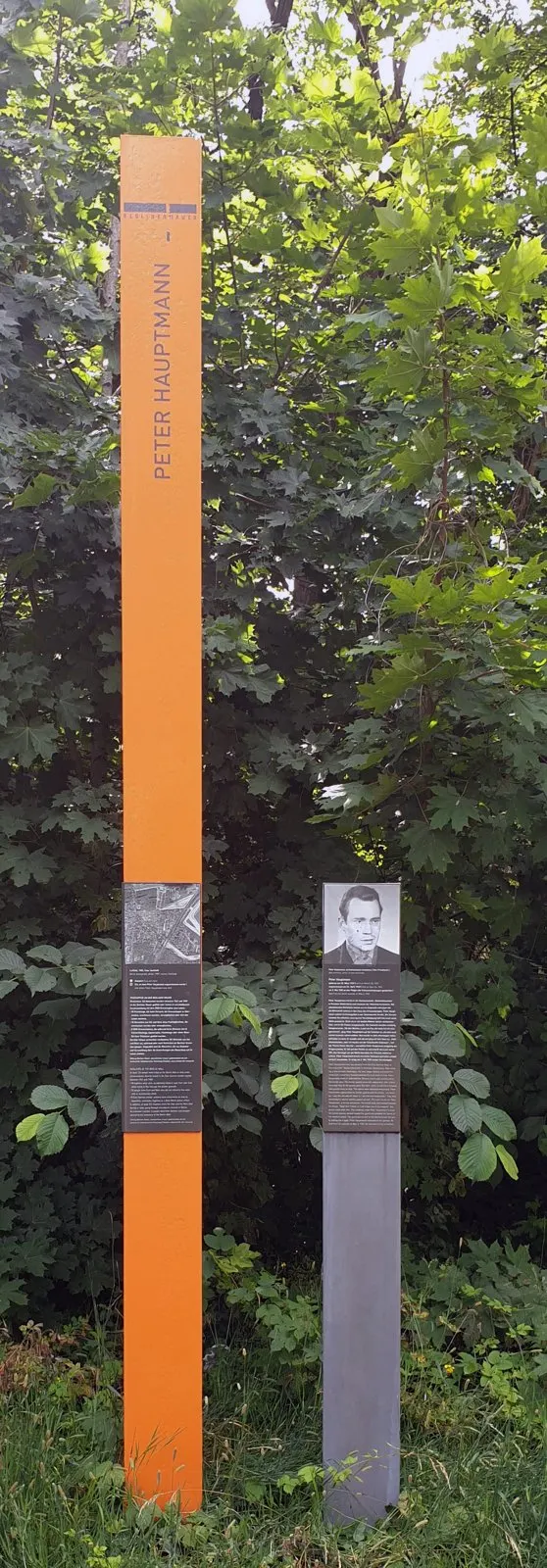
Two days after his death his widow filed a criminal complaint for negligent homicide against the border troops, supported by his father, a police captain, but their efforts came to nothing. An investigation opened in 1993 was discontinued in December 1996 because the Berlin public prosecutor's office held that the guard had acted in self-defence. Neither his widow nor the neighbours who had watched from their balcony were heard in that investigation. A commemorative column to him was put up on Bernhard-Beyer-Strasse near Steinstücken.
_Peter_Hauptmann.jpg)
_Peter_Hauptmann2.jpg)
Also died on the outer ring between Berlin-Zehlendorf and Potsdam-Babelsberg
- Jörgen Schmidtchen 18 April 1962
- Peter Böhme 18 April 1962
- Günter Wiedenhöft Night of 5 to 6 December 1962
- Norbert Wolscht 28 July 1964
- Rainer Gneiser 28 July 1964
- Willi Marzahn 19 March 1966
- Horst Körner 15 November 1968
- Holger H. 22 January 1973
Sources
This profile is a summary written for this site. Every fact in it is taken from source 1, which also gives the full account with archival references.
- Martin Ahrends/Udo Baron/Hans-Hermann Hertle, “Peter Hauptmann”, biography in Chronik der Mauer, Federal Agency for Civic Education, Centre for Contemporary History Potsdam and Deutschlandradio. Accessed 23 September 2026. Read online. Basis for every fact in this profile, including the dates and place of death.
- German version of the same biography. Accessed 23 September 2026. Read online.
- Hans-Hermann Hertle and Maria Nooke (eds.), The Victims at the Berlin Wall, 1961–1989: A Biographical Handbook. Centre for Contemporary History Potsdam and Berlin Wall Foundation, Berlin 2011. The printed handbook from which the online biography is taken.
- Hans-Hermann Hertle and Maria Nooke, “140 Victims at the Berlin Wall, 1961–1989” (list), Centre for Contemporary History Potsdam and Berlin Wall Foundation, August 2017. PDF. Used to cross-check names and dates.
- Hans-Hermann Hertle and Maria Nooke, “The Victims at the Berlin Wall, 1961–1989: Findings of a Research Project”, August 2017. PDF. Source of the classification into escapees, people with no intent to escape, and border soldiers.
Image credits
- Peter Hauptmann; privately owned photograph (date unknown) reproduced on his memorial on the Berlin Wall Trail. Assenmacher, CC BY-SA 3.0, Wikimedia Commons.
- Memorial column for Peter Hauptmann on Bernhard-Beyer-Straße in Berlin-Wannsee, photographed in 2020. OTFW, Berlin, CC BY-SA 3.0, Wikimedia Commons.
- Memorial panel for Peter Hauptmann on Bernhard-Beyer-Straße in Berlin-Wannsee, with his photograph, photographed in 2020. OTFW, Berlin, CC BY-SA 3.0, Wikimedia Commons.
Cite this page
“Peter Hauptmann”, Victims of the Berlin Wall, Berlin Experiences. https://victimsofthewall.com/victims/hauptmann-peter/
Map
The pin position is based on the place of death described in source 1. Base map © OpenStreetMap contributors; course of the Wall in 1989 from Geoportal Berlin (dl-de/zero-2.0). Accessed 23 September 2026.