Norbert Wolscht
1943–1964
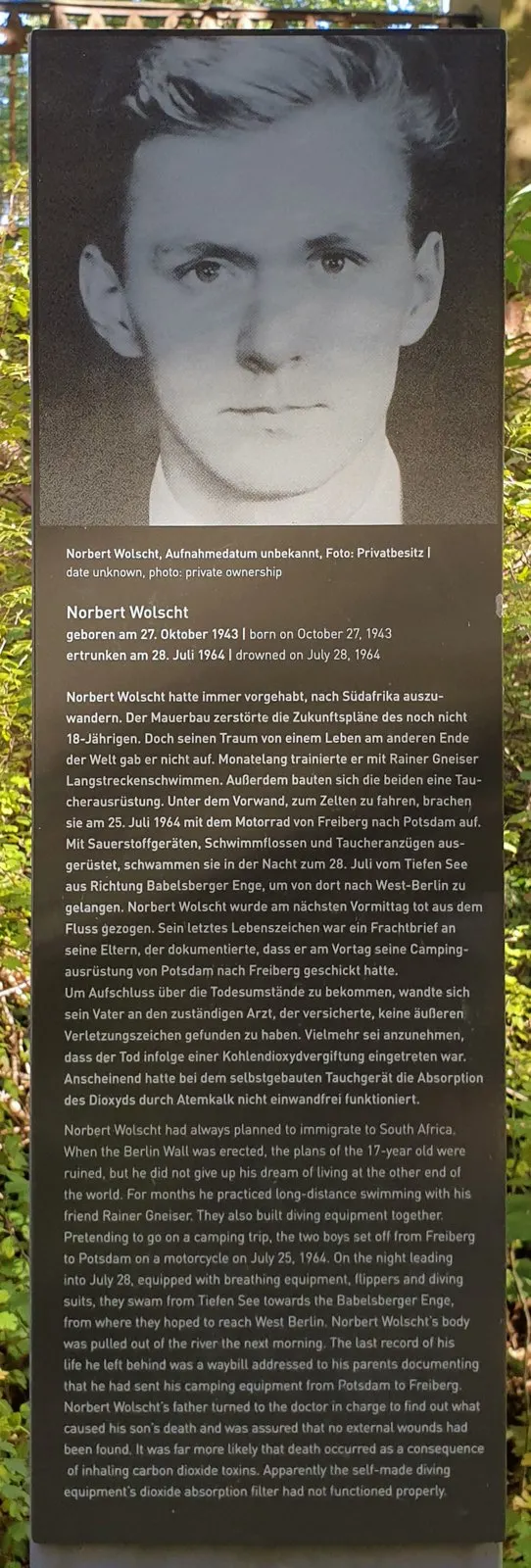
Norbert Wolscht, a 20-year-old lathe operator from Freiberg in Saxony, drowned in the Havel near Potsdam on 28 July 1964 when his home-made diving equipment apparently failed during an underwater escape attempt with his friend Rainer Gneiser.
_Norbert_Wolscht.jpg)
Norbert Wolscht was born on 27 October 1943 in Greiffenberg in Silesia, the second child of Benno and Charlotte Wolscht; his sister Barbara was a year older. In 1947, with his father still a prisoner of war, his mother, grandmother and the children had to leave Greiffenberg, which had become part of Poland. His sister later said the war and the expulsion had marked their childhood. His mother hoped to join her brothers in Düsseldorf, but the refugee camp near Görlitz was so overcrowded that she arranged to move to relatives in Freiberg, and the family settled in Saxony.
After leaving school with a secondary certificate he trained as a lathe operator in a precision engineering firm. His sister felt he found it hard to submit to the ideological demands of the state. According to his sister, he had always meant to emigrate to South Africa one day, like a friend with whom he corresponded for many years; on that friend's advice he first wanted to finish his apprenticeship and learn English. He was not yet 18 when the Wall was built, but he probably never completely gave up his dream. In the summer of 1963 he is said to have teamed up with Rainer Gneiser, a friend since their school days in Freiberg who had already failed once to escape. They trained in long-distance swimming and learned how diving equipment was built. Norbert was athletic and a strong swimmer.
On 25 July 1964, telling family and friends they were going camping, the two set off from Freiberg by motorcycle, probably heading straight for Potsdam. On 27 July Norbert sent his camping gear home to his parents from Potsdam; it was the last sign of life he left. Their plan was to get across the Havel to West Berlin during the night leading into 28 July, using diving suits, flippers and oxygen tanks. Exactly when and where they entered the water is not known; they probably set out from the Tiefen See and meant to swim underwater north through the Babelsberger Enge towards the West Berlin bank.
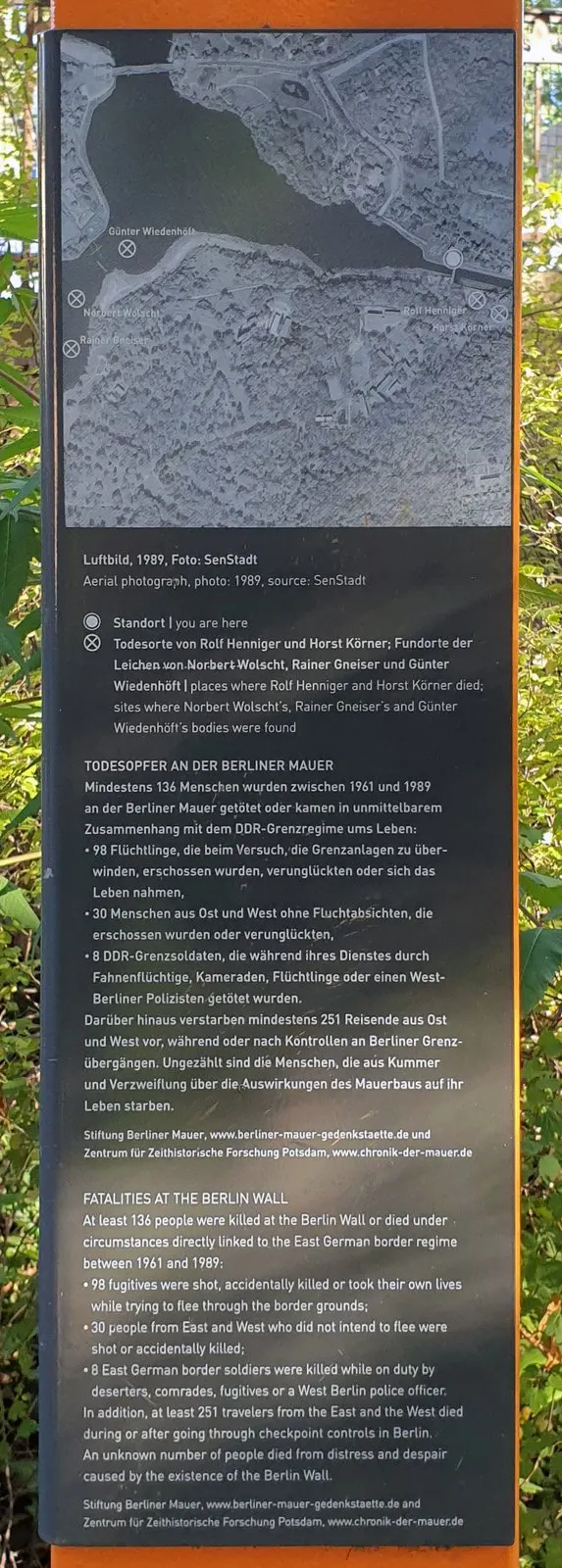
Both young men drowned in unexplained circumstances. Border soldiers pulled Norbert's body from the river the next morning; Rainer Gneiser's body was found on the Babelsberg bank a week later. The autopsy placed Norbert's death at around 2 a.m. on 28 July and attributed it to failure of the breathing apparatus; a doctor told his father there were no external injuries and that death was presumably caused by carbon dioxide poisoning, because the soda lime in the home-made equipment had apparently not absorbed the gas properly. The West knew nothing of their fate at the time.
His parents were informed the same evening and were allowed to see their son. Norbert Wolscht was buried in the Donatsfriedhof in Freiberg on 1 August 1964. In the death notice his parents wrote of an accident, but they did not hide from relatives and friends that he had died trying to escape. After the collapse of East Germany, friends and relatives drew attention to the case, and investigations confirmed that the two had died in an accident during their escape attempt.
_Gneiser_Henninger_K%C3%B6rner_Wiedenh%C3%B6ft_Wolscht.jpg)
_Gneiser_Henninger_K%C3%B6rner_Wiedenh%C3%B6ft_Wolscht2.jpg)
Read more
Also died on the outer ring between Berlin-Zehlendorf and Potsdam-Babelsberg
- Jörgen Schmidtchen 18 April 1962
- Peter Böhme 18 April 1962
- Günter Wiedenhöft Night of 5 to 6 December 1962
- Rainer Gneiser 28 July 1964
- Peter Hauptmann 3 May 1965
- Willi Marzahn 19 March 1966
- Horst Körner 15 November 1968
- Holger H. 22 January 1973
Sources
This profile is a summary written for this site. Every fact in it is taken from source 1, which also gives the full account with archival references.
- Christine Brecht, “Norbert Wolscht”, biography in Chronik der Mauer, Federal Agency for Civic Education, Centre for Contemporary History Potsdam and Deutschlandradio. Accessed 23 September 2026. Read online. Basis for every fact in this profile, including the dates and place of death.
- German version of the same biography. Accessed 23 September 2026. Read online.
- Hans-Hermann Hertle and Maria Nooke (eds.), The Victims at the Berlin Wall, 1961–1989: A Biographical Handbook. Centre for Contemporary History Potsdam and Berlin Wall Foundation, Berlin 2011. The printed handbook from which the online biography is taken.
- Hans-Hermann Hertle and Maria Nooke, “140 Victims at the Berlin Wall, 1961–1989” (list), Centre for Contemporary History Potsdam and Berlin Wall Foundation, August 2017. PDF. Used to cross-check names and dates.
- Hans-Hermann Hertle and Maria Nooke, “The Victims at the Berlin Wall, 1961–1989: Findings of a Research Project”, August 2017. PDF. Source of the classification into escapees, people with no intent to escape, and border soldiers.
Further reading
Image credits
- Memorial panel for Norbert Wolscht on Lankestraße 2 in Klein Glienicke, with his photograph, photographed in 2023. OTFW, Berlin, CC BY-SA 3.0, Wikimedia Commons.
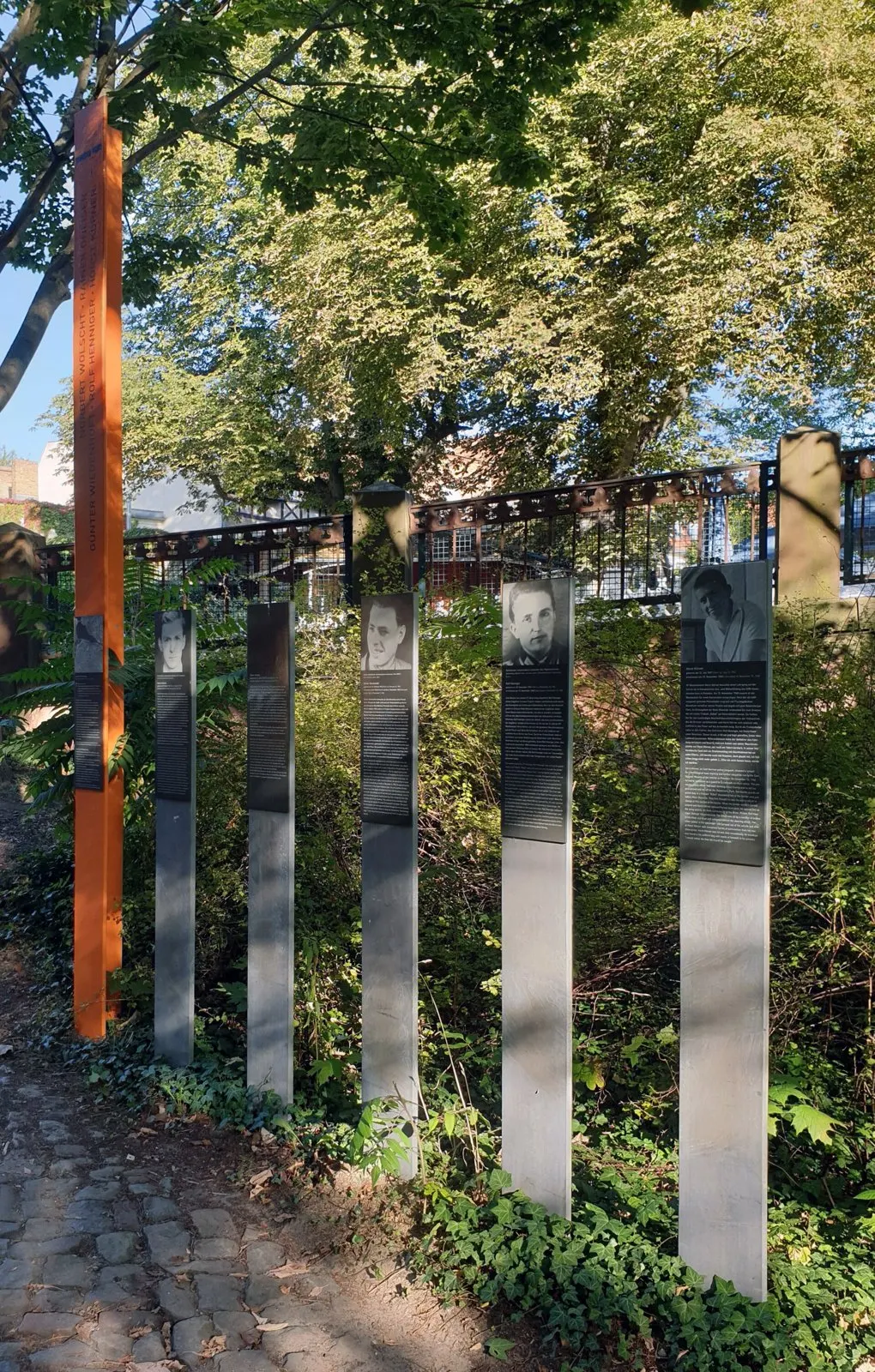
- Memorial for five victims of the Berlin Wall, including Norbert Wolscht, on Lankestraße 2 in Klein Glienicke, photographed in 2023. OTFW, Berlin, CC BY-SA 3.0, Wikimedia Commons.
- Panel with a 1989 aerial photograph marking where the bodies of Norbert Wolscht and others were found, Lankestraße, Klein Glienicke. OTFW, Berlin, CC BY-SA 3.0, Wikimedia Commons.
Cite this page
“Norbert Wolscht”, Victims of the Berlin Wall, Berlin Experiences. https://victimsofthewall.com/victims/wolscht-norbert/
Map
The pin position is based on the place of death described in source 1. Base map © OpenStreetMap contributors; course of the Wall in 1989 from Geoportal Berlin (dl-de/zero-2.0). Accessed 23 September 2026.