Walter Heike
1934–1964
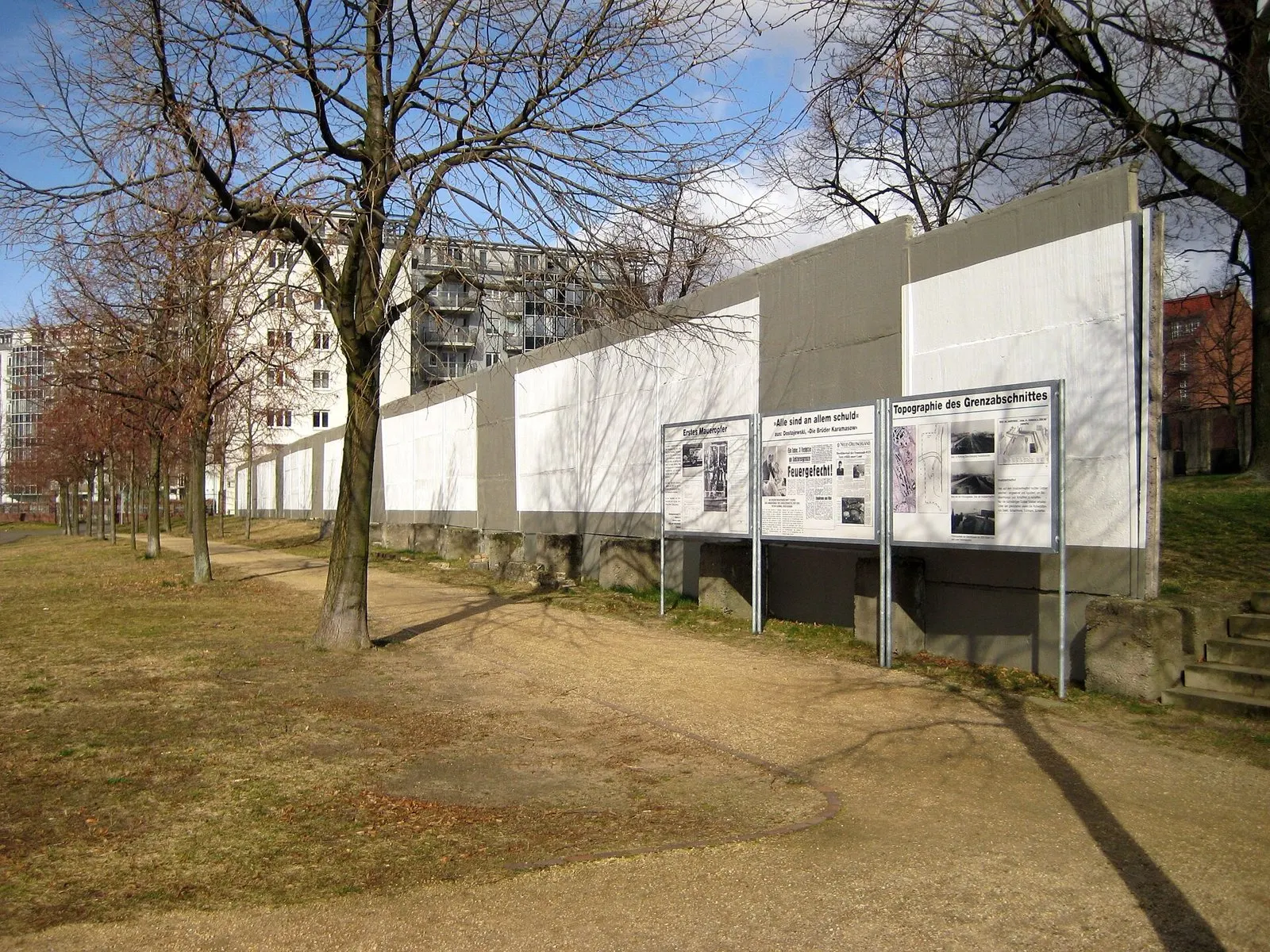
Walter Heike, a 29-year-old painter and former customs officer, was shot dead on 22 June 1964 after crossing the grounds of the Invaliden Cemetery, as he tried to climb the Wall on the bank of the Spandauer Schifffahrts Canal.

Walter Heike was born in 1934 in Taurage (Tauroggen), Lithuania, the elder of Marie and Rudolf Heike's two children; his father was a carpenter. For generations the family had been part of a small German community in the Baltic states. The war brought resettlement, return and flight, until in July 1945 he arrived with his mother and sister in Wriezen in Brandenburg. His father never came back and was listed as missing.
He left school at 16 without a certificate, worked for a time for a firm in Strausberg that painted for theatres and advertising, and then did an apprenticeship as a painter. In early 1955 he enlisted for five years in the Garrisoned Police, which became the National People's Army, and after his service he was given a post in the East Berlin customs administration. On 5 February 1964 he was dismissed, reportedly because he had met a woman from West Berlin while on duty at the Friedrichstrasse customs office. He then lived with his mother in Bad Freienwalde and went back to work as a painter. In a résumé written soon afterwards he presented himself as confident, mentioning his singing in a choir, his work designing wall newspapers and club rooms, his wish to go on learning and his many cultural interests.
The files do not show when he began to think of escape, or whether, as the East German authorities claimed, he wanted to be with the woman from West Berlin. There are strong signs that he planned it: according to his sister, on his last visit in early June 1964 he hinted that inquiries would soon be made about him; he carried documents and cash, and he left behind a notebook carefully listing the books he would have to leave.
Early on 22 June 1964 he entered the border area from a building plot on Scharnhorststrasse, near the Sandkrug Bridge. A Stasi guard at the government hospital next door ordered him to stop and fired two warning shots, but he kept going, got over the Invaliden Cemetery wall and made for the canal bank. According to military records, at around 5.30 a.m. four border soldiers noticed him. An NCO went after him as he was trying to pull himself over the last wall in front of the canal embankment, knelt and fired from 25 to 30 metres. A bullet struck Walter Heike in the abdomen, and he presumably died at the scene. West Berlin police across the canal heard shots and saw a seemingly lifeless person carried away on a stretcher, but could not see what had happened.
Two days later a Stasi officer visited and questioned his mother and sister; when his sister insisted on knowing why, she was told only that he had been fatally injured in Berlin through his own fault; they were not told he had died at the border. His sister's attempts to learn where and how he had died came to nothing. When his last employer asked for a death certificate, the prosecutor in charge of the case told the employer that the family had no claim to death benefits because the state had paid for the burial. In fact, the burial had been paid for with the money Walter Heike was carrying when he died.
Also died on the sector border between Berlin-Mitte and Berlin-Tiergarten
- Günter Litfin 24 August 1961
- Ingo Krüger 11 December 1961
- Peter Göring 23 May 1962
- Lutz Haberlandt 27 May 1962
- Axel Hannemann 5 June 1962
- Klaus Schröter 4 November 1963
- Heinz Sokolowski 25 November 1965
- Paul Stretz 29 April 1966
- Heinz Schmidt 29 August 1966
- Elke Weckeiser 18 February 1968
- Dieter Weckeiser 19 February 1968
- Siegfried Krug 6 July 1968
- Dieter Beilig 2 October 1971
- Manfred Gertzki 27 April 1973
- Henri Weise Probably May 1977
Sources
This profile is a summary written for this site. Every fact in it is taken from source 1, which also gives the full account with archival references.
- Christine Brecht, “Walter Heike”, biography in Chronik der Mauer, Federal Agency for Civic Education, Centre for Contemporary History Potsdam and Deutschlandradio. Accessed 23 September 2026. Read online. Basis for every fact in this profile, including the dates and place of death.
- German version of the same biography. Accessed 23 September 2026. Read online.
- Hans-Hermann Hertle and Maria Nooke (eds.), The Victims at the Berlin Wall, 1961–1989: A Biographical Handbook. Centre for Contemporary History Potsdam and Berlin Wall Foundation, Berlin 2011. The printed handbook from which the online biography is taken.
- Hans-Hermann Hertle and Maria Nooke, “140 Victims at the Berlin Wall, 1961–1989” (list), Centre for Contemporary History Potsdam and Berlin Wall Foundation, August 2017. PDF. Used to cross-check names and dates.
- Hans-Hermann Hertle and Maria Nooke, “The Victims at the Berlin Wall, 1961–1989: Findings of a Research Project”, August 2017. PDF. Source of the classification into escapees, people with no intent to escape, and border soldiers.
Further reading
Image credits
- Remains of the East German border fortifications at the Invaliden Cemetery in Berlin, photographed in 2008. Walter Heike was shot on the cemetery grounds on 22 June 1964.. Beek100, Public domain, Wikimedia Commons.
Cite this page
“Walter Heike”, Victims of the Berlin Wall, Berlin Experiences. https://victimsofthewall.com/victims/heike-walter/
Map
The pin position is based on the place of death described in source 1. Base map © OpenStreetMap contributors; course of the Wall in 1989 from Geoportal Berlin (dl-de/zero-2.0). Accessed 23 September 2026.