Lutz Haberlandt
1938–1962
Lutz Haberlandt, a 24-year-old mason from Prenzlauer Berg, was fatally shot on 27 May 1962 after climbing from the grounds of Charité Hospital into the border strip on the Alexander embankment, trying to reach West Berlin.
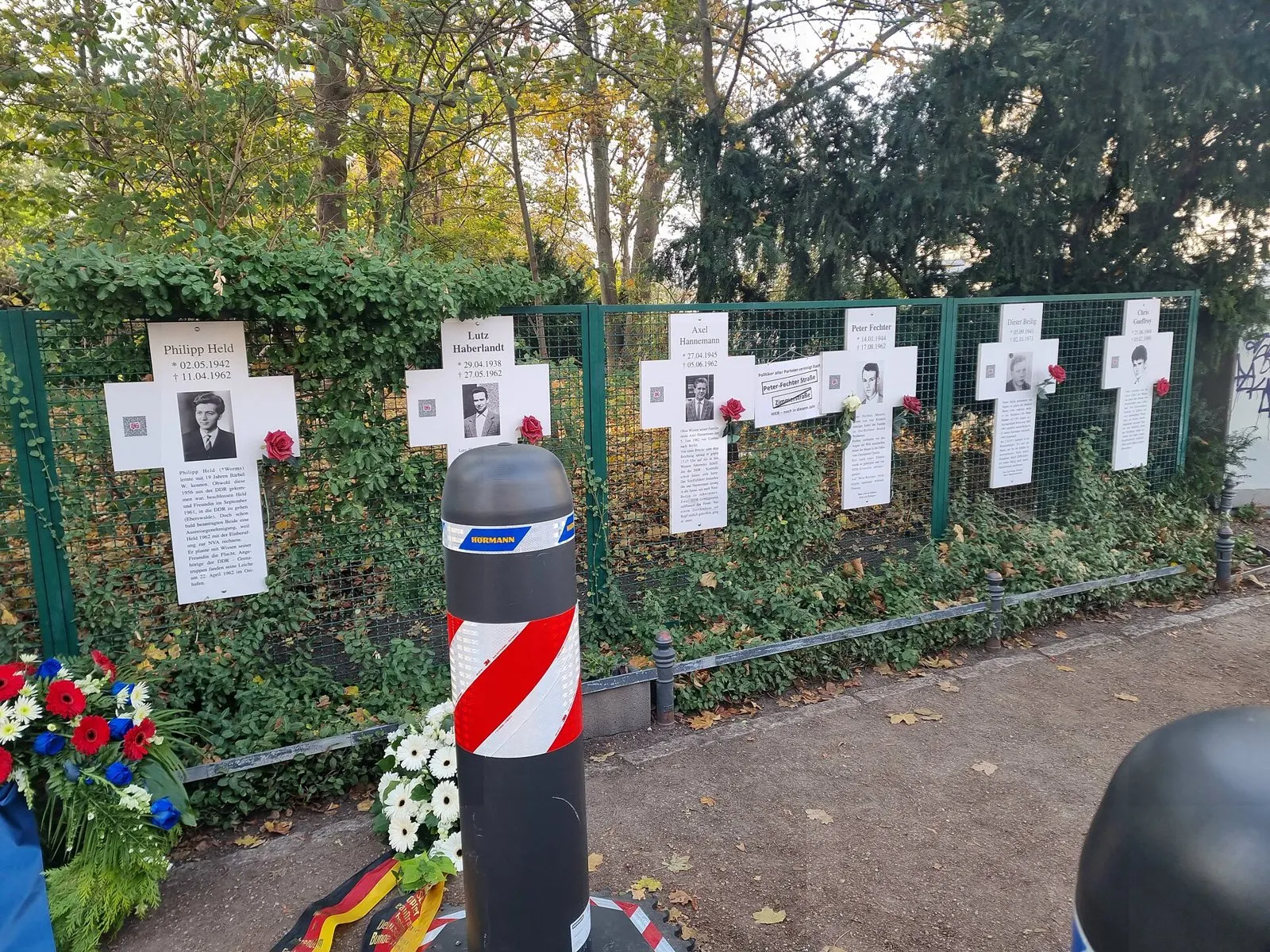

Lutz Haberlandt was born in Berlin in 1938, the second of three children, and grew up in Prenzlauer Berg. After eight years of school he trained as a bricklayer and worked as a mason. His father, until the Wall went up, worked as a fabric tracer at a West Berlin textile firm (the family had many relatives in the western half of the city). As a cross-border commuter he lost that job when the Wall was built and had to take work at the East Berlin post office. His sister Lieselott remembered that the Wall made their father, and her brother above all, feel hemmed in.
At 24 he still lived with his parents on what was then Dimitroffstrasse, today's Danziger Strasse. Sunday 27 May 1962 was a warm, sunny day. Around noon Lutz fetched his sister and her daughter Andrea for the family's Sunday meal, cooked as so often by his mother. After his sister had gone home, he left his parents' flat without a word. He had never told his family that he meant to flee. He stopped at a local bar for a beer and talked with a friend, who later told investigators he knew nothing of any escape plan. His parents also told the Stasi they had had no idea of his intentions or reasons.
Probably not entirely sober, he went into the city centre and onto the grounds of Charité Hospital, which lay right on the border. At about 4 p.m. two transport policemen watching from a nearby railway bridge noticed him; they later recorded that they saw him climb onto a shed roof, take off his jacket and shoes and lie in the sun. After a while, by their account, he suddenly jumped down and climbed the property wall into the border strip. From the tower of the Supreme Court building on Invalidenstrasse, about a hundred metres away, a guard fired a warning shot and then two aimed shots; one struck Lutz Haberlandt in the head. Doctors, nurses and patients at the neighbouring Charité psychiatric clinic saw him left lying in the bushes for about forty minutes. By the time he was finally taken away, he was probably already dead.
Other guards had fired too, and some bullets crossed into West Berlin. A West Berlin policeman returned fire, and East German propaganda denounced this as a serious provocation. Only four days earlier an exchange of fire had killed the border policeman Peter Göring, and on 27 May itself the Governing Mayor, Willy Brandt, had appealed to West Berliners in a radio address to remain calm.
A few days after his death, anonymous tips, probably from relatives in the West, reached the West Berlin police and pointed to who he was. According to this information, People's Police officers and an East German prosecutor had come to his parents' home at about four o'clock on the morning after his death to tell them; when his mother asked whether her son had been shot, they confirmed it. They then searched the flat, pressed the parents to agree to cremation and told them the funeral would be on 8 July at the Weissensee Cemetery. His close family gathered there. According to his sister, it took the family months to take in his death, and his grave and headstone later disappeared from the cemetery without their knowledge.
Investigations of the guards involved began in the 1990s. It was established beyond doubt which guard had fired the fatal shot, and in March 1996 he was convicted of manslaughter and given a youth sentence of a year and a half, suspended on probation.
Also died on the sector border between Berlin-Mitte and Berlin-Tiergarten
- Günter Litfin 24 August 1961
- Ingo Krüger 11 December 1961
- Peter Göring 23 May 1962
- Axel Hannemann 5 June 1962
- Klaus Schröter 4 November 1963
- Walter Heike 22 June 1964
- Heinz Sokolowski 25 November 1965
- Paul Stretz 29 April 1966
- Heinz Schmidt 29 August 1966
- Elke Weckeiser 18 February 1968
- Dieter Weckeiser 19 February 1968
- Siegfried Krug 6 July 1968
- Dieter Beilig 2 October 1971
- Manfred Gertzki 27 April 1973
- Henri Weise Probably May 1977
Sources
This profile is a summary written for this site. Every fact in it is taken from source 1, which also gives the full account with archival references.
- Christine Brecht, “Lutz Haberlandt”, biography in Chronik der Mauer, Federal Agency for Civic Education, Centre for Contemporary History Potsdam and Deutschlandradio. Accessed 23 September 2026. Read online. Basis for every fact in this profile, including the dates and place of death.
- German version of the same biography. Accessed 23 September 2026. Read online.
- Hans-Hermann Hertle and Maria Nooke (eds.), The Victims at the Berlin Wall, 1961–1989: A Biographical Handbook. Centre for Contemporary History Potsdam and Berlin Wall Foundation, Berlin 2011. The printed handbook from which the online biography is taken.
- Hans-Hermann Hertle and Maria Nooke, “140 Victims at the Berlin Wall, 1961–1989” (list), Centre for Contemporary History Potsdam and Berlin Wall Foundation, August 2017. PDF. Used to cross-check names and dates.
- Hans-Hermann Hertle and Maria Nooke, “The Victims at the Berlin Wall, 1961–1989: Findings of a Research Project”, August 2017. PDF. Source of the classification into escapees, people with no intent to escape, and border soldiers.
Further reading
Image credits
- Memorial cross for Lutz Haberlandt (second from left) among the White Crosses on Ebertstraße, photographed on 9 November 2024. C.Suthorn / cc-by-sa-4.0 / commons.wikimedia.org, CC BY-SA 4.0, Wikimedia Commons.
Cite this page
“Lutz Haberlandt”, Victims of the Berlin Wall, Berlin Experiences. https://victimsofthewall.com/victims/haberlandt-lutz/
Map
The pin position is based on the place of death described in source 1. Base map © OpenStreetMap contributors; course of the Wall in 1989 from Geoportal Berlin (dl-de/zero-2.0). Accessed 23 September 2026.