Siegfried Krug
1939–1968
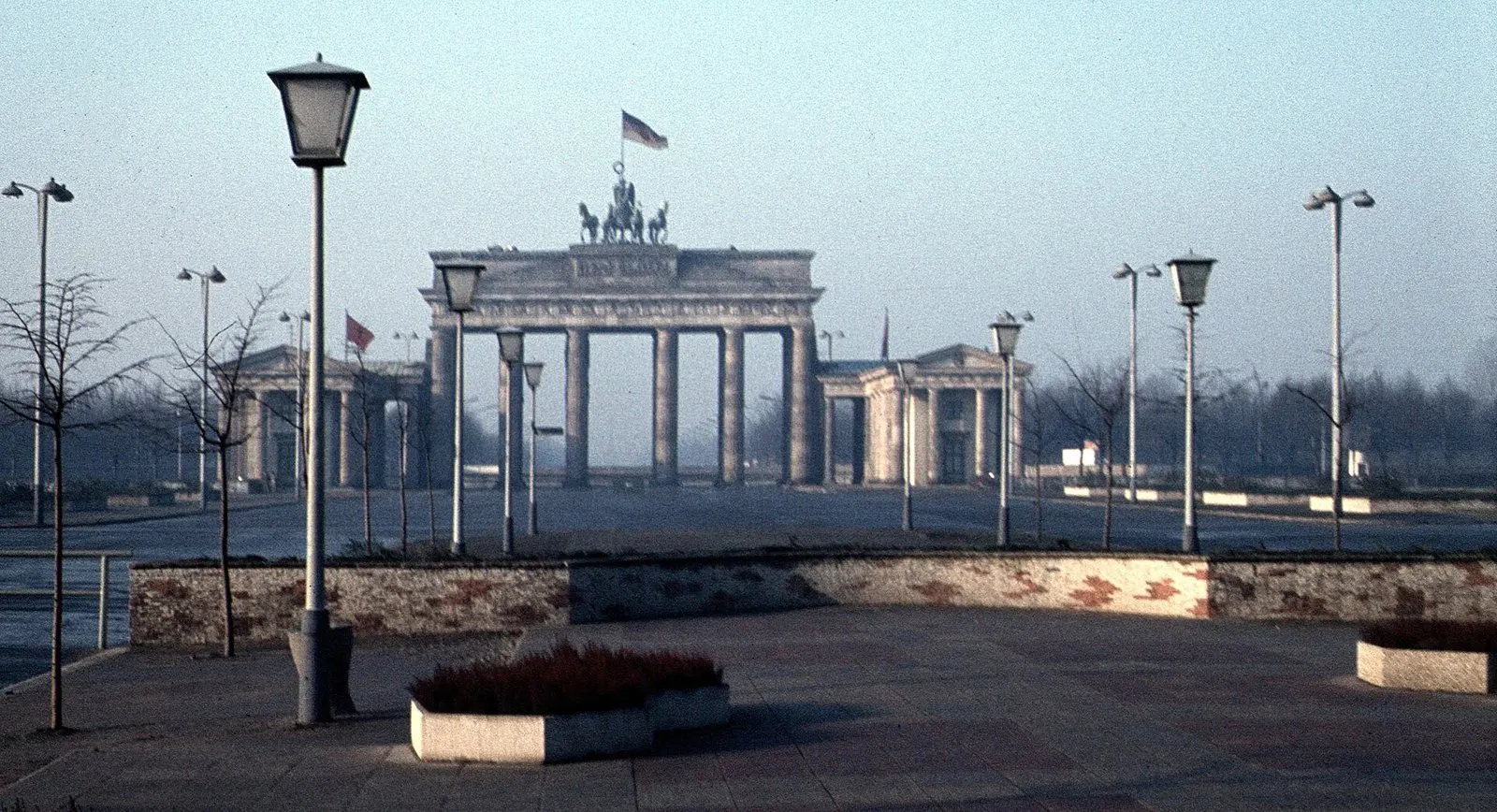
Siegfried Krug, a 28-year-old West German living in Frankfurt am Main, was shot on Pariser Platz on 6 July 1968 after walking unarmed from the East towards the Brandenburg Gate, and died an hour later.

Siegfried Krug was born in Stettin on 22 July 1939. Driven from his home during the war, he fled with his parents and sister to Erfurt at the end of February 1945. There, after leaving school, he trained as a high-voltage electrician. The Stasi regarded him as oriented towards the West; according to its records, cycling was his passion and he had made tours as far as Austria and Italy. Shortly before the Wall was built he fled to West Germany. His married sister, who had also left East Germany, lived near Marburg, and when their mother joined them a little later the family was together again in the West.
He moved to Frankfurt am Main and seemed to be doing well; on visits to Marburg he was well dressed and sometimes arrived in his employer's Mercedes. He told his family he worked for a publisher, though in fact he sold newspaper subscriptions door to door. He was engaged, and the couple planned to marry in Frankfurt in summer 1968.
In early July 1968 he told his fiancée he was going to Berlin and would return, but did not know when; he told his sister he did not want to marry and would disappear for a long time. On 5 July he flew to West Berlin. The next evening he crossed at Friedrichstrasse at about 6.30 p.m. and, an hour later, stepped out of a taxi at the Brandenburg Gate. With a white briefcase holding, among other things, about 1,100 West German marks in large notes, he ducked under the barrier and walked calmly across Pariser Platz towards the Gate. Why he did this, where the taxi took him and what the money was for remain unanswered.
He was the only civilian on the square. A guard called on him to stop; he reportedly answered that he wanted to go to the Brandenburg Gate and walked on. The guard fired a burst of warning shots into the air, and two more guards came running and blocked his way with their weapons drawn. When one of them warned that he would shoot, he calmly replied that they would not shoot anyway, and walked on between them, apparently certain that no one would open fire in such a visible place. After about 50 metres, with 250 still to go, he stopped, turned and walked back towards the guard behind him, who had fired the last warning shots. He was unarmed. When he was a few metres away the guard fired a single burst, and all three bullets struck him, in the stomach, chest and upper arm. He was quickly taken out of sight to the People's Police Hospital and died there about an hour afterwards.
As was customary, the guard was transferred and decorated, though some soldiers who knew what had happened protested, and in his report a lieutenant colonel of the border troops concluded that, given the guards' superior numbers, the guard ought to have acted differently. Only when questioned by police in 1992 did he learn that his shots had been fatal. The Berlin Regional Court convicted him of manslaughter and gave him a two-year suspended sentence; the verdict said he had simply shot an intruder who was obviously no longer dangerous and was unprotected and defenceless.
Only the Stasi knew that the dead man was a West German citizen, not an East German trying to flee. They had his body cremated and buried anonymously in Treptow, and made sure that East German authorities would not answer any inquiries about him. His fiancée, mother and sister never heard anything from the East German authorities; for years he was considered missing and they hoped he would come home. They learned of his death only in 1991.
Also died on the sector border between Berlin-Mitte and Berlin-Tiergarten
- Günter Litfin 24 August 1961
- Ingo Krüger 11 December 1961
- Peter Göring 23 May 1962
- Lutz Haberlandt 27 May 1962
- Axel Hannemann 5 June 1962
- Klaus Schröter 4 November 1963
- Walter Heike 22 June 1964
- Heinz Sokolowski 25 November 1965
- Paul Stretz 29 April 1966
- Heinz Schmidt 29 August 1966
- Elke Weckeiser 18 February 1968
- Dieter Weckeiser 19 February 1968
- Dieter Beilig 2 October 1971
- Manfred Gertzki 27 April 1973
- Henri Weise Probably May 1977
Sources
This profile is a summary written for this site. Every fact in it is taken from source 1, which also gives the full account with archival references.
- Martin Ahrends/Udo Baron, “Siegfried Krug”, biography in Chronik der Mauer, Federal Agency for Civic Education, Centre for Contemporary History Potsdam and Deutschlandradio. Accessed 23 September 2026. Read online. Basis for every fact in this profile, including the dates and place of death.
- German version of the same biography. Accessed 23 September 2026. Read online.
- Hans-Hermann Hertle and Maria Nooke (eds.), The Victims at the Berlin Wall, 1961–1989: A Biographical Handbook. Centre for Contemporary History Potsdam and Berlin Wall Foundation, Berlin 2011. The printed handbook from which the online biography is taken.
- Hans-Hermann Hertle and Maria Nooke, “140 Victims at the Berlin Wall, 1961–1989” (list), Centre for Contemporary History Potsdam and Berlin Wall Foundation, August 2017. PDF. Used to cross-check names and dates.
- Hans-Hermann Hertle and Maria Nooke, “The Victims at the Berlin Wall, 1961–1989: Findings of a Research Project”, August 2017. PDF. Source of the classification into escapees, people with no intent to escape, and border soldiers.
Further reading
Image credits
- Pariser Platz and the Brandenburg Gate in January 1974. Siegfried Krug was shot on Pariser Platz in front of the Gate on 6 July 1968.. Andreas Schwarzkopf, CC BY-SA 3.0, Wikimedia Commons.
Cite this page
“Siegfried Krug”, Victims of the Berlin Wall, Berlin Experiences. https://victimsofthewall.com/victims/krug-siegfried/
Map
The pin position is based on the place of death described in source 1. Base map © OpenStreetMap contributors; course of the Wall in 1989 from Geoportal Berlin (dl-de/zero-2.0). Accessed 23 September 2026.