Ingo Krüger
1940–1961
Ingo Krüger, a 21-year-old cook from East Berlin separated from his fiancée by the Wall, died in the Spree near the Marschall Bridge on the night of 10 to 11 December 1961 while trying to dive across to West Berlin.
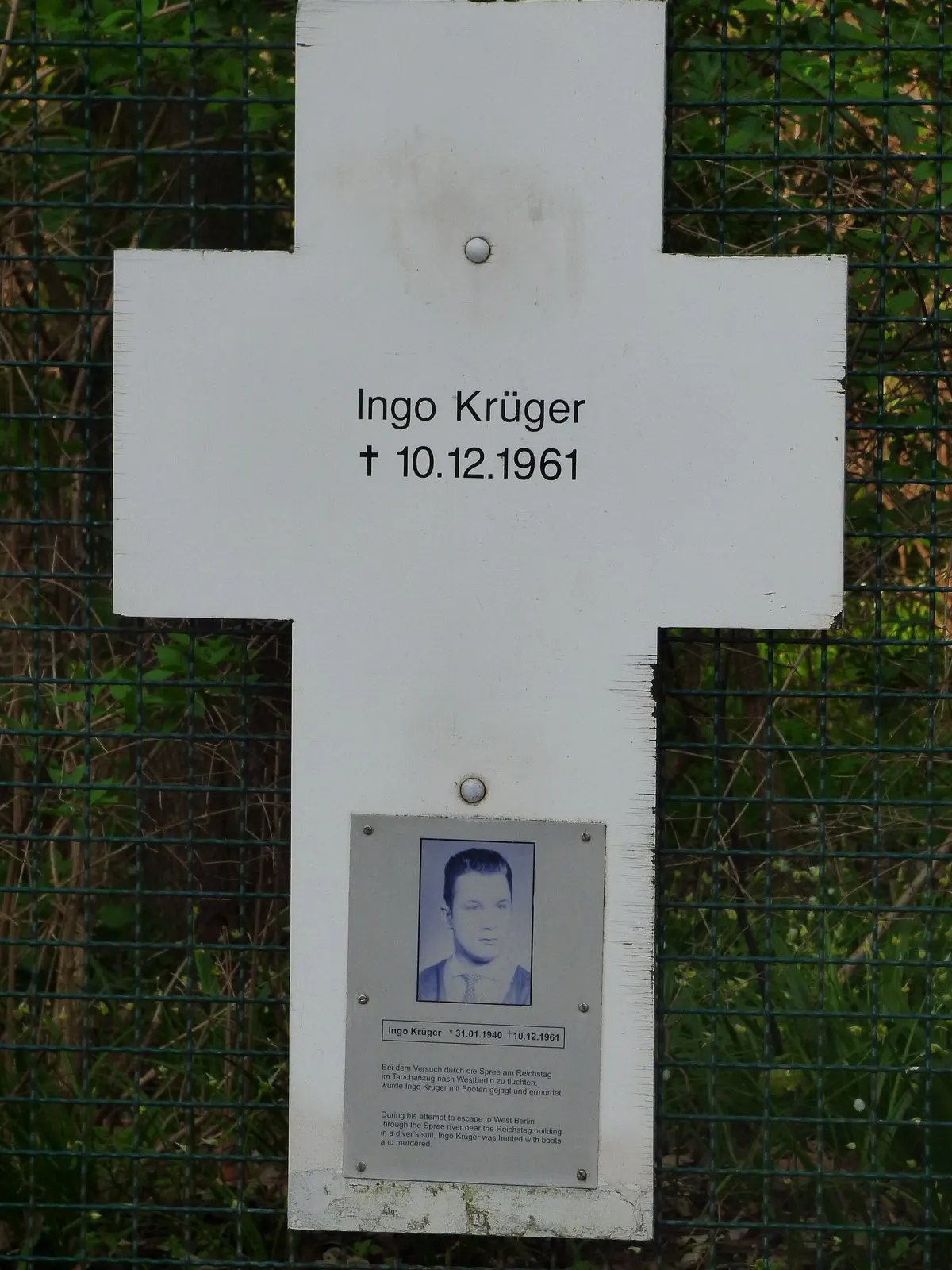

Ingo Krüger was born in Berlin-Dahlem on 31 January 1940. His father died as a soldier in the Second World War, and when his mother remarried the family moved to the east of the city. He grew up in Niederschöneweide in Treptow. After school he trained as a cook and then worked for the state company that catered for the East German government's guest houses.
His fiancée Ingrid had been at school with him in Johannisthal. They began going out in 1958, although she and her mother had moved to West Berlin, and colleagues who informed for the Stasi recorded his contacts with the West. On Saturday 12 August 1961 the couple spent the day with friends in East Berlin and then stayed the night at her flat in the West; early the next morning, unaware of what was happening at the border, he drove back east for his Sunday shift. From then on they were divided.
At first they met at quiet spots on the edge of the city, passing letters and gifts across the barbed wire, but these meetings grew harder to arrange, and during one attempt to make contact he was briefly detained and warned to keep away from the border. Ingrid then registered her address with relatives in West Germany, which allowed her to visit him in East Berlin. When it became clear that the border would stay closed, Ingo, a sport diver, began in early November to plan an escape underwater, across the Spree towards the Reichstag. Stasi observers were watching him closely.
At around 11 p.m. on 10 December 1961 he took a taxi with two friends to the Spree at Schiffbauerdamm, wearing his diving suit under his coat. A woman friend who kept watch on boat traffic on the Spree advised him to enter the water beneath Friedrichstrasse station, out of sight of the East German customs boats. He put on his breathing apparatus and went in. His friends soon realised something had gone wrong. On the West Berlin bank Ingrid watched East German customs officers in a boat search the water with hooks and spotlights and finally pull a body out; despite the poor visibility, she had no doubt that it was him.
Border police reports say the 21-year-old was already dead when he was recovered near the Marschall Bridge, which would place his death on 10 December; the forensic institute recorded 12.10 a.m. on 11 December. The autopsy gave the cause as presumably drowning. Stasi investigations are said to have blamed a failed breathing apparatus, while investigations in the 1990s concluded that he died of cold shock. Theories of a violent death could not be confirmed.
The authorities told his parents and colleagues that his fiancée and friends were to blame. One friend was arrested for helping him, and another was blackmailed into working with the Stasi. He was buried on 23 December in the cemetery on Baumschulenweg in East Berlin, while Ingrid still did not know what had become of him. Her letters to his mother went unanswered for weeks, and she learned the truth only in January. A photograph from 2005 shows a memorial cross for him at Checkpoint Charlie.

Read more
Also died on the sector border between Berlin-Mitte and Berlin-Tiergarten
- Günter Litfin 24 August 1961
- Peter Göring 23 May 1962
- Lutz Haberlandt 27 May 1962
- Axel Hannemann 5 June 1962
- Klaus Schröter 4 November 1963
- Walter Heike 22 June 1964
- Heinz Sokolowski 25 November 1965
- Paul Stretz 29 April 1966
- Heinz Schmidt 29 August 1966
- Elke Weckeiser 18 February 1968
- Dieter Weckeiser 19 February 1968
- Siegfried Krug 6 July 1968
- Dieter Beilig 2 October 1971
- Manfred Gertzki 27 April 1973
- Henri Weise Probably May 1977
Sources
This profile is a summary written for this site. Every fact in it is taken from source 1, which also gives the full account with archival references.
- Christine Brecht, “Ingo Krüger”, biography in Chronik der Mauer, Federal Agency for Civic Education, Centre for Contemporary History Potsdam and Deutschlandradio. Accessed 23 September 2026. Read online. Basis for every fact in this profile, including the dates and place of death.
- German version of the same biography. Accessed 23 September 2026. Read online.
- Hans-Hermann Hertle and Maria Nooke (eds.), The Victims at the Berlin Wall, 1961–1989: A Biographical Handbook. Centre for Contemporary History Potsdam and Berlin Wall Foundation, Berlin 2011. The printed handbook from which the online biography is taken.
- Hans-Hermann Hertle and Maria Nooke, “140 Victims at the Berlin Wall, 1961–1989” (list), Centre for Contemporary History Potsdam and Berlin Wall Foundation, August 2017. PDF. Used to cross-check names and dates.
- Hans-Hermann Hertle and Maria Nooke, “The Victims at the Berlin Wall, 1961–1989: Findings of a Research Project”, August 2017. PDF. Source of the classification into escapees, people with no intent to escape, and border soldiers.
Further reading
Image credits
- Memorial cross for Ingo Krüger among the White Crosses on Ebertstraße, photographed in April 2016. Luis Alvaz, CC BY-SA 4.0, Wikimedia Commons.
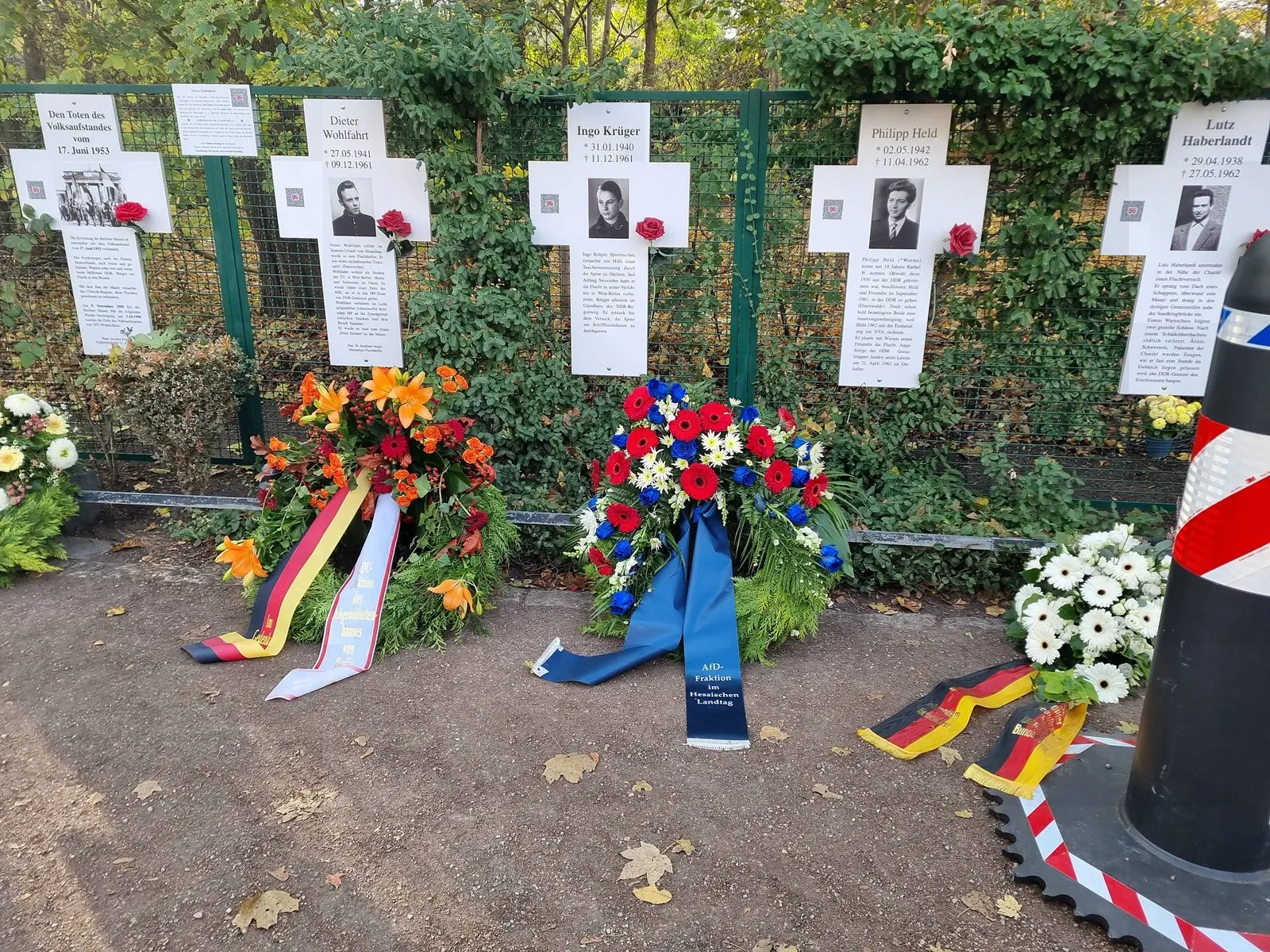
- Memorial cross for Ingo Krüger among the White Crosses on Ebertstraße, between the crosses for the dead of 17 June 1953 and Dieter Wohlfahrt on one side and Philipp Held on the other, photographed on 9 November 2024. C.Suthorn / cc-by-sa-4.0 / commons.wikimedia.org, CC BY-SA 4.0, Wikimedia Commons.
Cite this page
“Ingo Krüger”, Victims of the Berlin Wall, Berlin Experiences. https://victimsofthewall.com/victims/krueger-ingo/
Map
The pin position is based on the place of death described in source 1. Base map © OpenStreetMap contributors; course of the Wall in 1989 from Geoportal Berlin (dl-de/zero-2.0). Accessed 23 September 2026.