Georg Feldhahn
1941–1961
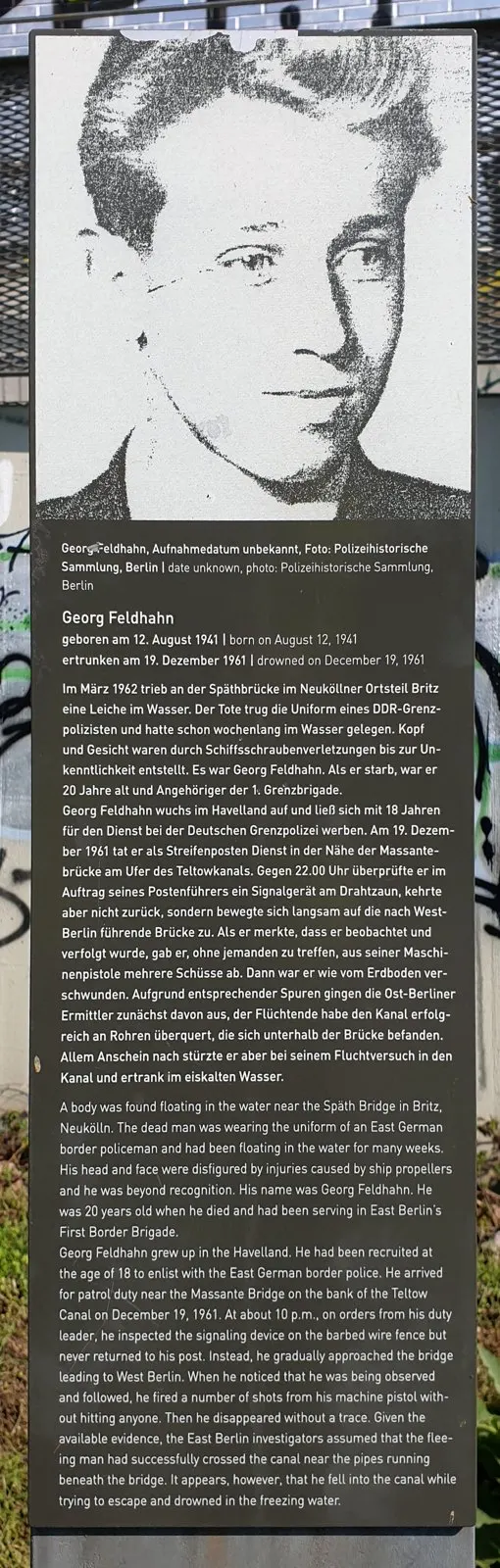
Georg Feldhahn, a 20-year-old East German border policeman from the Havelland, left his post near the Massante Bridge on the Teltow Canal on 19 December 1961 in an attempt to desert, and drowned in the canal. His body was found in March 1962.
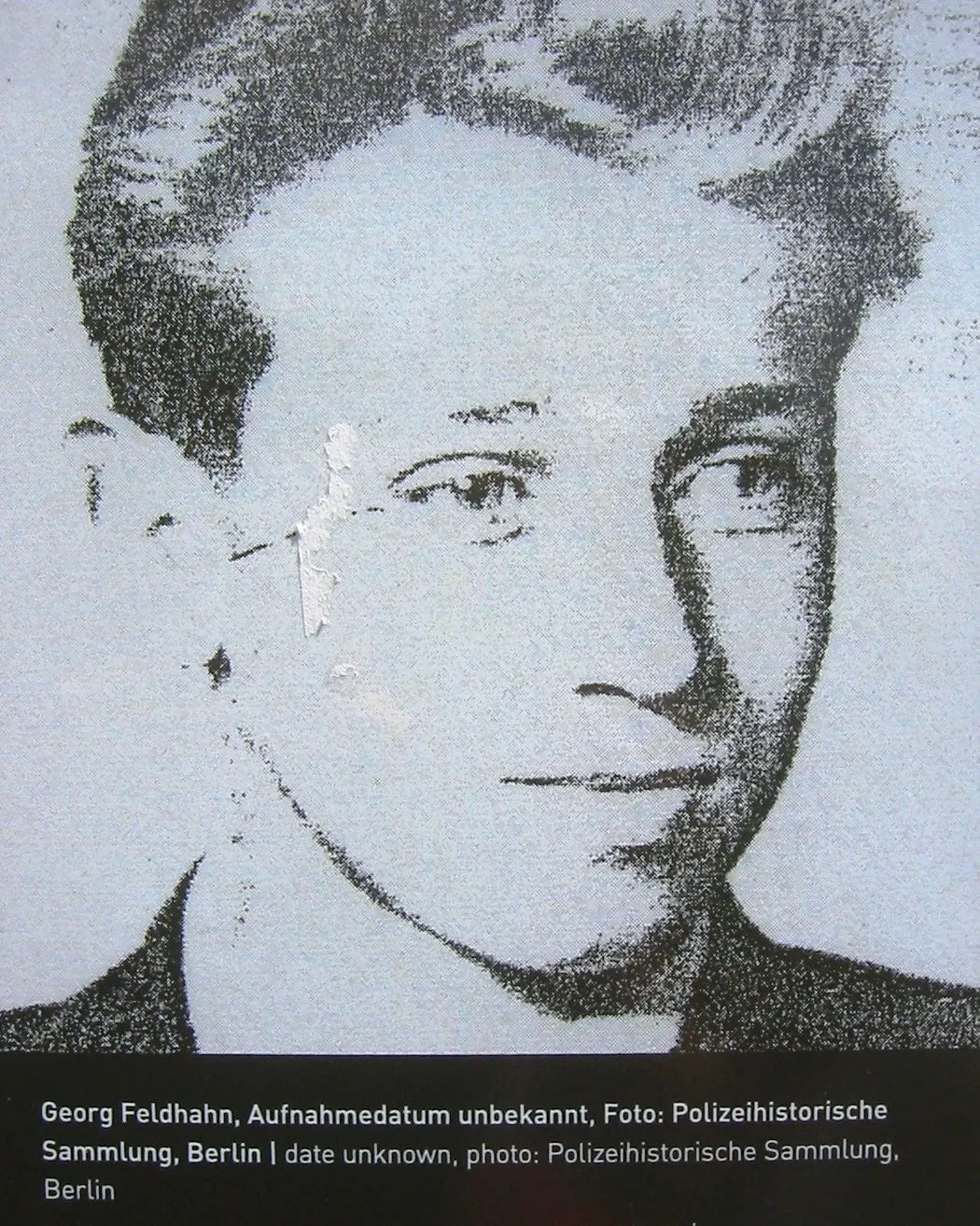

Georg Feldhahn was born on 12 August 1941 in Friesack in the Havelland, west of Berlin, and grew up in that rural area. He never knew his parents; according to what he himself wrote, his father had died in 1942 in the Buchenwald concentration camp. As far as is known, he was separated from his mother when he was four months old and placed in a children's home with his older sister. When the war ended, foster parents living in the small village of Buschow took the two children in.
After school he trained as a tractor driver on a state farm, and at 18 he was recruited into the border police, signing on for three years. He had asked to serve in Thuringia, but from September 1959 he served with the Gross-Glienicke border unit, stationed in Seeburg on the edge of West Berlin's Spandau district. In October 1961, as the Wall was being built, he was moved to the 1st Border Brigade on the inner-city border, in a unit deployed between Treptow and Neukölln.
In the first months after the Wall went up, many border guards deserted, and loudspeaker announcements and leaflets from West Berlin openly urged them to do so. What led Georg Feldhahn to try is not recorded, nor whether it was a sudden decision, as the Stasi assumed, or long planned. He had apparently attracted no attention; at least the two Stasi informers in his unit had noticed no escape preparations or contacts with the West. The files record only that he had been in the city with two comrades before his shift and is said to have been drinking.
He went on duty at 9 p.m. by the Massante Bridge, beside the Teltow Canal. According to the Stasi report, at about 10 p.m. he was sent by the leader of his guard post to check a signal device on the wire fence but did not return, and instead made his way towards the bridge leading to West Berlin. When he realised he was being watched and followed, he fired a number of shots with his machine pistol, hitting no one, and disappeared before anyone could fire back.
East Berlin investigators assumed he had crossed the canal successfully. Then, on Sunday 11 March 1962, a West Berlin customs officer found a body in a border police uniform in the canal near the Späth Bridge in Neukölln. It had been in the water for weeks. West Berlin newspapers, citing the police, reported that he had drowned and showed no signs of external violence, and the West Berlin authorities identified him as Georg Feldhahn. The Stasi concluded that he had probably fallen into the freezing canal and drowned.
With contact between the two halves of the city frozen, West Berlin officials could not reach his family, and in the West the circumstances of his death remained uncertain until after the end of East Germany. The East German authorities kept what they knew locked away in their files, and his fate was forgotten for decades. His sister learned of his death only in the 1990s; whether his foster parents ever knew what had happened to him is not known.
_Georg_Feldhahn.jpg)
_Feldhahn_Widera.jpg)
Read more
Also died on the sector border between Berlin-Neukölln and Berlin-Treptow
- Heinz Jercha 27 March 1962
- Wolfgang Glöde 11 June 1962
- Horst Kutscher 15 January 1963
- Siegfried Widera 8 September 1963
- Dieter Berger 13 December 1963
- Walter Hayn 27 February 1964
- Hans-Joachim Wolf 26 November 1964
- Erich Kühn 3 December 1965
- Jörg Hartmann 14 March 1966
- Lothar Schleusener 14 March 1966
- Michael Kollender 25 April 1966
- Max Sahmland 27 January 1967
- Gerald Thiem 7 August 1970
- Christian Peter Friese 25 December 1970
- Werner Kühl 24 July 1971
- Johannes Sprenger 10 May 1974
- Manfred Mäder 21 November 1986
- René Gross 21 November 1986
- Lutz Schmidt 12 February 1987
- Chris Gueffroy 5 February 1989
Sources
This profile is a summary written for this site. Every fact in it is taken from source 1, which also gives the full account with archival references.
- Christine Brecht, “Georg Feldhahn”, biography in Chronik der Mauer, Federal Agency for Civic Education, Centre for Contemporary History Potsdam and Deutschlandradio. Accessed 23 September 2026. Read online. Basis for every fact in this profile, including the dates and place of death.
- German version of the same biography. Accessed 23 September 2026. Read online.
- Hans-Hermann Hertle and Maria Nooke (eds.), The Victims at the Berlin Wall, 1961–1989: A Biographical Handbook. Centre for Contemporary History Potsdam and Berlin Wall Foundation, Berlin 2011. The printed handbook from which the online biography is taken.
- Hans-Hermann Hertle and Maria Nooke, “140 Victims at the Berlin Wall, 1961–1989” (list), Centre for Contemporary History Potsdam and Berlin Wall Foundation, August 2017. PDF. Used to cross-check names and dates.
- Hans-Hermann Hertle and Maria Nooke, “The Victims at the Berlin Wall, 1961–1989: Findings of a Research Project”, August 2017. PDF. Source of the classification into escapees, people with no intent to escape, and border soldiers.
Further reading
Image credits
- Portrait of Georg Feldhahn on the memorial stele near the Massantebrücke, Berlin-Baumschulenweg (original photo: Polizeihistorische Sammlung, Berlin). Assenmacher, CC BY-SA 3.0, Wikimedia Commons.
- Memorial stele for Georg Feldhahn at the Massantebrücke, Berlin-Johannisthal. OTFW, Berlin, CC BY-SA 3.0, Wikimedia Commons.
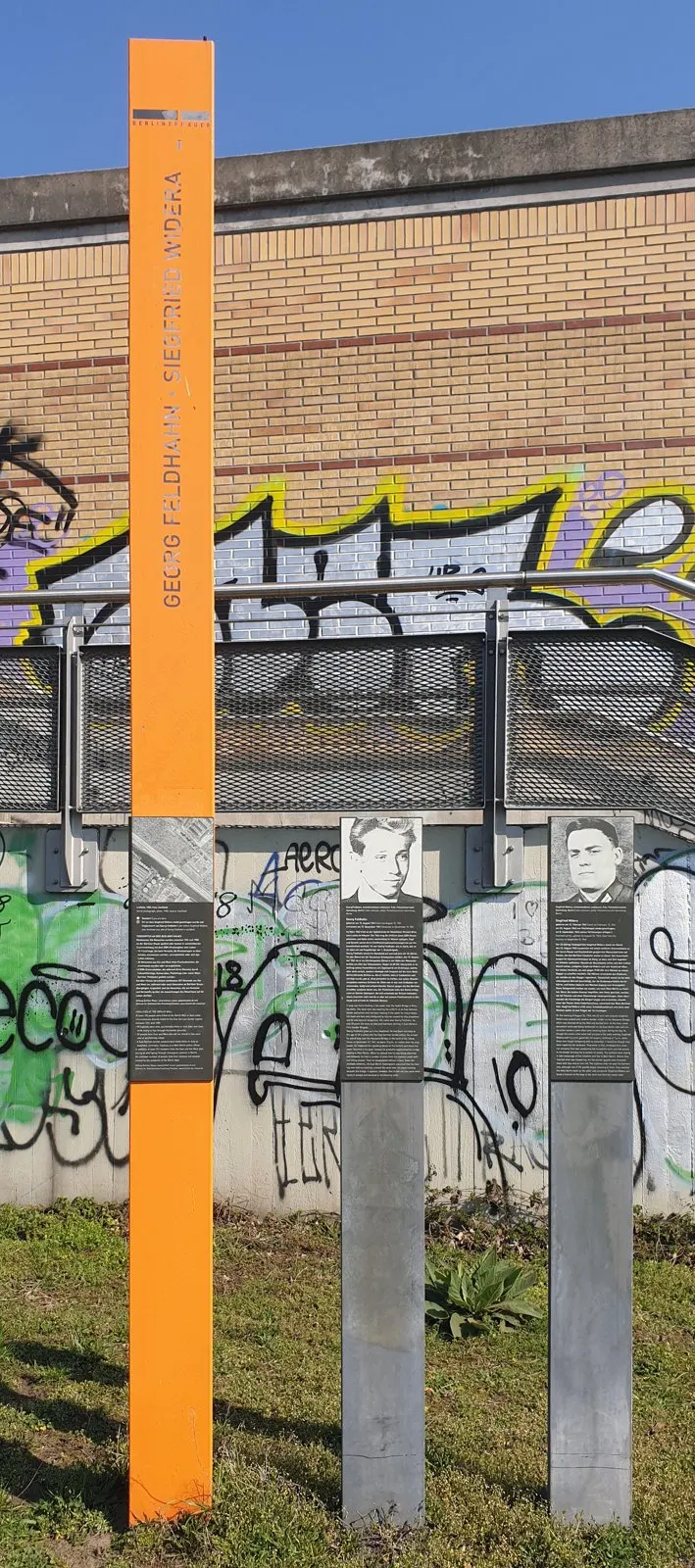
- Memorial steles for Georg Feldhahn and Siegfried Widera at the Massantebrücke. OTFW, Berlin, CC BY-SA 3.0, Wikimedia Commons.
Cite this page
“Georg Feldhahn”, Victims of the Berlin Wall, Berlin Experiences. https://victimsofthewall.com/victims/feldhahn-georg/
Map
The pin position is based on the place of death described in source 1. Base map © OpenStreetMap contributors; course of the Wall in 1989 from Geoportal Berlin (dl-de/zero-2.0). Accessed 23 September 2026.