René Gross
1964–1986
René Gross, a 22-year-old driver from East Berlin, was shot dead on 21 November 1986 near Karpfenteichstrasse when he and Manfred Mäder drove a truck through the border fortifications between Treptow and Neukölln in an attempt to reach West Berlin.
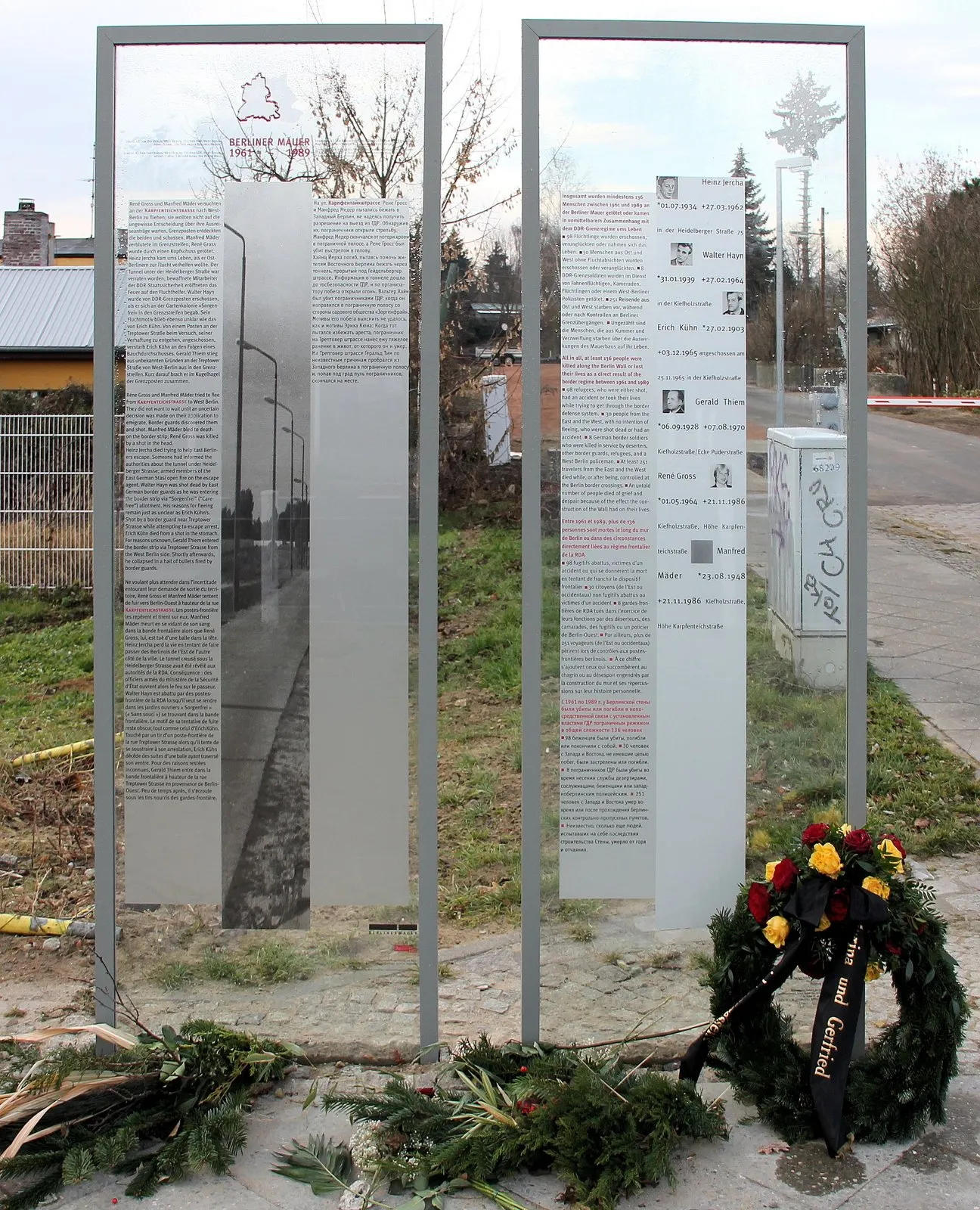
_Jercha_Hayn_K%C3%BChn_Thiem_Gross_M%C3%A4der.jpg)
René Gross was born in East Berlin on 1 May 1964. He worked as a professional driver for the state-owned company "Kühlautomat Berlin" and, according to a Stasi report, made no secret of his rejection of the GDR. He married in 1985, and that same year applied to move to West Germany. Applicants rarely learned whether they would be allowed to go until a final decision had been made, and faced years of uncertainty about their future.
He could not bear to remain at the mercy of the authorities and wanted to decide his own future. But his wife also wanted to decide for herself, and she preferred to stay in the GDR with her six-year-old son. René met 38-year-old Manfred Mäder, who had also applied to leave, and the two agreed to escape to West Berlin ahead of their families. They may have been encouraged by the success of other people they knew who had got to the West.
At midday on 20 November 1986 he told his wife he was going out on an errand and would be back soon. That night the two men stole a W 50 truck with a lifting platform almost as high as the Wall. At about 5 a.m. they drove at speed towards the border between Treptow and Neukölln, broke through a gate in the inner wall and the signal fence, and after a sharp right turn came to a stop parallel to the border at the foot of the concrete wall facing West Berlin. Guards in two watchtowers and others who came running kept up continuous fire until both men lay dead or badly wounded. René Gross, who had given up his escape and taken cover under the truck, was killed by a shot to the head. Manfred Mäder jumped from the truck onto the top of the Wall but was hit in the left thigh, fell back on the eastern side and bled to death.
The soldiers involved were relieved from duty, decorated that same day (among other things with the bronze Merit Medal of the GDR Border Troops) and invited to a banquet. The East German military prosecutor closed the investigation two months later, on the grounds that the fatal injuries were the result of the men's own actions. Given the strong presence on the West Berlin side, where police and customs officers were trying to find out what had happened, the border troops and the Stasi decided, for what they called political-operational reasons, not to examine the scene and removed all traces. The Stasi blocked the public telephone box at the border regiment, made the soldiers sign declarations of secrecy and checked their post, and the widows of both men were placed under surveillance.
That morning René Gross's wife heard on Western radio about a failed escape between Treptow and Neukölln and feared it involved her husband. In the evening, at the police headquarters in Berlin-Mitte, she was told he was dead. There followed a period of interrogation and surveillance by the Stasi, which hoped to learn more about how the escape had been prepared, and the Stasi forbade her to contact Manfred Mäder's widow. René Gross was buried shortly afterwards in the cemetery in Berlin-Mahlsdorf.
No one was ever held to account for his death, even after reunification. Almost 18 years later the Berlin Regional Court convicted the guard who had shot Manfred Mäder of manslaughter and gave him a suspended ten-month prison sentence, but it could not be established who had killed René Gross.
Read more
Also died on the sector border between Berlin-Neukölln and Berlin-Treptow
- Georg Feldhahn 19 December 1961
- Heinz Jercha 27 March 1962
- Wolfgang Glöde 11 June 1962
- Horst Kutscher 15 January 1963
- Siegfried Widera 8 September 1963
- Dieter Berger 13 December 1963
- Walter Hayn 27 February 1964
- Hans-Joachim Wolf 26 November 1964
- Erich Kühn 3 December 1965
- Jörg Hartmann 14 March 1966
- Lothar Schleusener 14 March 1966
- Michael Kollender 25 April 1966
- Max Sahmland 27 January 1967
- Gerald Thiem 7 August 1970
- Christian Peter Friese 25 December 1970
- Werner Kühl 24 July 1971
- Johannes Sprenger 10 May 1974
- Manfred Mäder 21 November 1986
- Lutz Schmidt 12 February 1987
- Chris Gueffroy 5 February 1989
Sources
This profile is a summary written for this site. Every fact in it is taken from source 1, which also gives the full account with archival references.
- Udo Baron, “René Gross”, biography in Chronik der Mauer, Federal Agency for Civic Education, Centre for Contemporary History Potsdam and Deutschlandradio. Accessed 23 September 2026. Read online. Basis for every fact in this profile, including the dates and place of death.
- German version of the same biography. Accessed 23 September 2026. Read online.
- Hans-Hermann Hertle and Maria Nooke (eds.), The Victims at the Berlin Wall, 1961–1989: A Biographical Handbook. Centre for Contemporary History Potsdam and Berlin Wall Foundation, Berlin 2011. The printed handbook from which the online biography is taken.
- Hans-Hermann Hertle and Maria Nooke, “140 Victims at the Berlin Wall, 1961–1989” (list), Centre for Contemporary History Potsdam and Berlin Wall Foundation, August 2017. PDF. Used to cross-check names and dates.
- Hans-Hermann Hertle and Maria Nooke, “The Victims at the Berlin Wall, 1961–1989: Findings of a Research Project”, August 2017. PDF. Source of the classification into escapees, people with no intent to escape, and border soldiers.
Further reading
Image credits
- Memorial on Kiefholzstraße in Berlin-Plänterwald for Heinz Jercha, Walter Hayn, Erich Kühn, Gerald Thiem, René Gross and Manfred Mäder. OTFW, Berlin, CC BY-SA 3.0, Wikimedia Commons.
Cite this page
“René Gross”, Victims of the Berlin Wall, Berlin Experiences. https://victimsofthewall.com/victims/gross-rene/
Map
The pin position is based on the place of death described in source 1. Base map © OpenStreetMap contributors; course of the Wall in 1989 from Geoportal Berlin (dl-de/zero-2.0). Accessed 23 September 2026.