Werner Kühl
1949–1971
Werner Kühl, a 22-year-old garden labourer from West Berlin, was shot dead in the border strip on 24 July 1971 after he and his friend Bernd Langer, who was wounded, had climbed the border fence from Neukölln to reach East Berlin.
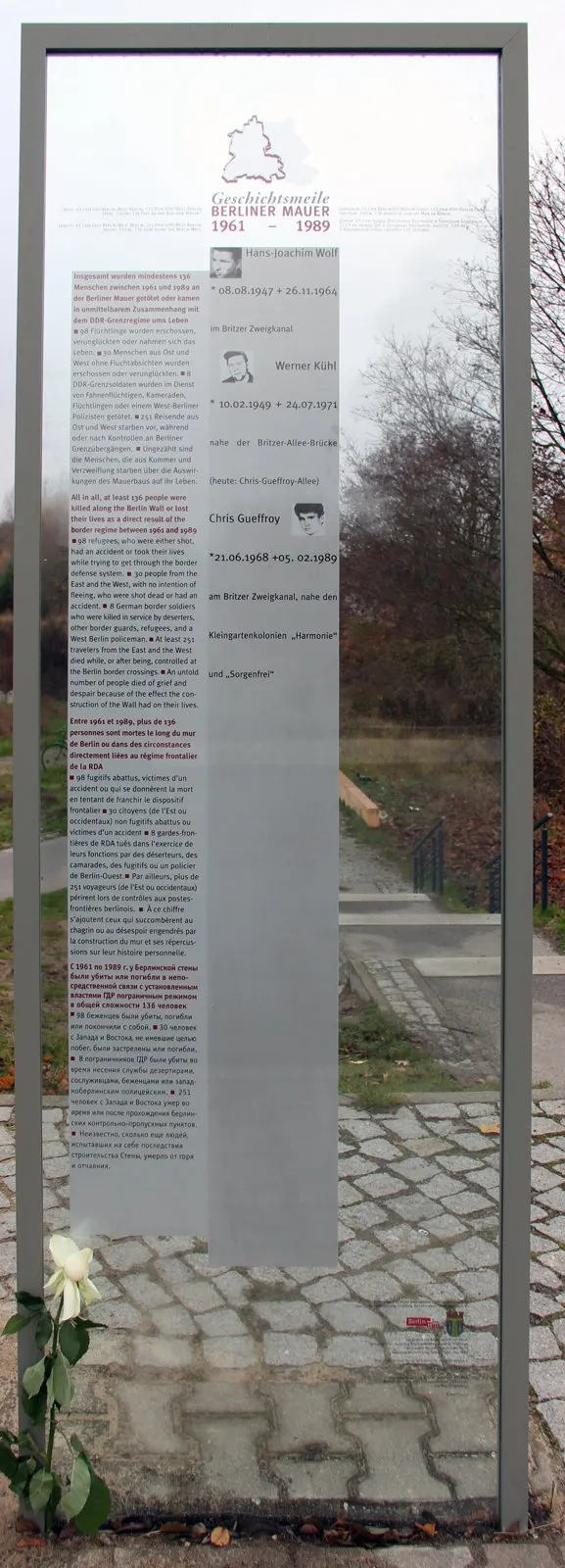
_Wolf_K%C3%BChl_Gueffroy2.jpg)
Werner Kühl was born in West Berlin on 10 February 1949. He left school in 1963 and worked as a garden labourer for various firms. His parents lived apart; he was registered at his father's address, while his mother looked after him. His life was unsettled, with repeated spells without work or a home.
In 1968–69, in a youth welfare hostel, he met Bernd Langer, a young man of the same age who had grown up in East Berlin with his grandmother and moved west to his father in 1966, but longed to go back. Bernd had suffered lasting health problems since a motorcycle accident in childhood. In July 1971 the two found a few days' work as transport workers, lived together in a guesthouse, and often talked of moving to East Germany, where they believed life could be better for them.
On Saturday 24 July 1971, a warm day, they took the S-Bahn to Neukölln with their luggage and walked to the Britzer Zweigkanal, where there was a bathing spot. There Werner proposed, perhaps on the spur of the moment, that they cross the border strip into East Berlin. Bernd objected that it was too dangerous and pointed out they could simply use a crossing point, but let himself be persuaded. They waited by the fence until dark and at around half past ten at night climbed over it, leaving most of their bags behind.
A man in a nearby allotment reported them to a watchtower. Taking them for East Germans trying to flee, the guards opened fire. Bernd Langer was wounded several times. Werner Kühl reached a border gate on the eastern side unhurt but could not open it; as he ran back, a bullet passed through his shoulder and chest and he collapsed at the anti-vehicle trench. His friend crawled to him, called to him and lay down beside him. Werner Kühl bled to death within minutes.
The shooting came during delicate negotiations over Berlin, and both sides used it. Without investigating, the West Berlin police released eyewitness observations to the press, and western media first reported a failed escape by three East Germans stopped by gunfire; East Berlin claimed that two West Berliners had committed a serious border provocation and had been injured, without mentioning a death. Only ten days later did East Germany admit that Werner Kühl had been killed, and the West Berlin police withdrew their account. The Stasi considered inventing evidence against him and, in agreement with the East German prosecutor-general's office, decided to have his body cremated, in its own words to prevent it being misused for political demonstrations in West Berlin.
Bernd Langer was released on 30 August 1971 and handed over to the West Berlin police, together with the urn containing Werner Kühl's ashes. A false death certificate gave the date of death as 26 July 1971. His family buried him in the St. Johannes Cemetery am Nordufer in Berlin-Wedding. The guards had been decorated; in May 2000 one of them was convicted of manslaughter as a co-perpetrator and given a youth sentence of a year and two months, suspended on probation, the other having died.
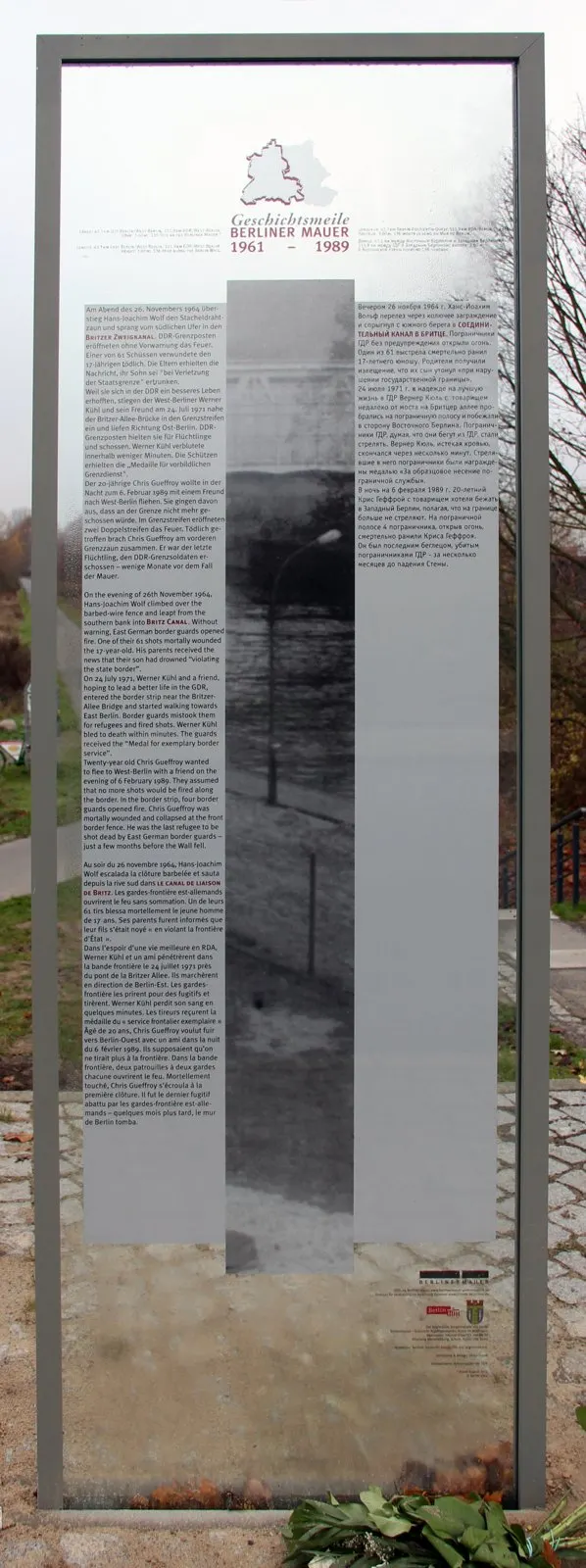
_Wolf_K%C3%BChl_Gueffroy.jpg)
Also died on the sector border between Berlin-Neukölln and Berlin-Treptow
- Georg Feldhahn 19 December 1961
- Heinz Jercha 27 March 1962
- Wolfgang Glöde 11 June 1962
- Horst Kutscher 15 January 1963
- Siegfried Widera 8 September 1963
- Dieter Berger 13 December 1963
- Walter Hayn 27 February 1964
- Hans-Joachim Wolf 26 November 1964
- Erich Kühn 3 December 1965
- Jörg Hartmann 14 March 1966
- Lothar Schleusener 14 March 1966
- Michael Kollender 25 April 1966
- Max Sahmland 27 January 1967
- Gerald Thiem 7 August 1970
- Christian Peter Friese 25 December 1970
- Johannes Sprenger 10 May 1974
- Manfred Mäder 21 November 1986
- René Gross 21 November 1986
- Lutz Schmidt 12 February 1987
- Chris Gueffroy 5 February 1989
Sources
This profile is a summary written for this site. Every fact in it is taken from source 1, which also gives the full account with archival references.
- Martin Ahrends/Udo Baron/Hans-Hermann Hertle, “Werner Kühl”, biography in Chronik der Mauer, Federal Agency for Civic Education, Centre for Contemporary History Potsdam and Deutschlandradio. Accessed 23 September 2026. Read online. Basis for every fact in this profile, including the dates and place of death.
- German version of the same biography. Accessed 23 September 2026. Read online.
- Hans-Hermann Hertle and Maria Nooke (eds.), The Victims at the Berlin Wall, 1961–1989: A Biographical Handbook. Centre for Contemporary History Potsdam and Berlin Wall Foundation, Berlin 2011. The printed handbook from which the online biography is taken.
- Hans-Hermann Hertle and Maria Nooke, “140 Victims at the Berlin Wall, 1961–1989” (list), Centre for Contemporary History Potsdam and Berlin Wall Foundation, August 2017. PDF. Used to cross-check names and dates.
- Hans-Hermann Hertle and Maria Nooke, “The Victims at the Berlin Wall, 1961–1989: Findings of a Research Project”, August 2017. PDF. Source of the classification into escapees, people with no intent to escape, and border soldiers.
Further reading
Image credits
- Memorial panel for Hans-Joachim Wolf, Werner Kühl and Chris Gueffroy at Chris-Gueffroy-Allee 20 in Berlin-Baumschulenweg, photographed in 2014. OTFW, Berlin, CC BY-SA 3.0, Wikimedia Commons.
- Other side of the memorial panel at Chris-Gueffroy-Allee 20, with texts on Hans-Joachim Wolf, Werner Kühl and Chris Gueffroy. OTFW, Berlin, CC BY-SA 3.0, Wikimedia Commons.
Cite this page
“Werner Kühl”, Victims of the Berlin Wall, Berlin Experiences. https://victimsofthewall.com/victims/kuehl-werner/
Map
The pin position is based on the place of death described in source 1. Base map © OpenStreetMap contributors; course of the Wall in 1989 from Geoportal Berlin (dl-de/zero-2.0). Accessed 23 September 2026.