Horst Kutscher
1931–1963
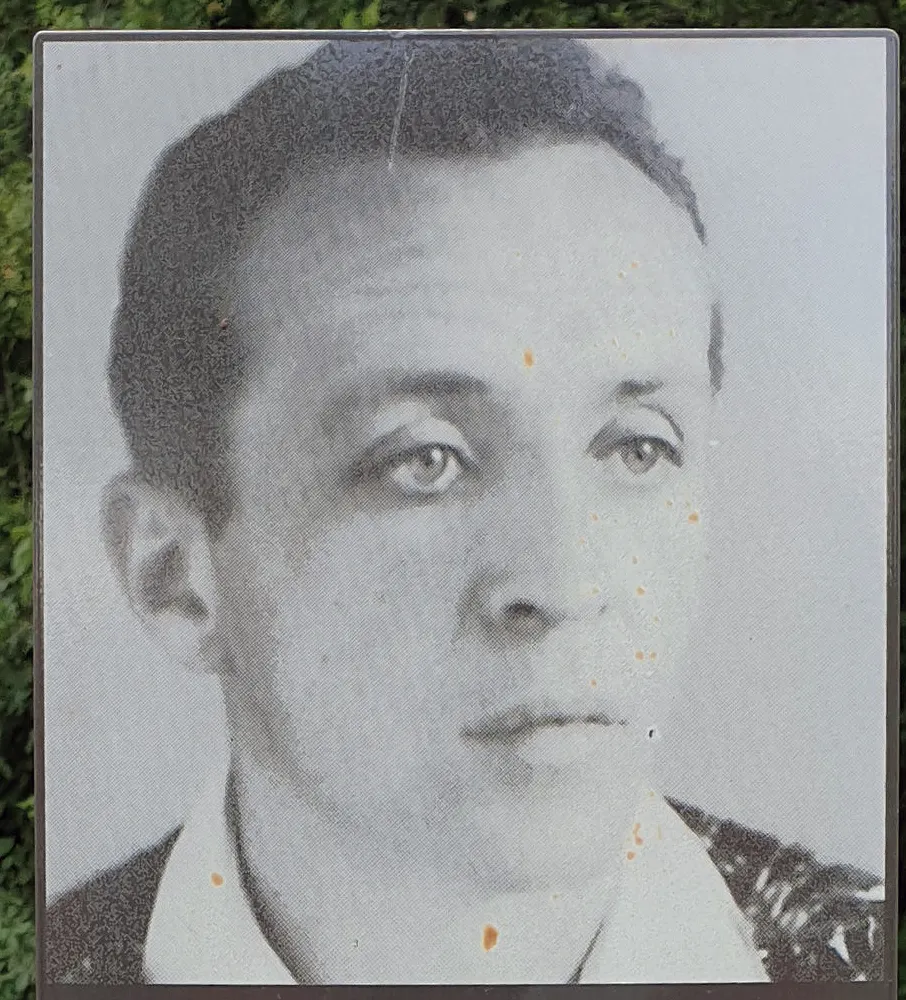
Horst Kutscher, a 31-year-old father of six from Berlin-Treptow who had worked for coal merchants, was shot dead shortly after midnight on 15 January 1963 while crawling towards the border near Rudower Strasse, 25 metres from West Berlin.
_Horst_Kutscher_(cropped).jpg)
Horst Kutscher was born in Berlin-Treptow on 5 July 1931, the youngest of thirteen children of a machine builder who later became a florist, and grew up in Adlershof. By his own account he left school at 14 and began training as a car mechanic, but had to stop after six months for reasons to do with the company. He then worked as a plasterer on building sites and, from September 1954, for coal merchants in the district. In March 1952, aged 21, he married; he and his wife had six children.
From his teenage years he was repeatedly convicted of offences including theft, burglary and assault, and was sentenced to a number of prison terms. In February 1956 the police recruited him as an informant, possibly under pressure, but after two months released him from the arrangement because he missed the agreed meetings and talked openly about it. In April 1956 he fled to West Germany, at first alone; his wife seems to have followed, and their fourth child was born in Bochum. A year later, for unknown reasons, the family moved back to Treptow, and he worked in West Berlin as a cross-border commuter until the border was closed on 13 August 1961.
His long struggle with alcohol led to divorce in November 1962. By then he had been living apart from his family at his father's home for two and a half years. On 14 December 1962 he and a colleague, Joachim F., were sacked from their jobs at a coal merchant's for drinking at work. They went to court, but on 14 January 1963 the Treptow district labour court rejected their claim.
From midday that day the two men tried to drown their disappointment in alcohol and, after several bars, decided to flee to West Berlin that same night. They did not know that, because the Sixth Party Congress of the SED was to begin the next day, more guards had been posted and each had been told to regard preventing any border breach as a personal duty. At about 10 p.m. they went to Semmelweissstrasse to cross the frozen Teltow Canal, but the area was brightly lit. They tried instead along the gardens between the Wrede Bridge and the duck pond at Rudower Strasse, crawling on through the security ditch once the guards had moved away.
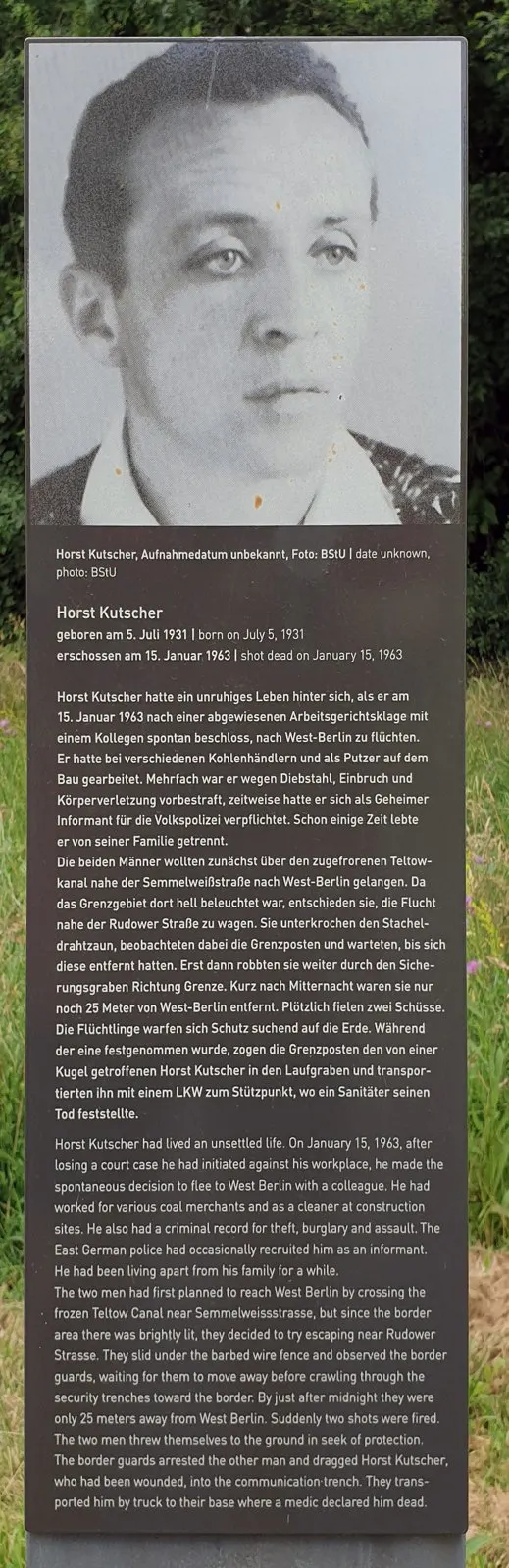
At about ten past midnight, 25 metres from the border, two shots rang out. Both men threw themselves to the ground. Joachim F. was arrested; Horst Kutscher, hit by a bullet, was dragged by the guards into a trench and taken by truck to their base, where a medic pronounced him dead.
The Stasi tried to keep the death secret, but Joachim F. told a fellow prisoner, who later reached West Berlin and informed the police in October 1963. Horst Kutscher's father later told the West Berlin police that he had been allowed neither to see his dead son one last time nor to attend the funeral. His former wife, questioned as a witness after the end of East Germany, recalled that she had found his grave at Baumschulenweg Cemetery only with the help of the cemetery attendant: a nameless grave in which he had been buried with two other dead. On 27 August 1997 the guard who fired the fatal shot was given a suspended sentence of a year and three months.
_Horst_Kutscher.jpg)
_Kutscher_Sprenger3.jpg)
Also died on the sector border between Berlin-Neukölln and Berlin-Treptow
- Georg Feldhahn 19 December 1961
- Heinz Jercha 27 March 1962
- Wolfgang Glöde 11 June 1962
- Siegfried Widera 8 September 1963
- Dieter Berger 13 December 1963
- Walter Hayn 27 February 1964
- Hans-Joachim Wolf 26 November 1964
- Erich Kühn 3 December 1965
- Jörg Hartmann 14 March 1966
- Lothar Schleusener 14 March 1966
- Michael Kollender 25 April 1966
- Max Sahmland 27 January 1967
- Gerald Thiem 7 August 1970
- Christian Peter Friese 25 December 1970
- Werner Kühl 24 July 1971
- Johannes Sprenger 10 May 1974
- Manfred Mäder 21 November 1986
- René Gross 21 November 1986
- Lutz Schmidt 12 February 1987
- Chris Gueffroy 5 February 1989
Sources
This profile is a summary written for this site. Every fact in it is taken from source 1, which also gives the full account with archival references.
- Lydia Dollmann, “Horst Kutscher”, biography in Chronik der Mauer, Federal Agency for Civic Education, Centre for Contemporary History Potsdam and Deutschlandradio. Accessed 23 September 2026. Read online. Basis for every fact in this profile, including the dates and place of death.
- German version of the same biography. Accessed 23 September 2026. Read online.
- Hans-Hermann Hertle and Maria Nooke (eds.), The Victims at the Berlin Wall, 1961–1989: A Biographical Handbook. Centre for Contemporary History Potsdam and Berlin Wall Foundation, Berlin 2011. The printed handbook from which the online biography is taken.
- Hans-Hermann Hertle and Maria Nooke, “140 Victims at the Berlin Wall, 1961–1989” (list), Centre for Contemporary History Potsdam and Berlin Wall Foundation, August 2017. PDF. Used to cross-check names and dates.
- Hans-Hermann Hertle and Maria Nooke, “The Victims at the Berlin Wall, 1961–1989: Findings of a Research Project”, August 2017. PDF. Source of the classification into escapees, people with no intent to escape, and border soldiers.
Further reading
Image credits
- Horst Kutscher; photograph from his memorial panel on the Berliner Mauerweg in Berlin-Altglienicke (date of the original photograph unknown). OTFW, Berlin, CC BY-SA 3.0, Wikimedia Commons.
- Memorial panel for Horst Kutscher on the Berliner Mauerweg in Berlin-Altglienicke, photographed in 2019. OTFW, Berlin, CC BY-SA 3.0, Wikimedia Commons.
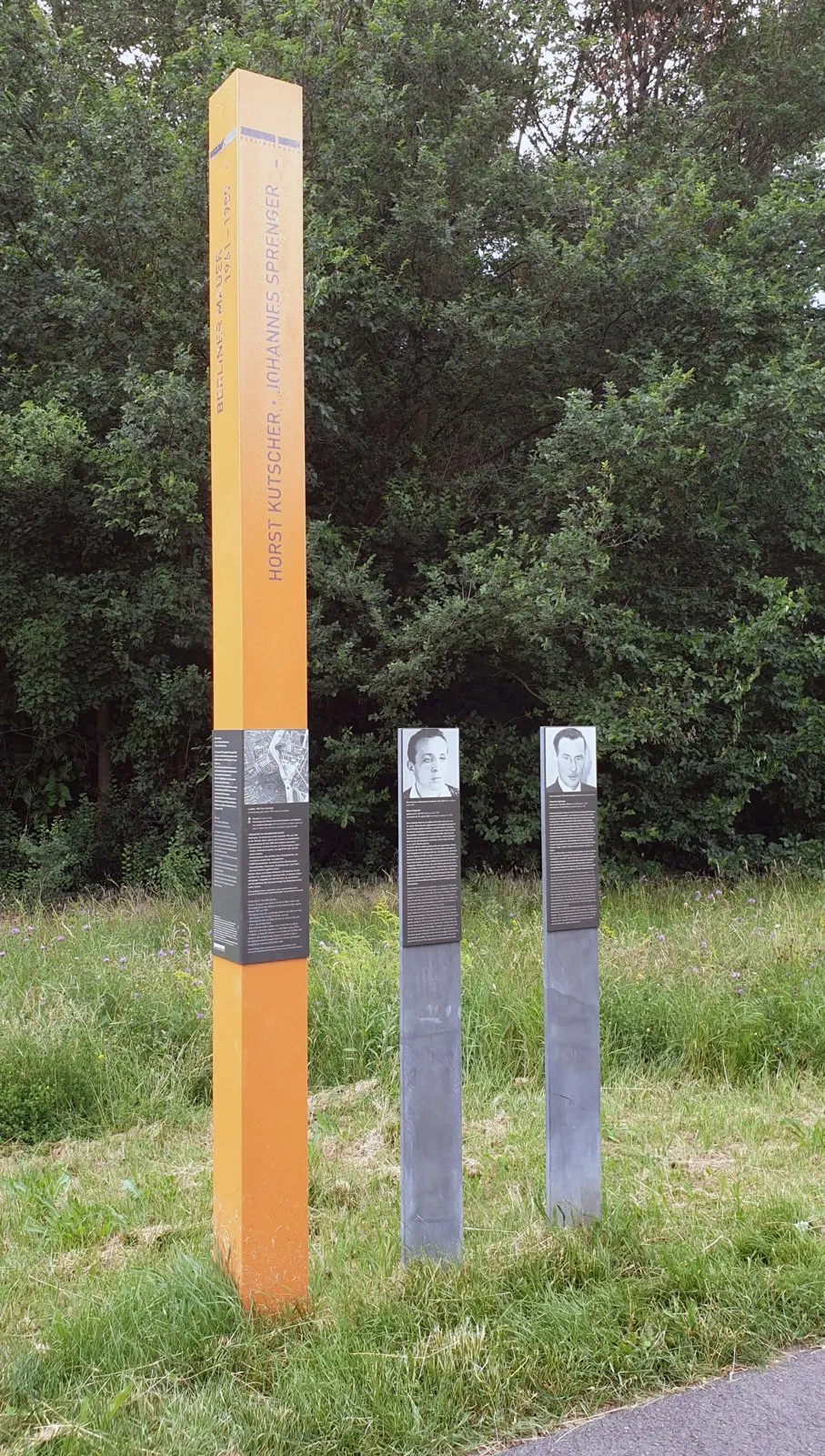
- Memorial for Horst Kutscher and Johannes Sprenger on the Berliner Mauerweg in Berlin-Altglienicke, photographed in 2019. OTFW, Berlin, CC BY-SA 3.0, Wikimedia Commons.
Cite this page
“Horst Kutscher”, Victims of the Berlin Wall, Berlin Experiences. https://victimsofthewall.com/victims/kutscher-horst/
Map
The pin position is based on the place of death described in source 1. Base map © OpenStreetMap contributors; course of the Wall in 1989 from Geoportal Berlin (dl-de/zero-2.0). Accessed 23 September 2026.