Siegfried Widera
1941–1963
Siegfried Widera, a 22-year-old East German border soldier and former lathe operator, was struck down by escaping workers at the Massante Bridge between Treptow and Neukölln on 23 August 1963 and died of his injuries on 8 September 1963.
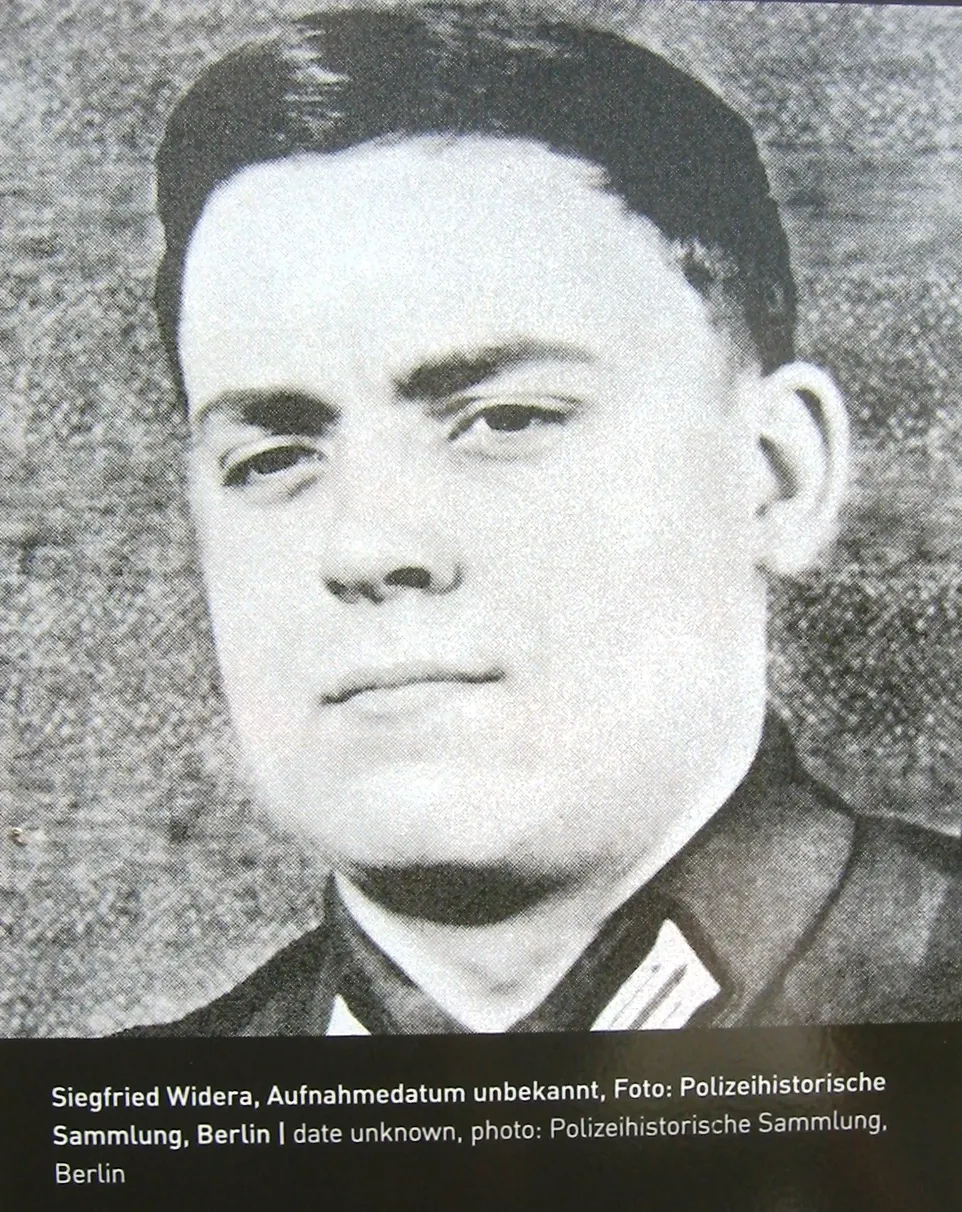

Siegfried Widera was born on 12 February 1941 in Silesia and grew up after the war in the Mansfelder Land, on the edge of the Harz Mountains. He worked as a lathe operator, and according to official reports he joined the border service voluntarily in October 1960. Just weeks before his death he had married, and his wife was expecting a child.
He served as a corporal in the 5th company of Border Regiment 42, which guarded the border between Treptow and Neukölln. On the evening of 23 August 1963, aged 22, he was posted with his junior guard, a lance corporal, at the Massante Bridge, which was closed off by the Wall and barbed wire. Excavation work for sewage pipes was under way on the East Berlin bank of the canal, and workers were often there during the day. At around 7 p.m., although work had stopped early in the evening, three men in work clothes began tinkering with an excavator; the two guards apparently thought nothing of it. The men were employees of the excavation company who had had access to the border area for weeks and hoped to use it to escape.
After talking with the guards, the men decided they had to knock them out to get past. Siegfried Widera and his fellow guard were struck with fists and an iron rod, and the three ran across the bridge and reached West Berlin unhurt despite shots from the second guard. Siegfried Widera had suffered a fracture at the base of his skull. He died on 8 September 1963 in the Köpenick Municipal Hospital, probably without ever regaining consciousness.
East German media blamed his death, without basis, on a West Berlin escape-helper group, and a propaganda version of events was repeated at every commemoration. Internally, however, the border troop leadership concluded that the two guards had disobeyed orders and been too trusting. He was promoted posthumously to sergeant. At a public ceremony in Hettstedt, his widow was handed a letter of condolence from Walter Ulbricht, and he was buried with military honours in Gorenzen, her home town.
In West Germany an investigation was opened against the three men. They said they had never meant to hurt anyone; one said he was deeply distressed that a young man had died because of his actions. The investigation was discontinued in April 1969, as it could not be proven that they had committed intentional or joint manslaughter. After the East German state ceased to exist the case was reopened against the other guard, who had fired despite a concussion, but since it had to be assumed, on the basis of the files, that he had been only half conscious at the time, he was not charged either.
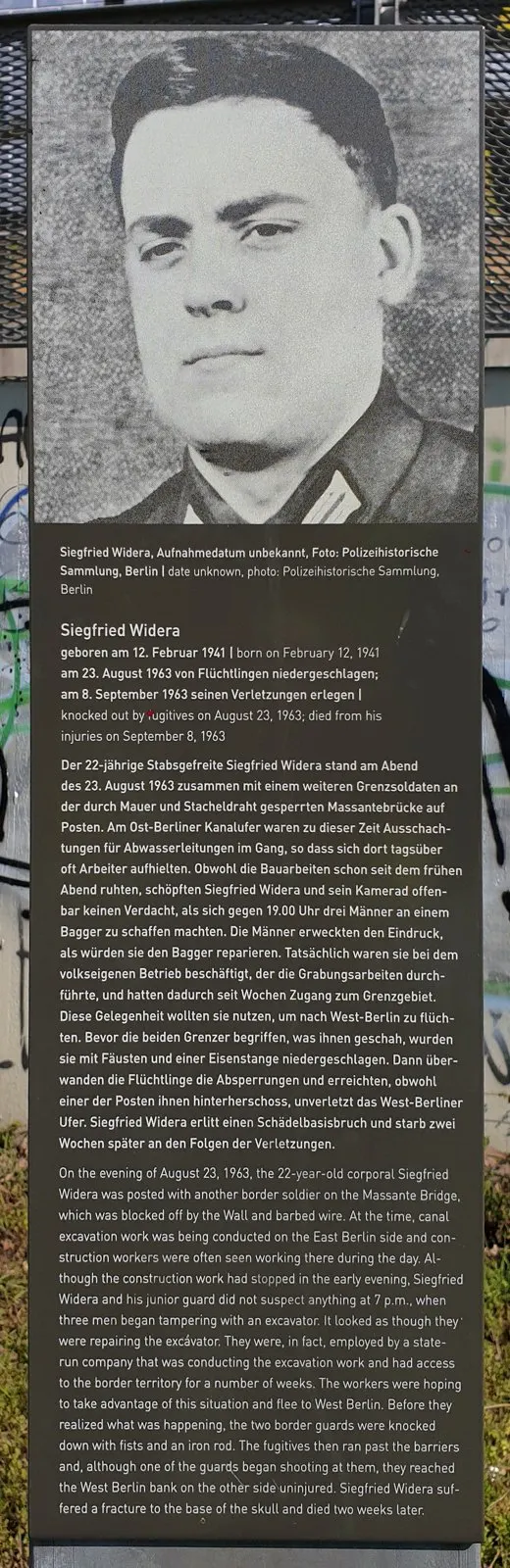
_Siegfried_Widera.jpg)
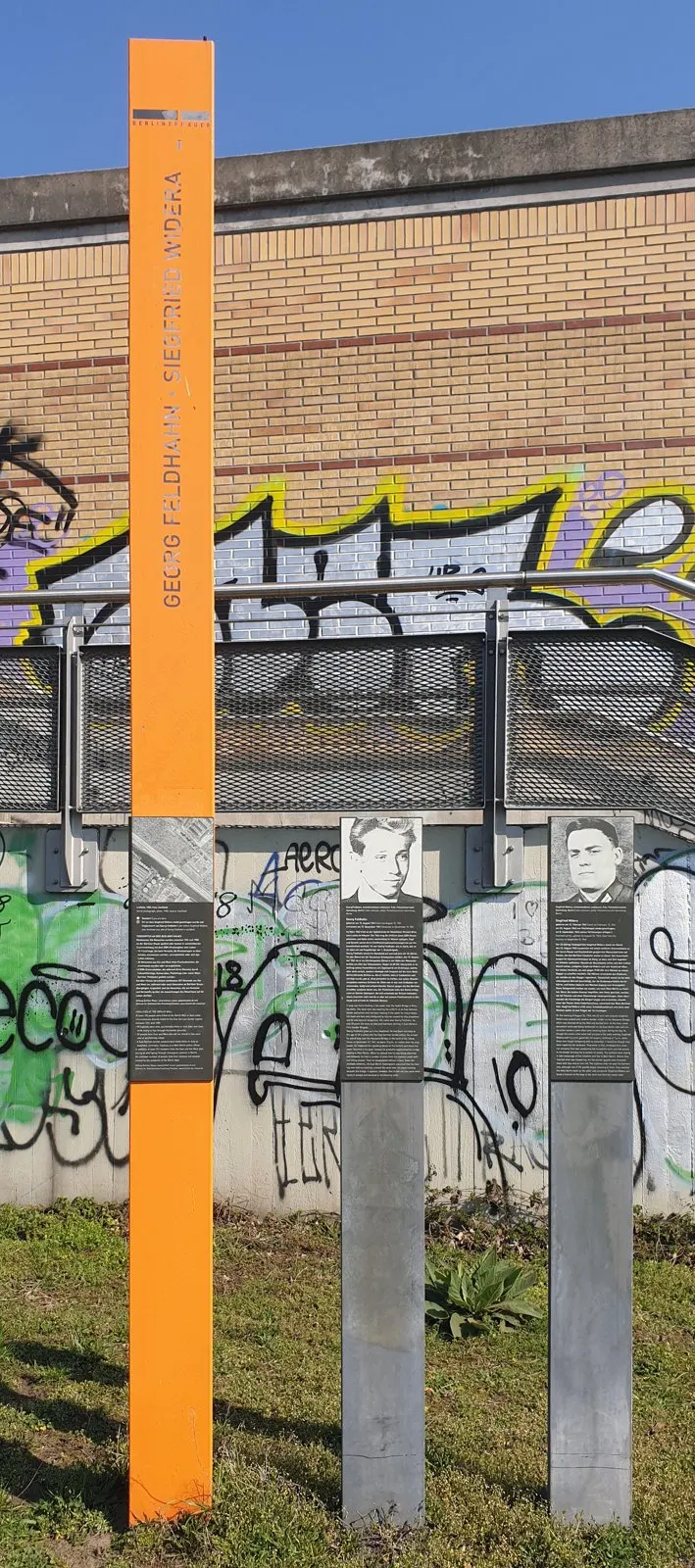
_Feldhahn_Widera.jpg)
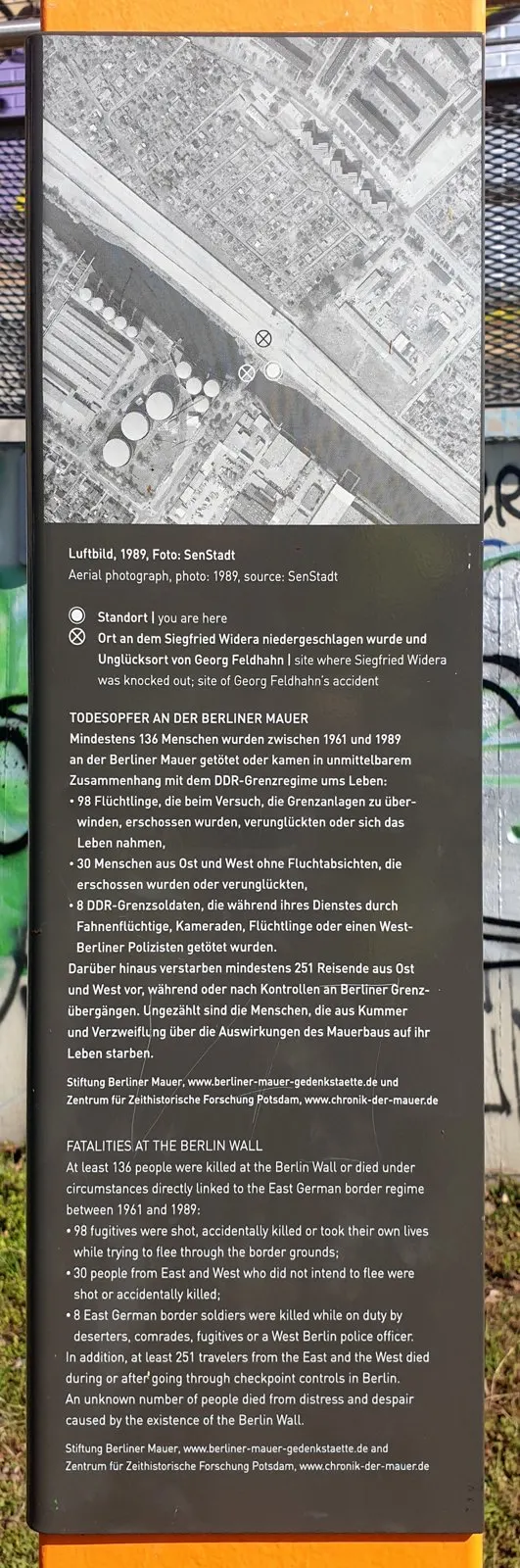
_Feldhahn_Widera.jpg)
Read more
Also died on the sector border between Berlin-Neukölln and Berlin-Treptow
- Georg Feldhahn 19 December 1961
- Heinz Jercha 27 March 1962
- Wolfgang Glöde 11 June 1962
- Horst Kutscher 15 January 1963
- Dieter Berger 13 December 1963
- Walter Hayn 27 February 1964
- Hans-Joachim Wolf 26 November 1964
- Erich Kühn 3 December 1965
- Jörg Hartmann 14 March 1966
- Lothar Schleusener 14 March 1966
- Michael Kollender 25 April 1966
- Max Sahmland 27 January 1967
- Gerald Thiem 7 August 1970
- Christian Peter Friese 25 December 1970
- Werner Kühl 24 July 1971
- Johannes Sprenger 10 May 1974
- Manfred Mäder 21 November 1986
- René Gross 21 November 1986
- Lutz Schmidt 12 February 1987
- Chris Gueffroy 5 February 1989
Sources
This profile is a summary written for this site. Every fact in it is taken from source 1, which also gives the full account with archival references.
- Christine Brecht, “Siegfried Widera”, biography in Chronik der Mauer, Federal Agency for Civic Education, Centre for Contemporary History Potsdam and Deutschlandradio. Accessed 23 September 2026. Read online. Basis for every fact in this profile, including the dates and place of death.
- German version of the same biography. Accessed 23 September 2026. Read online.
- Hans-Hermann Hertle and Maria Nooke (eds.), The Victims at the Berlin Wall, 1961–1989: A Biographical Handbook. Centre for Contemporary History Potsdam and Berlin Wall Foundation, Berlin 2011. The printed handbook from which the online biography is taken.
- Hans-Hermann Hertle and Maria Nooke, “140 Victims at the Berlin Wall, 1961–1989” (list), Centre for Contemporary History Potsdam and Berlin Wall Foundation, August 2017. PDF. Used to cross-check names and dates.
- Hans-Hermann Hertle and Maria Nooke, “The Victims at the Berlin Wall, 1961–1989: Findings of a Research Project”, August 2017. PDF. Source of the classification into escapees, people with no intent to escape, and border soldiers.
Further reading
Image credits
- Siegfried Widera in uniform; photograph on his memorial stele near the Massantebrücke in Berlin-Baumschulenweg (date of the original photograph unknown). Assenmacher, CC BY-SA 3.0, Wikimedia Commons.
- Memorial panel for Siegfried Widera at the Massantebrücke in Berlin-Johannisthal, photographed in 2019. OTFW, Berlin, CC BY-SA 3.0, Wikimedia Commons.
- Memorial steles for Georg Feldhahn and Siegfried Widera at the Massantebrücke in Berlin-Johannisthal, photographed in 2019. OTFW, Berlin, CC BY-SA 3.0, Wikimedia Commons.
- Map panel at the Massantebrücke marking the site where Siegfried Widera was knocked down, Berlin-Johannisthal. OTFW, Berlin, CC BY-SA 3.0, Wikimedia Commons.
Cite this page
“Siegfried Widera”, Victims of the Berlin Wall, Berlin Experiences. https://victimsofthewall.com/victims/widera-siegfried/
Map
The pin position is based on the place of death described in source 1. Base map © OpenStreetMap contributors; course of the Wall in 1989 from Geoportal Berlin (dl-de/zero-2.0). Accessed 23 September 2026.