Klaus Schröter
1940–1963
Klaus Schröter, a 23-year-old electrical engineer working in East Berlin, was shot at by border guards while diving under the Spree near the Reichstag building in scuba gear; a bullet grazed his head and he drowned. He died on 4 November 1963.
_wei%C3%9Fe_Kreuze.jpg)
Klaus Schröter was born on 21 February 1940 in Friedersdorf near Bitterfeld and grew up there with two brothers. His parents had a small house on a housing estate, which in East German times had to make way for lignite mining. Drawn to technology from an early age, he trained as an electrician at the Agfa film factory in nearby Wolfen. At 18 he was sent by the firm to study electrical engineering at the engineering school in Velten, in Brandenburg, named after Hanno Günther.
In September 1961, a few weeks after the Wall was built, he began work as an electrical engineer at the state-owned heavy current plant on Schlegelstrasse in Berlin-Mitte. His career went well: he started a further degree and taught on the side at Pankow's adult education centre. In April 1963, disappointed that his firm would not let him make a change of job he had hoped for, he handed in his notice, but the management refused to accept it and forced him to withdraw it. Friends and colleagues believed this pushed him to act on a plan to escape that he had long been considering. His mother said he never hid his rejection of the SED and its regime from her.
He prepared with great care and told no one the details. A friend he visited the evening before later recalled knowing that he meant to flee at some point, but not that it would be the following night; Klaus had not wanted to tell him the exact date, the friend said, so as not to get him into trouble. He planned a route under the water of the Spree, sold his television to buy scuba equipment, had compressed air tanks delivered to his flat and sewed his own diving suit, weighted with lead.
Before sunrise he cycled with his equipment to Mitte and left his bicycle on the Marschall Bridge, which crosses the Spree between Reichstagsufer and Schiffbauerdamm close to the sector border. Beneath the bridge he cut through the barbed wire, went down the steps in the embankment and entered the river. A guard in the watchtower at the corner of Reichstagsufer and Ebertstrasse saw him, and he and two other guards fired as soon as he dived. A bullet grazed the back of his head; he lost consciousness and drowned. His body was recovered after a long search at around 7.45 a.m., while an East Berlin fire boat hung out a curtain of water to screen the scene from the western bank.
East Germany denied that he had been shot. A Stasi officer, posing as a state prosecutor, told his mother he had drowned after a brain contusion and pressed her to agree to cremation. At his workplace, a meeting was organised to stop rumours of a shooting, but his colleagues did not believe the official version; they had heard on West Berlin radio of shots on the Reichstagsufer that morning. His mother, who was also told that wearing black was no longer the fashion, later said that she had worn mourning clothes for a whole year as an act of opposition.
Despite the intimidation, friends and colleagues travelled to Friedersdorf for his funeral on 14 December 1963, where the urn was buried in his father's grave. The minister did not mention how he had died, but chose as the text for his sermon a verse from the Epistle to the Romans. Some thirty years later the truth came out, and in 1994 the guards were brought to court. They denied guilt, saying they had fired into the water without aiming so as not to be punished for refusing orders, but the judges found it proven that at least one of them had acted with conditional intent to kill, and convicted him of manslaughter.
_Maueropfer.JPG)
Also died on the sector border between Berlin-Mitte and Berlin-Tiergarten
- Günter Litfin 24 August 1961
- Ingo Krüger 11 December 1961
- Peter Göring 23 May 1962
- Lutz Haberlandt 27 May 1962
- Axel Hannemann 5 June 1962
- Walter Heike 22 June 1964
- Heinz Sokolowski 25 November 1965
- Paul Stretz 29 April 1966
- Heinz Schmidt 29 August 1966
- Elke Weckeiser 18 February 1968
- Dieter Weckeiser 19 February 1968
- Siegfried Krug 6 July 1968
- Dieter Beilig 2 October 1971
- Manfred Gertzki 27 April 1973
- Henri Weise Probably May 1977
Sources
This profile is a summary written for this site. Every fact in it is taken from source 1, which also gives the full account with archival references.
- Christine Brecht, “Klaus Schröter”, biography in Chronik der Mauer, Federal Agency for Civic Education, Centre for Contemporary History Potsdam and Deutschlandradio. Accessed 23 September 2026. Read online. Basis for every fact in this profile, including the dates and place of death.
- German version of the same biography. Accessed 23 September 2026. Read online.
- Hans-Hermann Hertle and Maria Nooke (eds.), The Victims at the Berlin Wall, 1961–1989: A Biographical Handbook. Centre for Contemporary History Potsdam and Berlin Wall Foundation, Berlin 2011. The printed handbook from which the online biography is taken.
- Hans-Hermann Hertle and Maria Nooke, “140 Victims at the Berlin Wall, 1961–1989” (list), Centre for Contemporary History Potsdam and Berlin Wall Foundation, August 2017. PDF. Used to cross-check names and dates.
- Hans-Hermann Hertle and Maria Nooke, “The Victims at the Berlin Wall, 1961–1989: Findings of a Research Project”, August 2017. PDF. Source of the classification into escapees, people with no intent to escape, and border soldiers.
Further reading
Image credits
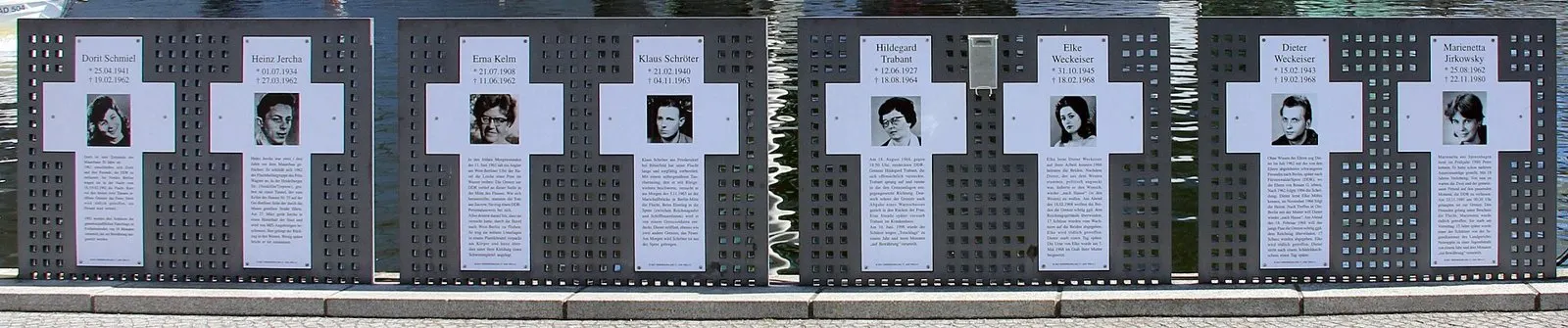
- The 'White Crosses' memorial for victims of the Berlin Wall, with a cross for Klaus Schröter bearing his photograph and dates. OTFW, Berlin, CC BY-SA 3.0, Wikimedia Commons.
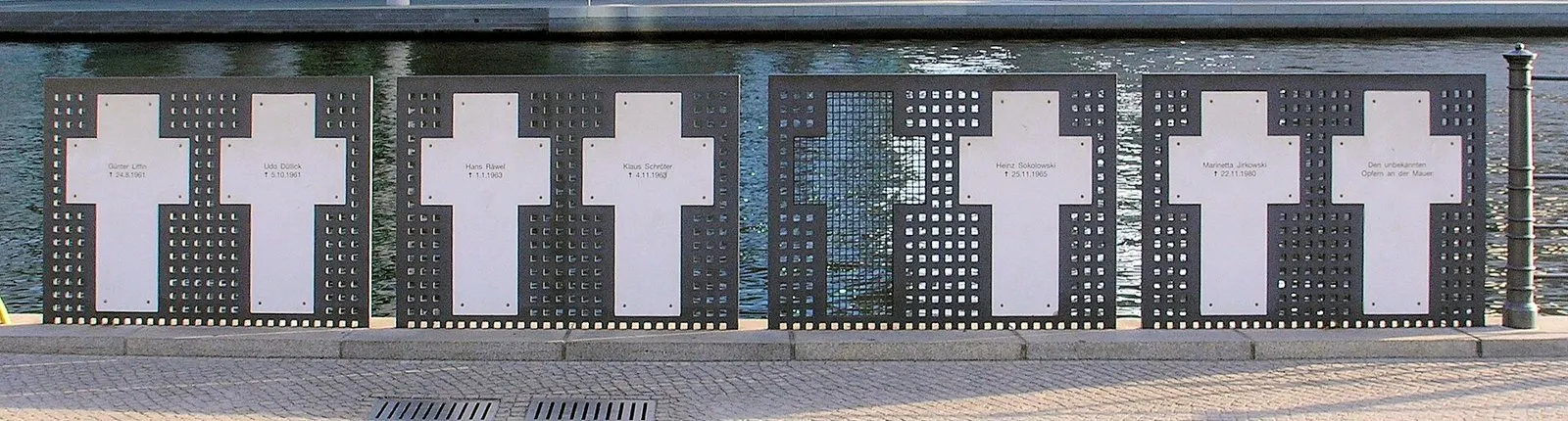
- White crosses for victims of the Berlin Wall at the Reichstagsufer in Berlin-Tiergarten, including one for Klaus Schröter, photographed in 2009. OTFW, Berlin, CC BY-SA 3.0, Wikimedia Commons.
Cite this page
“Klaus Schröter”, Victims of the Berlin Wall, Berlin Experiences. https://victimsofthewall.com/victims/schroeter-klaus/
Map
The pin position is based on the place of death described in source 1. Base map © OpenStreetMap contributors; course of the Wall in 1989 from Geoportal Berlin (dl-de/zero-2.0). Accessed 23 September 2026.