Axel Hannemann
1945–1962
Axel Hannemann, a 17-year-old from Cottbus, was shot dead on 5 June 1962 while swimming across the Spree towards the West Berlin bank behind the Reichstag building, after a barge captain refused to take him to the West.
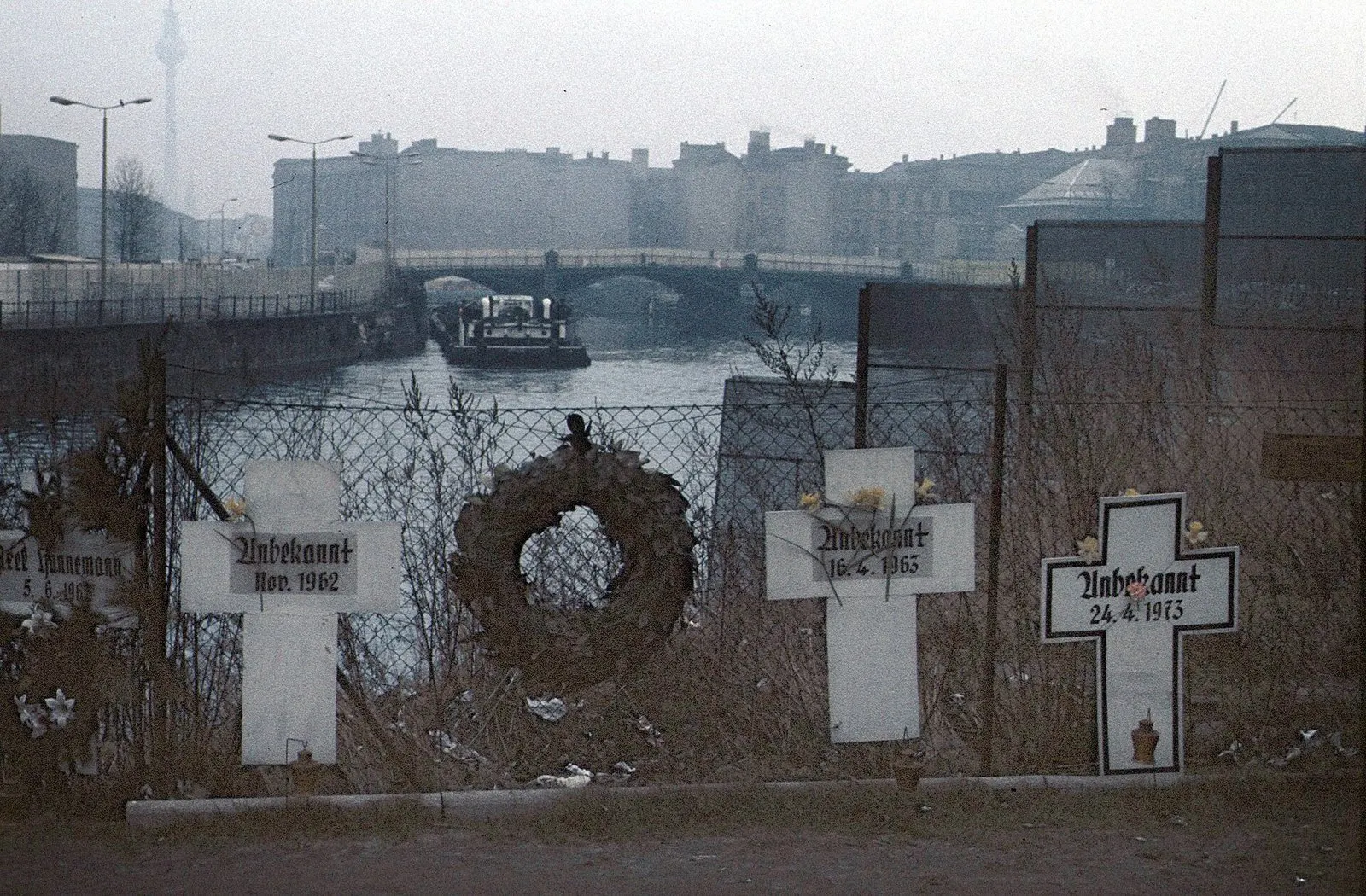

Axel Hannemann was born in Buchhain in Lusatia in April 1945, a few days before the war in Europe ended. He grew up with three older siblings in nearby Cottbus, where his father worked in a department store. At 17 he was still living with his parents and was serving an apprenticeship. His mother later wrote that the news of his death came completely unexpectedly and caused his parents and siblings deep pain.
His family had not known he meant to leave, nor why. His elder brother Wolfgang later said he did not think the reasons were political, but that Axel had simply wanted a better and different life. Another brother, Jürgen, thought he might have been heading for their grandparents' home in West Berlin. In a farewell note Axel asked his family to understand this unannounced step; he wrote that he had no other way out, promising to explain once he had made it, and adding that he had done nothing wrong.
On 5 June 1962 he travelled by train from Cottbus to East Berlin and made his way to the Marschall Bridge, close to where the sector border crossed the Spree. There East German customs inspected cargo boats that were allowed to pass through West Berlin on their way to the surrounding area. At a quarter past five in the afternoon he jumped from the bridge onto a barge that had already been cleared and was heading west, but the captain would not take him, stopped the boat and alerted the customs officers and border guards. Axel broke free from the captain after a struggle, jumped into the river and swam for the West Berlin bank. Two border policemen fired at him from close range. Only metres from the bank he was hit and went under. According to the post-mortem report he had been shot through the skull; how many bullets hit him could not be established with certainty.
East Berlin firemen recovered his body two hours later, directly behind the Reichstag building, which stood in West Berlin. West Berlin police and journalists photographed the recovery. The East German authorities looked into his background hoping to find something they could use, but there seemed to be nothing against him: the report from Cottbus said he was no layabout, had not come to the attention of the police and had attended dancing lessons. Even so, the interior minister issued a statement calling him a criminal who had tried to force his way through the border.
In West Berlin, the police and public prosecutor opened an investigation into the guards who had fired, and the police chief offered a reward of 3,000 German marks for information leading to the identification of the culprit. Wanted posters were hung along the Wall where the guards could see them, as a reminder that they might one day have to answer for shooting fugitives.
It was some thirty years before the guards could be prosecuted. By then the former guard leader, to whom the fatal shots could be clearly attributed, had died. Because the second guard had also fired aimed shots, a court found him guilty of joint manslaughter in September 1993; his two-year prison sentence was suspended on probation.
Read more
Also died on the sector border between Berlin-Mitte and Berlin-Tiergarten
- Günter Litfin 24 August 1961
- Ingo Krüger 11 December 1961
- Peter Göring 23 May 1962
- Lutz Haberlandt 27 May 1962
- Klaus Schröter 4 November 1963
- Walter Heike 22 June 1964
- Heinz Sokolowski 25 November 1965
- Paul Stretz 29 April 1966
- Heinz Schmidt 29 August 1966
- Elke Weckeiser 18 February 1968
- Dieter Weckeiser 19 February 1968
- Siegfried Krug 6 July 1968
- Dieter Beilig 2 October 1971
- Manfred Gertzki 27 April 1973
- Henri Weise Probably May 1977
Sources
This profile is a summary written for this site. Every fact in it is taken from source 1, which also gives the full account with archival references.
- Christine Brecht, “Axel Hannemann”, biography in Chronik der Mauer, Federal Agency for Civic Education, Centre for Contemporary History Potsdam and Deutschlandradio. Accessed 23 September 2026. Read online. Basis for every fact in this profile, including the dates and place of death.
- German version of the same biography. Accessed 23 September 2026. Read online.
- Hans-Hermann Hertle and Maria Nooke (eds.), The Victims at the Berlin Wall, 1961–1989: A Biographical Handbook. Centre for Contemporary History Potsdam and Berlin Wall Foundation, Berlin 2011. The printed handbook from which the online biography is taken.
- Hans-Hermann Hertle and Maria Nooke, “140 Victims at the Berlin Wall, 1961–1989” (list), Centre for Contemporary History Potsdam and Berlin Wall Foundation, August 2017. PDF. Used to cross-check names and dates.
- Hans-Hermann Hertle and Maria Nooke, “The Victims at the Berlin Wall, 1961–1989: Findings of a Research Project”, August 2017. PDF. Source of the classification into escapees, people with no intent to escape, and border soldiers.
Further reading
Image credits
- White crosses in memory of Berlin Wall victims by the Reichstag building, January 1974; the cross for Axel Hannemann is at the left edge. Andreas Schwarzkopf, CC BY-SA 3.0, Wikimedia Commons.
Cite this page
“Axel Hannemann”, Victims of the Berlin Wall, Berlin Experiences. https://victimsofthewall.com/victims/hannemann-axel/
Map
The pin position is based on the place of death described in source 1. Base map © OpenStreetMap contributors; course of the Wall in 1989 from Geoportal Berlin (dl-de/zero-2.0). Accessed 23 September 2026.