Dieter Weckeiser
1943–1968
Dieter Weckeiser, 25, and his wife Elke, 22, were shot from an East German border watchtower on 18 February 1968 while trying to escape across the Spree opposite the Reichstag building; Elke died that night and Dieter the following day.

Dieter Weckeiser was born on 15 February 1943 in Rhodebach, East Prussia. His father fell on the eastern front that same year, and much of his childhood was spent on the move: his mother fled with him to Elbing in 1944 and westward again in January 1945, and after a few years in the Soviet zone they reached West Germany in 1949, living in refugee centres and shelters. Only in 1954, when his mother remarried, did they settle in Warendorf, Westphalia. As a boy he had tuberculosis, and at seven he spent six months in a sanatorium where his mother could not visit him.
He trained as a furniture upholsterer and met a young woman who had come to Warendorf from East Germany in 1961. His mother and stepfather opposed the relationship, and in July 1962 the couple, she by then pregnant, left for West Berlin without telling them. Unable to establish themselves there, they moved at her urging to Fürstenwalde/Spree in East Germany, where they married and had three children. He worked in several jobs, among them interior decorator and co-driver. The marriage ended in divorce in 1966, and soon afterwards he became seriously ill.
Elke Möbis was born on 31 October 1945; an East German army report on the shooting gives her birthplace as Lebus. After an apprenticeship as a textile twister she worked as a kitchen assistant in a company canteen in Fürstenwalde. She met Dieter at about the time of his divorce and illness, when she was 20. They married in late November 1966. The following year Dieter saw his mother again for the first time since leaving Warendorf, meeting her daily for a week in East Berlin, since she was not allowed to travel to Fürstenwalde and came over from West Berlin on day visas. According to what his mother told a court in 1997, he said that he had run into political trouble after drawing on his own experience of the West to challenge the official picture of West Germany, and that he wished to come home to the West.
On the near-freezing evening of 18 February 1968, the couple tried to escape across the heavily guarded Spree in the city centre, diagonally opposite the Reichstag building. They would have had to pass barbed wire and a dog run, climb a three-metre fence, swim the icy river and haul themselves up the wall of the western bank. At about 11 p.m., as they crawled through the first barbed-wire fence, they were spotted from a watchtower and fired on without a challenge; seventeen shots were fired at them from the tower. Elke was hit in the chest and thigh, and Dieter in the head. Elke died that night in the People's Police Hospital; Dieter died the next day after emergency surgery.
To hide what had happened, the Stasi planned a cover story and a deliberate campaign to damage the couple's reputation. It even decided to pay Dieter's debts from state funds so creditors would not ask questions, told his former wife that the couple had died in an accident in a stolen car, and monitored, and in some cases confiscated, the relatives' mail. His mother, whose enquiries to the East German police were in vain, learned only a year later, through direct contact between the pastors of her home town in the West and of Fürstenwalde in the East, that her son had died trying to escape. Elke's urn was buried in her mother's grave in Fürstenwalde on 7 May 1968, after her half-sister had been required to assure the Stasi that she would forgo a ceremonial burial and a notice in the press. Dieter's urn was withheld from his family and buried at the Baumschulenweg Cemetery in Berlin-Treptow.
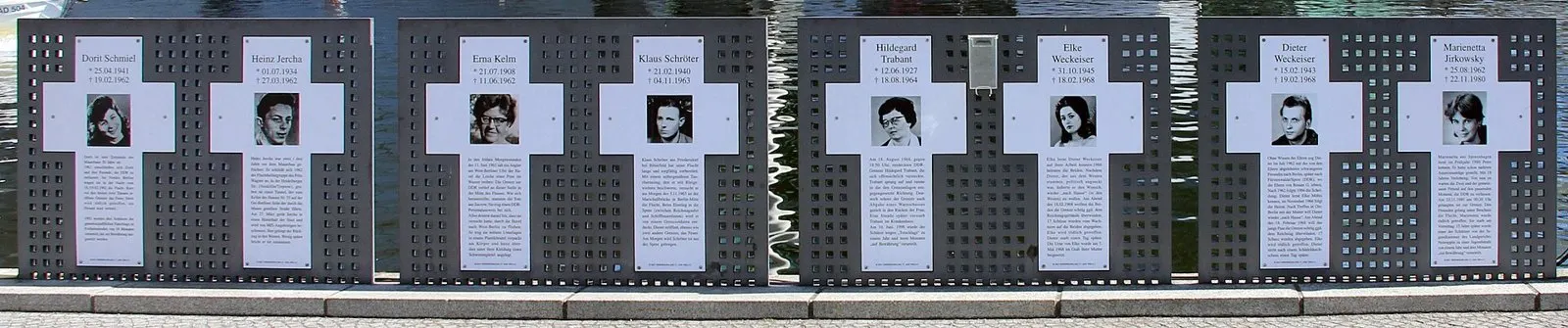
The guards were commended and awarded the Medal for Exemplary Border Service at the time, and one was promoted early. Thirty years later they were brought before the Berlin Regional Court. Most of the officers and soldiers stationed at the border had already told police that, objectively, the shooting had not been necessary. In 1997 the guard who had fired was given a suspended sentence of one year and nine months, the court treating the killing as manslaughter of a less serious kind; his superior was acquitted. Elke and Dieter Weckeiser are both named on the White Crosses memorial on the bank of the Spree near the Reichstag building.
Dieter Weckeiser died together with Elke Weckeiser. Their story is told on both profiles.
Read more
Also died on the sector border between Berlin-Mitte and Berlin-Tiergarten
- Günter Litfin 24 August 1961
- Ingo Krüger 11 December 1961
- Peter Göring 23 May 1962
- Lutz Haberlandt 27 May 1962
- Axel Hannemann 5 June 1962
- Klaus Schröter 4 November 1963
- Walter Heike 22 June 1964
- Heinz Sokolowski 25 November 1965
- Paul Stretz 29 April 1966
- Heinz Schmidt 29 August 1966
- Siegfried Krug 6 July 1968
- Dieter Beilig 2 October 1971
- Manfred Gertzki 27 April 1973
- Henri Weise Probably May 1977
Sources
This profile is a summary written for this site from the biography in source 1, which also gives the full account with archival references. Facts taken from other sources are listed below with what they support.
- Martin Ahrends/Udo Baron, “Dieter Weckeiser and Elke Weckeiser”, biography in Chronik der Mauer, Federal Agency for Civic Education, Centre for Contemporary History Potsdam and Deutschlandradio. Accessed 23 September 2026. Read online. The biography from which this profile was written, and the source of the dates and place of death.
- German version of the same biography. Accessed 23 September 2026. Read online.
- Report of the East Berlin city commandant of the National People's Army to Erich Honecker on the escape attempt of Elke and Dieter Weckeiser, 19 February 1968 (BArch, VA-07/8374, Bl. 38/39), transcription on Chronik der Mauer. Accessed 5 October 2026. Read online. Source for: the time and place of the shooting, the couple's dates of birth, trades and home town, Elke's birthplace, and the commendation of the guards.
- Letter from the Protestant pastor of Fürstenwalde/Spree to his fellow pastor in Warendorf, 22 January 1969 (private collection), transcription on Chronik der Mauer. Accessed 5 October 2026. Read online. Source for: how Dieter's mother learned of their deaths a year later, Elke's burial in Fürstenwalde, and that Dieter's urn was probably in Berlin-Treptow.
- White Crosses memorial on the Spree bank east of the Reichstag building, crosses for Elke and Dieter Weckeiser; photograph by OTFW, Berlin, 8 August 2022, Wikimedia Commons (CC BY-SA 3.0). Accessed 5 October 2026. Read online. Source for: both are named on the White Crosses, with their dates of death.
- Hans-Hermann Hertle and Maria Nooke (eds.), The Victims at the Berlin Wall, 1961–1989: A Biographical Handbook. Centre for Contemporary History Potsdam and Berlin Wall Foundation, Berlin 2011. The printed handbook from which the online biography is taken.
- Hans-Hermann Hertle and Maria Nooke, “140 Victims at the Berlin Wall, 1961–1989” (list), Centre for Contemporary History Potsdam and Berlin Wall Foundation, August 2017. PDF. Used to cross-check names and dates.
- Hans-Hermann Hertle and Maria Nooke, “The Victims at the Berlin Wall, 1961–1989: Findings of a Research Project”, August 2017. PDF. Source of the classification into escapees, people with no intent to escape, and border soldiers.
Corrections
This profile was corrected on 24 and 28 September and 3 and 5 October 2026. Each round of corrections is described in the corrections log:
-
: Court outcomes checked against the German originals
- Corrected the name of the court: the Berlin Regional Court (Landgericht Berlin), not the “Berlin district court”.
- Corrected the sentence: a suspended sentence of one year and nine months, not “a probation term” of that length.
- : All profiles and articles cross-checked against the German originals
- : Every profile checked against all the sources
- : Independent sources added for the other 88 profiles
Further reading
Image credits
- White memorial crosses for victims of the Berlin Wall on Friedrich-Ebert-Platz in Berlin, including those for Dieter and Elke Weckeiser, photographed in 2022. OTFW, Berlin, CC BY-SA 3.0, Wikimedia Commons.
Cite this page
“Dieter Weckeiser”, Victims of the Berlin Wall, Berlin Experiences. https://victimsofthewall.com/victims/weckeiser-dieter/
Map
The pin position is based on the place of death described in source 1. Base map © OpenStreetMap contributors; course of the Wall in 1989 from Geoportal Berlin (dl-de/zero-2.0). Accessed 23 September 2026.