Was There a Shoot-to-Kill Order at the Berlin Wall?
East Germany denied it, but from 1961 orders told Wall guards to use firearms against escapees. How the Schießbefehl worked, and how it ended in April 1989.
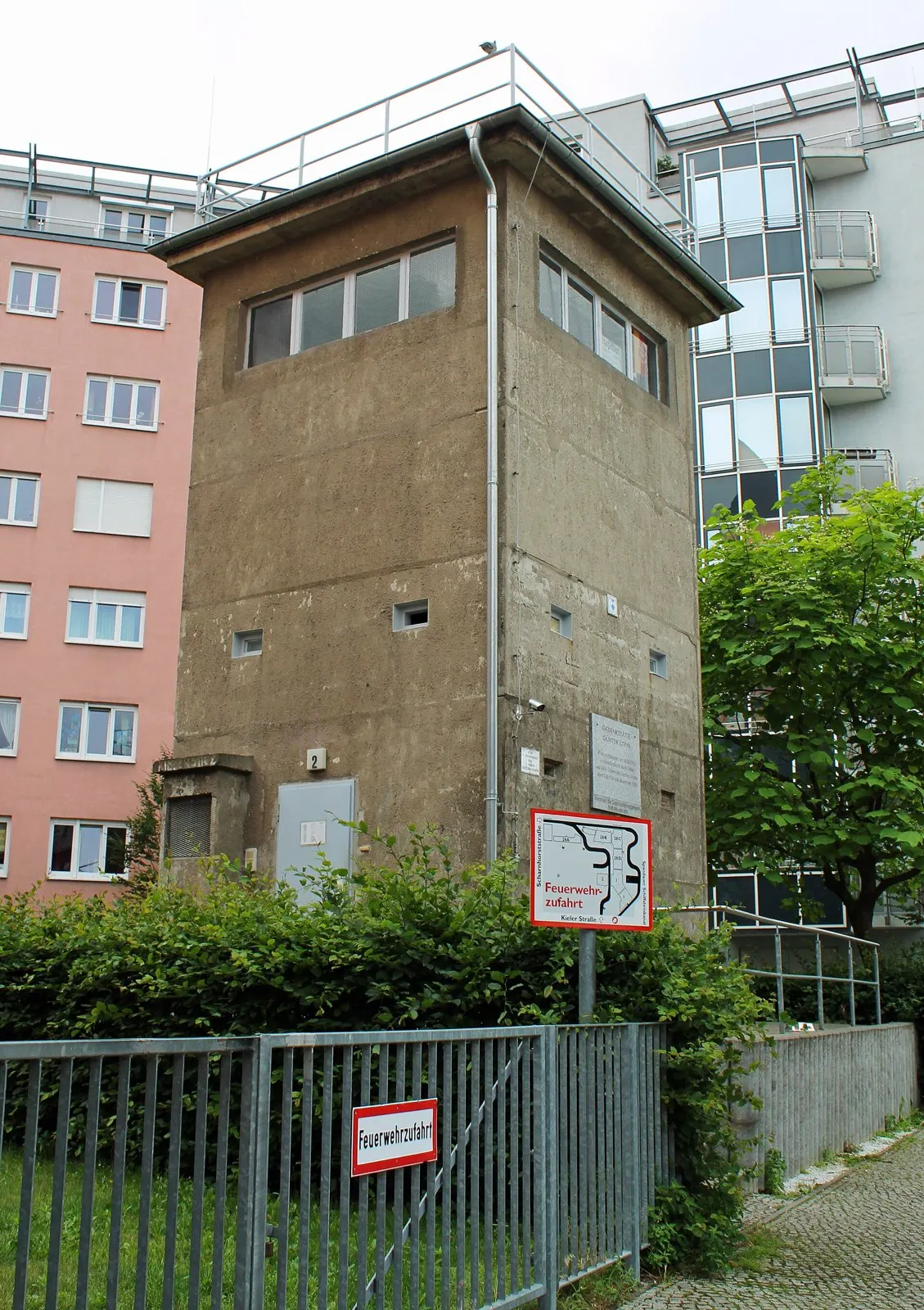

Officially, East Germany never had a shoot-to-kill order, and its leaders always publicly denied that one existed. But from August 1961 until April 1989, political instructions, military orders, service regulations and oral briefings before each shift told the guards at the Berlin Wall to stop escapes with firearms if other means failed, a 1982 law declared such shooting justified, and guards who killed escapees were as a rule decorated and rewarded. In German this is known as the Schießbefehl, the order to shoot.
At the Berlin Wall, 68 of the 101 escapees who died were shot dead. The first was Günter Litfin on 24 August 1961; the last was Chris Gueffroy on 5 February 1989. For the full toll, see how many people died at the Berlin Wall.
“Border violators are to be arrested or destroyed”
With the words “Grenzverletzer sind festzunehmen oder zu vernichten” – border violators are to be arrested or destroyed – East German border soldiers were sent to their posts in the death strip every day into the 1980s. The Chronik der Mauer (Berlin Wall chronicle) calls fatal shots at escapees a decisive cornerstone of the GDR border regime. The historian Hans-Hermann Hertle writes that from the start the SED leadership had no doubt that only the threat of death, and ultimately killing, could deter people from fleeing en masse.
The first orders after the Wall was built, 1961–1962
On 22 August 1961 the SED Politburo instructed Albert Norden, the Central Committee secretary for propaganda, to have army and police units sign written declarations that anyone who broke the GDR’s laws would be called to order, with a weapon if necessary. Hundreds of people still managed to escape in the first weeks after the Wall went up (many escapes are documented at berlinwallescapes.com), and 85 people’s police officers defected to the West. On 20 September 1961 Erich Honecker, the Politburo member in charge of the border closure, reaffirmed the instruction that firearms were to be used against traitors and border violators.
The Defence Minister’s first order on the subject followed on 6 October 1961. Order No. 76/61, addressed to the army’s Border Command, obliged its guards, posts and patrols on the GDR’s western border and coast to use firearms in several situations, including to arrest people who did not stop at the call “Halt - stehenbleiben - Grenzposten!” (halt, stand still, border guard) or after a warning shot, who were evidently trying to violate the GDR’s state border, and whom there was no other way to arrest. Shots were to be fired only towards GDR territory or parallel to the border, and not at children, members of foreign armies or diplomats. Hertle notes that this order reappeared, only slightly changed, in service regulations over the following years. (Berlin’s own border units stayed under the Interior Ministry until August 1962.)
In 1962 the minister ordered that shooting practice be organised so that every border soldier would become an excellent marksman, able to destroy any stationary or moving target with the first shot (or burst) by day or night. Later regulations added that using a firearm was the most extreme measure of force against people, permitted only when all other measures had failed or the situation made other measures impossible.
When Peter Göring, a border guard, was killed by a ricochet at the Spandauer Schifffahrts Canal on 23 May 1962, he had been firing at a 14-year-old boy, in breach of the regulations that forbade firing at children or towards the West.
Honecker in the National Defence Council, 3 May 1974
In 1971 Honecker had succeeded Walter Ulbricht as SED First Secretary and as chairman of the National Defence Council. The minutes of the council’s 45th session on 3 May 1974 record his points on the situation at the border: there had to be a clear field of fire everywhere, firearms still had to be used “rücksichtslos” (ruthlessly) against attempts to break through the border, and comrades who had used their firearms successfully were to be commended. According to the minutes, he added that nothing about the existing rules on this would change, now or in the future.
The 1982 Border Law and Section 27
On 25 March 1982 the GDR’s parliament passed the Law on the State Border (Grenzgesetz). Its Section 27 on the use of firearms describes shooting as the most extreme measure of force against people, to be used only when physical force had failed or was clearly hopeless. It declared shooting justified to prevent the imminent commission or continuation of an offence that constituted a Verbrechen (a serious crime), and to apprehend people strongly suspected of one. Shooting was to be announced by a call or a warning shot unless an immediate danger could only be stopped by aimed fire. Guards were not to shoot if bystanders could be endangered or if people appeared to be children, and wherever possible not at young people or women. Life was to be spared where possible, and the injured given first aid.
Under the GDR’s political criminal laws, escape attempts could be classed as a Verbrechen in certain circumstances. Hertle describes the Border Law as giving the practice of fatal shooting a legal facade; the Berlin Regional Court later found that it was meant to create the impression of legitimacy in line with the rule of law without changing the previous practice in any way.
How the order worked in practice
Hertle writes that no case is known in which the GDR’s political and military leadership opened an investigation into a guard who had killed someone, to check whether the shooting had been lawful. Instead, guards were as a rule decorated and rewarded for killings, with a medal for exemplary border service, with money and gifts, and with promotions. The border soldiers involved in the shooting of Elke and Dieter Weckeiser on 18 February 1968 were commended and given the same medal, although most of the officers and soldiers stationed there later told police that, objectively, the use of firearms had not been necessary.
The Stasi was part of the system. According to the MfS-Lexikon, the Federal Archives’ reference work on the Stasi, border soldiers who refused to shoot at escapees, or who might flee themselves, should on no account be deployed at the border, and a candidate could not even be examined for the border troops until the local Stasi office had secretly vetted him and given its approval. It also notes that a successful escape weighed more heavily than killing the escapee: even when guards clearly exceeded their orders, or escapees who had been stopped were in effect executed, there were no criminal consequences for the soldier concerned.
The pressure could reach the guards’ own ranks. The biography of Günter Seling, a border soldier shot in fog by a comrade who took him for an escapee on 29 September 1962, concludes that the pressure to prevent “border breaches” was so great that in doubtful cases guards even shot at their own comrades. See also border soldiers killed at the Berlin Wall.
When shooting did not suit the leadership politically, for example around state visits, the order was suspended for short periods, as during West German Chancellor Helmut Schmidt’s visit to the GDR in December 1981. Hertle quotes the Stasi minister, Erich Mielke, preparing security for the 1973 World Youth Festival in East Berlin: “Der Schießbefehl wird natürlich nicht aufgehoben” – the order to shoot will of course not be lifted.
The 2007 document from the Stasi files
In August 2007 the Magdeburg branch of the Stasi records agency presented a seven-page document dated 1 October 1973 as the first proof of a written order to shoot at the inner-German border (not at the Berlin Wall). The BBC reported that it had been found among the papers of an East German border guard. In the BBC’s translation it said: “Do not hesitate with the use of a firearm”, even when women and children were involved in escapes. Marianne Birthler, head of the agency, told a newspaper that the document mattered because the former political leaders continued to deny there had been an order to shoot.
The picture soon became more complicated. The Neue Zürcher Zeitung reported that a researcher at the agency had published the identical wording in 1997, and that the next day Birthler had to acknowledge the find had long been known. The agency also clarified that the text was not an order to the border troops; according to the newspaper, it was an instruction to a Stasi unit that hunted border soldiers deserting to the West. The newspaper concluded that the document on its own was not proof of a general order to shoot, and argued that Section 27 of the 1982 Border Law already amounted to a de facto order to shoot in writing.
How historians and courts have judged it
In the trials after 1990, members of the former political and military leadership denied that there had ever been an order to shoot; in an interview published in Die Zeit on 30 September 1988, Defence Minister Heinz Kessler had claimed there had never been one. Hertle and the Berlin Wall chronicle both accept that, in formal legal terms, the laws, regulations and orders only created a permission to shoot, not a duty to kill, as the criminal courts also found. Hertle argues, however, that political criminal laws, an ideology of hatred towards the enemy, and praise and bonuses for guards who killed moved that permission close to an obligation.
The courts did not accept the Border Law as a justification. As the Federal Constitutional Court’s 1996 decision records, the Berlin Regional Court, following a ruling of the Federal Court of Justice of 3 November 1992, held that the state practice based on Section 27 could not justify the killings, because it had obviously and intolerably violated elementary requirements of justice and human rights protected under international law. The Constitutional Court ruled that the strict protection of trust under the ban on retroactive punishment must give way where those holding state power exclude criminal liability for the gravest criminal injustice through grounds of justification by calling for and encouraging such injustice beyond the written law, and so seriously disregarding internationally recognised human rights. More on the prosecutions is in the Berlin Wall shooting trials.
The end of the shooting in April 1989
On 19 December 1988 Honecker told West Germany’s departing representative in East Berlin that the defence minister had recently stated there was no (longer an) order to shoot, and that any shots still fired were warning shots. Friends told Chris Gueffroy that the order to shoot had been suspended. It had not been. On 5 February 1989 he was shot dead at the Britzer Zweigkanal between Treptow and Neukölln, the last person killed by gunfire at the Wall.
The protests that followed put the SED leadership under severe pressure. In mid-January 1989 the GDR had signed the Vienna CSCE agreement, committing itself to respect everyone’s right to leave any country, including their own. Honecker’s instruction to stop shooting was given orally, through Egon Krenz, the Central Committee secretary for security, who informed Deputy Defence Minister Fritz Streletz on 2 April 1989. According to the minutes of a meeting on 3 April at which Streletz passed this on to the border troop leadership, the message was that people who were fleeing must not be shot at if there was no order to shoot. From about 7 p.m. that day, all border units were orally instructed not to use firearms to prevent border breakthroughs; guards could shoot only if their own lives were threatened. By 4 April the instruction had reached the border posts.
Five days after the order was lifted, on 8 April 1989, a passport controller stopped two people trying to rush the Chausseestrasse crossing with a warning shot. According to Hertle, the passport controllers wore border troop uniforms only as a disguise and were in fact members of the Stasi, which had not been informed that the order had been lifted. A Stasi note of 12 April 1989, however, records that the platoon leader of the passport control unit at the Chausseestrasse crossing had been briefed on the new order on the morning of 5 April. According to the German federal government’s chronicle, these were the last known shots at the Berlin Wall, and the order to shoot was formally lifted only by the Modrow government on 21 December 1989. The last deaths at the Wall are covered in the last victims of the Berlin Wall.
Seven months after the order was lifted in April, the Wall fell, and, as Hertle puts it, no shot disturbed the celebrations.
Questions and answers
- Was there a shoot-to-kill order at the Berlin Wall?
- Officially, no: the GDR leadership always publicly denied that one existed. But instructions from August and September 1961, the Defence Minister's order of October 1961 for the army's border units, later service regulations and oral briefings before each shift told guards to stop escapes with firearms if other means failed, the 1982 Border Law declared such shooting justified, and guards who killed escapees were as a rule decorated and rewarded.
- What did the Schießbefehl say?
- The Defence Minister's order of 6 October 1961 obliged the army's border guards on the GDR's western border and coast to use firearms to arrest people who ignored the call to halt or a warning shot and were evidently trying to violate the GDR's border, if there was no other way to arrest them. Into the 1980s, guards were sent on duty every day with the oral order that border violators were to be arrested or destroyed.
- What was found in the Stasi files in 2007?
- In August 2007 the Stasi records agency in Magdeburg presented a document dated 1 October 1973 as proof of a written order to shoot at the inner-German border; it told the reader not to hesitate to use firearms, even when women and children were involved. The agency soon had to acknowledge that the find had long been known (the same wording had been published in 1997), and it clarified that the text was not an order to the border troops; according to the Neue Zürcher Zeitung, it was addressed to a Stasi unit pursuing deserting border soldiers.
- When did the shooting at the Berlin Wall stop?
- On 3 April 1989 border units were orally instructed not to use firearms to prevent border breakthroughs, after the killing of Chris Gueffroy on 5 February 1989. Firearms were to be used only if a guard's own life was threatened.
Sources
- Hans-Hermann Hertle, "Grenzverletzer sind festzunehmen oder zu vernichten", bpb (2012)
- Chronik der Mauer: Das Grenzsystem
- Chronik der Mauer: Order No. 76/61 on the use of firearms, 6 October 1961
- Chronik der Mauer: Minutes of the 45th session of the National Defence Council, 3 May 1974 (extract)
- Chronik der Mauer: Border Law of the GDR, 25 March 1982
- Chronik der Mauer: On the lifting of the order to shoot, 12 April 1989
- Stasi-Mediathek: Minutes of the meeting with the Minister of National Defence on lifting the order to shoot (1989)
- Bundesarchiv (Stasi Records Archive), MfS-Lexikon: Grenzsicherung
- Bundesregierung: 3 April 1989 – Aufhebung des Schießbefehls
- BBC News: E German 'licence to kill' found (12 August 2007)
- Neue Zürcher Zeitung: Die Stasi-Behörde kennt ihre Archive nicht (14 August 2007)
- Federal Constitutional Court, decision of 24 October 1996 (2 BvR 1851/94 and others)
- LeMO (Haus der Geschichte): Erich Honecker
- Hertle/Nooke, The Victims at the Berlin Wall, 1961–1989: Findings (2017)
Every fact in this article was checked against these sources. To report an error, email info@berlinexperiences.com.
Cite this page
“Was There a Shoot-to-Kill Order at the Berlin Wall?”, Victims of the Berlin Wall, Berlin Experiences. https://victimsofthewall.com/articles/shoot-to-kill-order-berlin-wall/
A Berlin Experiences project