Berlin Wall Victims Memorials: Where to Remember the Dead
Where to remember the victims of the Berlin Wall: the Window of Remembrance, the White Crosses, memorial columns and the Fechter, Litfin and Gueffroy memorials.
.jpg)
The central place to remember the people who died at the Berlin Wall is the Berlin Wall Memorial on Bernauer Strasse, where the Window of Remembrance shows their names and dates and, where one could be found, a photograph. Beyond it, the victims are remembered across the city: by the White Crosses on the Spree near the Reichstag building, by memorial columns along the Berlin Wall Trail, and by individual memorials such as those for Peter Fechter on Zimmerstrasse, Günter Litfin in a former watchtower on Kieler Strasse and Chris Gueffroy on the Britzer Zweigkanal.
According to a 2009 exhibition by the Berlin Senate Department for Urban Development, more than 100 sites along the Wall’s 160-kilometre route commemorated the victims and particular events at the Wall at that time. This guide covers some of the best-known ones and what to know before visiting. Opening times change, so check the Berlin Wall Foundation’s website before you go.
The Berlin Wall Memorial and the Window of Remembrance
The Berlin Wall Memorial stretches along both sides of Bernauer Strasse. In the former border strip, on what was the East Berlin side, are the outdoor exhibition, the official monument to the divided city and the victims of communist tyranny, the Chapel of Reconciliation and the Window of Remembrance. The Visitor Center and the Documentation Center, with its observation tower and permanent exhibition, stand on the opposite side, which was once part of West Berlin.
The memorial grew out of local efforts to save a stretch of the Wall after 1989. Its monument, chosen in a 1994 design competition, was inaugurated on 13 August 1998; the Documentation Center opened on 9 November 1999 and the Chapel of Reconciliation was dedicated in 2000. In 2006 the Berlin Senate declared the site the central place of remembrance for the division of Berlin.
The Window of Remembrance
The Window of Remembrance presents photographs of the people who died at the Wall, together with their names and dates of birth and death, so that each person is remembered individually. Relatives often bring flowers, stones or candles. Not every person could be shown with a photograph, and some niches have been kept free in case further victims are identified.
The eight East German border soldiers who were killed on duty are not shown in the Window. After intense discussion, the Foundation’s committees decided to leave them out, on the argument that, as helpers of the dictatorship, albeit often unwilling conscripts, they should not be honoured alongside its victims. Their names are shown separately on a column near the Window. Their stories are told in the article on the border soldiers killed at the Wall.
Seven people lost their lives on Bernauer Strasse itself while trying to get through the border fortifications, all of them in the 1960s, and markers on the memorial grounds tell their stories where they happened. One of them was Ida Siekmann, who jumped from her window at Bernauer Strasse 48 on 22 August 1961; the Wedding district office later erected a monument for her at the site, where memorial services were held for decades.
In the Chapel of Reconciliation, short midday prayer services are held several days a week, and at each one the biography of one of the 140 victims is read aloud. They are open to the public without registration. Each year the memorial also hosts the central commemorations of the building of the Wall on 13 August and of its fall on 9 November.
Visiting Bernauer Strasse
- Where: start at the Visitor Center, Bernauer Strasse 119. The Documentation Center is at Bernauer Strasse 111.
- Getting there: S-Bahn lines S1, S2, S25 and S26 to Nordbahnhof.
- Admission: free to all exhibitions on Bernauer Strasse.
- Access: the outdoor exhibition runs for 1.4 kilometres along the street and is barrier-free only in part, while the Visitor Center, the Documentation Center and all seminar rooms are barrier-free.
- Opening times: the outdoor exhibition can be visited every day; the Visitor Center and Documentation Center have shorter hours and are closed on Mondays. Times change, so check the Foundation’s visitor page before you go.
The White Crosses by the Reichstag
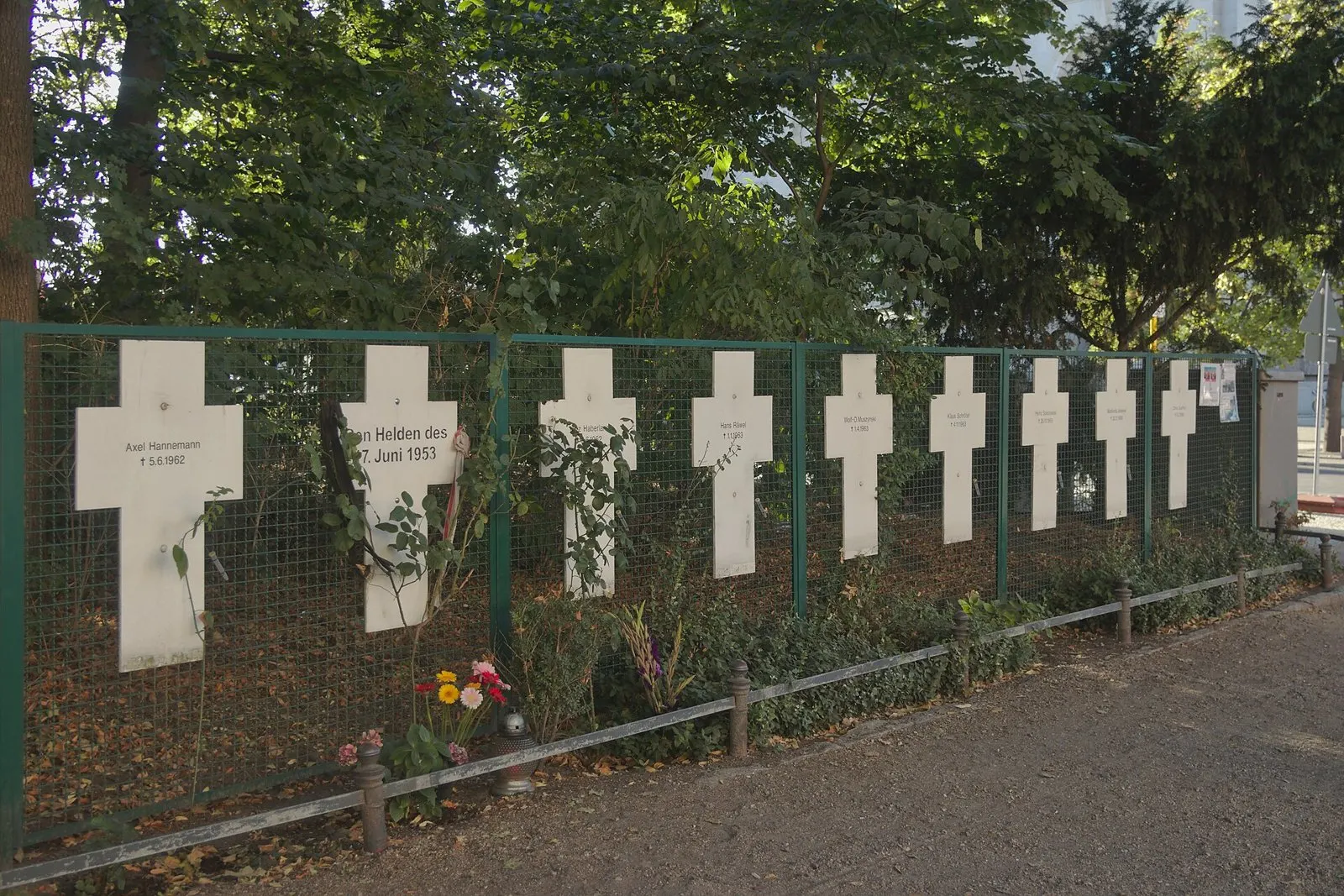
Behind the east entrance of the Reichstag building, the south bank of the Spree was part of West Berlin, but the river itself was East Berlin territory. Where the border wall met the bank, a private Berlin citizens’ association set up the “White Crosses” memorial in 1971, for the tenth anniversary of the building of the Wall.
The crosses had first stood at the places where people had died trying to reach West Berlin. Over the years the association could no longer care for crosses scattered across the city; according to the Berlin Wall Foundation, they were brought together on the Spree, while the Berlin Senate’s 2006 memorial concept says they were gathered behind the Reichstag building and on Bernauer Strasse. After a temporary move during building work, the memorial returned to the riverbank on 17 June 2003 as an installation of seven white crosses. The names on them include Günter Litfin, Udo Düllick, Werner Probst and Chris Gueffroy, and the crosses also honour the unknown victims of the Wall. The 2006 concept also noted that the temporary site at the corner of Ebertstrasse and Scheidemannstrasse had not been removed, so at that time the same victims were remembered in two places.
One of the crosses remembers Marienetta Jirkowsky, shot on 22 November 1980. A memorial cross for her had been placed on the Wall near the Reichstag building in the 1980s; in 2003 it became part of the White Crosses memorial.
Memorial columns along the Berlin Wall Trail
In 2001 the Berlin Senate began opening up the whole 160-kilometre route of the former Wall to cyclists and walkers as the Berlin Wall Trail (Berliner Mauerweg), with signs, maps and information columns at historic places. Along the trail, memorial columns mark places where people died.
In 2011, the year of the Wall’s 50th anniversary, the Brandenburg state government announced that under a Berlin Wall Foundation project 29 columns were to be put up on Brandenburg territory along the trail to commemorate 50 people who died at the Wall, each as close as possible to where they were killed; Brandenburg and Berlin contributed to the cost. The first was unveiled in Teltow in August 2011, near the Teltow Canal where Peter Mädler was shot in 1963 and Karl-Heinz Kube in 1966. According to Peter Mädler’s biography, city councillors, relatives and friends gather at the columns for the two men at the Knesebeck Bridge in Teltow every 13 August to lay wreaths and flowers.
Other columns mentioned in the victims’ biographies include one for Marienetta Jirkowsky on Florastrasse, near the place of her escape attempt, erected in late 2006, and one for Winfried Freudenberg, whom his biography calls “the last person to die in Berlin as a consequence of the Berlin Wall”, dedicated in 2012 on Erdmann-Graeser-Weg in Zehlendorf, not far from where he fell to his death.
The Peter Fechter memorial on Zimmerstrasse
A 2.60-metre steel column on Zimmerstrasse in Berlin-Mitte, about 200 metres from the former Checkpoint Charlie, remembers Peter Fechter. The 18-year-old was shot on 17 August 1962 while trying to climb the Wall with a work colleague, and lay wounded at its foot without help. The inscription reads “Peter Fechter 1944 – 1962 …er wollte nur die Freiheit” (“he only wanted freedom”), and a plate set into the ground in front of the column marks the spot where he lay.
A memorial had stood here since the day of his death, when it was set up during a spontaneous protest. An early wooden cross was set up as close to the Wall as possible by Dieter Beilig, a West Berlin activist against the Wall who was himself arrested and shot dead in East Berlin, near the Brandenburg Gate, in 1971. Beilig’s cross was later replaced by another wooden cross. In 1998 the Axel Springer publishing house held a competition to redesign the site, and on 13 August 1999 that cross was replaced by the column designed by the Berlin sculptor Karl Biedermann. People still gather here every year to remember the victims of the Wall.
The Günter Litfin Memorial on Kieler Strasse
Günter Litfin was shot dead on 24 August 1961, the first person to be shot dead at the Berlin Wall. His memorial is inside a former border watchtower at Kieler Eck, by the Spandau shipping canal. His younger brother Jürgen Litfin (1940–2018) learned of the tower by chance in 2001. Thanks to his efforts it was preserved and listed as a protected landmark in 2003, and he created an exhibition inside called “From Günter Litfin to Chris Gueffroy”. The memorial opened on 24 August 2003, the anniversary of Günter’s death, and became part of the Berlin Wall Foundation in 2017.
A memorial stone first put up for him in 1962 by the Humboldt Harbor, which later stood by the Sandkrug Bridge, was moved in 2015 to the place where he was shot. A street in Weissensee, the district where he had lived, was named after him in 2000.
Visiting the Litfin memorial
- Where: Kieler Strasse 2, 10115 Berlin.
- Getting there: U-Bahn U6 to Schwartzkopffstrasse, or tram M5, M8 or M10 to Invalidenpark.
- Admission: free.
- Opening: the tower opens regularly at weekends during a summer season (in 2026, from May to early October), plus occasional special openings (in 2026, for example, on 9 November). Check the Foundation’s visitor page for the current dates and times before you go.
- Access: the tower is not barrier-free and has a steep staircase inside. Children under eight are not allowed in, and there are no toilets on site.
The Chris Gueffroy memorial on the Britzer Zweigkanal
Chris Gueffroy was shot dead on 5 February 1989 at the border fortifications in front of the Britzer Zweigkanal (Britz branch canal), the canal that formed the border between Treptow in the East and Neukölln in the West; according to his biography, the shots fired at him and his companion were the last fatal bullets fired at the Wall. On the day of his funeral, 23 February 1989, a memorial cross was put up for him on the West Berlin side in Neukölln.
On 21 June 2003, his 35th birthday, a memorial column was set up at the site of his escape attempt, on the route of the Berlin Wall Trail, in the presence of his family and friends. It was commissioned by the Senate Department for Science, Research and Culture and deliberately modelled on the Fechter memorial, also to a design by Karl Biedermann. Its inscription describes him as the last refugee to be shot while trying to overcome the East German border installations. The column stands on the canal bank at Chris-Gueffroy-Allee in Treptow. On 13 August 2010 Britzer Allee, between Treptow and Neukölln, was renamed Chris-Gueffroy-Allee. How the guards who shot him were later tried is explained in the article on the Berlin Wall shooting trials, and his story is told alongside other late deaths in the last victims of the Berlin Wall.
Other places of remembrance
Many victims are also remembered by smaller plaques, stones and crosses near where they died. According to their biographies, a plaque on Heidelberger Strasse recalls Heinz Jercha; a memorial stone to the unknown fugitive, unveiled on the West Berlin bank of the Teltow Canal in Lichterfelde on the first anniversary of the death of Roland Hoff, is still there; and a memorial cross has stood for decades for Horst Kullack on Wittelsbacher Strasse in Lichtenrade. The Berlin Wall Foundation keeps an interactive map of places in the city that commemorate the victims, and all 140 are listed on the victims page.
If you want to see what survives of the Wall itself, Where Is the Wall maps surviving segments around the world.
Questions and answers
- Where is the main memorial to the victims of the Berlin Wall?
- The Berlin Wall Memorial on Bernauer Strasse is the central site of remembrance. Its Window of Remembrance shows the names and dates of the people who died at the Wall and, where one could be found, their photograph; the eight border soldiers killed on duty are named separately on a nearby column.
- What are the White Crosses in Berlin?
- A memorial on the bank of the Spree near the Reichstag building, first set up by a private citizens' association in 1971. Since 17 June 2003 it has consisted of seven white crosses bearing the names of people who died at the Wall, and it also honours the unknown victims.
- Where is the Peter Fechter memorial?
- On Zimmerstrasse in Berlin-Mitte, about 200 metres from the former Checkpoint Charlie. A steel column, unveiled on 13 August 1999, stands near the place where he was shot on 17 August 1962.
- Can you visit the Günter Litfin memorial?
- Yes. It is in a former border watchtower at Kieler Strasse 2 and is run by the Berlin Wall Foundation. Admission is free. It opens regularly at weekends in the summer season, plus occasional special openings, so check the Berlin Wall Foundation's visitor page for the current dates. The tower is not barrier-free and children under eight are not allowed in.
- Are the eight border soldiers remembered at the Window of Remembrance?
- No. The Berlin Wall Foundation decided not to include them in the Window of Remembrance; their names are shown separately on a column nearby.
Sources
- Berlin Wall Foundation: The Berlin Wall Memorial
- Berlin Wall Foundation: Information for your visit (Berlin Wall Memorial)
- Berlin Wall Memorial digital tour guide: Window of Remembrance
- Berlin Wall Foundation: Victims at the Berlin Wall
- Berlin Wall Foundation: Memorial "Weiße Kreuze"
- Chronik der Mauer: Der Gedenkort für Peter Fechter
- Berlin Wall Foundation: The Günter Litfin Memorial
- Berlin Wall Foundation: Information for your visit (Günter Litfin Memorial)
- Gesamtkonzept zur Erinnerung an die Berliner Mauer (Berlin Senate, 2006)
- Land Brandenburg press release, 8 August 2011: Platzeck und Wowereit enthüllen Erinnerungsstele
- Senate Department for Urban Development: Berliner Mauer – Orte der Erinnerung und des Gedenkens (exhibition, 2009)
- Chronik der Mauer: Chris Gueffroy
- Chronik der Mauer: Günter Litfin
- Chronik der Mauer: Marienetta Jirkowsky
- Chronik der Mauer: Peter Mädler
- Chronik der Mauer: Dieter Beilig
Every fact in this article was checked against these sources. To report an error, email info@berlinexperiences.com.
Cite this page
“Berlin Wall Victims Memorials: Where to Remember the Dead”, Victims of the Berlin Wall, Berlin Experiences. https://victimsofthewall.com/articles/berlin-wall-victims-memorials/
A Berlin Experiences project