Ida Siekmann
1902–1961
Ida Siekmann, a 58-year-old woman living alone at Bernauer Strasse 48, jumped from her third-floor window towards the West Berlin pavement on 22 August 1961, nine days after the border was sealed, and died of her injuries on the way to hospital.
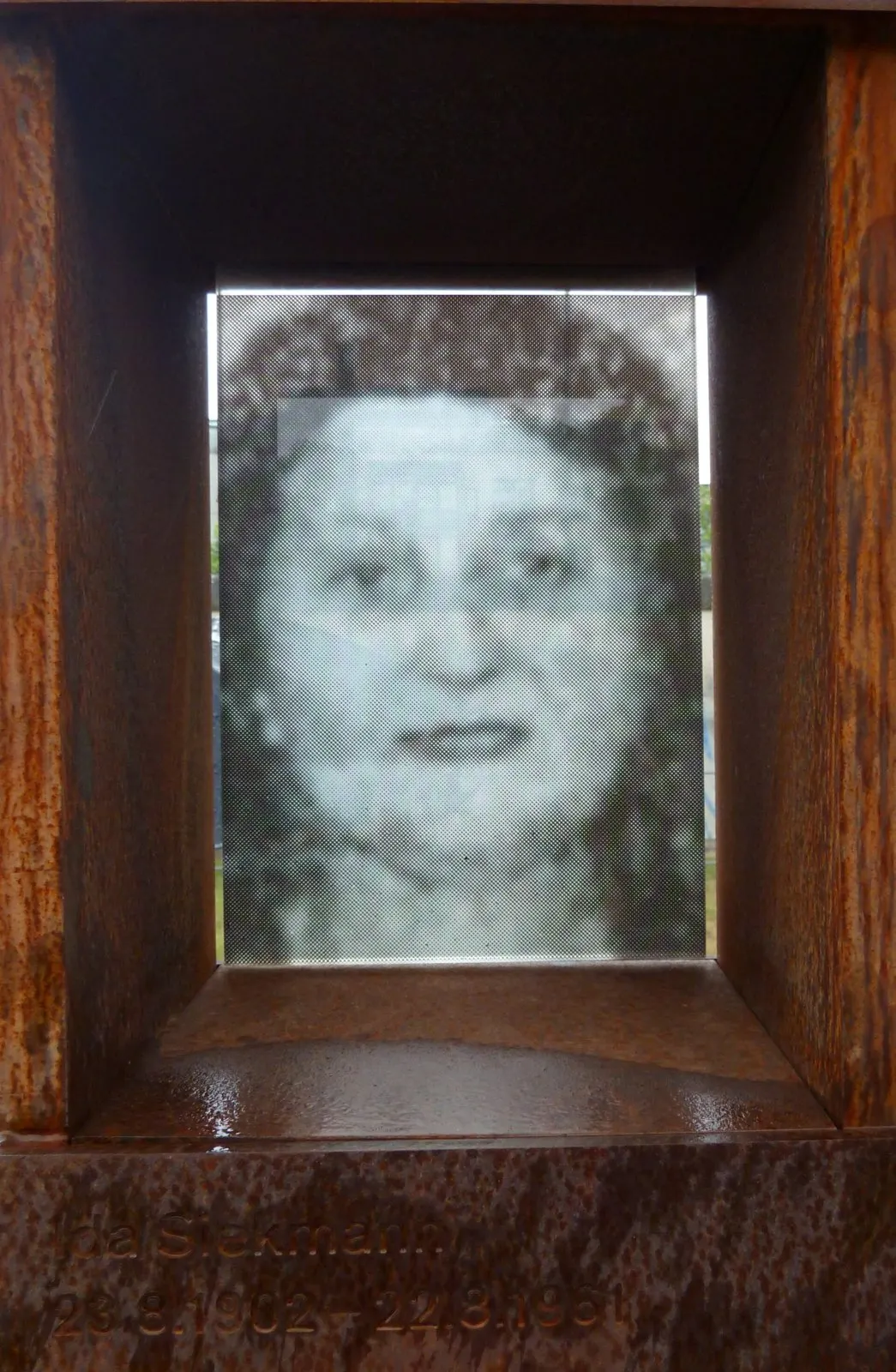

Ida Siekmann was born on 23 August 1902 in Gorken, a small village then in the West Prussian district of Marienwerder and today part of Poland. It is not known when she moved to Berlin. By 1961 she was living alone at Bernauer Strasse 48. Her building stood in Mitte, in East Berlin, but the street and the pavement outside her front door belonged to Wedding, in West Berlin, so she regularly crossed the border to enter her building. She probably also visited her sister regularly, who lived a few streets away in the West.
When the sector border was sealed on 13 August 1961, she was cut off overnight from family and friends in the West, and because she lived on the border itself, the new controls affected her even more directly. From 18 August the front doors onto the western pavement were nailed shut or bricked up, new entrances were made through the back courtyards, and militia and police checked everyone in the corridors and stairwells. Frightened, many residents jumped from their windows or climbed down ropes, while West Berlin firemen tried to catch them in rescue nets.
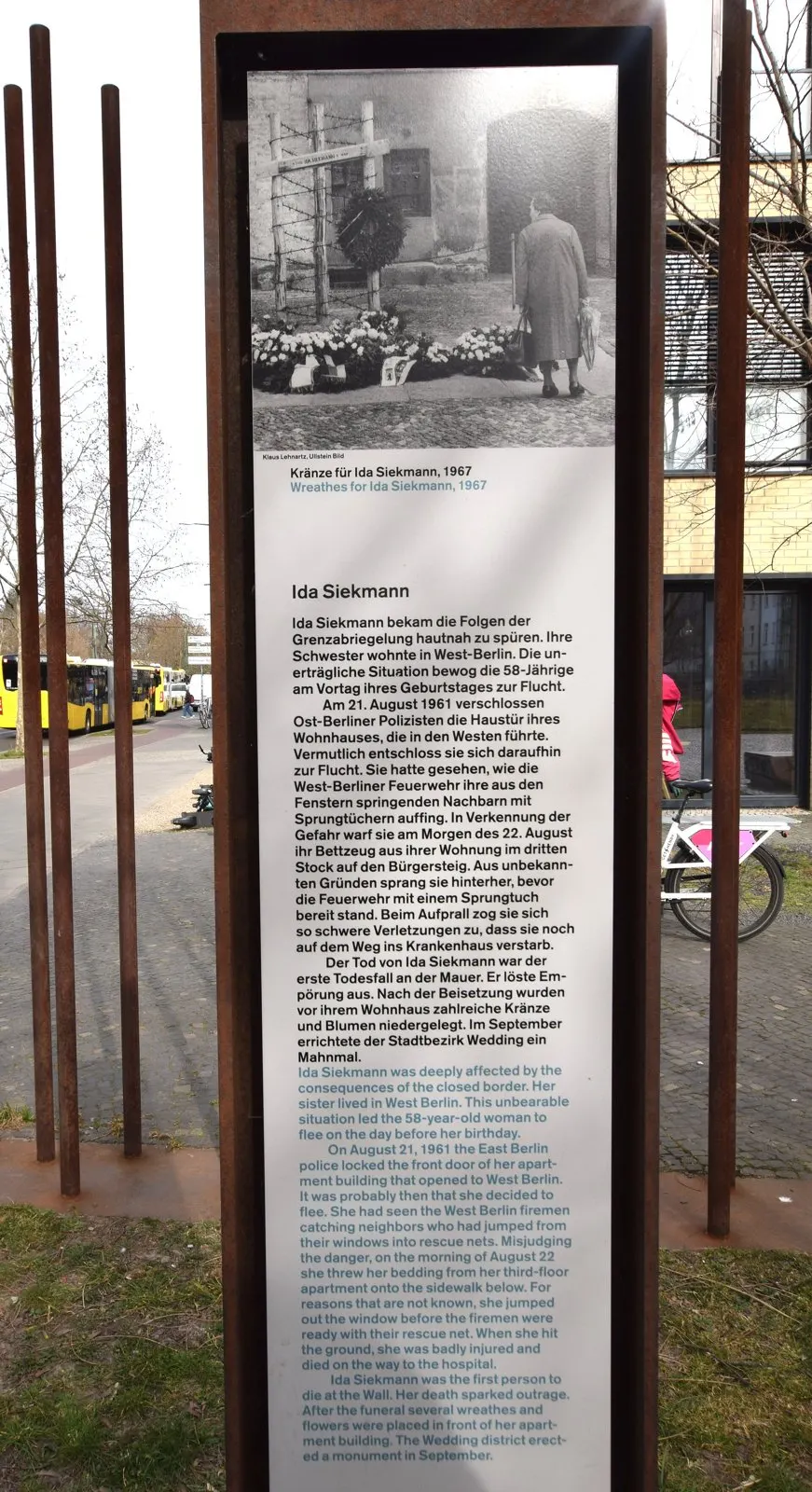
On 21 August Ida Siekmann watched the door of her building being barricaded. Early the next morning she threw her bedding and some belongings out of her third-floor window, and then jumped after them, perhaps afraid of being discovered, before the West Berlin fire brigade could arrive with a rescue net. She hit the pavement and was badly hurt. She died while being taken to the Lazarus Hospital close by, a day short of her 59th birthday. In East Berlin a daily police report meticulously recorded the circumstances, giving the time as about ten to seven in the morning and noting that the pool of blood had been covered with sand.
Her death caused widespread indignation in West Berlin, and newspapers held the East German leadership responsible. Newspaper articles also noted widespread frustration at the restrained response of the western Allies and the federal government; Chancellor Konrad Adenauer arrived in West Berlin only on the day she died.
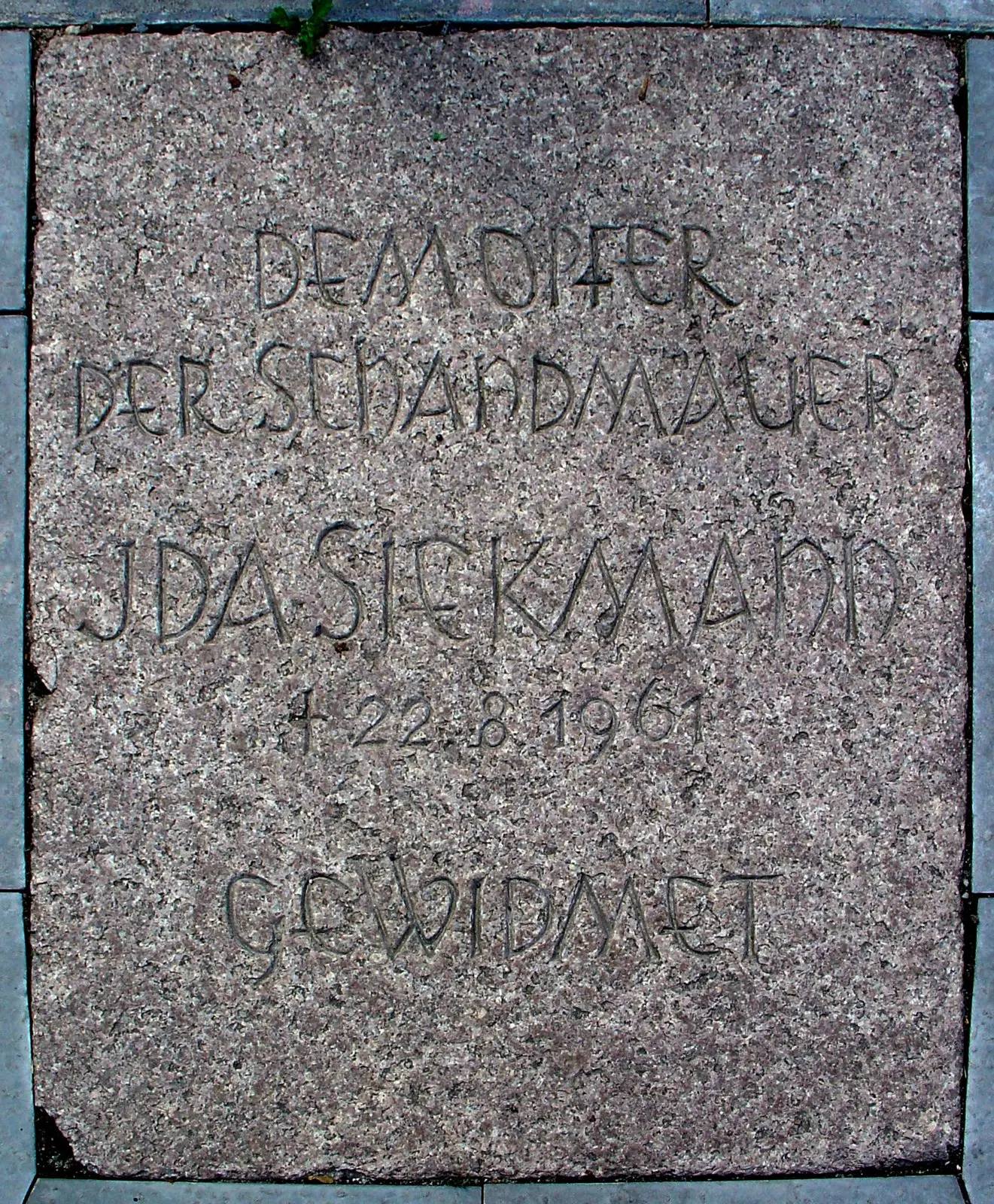
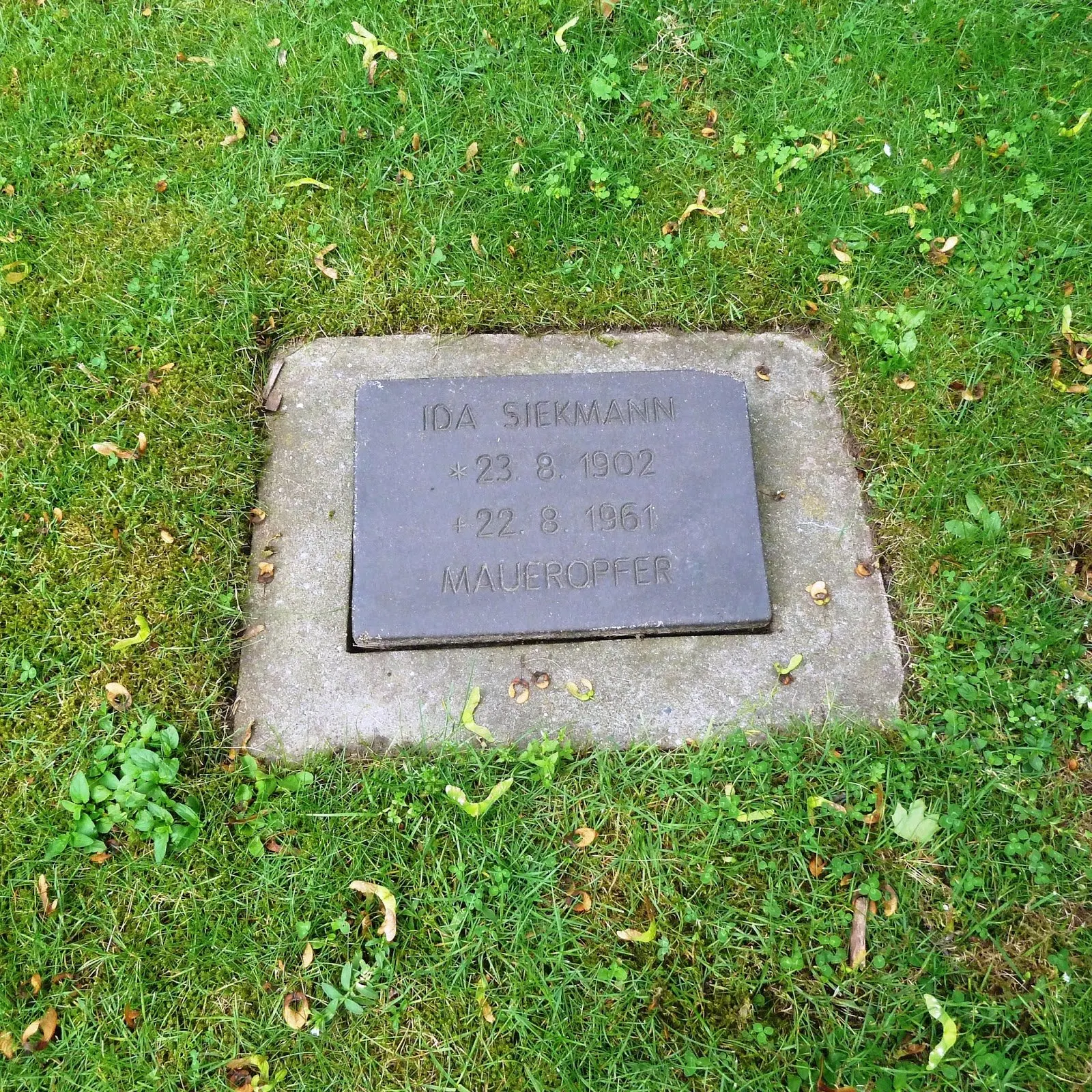
An official funeral was held on 29 August at the Municipal Cemetery on Seestrasse in Wedding, attended by many West Berliners; her coffin was decorated with red roses and white carnations. Afterwards the federal minister for all-German affairs and the mayor of Wedding laid a wreath outside Bernauer Strasse 48 inscribed "Dem Opfer der Unfreiheit" ("to the victim of unfreedom"), and in September the Wedding district office put up a memorial of three wooden logs wrapped in barbed wire where she died. Memorial services were held there for decades, and visitors including Robert Kennedy and Konrad Adenauer laid wreaths and stood in silence.



Read more
Also died on the sector border between Berlin-Mitte and Berlin-Wedding
- Rudolf Urban 17 September 1961
- Olga Segler 26 September 1961
- Bernd Lünser 4 October 1961
- Ernst Mundt 4 September 1962
- Otfried Reck 27 November 1962
- Egon Schultz 5 October 1964
- Heinz Cyrus 11 November 1965
- Dieter Brandes 11 January 1966
- Leo Lis 20 September 1969
Sources
This profile is a summary written for this site. Every fact in it is taken from source 1, which also gives the full account with archival references.
- Christine Brecht, “Ida Siekmann”, biography in Chronik der Mauer, Federal Agency for Civic Education, Centre for Contemporary History Potsdam and Deutschlandradio. Accessed 23 September 2026. Read online. Basis for every fact in this profile, including the dates and place of death.
- German version of the same biography. Accessed 23 September 2026. Read online.
- Hans-Hermann Hertle and Maria Nooke (eds.), The Victims at the Berlin Wall, 1961–1989: A Biographical Handbook. Centre for Contemporary History Potsdam and Berlin Wall Foundation, Berlin 2011. The printed handbook from which the online biography is taken.
- Hans-Hermann Hertle and Maria Nooke, “140 Victims at the Berlin Wall, 1961–1989” (list), Centre for Contemporary History Potsdam and Berlin Wall Foundation, August 2017. PDF. Used to cross-check names and dates.
- Hans-Hermann Hertle and Maria Nooke, “The Victims at the Berlin Wall, 1961–1989: Findings of a Research Project”, August 2017. PDF. Source of the classification into escapees, people with no intent to escape, and border soldiers.
Further reading
- Wikipedia (English)
- Wikipedia (Deutsch)
- Ida Siekmann, the first victim of the Berlin Wall (article, Berlin Experiences)
Image credits
- Portrait of Ida Siekmann in the Window of Remembrance at the Berlin Wall Memorial on Bernauer Strasse. Brewer Bob, CC BY-SA 3.0, Wikimedia Commons.
- Memorial plaque for Ida Siekmann on Bernauer Strasse, dedicated to "the victim of the wall of shame". Katzenmeier, Public domain, Wikimedia Commons.
- Information stele at the memorial for Ida Siekmann on Bernauer Strasse. Singlespeedfahrer, CC0, Wikimedia Commons.
- Grave of Ida Siekmann at the Urnenfriedhof Seestrasse, Berlin. Brewer Bob, CC BY-SA 4.0, Wikimedia Commons.
Cite this page
“Ida Siekmann”, Victims of the Berlin Wall, Berlin Experiences. https://victimsofthewall.com/victims/siekmann-ida/
Map
The pin position is based on the place of death described in source 1. Base map © OpenStreetMap contributors; course of the Wall in 1989 from Geoportal Berlin (dl-de/zero-2.0). Accessed 23 September 2026.