Otfried Reck
1944–1962
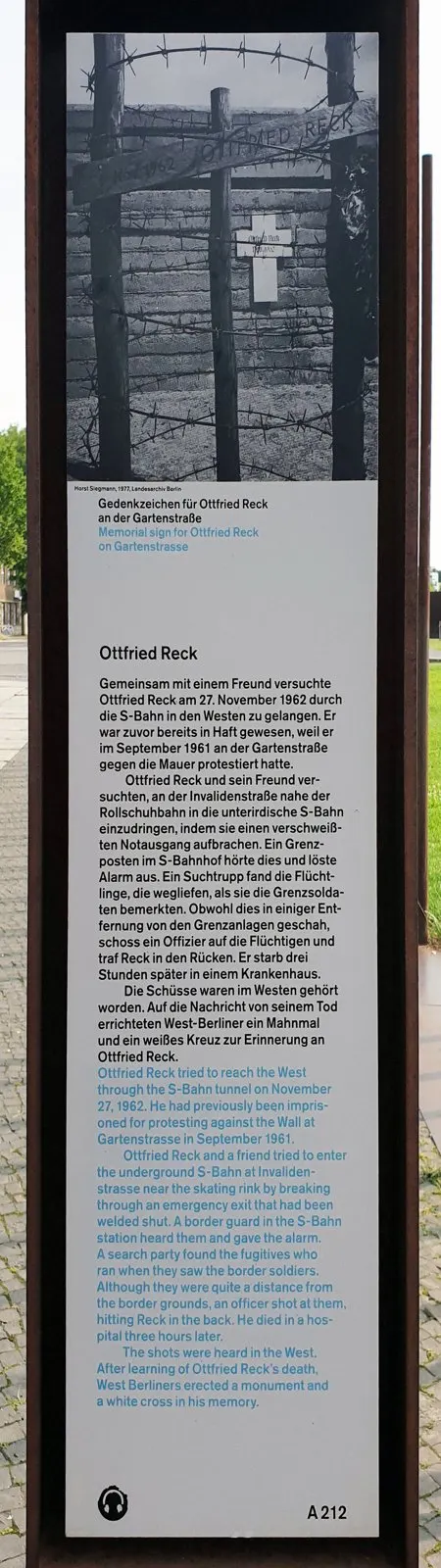
Otfried Reck, a 17-year-old apprentice from Berlin-Mitte who dreamed of singing opera, was shot in the back on 27 November 1962 near the corner of Invalidenstrasse and Gartenstrasse after he and a friend had already given up an escape attempt.
_Otfried_Reck.jpg)
Otfried Reck, called Otti by his friends, was born in Berlin in 1944, the only child of Otto and Margit Reck. The family lived on Torstrasse, renamed Wilhelm-Pieck-Strasse in 1951, had relatives in the western part of the city and kept its distance from the SED regime. His father, a trained tailor, worked as a night watchman; his mother, who came from Austria, worked at the buffet of the State Opera on Unter den Linden.
Through his mother he came to know opera early. He went to performances whenever he could and dreamed of becoming an opera singer, though his friends preferred rock and roll and teased him for his taste. He apparently had no difficulty finishing school with the secondary certificate, and began an apprenticeship as a petrol station attendant. With his friends he spent his free time at the local skating rink and at the 'Helmut Just' youth club across the street, and, before the Wall, often in West Berlin.
On 12 September 1961 he was arrested on Gartenstrasse because, in a crowd that had gathered at the sector border, he was alleged to have condemned the border closure. Although he was only 16, he was convicted of 'state-endangering agitation' and sentenced to one and a half years in prison, serving time in the youth penitentiaries of Dessau and Torgau until his parole in August 1962. His mother later said the state had blocked his future. Afraid of being arrested again, he decided to escape with his friend Gerd P., three years older.
According to Gerd P., the two had played on the railway grounds as children; they knew a ventilation shaft at the corner of Invalidenstrasse and Gartenstrasse, near the closed Nordbahnhof, leading down to the underground tracks. They planned to stop a train heading for West Berlin with a red-painted torch. The opening had since been fitted with a grille to prevent escapes, but that did not deter them: early on the evening of 27 November 1962 they set about levering it up with crowbars, while a friend, Michael M., who did not want to flee himself, kept watch. According to official reports, they were noticed at half past six in the evening, when a border soldier heard a noise and a search began. When Michael M. did not return from checking the situation, the two gave up their plan for the day, then saw their pursuers and ran.
It never occurred to them, Gerd P. later said, that soldiers might fire at them at the skating rink. An officer shot, and a bullet struck Otfried in the back. Gravely wounded, he was brought to the People's Police Hospital and died there three hours afterwards. The records did not mention that he was shot a long way from the border fortifications, and, contrary to usual practice, apparently no sketches of the site were made. In 1995 the Berlin Regional Court convicted the officer of manslaughter, finding that he should have recognised the escape attempt had already failed and that the shots could not be justified.
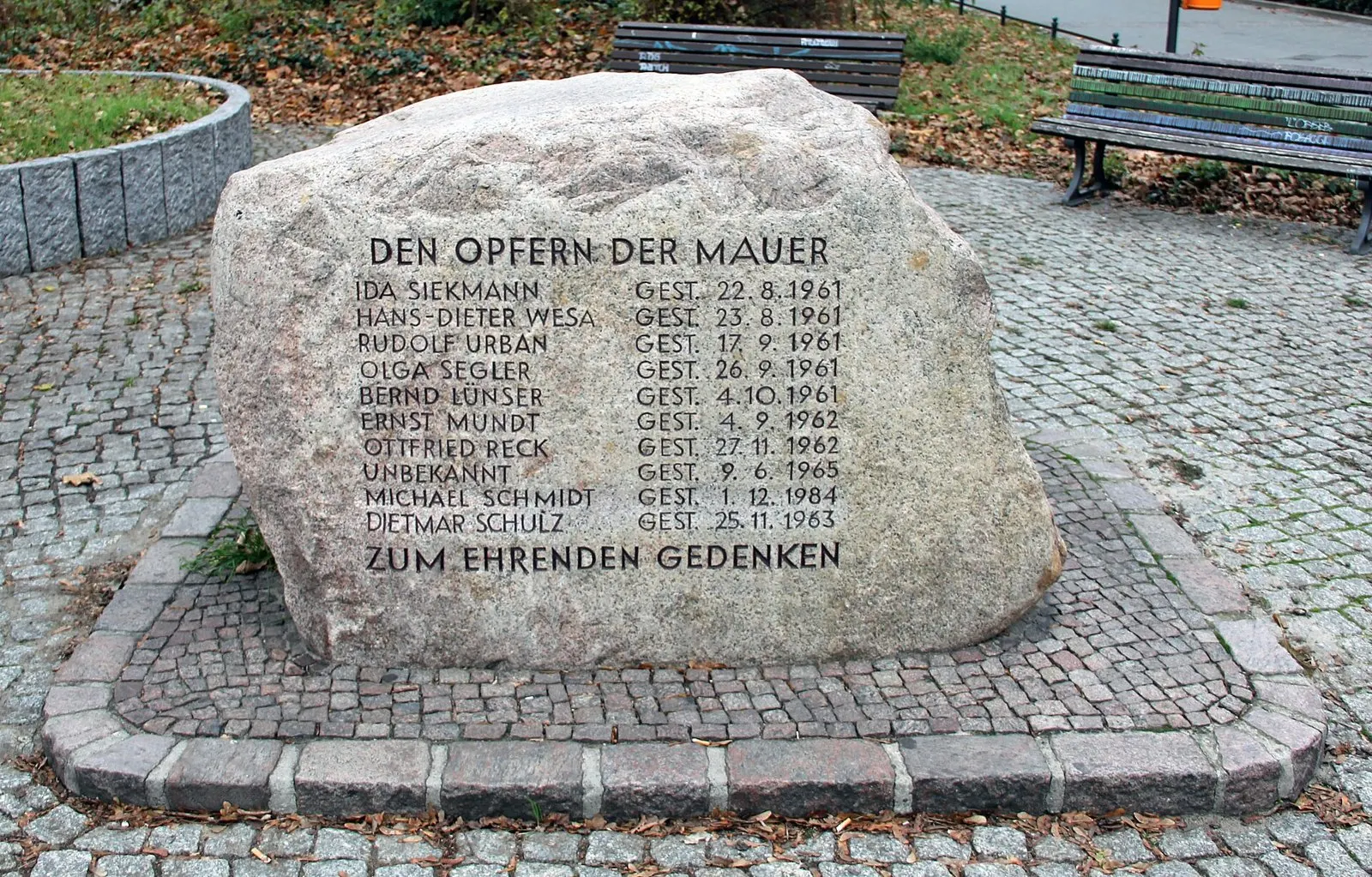
Gerd P. got away at first but, like Michael M., was arrested the next day, and he was later sentenced to three years in prison; for weeks his interrogators would not tell him what had happened to his friend. He still believes they were betrayed. The Stasi investigation set out to show that the boys had been led astray by western propaganda, leaving no room for the possibility that they had reasons of their own. A memorial on Bernauer Strasse in Wedding recalled him.
_Opfer_der_Mauer.jpg)
Read more
Also died on the sector border between Berlin-Mitte and Berlin-Wedding
- Ida Siekmann 22 August 1961
- Rudolf Urban 17 September 1961
- Olga Segler 26 September 1961
- Bernd Lünser 4 October 1961
- Ernst Mundt 4 September 1962
- Egon Schultz 5 October 1964
- Heinz Cyrus 11 November 1965
- Dieter Brandes 11 January 1966
- Leo Lis 20 September 1969
Sources
This profile is a summary written for this site. Every fact in it is taken from source 1, which also gives the full account with archival references.
- Christine Brecht, “Otfried Reck”, biography in Chronik der Mauer, Federal Agency for Civic Education, Centre for Contemporary History Potsdam and Deutschlandradio. Accessed 23 September 2026. Read online. Basis for every fact in this profile, including the dates and place of death.
- German version of the same biography. Accessed 23 September 2026. Read online.
- Hans-Hermann Hertle and Maria Nooke (eds.), The Victims at the Berlin Wall, 1961–1989: A Biographical Handbook. Centre for Contemporary History Potsdam and Berlin Wall Foundation, Berlin 2011. The printed handbook from which the online biography is taken.
- Hans-Hermann Hertle and Maria Nooke, “140 Victims at the Berlin Wall, 1961–1989” (list), Centre for Contemporary History Potsdam and Berlin Wall Foundation, August 2017. PDF. Used to cross-check names and dates.
- Hans-Hermann Hertle and Maria Nooke, “The Victims at the Berlin Wall, 1961–1989: Findings of a Research Project”, August 2017. PDF. Source of the classification into escapees, people with no intent to escape, and border soldiers.
Further reading
Image credits
- Memorial panel for Otfried Reck on Bernauer Straße in Berlin-Mitte, photographed in 2019; the panel spells his name 'Ottfried'. OTFW, Berlin, CC BY-SA 3.0, Wikimedia Commons.
- Memorial stone 'Den Opfern der Mauer' at Bernauer Straße 69–70 in Berlin-Gesundbrunnen, listing Otfried Reck among others, photographed in 2012. OTFW, Berlin, CC BY-SA 3.0, Wikimedia Commons.
Cite this page
“Otfried Reck”, Victims of the Berlin Wall, Berlin Experiences. https://victimsofthewall.com/victims/reck-otfried/
Map
The pin position is based on the place of death described in source 1. Base map © OpenStreetMap contributors; course of the Wall in 1989 from Geoportal Berlin (dl-de/zero-2.0). Accessed 23 September 2026.