Ernst Mundt
1921–1962
Ernst Mundt, a 40-year-old former carpenter living in Prenzlauer Berg, was shot in the head on 4 September 1962 while running along the wall of the Sophien Cemetery towards the sector border at Bernauer Strasse.
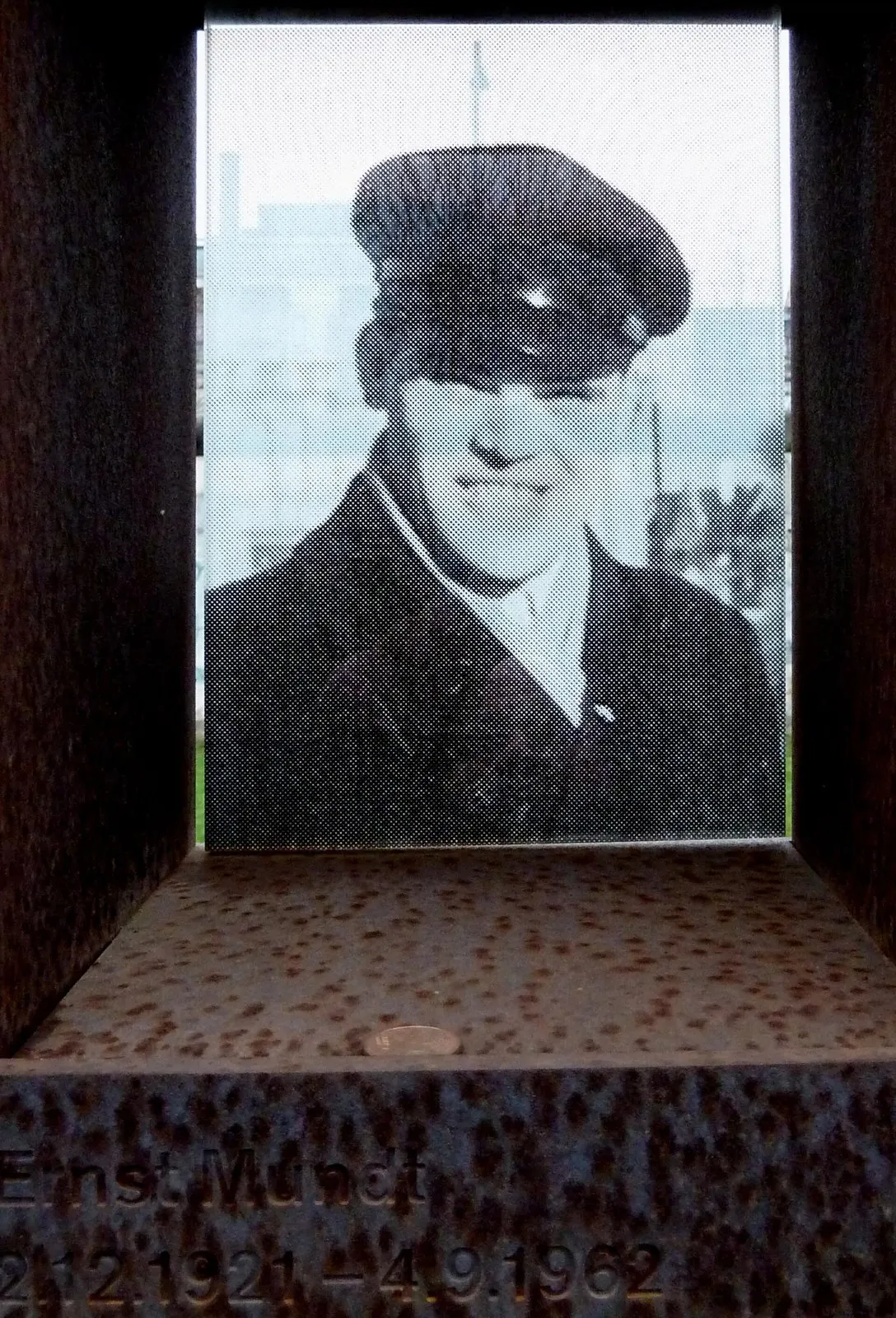

Ernst Mundt was born on 2 December 1921 in Bad Polzin in Eastern Pomerania. A carpenter, he moved from Falkensee to East Berlin in 1950 to find work, and helped build the Friesen Stadium on what was then Dimitroffstrasse, which opened in 1951. Poor health later forced him to give up his trade. He was unmarried, lived on a disability pension in a studio flat in Prenzlauer Berg, and had relatives in the western part of the city.
Once the Wall was built, visits were impossible, and his mother kept in touch by letter and sent him regular parcels of food and necessities. She did not know he was planning to leave, or why. The East German authorities never learned his reasons either; Stasi officers who questioned his neighbours learned only that he was said to have openly criticised the sealing of the border.
The Sophien Parish cemetery lay in East Berlin and bordered Bernauer Strasse, which belonged to the West; border guards patrolled among the graves. On the afternoon of 4 September 1962 Ernst Mundt cycled there, left his bike on Bergstrasse where barbed wire blocked the way, climbed onto the glass-topped cemetery wall and ran along it towards the border. When cemetery visitors and border guards told him to get down, he is said, according to eyewitness accounts, to have replied that he would not come down because he was on duty. He had nearly reached the border when two transport police officers about a hundred metres away at Nordbahnhof saw him. One of them fired a warning shot and an aimed shot in quick succession; Ernst Mundt was hit in the head and killed instantly. His cap flew over to the western side, and witnesses remembered him as the man with the cap.
The shooter was given a bonus and a medal that same day, and the guards were praised for removing him quickly, before the western press could arrive, under an order issued in response to the death of Peter Fechter. His mother's enquiries went unanswered. In early November his younger brother travelled from Krefeld to East Berlin and refused to leave without answers; an East Berlin prosecutor finally told him that his brother had been injured in what he called a border provocation and had died of that injury. The family was told his urn lay in the Baumschulenweg Cemetery, but the Stasi had already had him cremated and buried anonymously. Thirty years later the man who had fired, called to account in court, said he had only carried out an order.
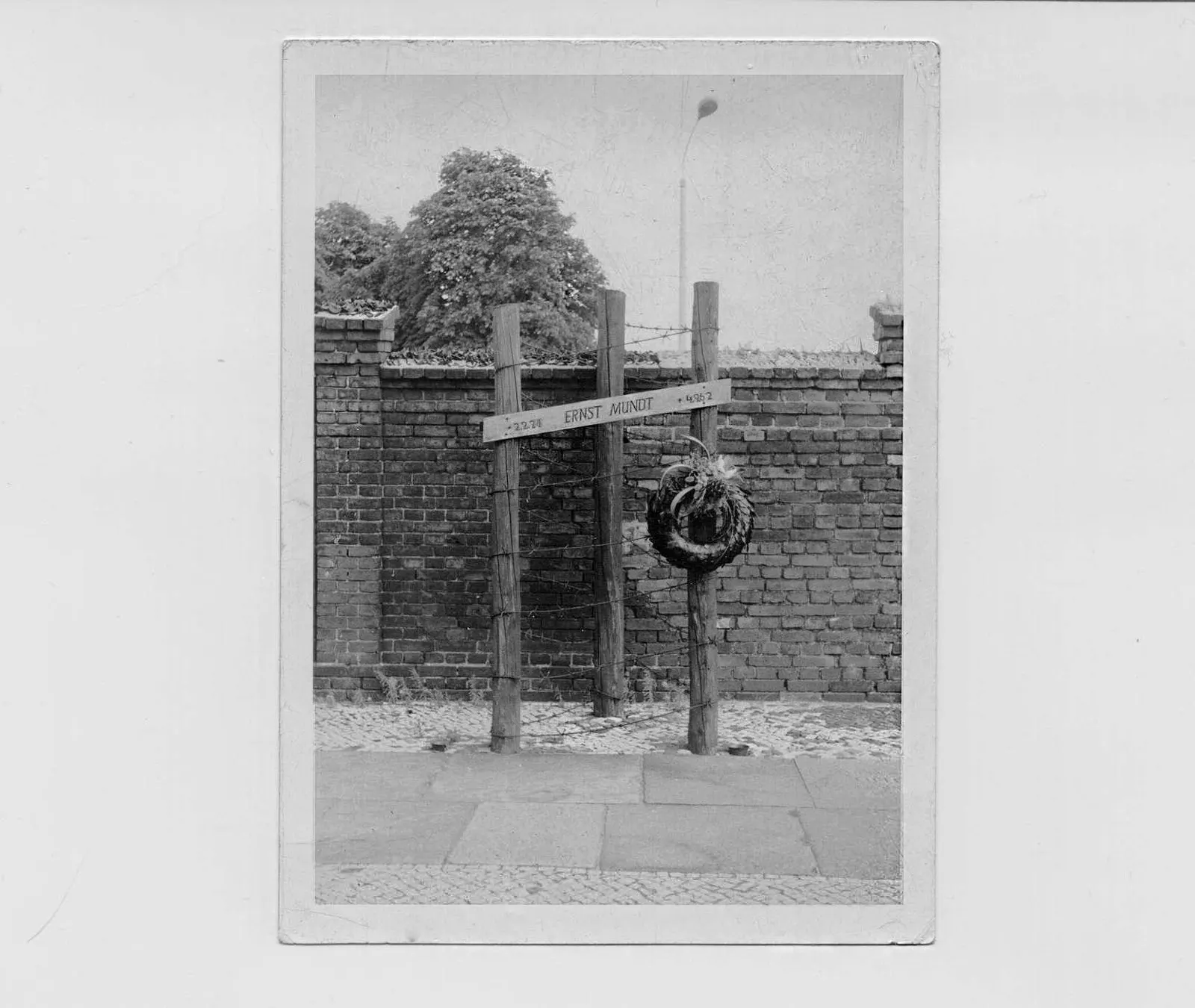
Ernst Mundt was the third fugitive shot dead at the Wall in quick succession, and anger grew in West Berlin. A cross put up at the corner of Bernauer Strasse and Bergstrasse was covered in flowers and wreaths, and half a year later the Wedding district office replaced it with a memorial of logs and barbed wire. According to his biography, a pavement slab inscribed "Dem unbekannten Opfer der Schandmauer † 4.9.1962" (to the unknown victim of the wall of shame) marks the place where he died.

_Opfer_der_Mauer.jpg)
Read more
Also died on the sector border between Berlin-Mitte and Berlin-Wedding
- Ida Siekmann 22 August 1961
- Rudolf Urban 17 September 1961
- Olga Segler 26 September 1961
- Bernd Lünser 4 October 1961
- Otfried Reck 27 November 1962
- Egon Schultz 5 October 1964
- Heinz Cyrus 11 November 1965
- Dieter Brandes 11 January 1966
- Leo Lis 20 September 1969
Sources
This profile is a summary written for this site. Every fact in it is taken from source 1, which also gives the full account with archival references.
- Christine Brecht, “Ernst Mundt”, biography in Chronik der Mauer, Federal Agency for Civic Education, Centre for Contemporary History Potsdam and Deutschlandradio. Accessed 23 September 2026. Read online. Basis for every fact in this profile, including the dates and place of death.
- German version of the same biography. Accessed 23 September 2026. Read online.
- Hans-Hermann Hertle and Maria Nooke (eds.), The Victims at the Berlin Wall, 1961–1989: A Biographical Handbook. Centre for Contemporary History Potsdam and Berlin Wall Foundation, Berlin 2011. The printed handbook from which the online biography is taken.
- Hans-Hermann Hertle and Maria Nooke, “140 Victims at the Berlin Wall, 1961–1989” (list), Centre for Contemporary History Potsdam and Berlin Wall Foundation, August 2017. PDF. Used to cross-check names and dates.
- Hans-Hermann Hertle and Maria Nooke, “The Victims at the Berlin Wall, 1961–1989: Findings of a Research Project”, August 2017. PDF. Source of the classification into escapees, people with no intent to escape, and border soldiers.
Further reading
Image credits
- Portrait of Ernst Mundt in the Window of Remembrance, Bernauer Strasse. Brewer Bob, CC BY-SA 4.0, Wikimedia Commons.
- Memorial cross for Ernst Mundt at a wall, from a private photograph. Henning1951, CC BY-SA 4.0, Wikimedia Commons.
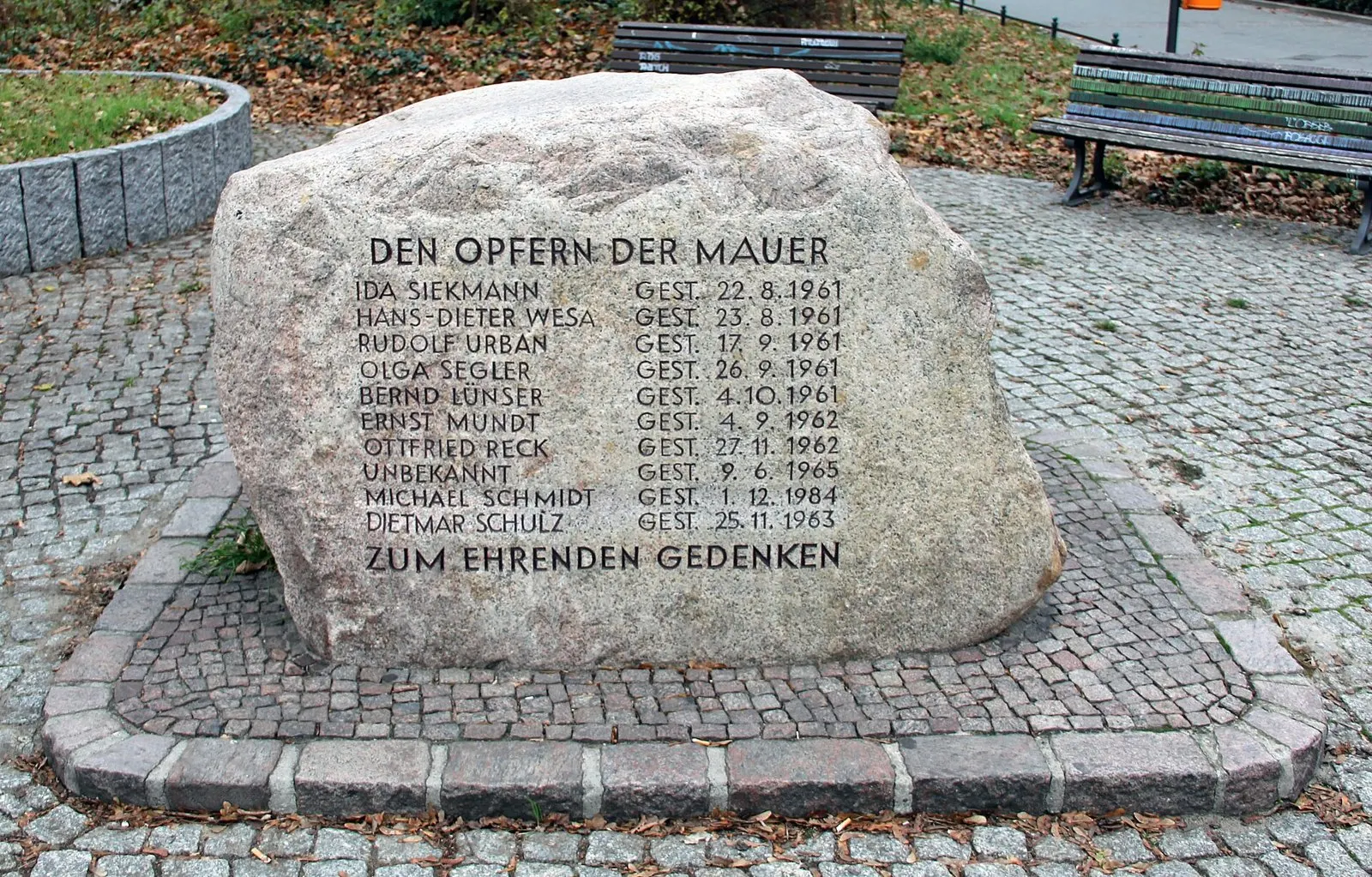
- Memorial stone "Den Opfern der Mauer" at Bernauer Strasse 69-70, listing Ernst Mundt. OTFW, Berlin, CC BY-SA 3.0, Wikimedia Commons.
Cite this page
“Ernst Mundt”, Victims of the Berlin Wall, Berlin Experiences. https://victimsofthewall.com/victims/mundt-ernst/
Map
The pin position is based on the place of death described in source 1. Base map © OpenStreetMap contributors; course of the Wall in 1989 from Geoportal Berlin (dl-de/zero-2.0). Accessed 23 September 2026.