Dieter Brandes
1946–1966
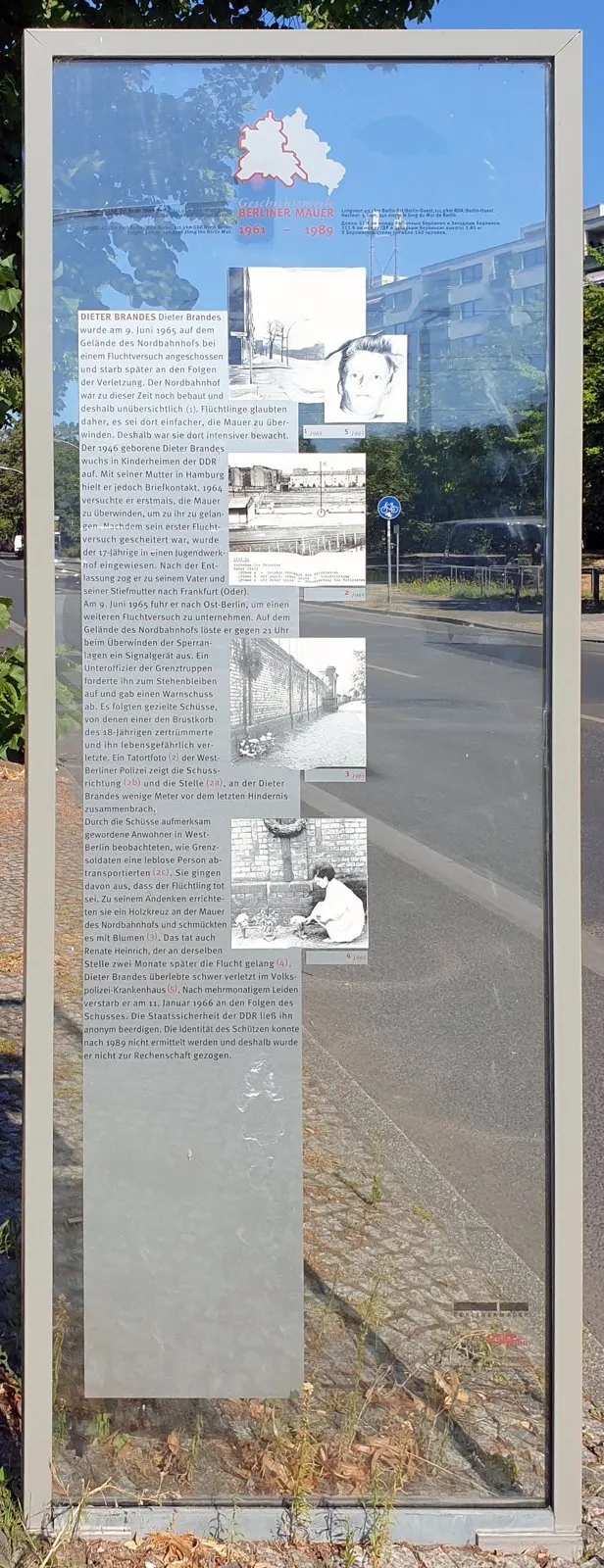
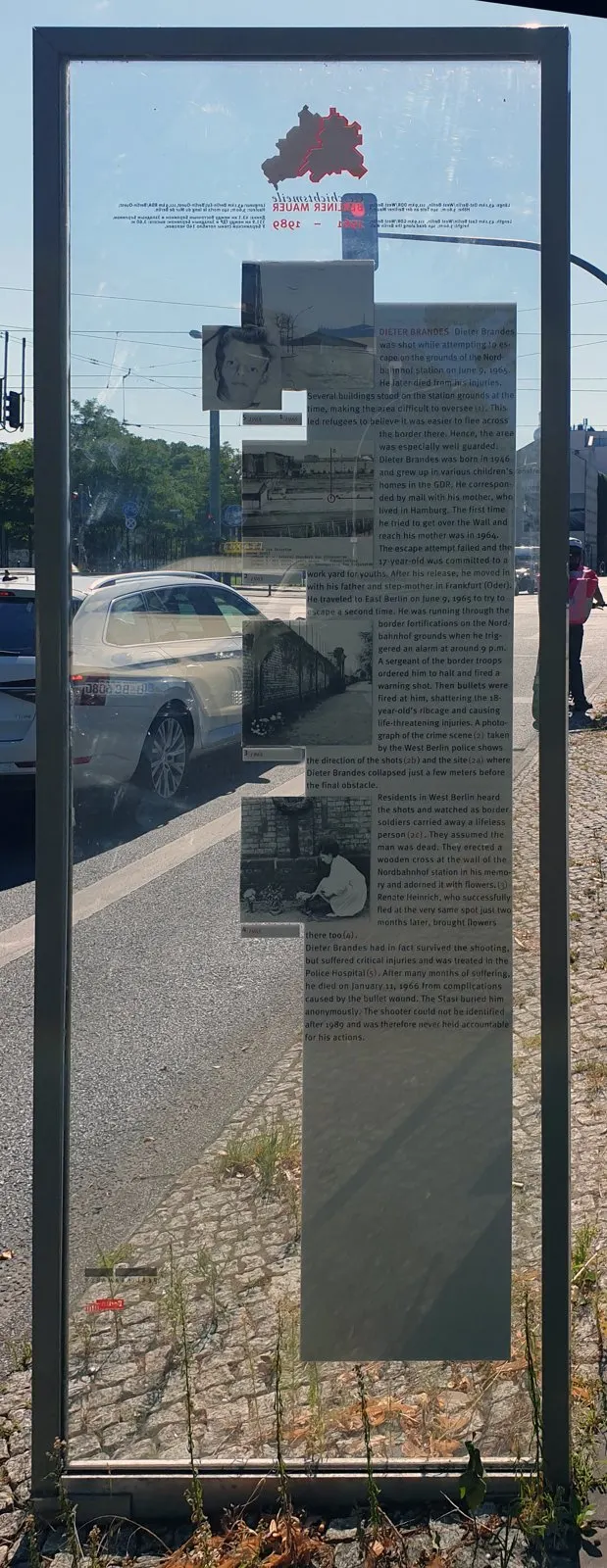
Dieter Brandes, an 18-year-old concrete worker who had grown up in children's homes, was shot on the grounds of the Nordbahnhof station on 9 June 1965 while trying to escape. Paralysed, he died of his wounds in hospital on 11 January 1966.
_Dieter_Brandes.jpg)
Dieter Brandes was born in Frankfurt an der Oder on 23 October 1946. He spent his first sixteen years in a succession of children's homes and later lived in a home for young people in Bad Freienwalde. In June 1964, aged 17, he is said to have tried to escape and failed; as punishment he was sent to a "youth work yard" in Sömmerda, Thuringia, one of the institutions East Germany used to re-educate non-conforming young people and young offenders in line with the socialist state.
After his release at the end of 1964 he went to live with his father and stepmother in Frankfurt an der Oder and worked as an unskilled concrete worker. His natural mother lived in Hamburg, and he was said to be in contact with her by letter. When he did not come home on 9 June 1965, his parents assumed, according to Stasi files, that he was trying once more to reach the West and his mother.
That day he had indeed travelled to East Berlin. In the evening, on the grounds of the Nordbahnhof station in Mitte, he set off an alarm at around 9 p.m. while trying to get through the border installations. This alerted a non-commissioned officer of the border troops who was checking on the guards posted there. When he did not stop despite a call to halt and a warning shot, the NCO opened fire. He fell a few metres short of the last barrier. The soldiers involved and their superiors later received awards for it.
Residents of the Ernst Reuter housing estate in West Berlin watched from their windows and balconies as he was carried away, limp. From their accounts the West Berlin police concluded that he had been at least wounded, perhaps killed. The press reported the failed escape the next day, a wooden cross was put up on Gartenstrasse that evening, and the West Berlin police chief filed a criminal complaint on suspicion of manslaughter against unknown members of Border Regiment 33.
In fact he was still alive. A bullet had shattered his ribcage and badly injured his lung, and after an operation at the People's Police Hospital he woke up paralysed. On 12 June he was moved to the municipal clinic in Berlin-Buch, where he did not recover. A medical report of 31 August said he was often greatly changed mentally and apathetic towards his treatment and his future, and the investigation into his escape attempt was discontinued on 5 October 1965 because he could not be questioned. His father was told of his injuries and allowed to visit him. His condition kept worsening, and he died on 11 January 1966 when his circulation failed.
The ward staff had collected money for him and given him a Christmas present. In a note written two weeks after his death, the Stasi lieutenant in charge worked to counter any impression that he had been a victim, falsely claiming he had used violence and injured border soldiers; whether the staff believed this is not known. Under Stasi pressure his father waived the right to have the urn sent home, and Dieter Brandes was buried anonymously at Baumschulenweg Cemetery. An investigation reopened in October 1990 could not identify the man who shot him, and the proceedings were discontinued on 29 May 1996.
_Dieter_Brandes2.jpg)
Also died on the sector border between Berlin-Mitte and Berlin-Wedding
- Ida Siekmann 22 August 1961
- Rudolf Urban 17 September 1961
- Olga Segler 26 September 1961
- Bernd Lünser 4 October 1961
- Ernst Mundt 4 September 1962
- Otfried Reck 27 November 1962
- Egon Schultz 5 October 1964
- Heinz Cyrus 11 November 1965
- Leo Lis 20 September 1969
Sources
This profile is a summary written for this site. Every fact in it is taken from source 1, which also gives the full account with archival references.
- Christine Brecht, “Dieter Brandes”, biography in Chronik der Mauer, Federal Agency for Civic Education, Centre for Contemporary History Potsdam and Deutschlandradio. Accessed 23 September 2026. Read online. Basis for every fact in this profile, including the dates and place of death.
- German version of the same biography. Accessed 23 September 2026. Read online.
- Hans-Hermann Hertle and Maria Nooke (eds.), The Victims at the Berlin Wall, 1961–1989: A Biographical Handbook. Centre for Contemporary History Potsdam and Berlin Wall Foundation, Berlin 2011. The printed handbook from which the online biography is taken.
- Hans-Hermann Hertle and Maria Nooke, “140 Victims at the Berlin Wall, 1961–1989” (list), Centre for Contemporary History Potsdam and Berlin Wall Foundation, August 2017. PDF. Used to cross-check names and dates.
- Hans-Hermann Hertle and Maria Nooke, “The Victims at the Berlin Wall, 1961–1989: Findings of a Research Project”, August 2017. PDF. Source of the classification into escapees, people with no intent to escape, and border soldiers.
Image credits
- Memorial panel for Dieter Brandes at Gartenstraße, corner of Julie-Wolfthorn-Straße, in Berlin-Mitte, photographed in 2022. OTFW, Berlin, CC BY-SA 3.0, Wikimedia Commons.
- Reverse side of the memorial panel for Dieter Brandes on Gartenstraße, with the English text, photographed in 2022. OTFW, Berlin, CC BY-SA 3.0, Wikimedia Commons.
Cite this page
“Dieter Brandes”, Victims of the Berlin Wall, Berlin Experiences. https://victimsofthewall.com/victims/brandes-dieter/
Map
The pin position is based on the place of death described in source 1. Base map © OpenStreetMap contributors; course of the Wall in 1989 from Geoportal Berlin (dl-de/zero-2.0). Accessed 23 September 2026.