Willi Block
1934–1966
Willi Block, a 31-year-old former border policeman from Berlin, became entangled in barbed wire while trying to escape at Staaken, on the border with Spandau, on 7 February 1966 and was shot by East German border guards as West Berlin police looked on.
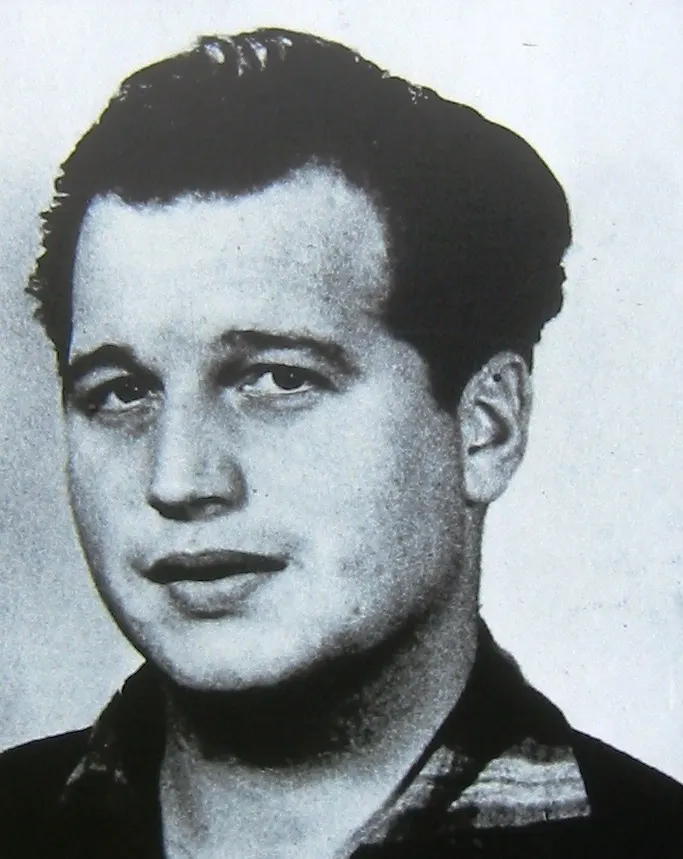

Willi Block was born in Berlin on 5 June 1934. He trained as a construction worker and from 1954 to 1959 served in the East German border police, where he became a tank commander and finally an instructor in Wismar, leaving with the rank of Feldwebel (sergeant) and as a member of the SED, the ruling party. As a member of a workers' militia, he took part in building the Wall in 1961.
He fled to West Berlin for the first time on 13 January 1962, then went back a month later to fetch his wife and was arrested. He was sent to a re-training and labour camp and released after six weeks, partly because his apparently influential father intervened, and while there agreed to inform for the Stasi under the cover name "Rabe", though he apparently refused concrete assignments as an informer. On 18 August 1962 he fled west again and told the authorities about his recruitment, after which proceedings were opened against him at the West Berlin superior court for violating the freedom protection law.
In December 1962, learning that his wife wanted a divorce, he returned to the East once more. This time he was treated as a traitor, accused of spying for western intelligence, and in April 1963 sentenced to five years, which he served in Bautzen. A British intelligence note suggests he had cooperated with a Western intelligence agency, and British officers had no doubt that he was a double agent. Released early in November 1965, he was assigned a job at the Staaken concrete plant near the border, where he often clashed with his supervisors.
On 7 February 1966 he drank so much during his shift that he was not allowed to carry on working; a colleague last saw him asleep on a cot in the lounge at around 3 p.m. Soon afterwards he must have decided to flee once more; unnoticed and in broad daylight, he got past the inner fence and a dog run near the border crossing into Spandau; according to the Stasi, he had come from the direction of Strasse 347, now Albrechtshofer Weg. At around 3:45 p.m. two guards on a watchtower spotted him; they fired a flare and a barrage, and shots struck the ground in front of him. He tried to crawl under the three coils of barbed wire between him and West Berlin, but his clothes caught in the second coil and he was held fast, lying on his stomach.
West Berlin customs officers and police arrived, soon followed by an ambulance, and tried to make contact with him. He called out that he was unhurt, gave the name of his brother, who lived in West Berlin, and asked them to pass on his regards. Guards on the eastern side, joined by their regiment commander, surrounded him; when an officer called on him to come back, he answered that he could not. For a few minutes nothing happened. Then, as he tried once more to pull himself towards the West, a number of guards opened fire, among them the regiment commander, who emptied his pistol and then fired a Kalashnikov from 15 metres. Seventy-two shots were fired; four hit him, three of them fatal.
His body had to be cut free from the wire. Two border soldiers on their way to their barracks glimpsed it on a truck and decided on the spot to flee, unwilling to find themselves having to shoot at an escapee; they reached West Berlin together that same evening. Three days later a Potsdam prosecutor told his father that his son had died in an accident during an attempt to break through the border for which he himself was to blame, made him sign an undertaking to keep the circumstances secret, and required an urn burial at Baumschulenweg Cemetery.
In 1993 four former officers and guards were charged with attempted manslaughter. The chief of staff and both guards were acquitted by the Berlin Regional Court in January 1995 because it could not be proved that they had aimed at him or acted together with the one who fired the fatal shots. In the separate proceedings against the regiment commander it could not be established who had fired the fatal shots, although it was considered highly probable that he had. In February 1995 he was convicted of attempted manslaughter; after the prosecution appealed, the Federal Court of Justice ruled in March 1996 that he was guilty of manslaughter, and in April 1997 the Berlin Regional Court sentenced him to three years in prison, not suspended. In its first judgment the court had said that his conduct at the scene bore the character of an (attempted) execution.


Read more
Also died on the outer ring between Berlin-Spandau and Staaken
- Dieter Wohlfahrt 9 December 1961
Sources
This profile is a summary written for this site from the biography in source 1, which also gives the full account with archival references. Facts taken from other sources are listed below with what they support.
- Martin Ahrends/Udo Baron/Hans-Hermann Hertle, “Willi Block”, biography in Chronik der Mauer, Federal Agency for Civic Education, Centre for Contemporary History Potsdam and Deutschlandradio. Accessed 23 September 2026. Read online. The biography from which this profile was written, and the source of the dates and place of death.
- German version of the same biography. Accessed 23 September 2026. Read online.
- Stasi (MfS) report on his attempted escape and shooting, 8 February 1966 (BStU, BV Potsdam AP 1114/76), transcript in Chronik der Mauer. Accessed 29 September 2026. Read online. Source for: that he came from the direction of Strasse 347.
- “Mauerweg: Von Staaken nach Hennigsdorf”, Berlin.de. Accessed 3 October 2026. Read online. Source for: with the Veikkos-Archiv entry, that Strasse 347 is today’s Albrechtshofer Weg (both locate his memorial cross).
- “Willi Block (Denkmal)”, Veikkos-Archiv. Accessed 29 September 2026. Read online. Source for: with the Berlin.de route guide, that Strasse 347 is today’s Albrechtshofer Weg.
- Bundesgerichtshof, judgment of 4 March 1996, 5 StR 494/95 (BGHSt 42, 65) Read online. Source for: the criminal proceedings after the death.
- Fernschreiben an das Bundesministerium für gesamtdeutsche Fragen, 11 February 1966 (BArch B 137/6429), transcript on Chronik der Mauer Read online. Source for: the criminal proceedings after the death.
- Hans-Hermann Hertle and Maria Nooke (eds.), The Victims at the Berlin Wall, 1961–1989: A Biographical Handbook. Centre for Contemporary History Potsdam and Berlin Wall Foundation, Berlin 2011. The printed handbook from which the online biography is taken.
- Hans-Hermann Hertle and Maria Nooke, “140 Victims at the Berlin Wall, 1961–1989” (list), Centre for Contemporary History Potsdam and Berlin Wall Foundation, August 2017. PDF. Used to cross-check names and dates.
- Hans-Hermann Hertle and Maria Nooke, “The Victims at the Berlin Wall, 1961–1989: Findings of a Research Project”, August 2017. PDF. Source of the classification into escapees, people with no intent to escape, and border soldiers.
Corrections
This profile was corrected on 24, 28 and 29 September and 3 October 2026. Each round of corrections is described in the corrections log:
-
: Court outcomes checked against the German originals
- Corrected his earlier case in West Berlin: proceedings were opened against him at the Kammergericht for violating the freedom protection law; the court did not charge him.
- Added the charge brought in 1993 against four former officers and guards: attempted manslaughter.
- Corrected the course of the trial: the main defendant was first convicted of attempted manslaughter and only after an appeal by the prosecution and a ruling of the Federal Court of Justice convicted of manslaughter, with three years in prison without probation; the Federal Court of Justice did not pass the sentence itself.
- : All profiles and articles cross-checked against the German originals
-
: Corrections from the research for the book
- Moved the map pin about 3 km north, from the Heerstraße crossing to Finkenkruger Weg opposite the end of Albrechtshofer Weg in Staaken: the Stasi report of 8 February 1966 says he came from the direction of today's Albrechtshofer Weg and was seen from the watchtower at the “Heuweg barrier”, and his memorial cross stands on Finkenkruger Weg. The pin remains approximate.
- Corrected the description of where he was shot: at Staaken, on the border with Spandau, in the Albrechtshof area; according to the Stasi report, he had come from the direction of what is now Albrechtshofer Weg. The profile had placed it near the Staaken border crossing to Spandau; his biography says only “near the Staaken border crossing”.
- : Every profile checked against all the sources
Further reading
Image credits
- Willi Block, photographed from an information column in Berlin-Staaken (photo: ullstein bild). Assenmacher, CC BY-SA 3.0, Wikimedia Commons.
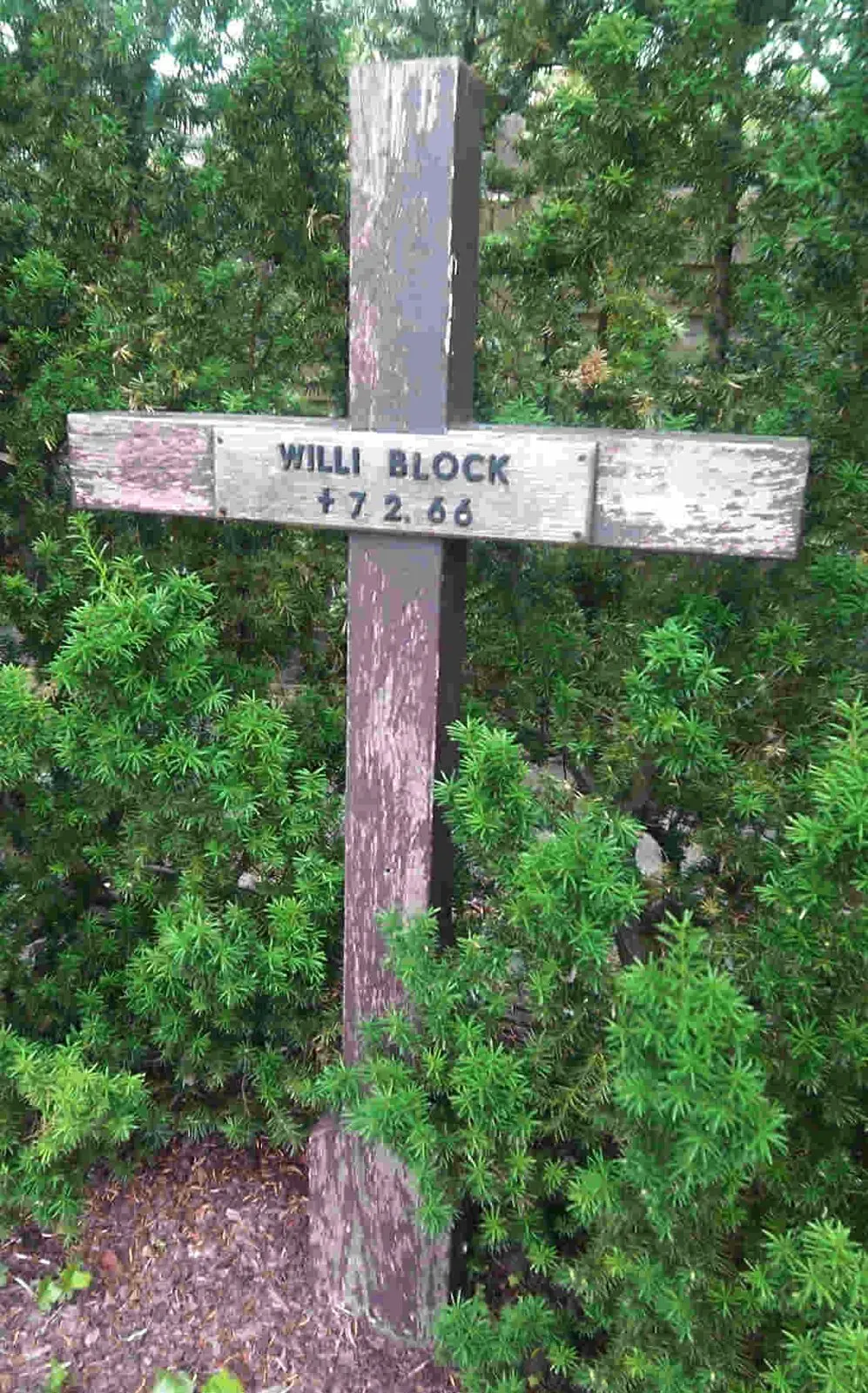
- Memorial cross for Willi Block on Finkenkruger Weg in Berlin-Staaken, photographed in 2009. Pemba.mpimaji, Public domain, Wikimedia Commons.
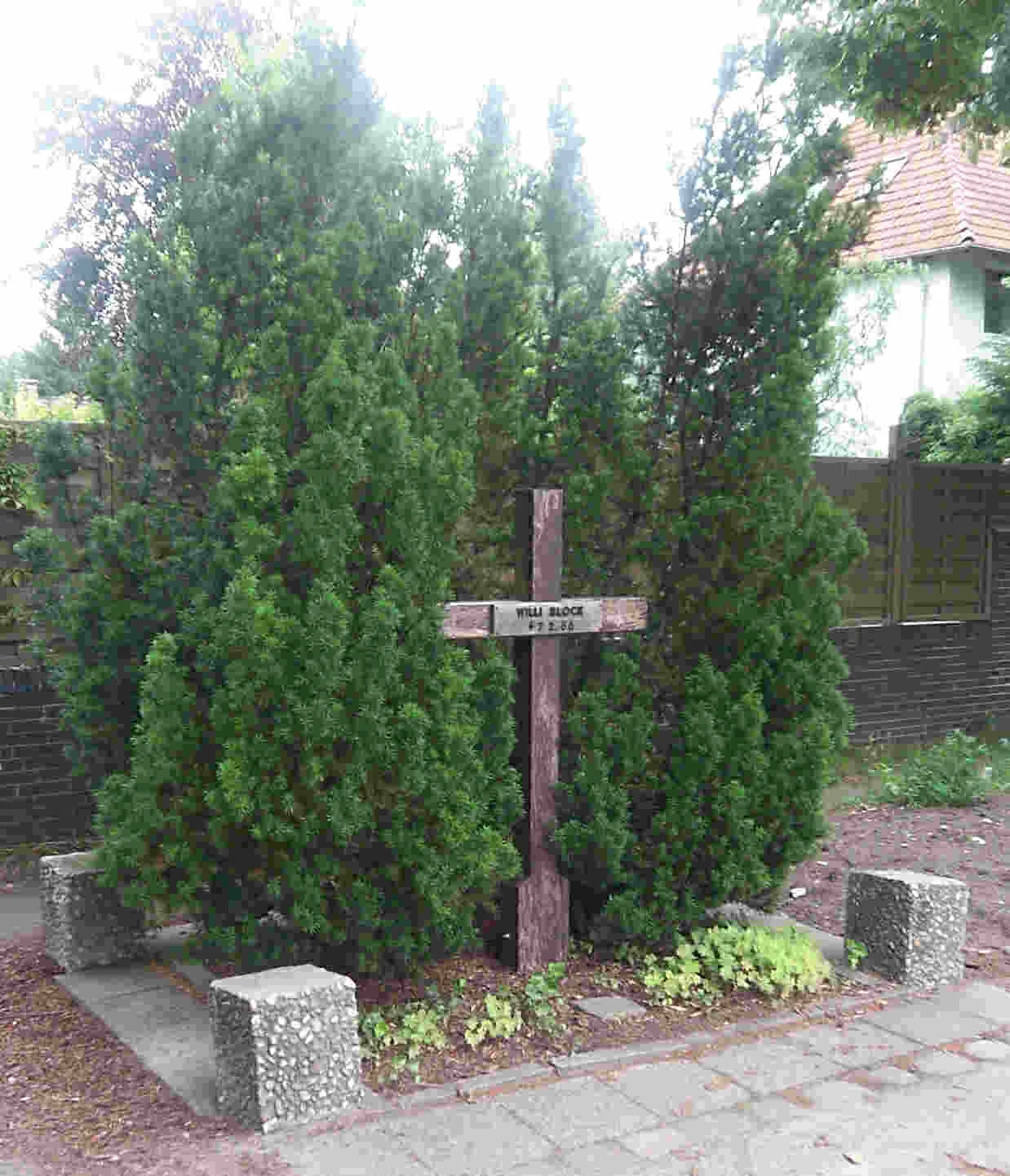
- The memorial cross for Willi Block in Staaken, set between conifers, photographed in 2009. Pemba.mpimaji, Public domain, Wikimedia Commons.
Cite this page
“Willi Block”, Victims of the Berlin Wall, Berlin Experiences. https://victimsofthewall.com/victims/block-willi/
Map
The pin position is based on the place of death described in source 1. Base map © OpenStreetMap contributors; course of the Wall in 1989 from Geoportal Berlin (dl-de/zero-2.0). Accessed 23 September 2026.