Dieter Wohlfahrt
1941–1961
Dieter Wohlfahrt, a 20-year-old chemistry student and escape helper from West Berlin, was shot dead by East German border police on 9 December 1961 at the corner of Bergstrasse and Hauptstrasse in Staaken while helping a woman flee.
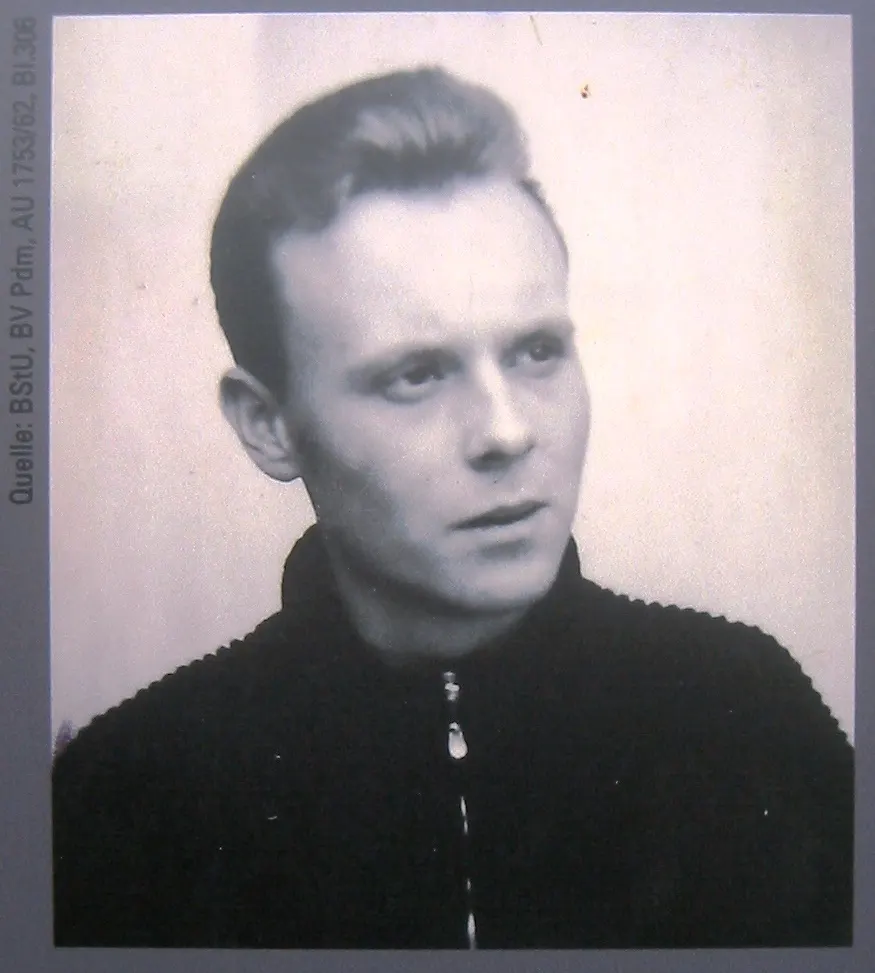

Dieter Wohlfahrt was born on 27 May 1941 in Berlin-Schöneberg and grew up, the eldest of three children in an educated Catholic family, in Hohen Neuendorf, just north of Berlin. Like his late father and his siblings he held Austrian citizenship, which allowed him to cross freely into West Berlin and West Germany. Refused a place at secondary school in East Germany at 14, he moved in with an aunt in West Berlin and attended the Bertha-von-Suttner School, whose special classes for pupils from the East brought together a close circle of friends.
When the border was sealed in August 1961, he was studying chemistry at the Technical University. He did not hesitate to help former classmates and their families to escape, joining a group of students that devised ways around the barriers. In the first weeks they brought people out through the sewers; with his Austrian passport, Dieter could go into East Berlin and discreetly open and close the manhole covers. Friends who reached the West this way remembered him as a quiet, unassuming young man who showed unexpected courage and determination and became completely absorbed in this work.
He readily offered his help to a 17-year-old girl who had recently fled from Staaken and wanted to bring her mother across at the same spot. On 9 December 1961 Dieter and friends drove to the corner of Bergstrasse and Hauptstrasse on the edge of Spandau. At around 7 p.m. he and a friend stepped over the rope marking the border and set to work with bolt cutters and pliers on the three-row barbed-wire fence. His friend later recalled that the mother suddenly came towards them from the other side, calling anxiously for her daughter; moments later someone shouted an order to halt in the name of the border police, and the first shots were fired almost at once. His friend crawled back to the West unhurt; Dieter lay motionless in East German territory, five or six metres from the border.
West Berlin police officers, who arrived soon afterwards, as did British military police, tried to reach him but were stopped by East German guards threatening to use their weapons, and no help came from the eastern side. He lay between the barbed wire for more than an hour, showing no sign of life, before he was taken away. East German authorities claimed that the young escape helpers had been armed and had opened fire, a claim western investigators rejected as propaganda because his friends credibly assured them that none of them had been armed. Confidential East German military and Stasi reports, which show that the border police lured him into an ambush that evening, nonetheless presented him as armed and as having fired first; there is good reason to suspect that these documents were falsified or manipulated for propaganda, but it cannot be proven. The criminal investigation of the former border policemen who shot him was discontinued in 1996 on the grounds that, given the doubt, they had to be assumed to have acted in self-defence.
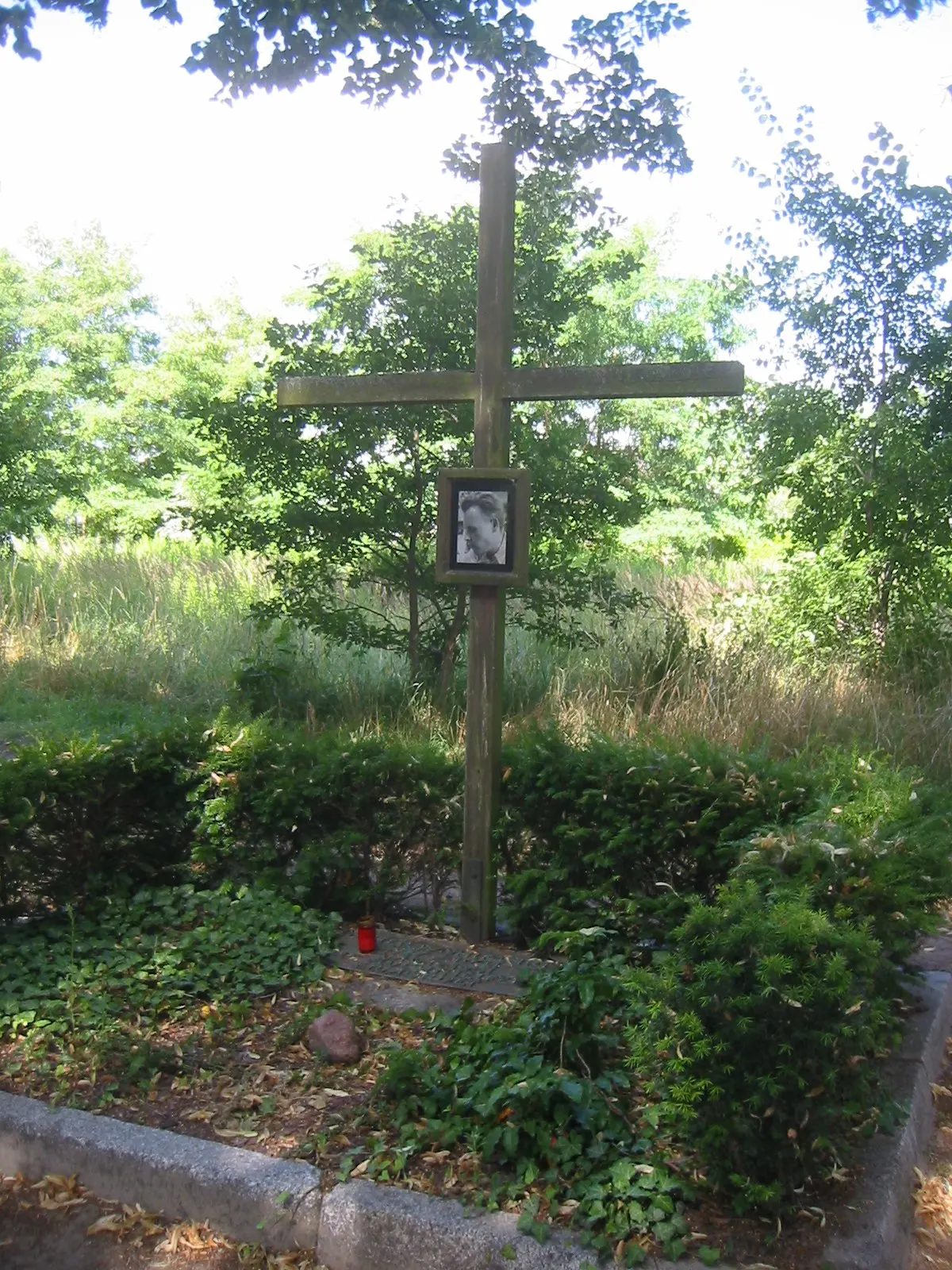
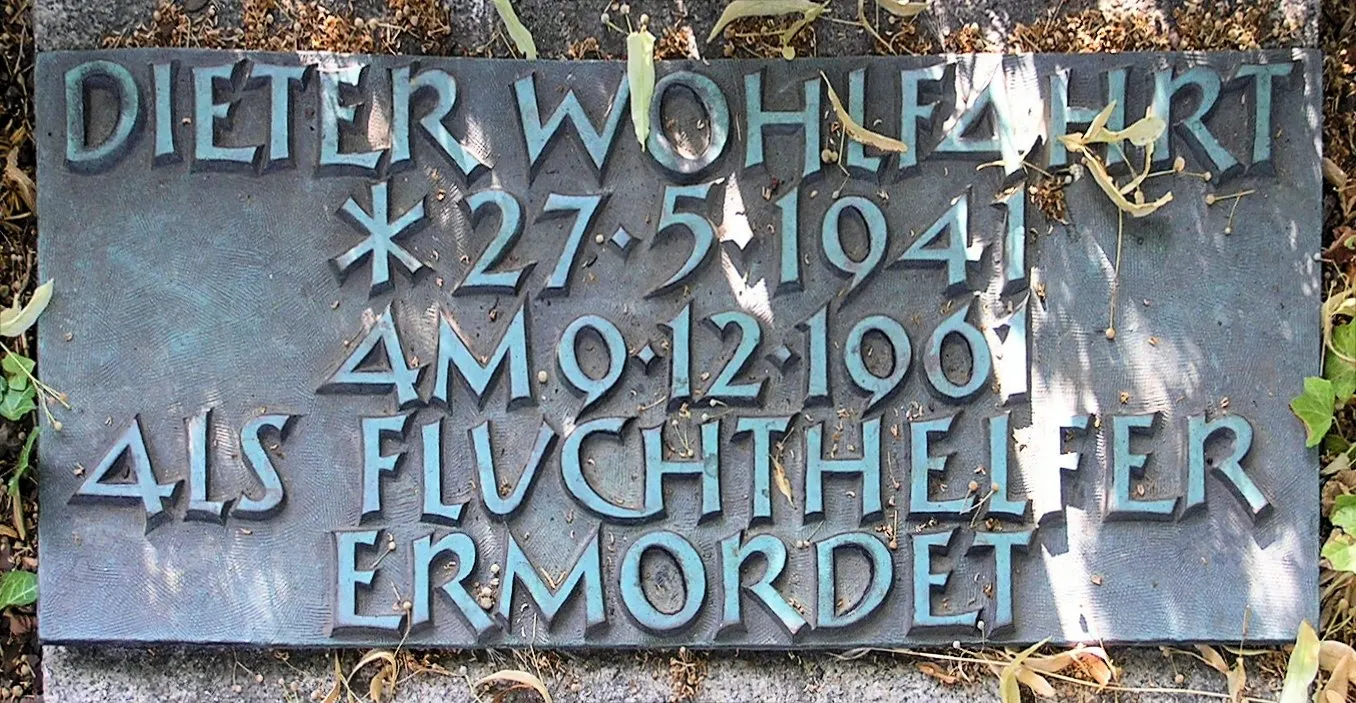
His mother and siblings were questioned by the Stasi, and only his family was allowed to attend the funeral in Nauen on 14 December. In West Berlin, at the initiative of the Catholic student community, a requiem was held in St Matthias Church in Schöneberg, and professors remembered him in lectures. Student representatives wrote an open letter to the Allied city commanders, the Governing Mayor and the interior senator, saying they could not understand why neither the police nor the British protecting power had found a way to help the wounded man. A wooden cross marked the spot, and a commemorative column was added in 2011. On the 50th anniversary of his death, a plaque was placed at his former school.

_Dieter_Wohlfahrt.jpg)
Read more
Also died on the outer ring between Berlin-Spandau and Staaken
- Willi Block 7 February 1966
Sources
This profile is a summary written for this site. Every fact in it is taken from source 1, which also gives the full account with archival references.
- Christine Brecht, “Dieter Wohlfahrt”, biography in Chronik der Mauer, Federal Agency for Civic Education, Centre for Contemporary History Potsdam and Deutschlandradio. Accessed 23 September 2026. Read online. Basis for every fact in this profile, including the dates and place of death.
- German version of the same biography. Accessed 23 September 2026. Read online.
- Hans-Hermann Hertle and Maria Nooke (eds.), The Victims at the Berlin Wall, 1961–1989: A Biographical Handbook. Centre for Contemporary History Potsdam and Berlin Wall Foundation, Berlin 2011. The printed handbook from which the online biography is taken.
- Hans-Hermann Hertle and Maria Nooke, “140 Victims at the Berlin Wall, 1961–1989” (list), Centre for Contemporary History Potsdam and Berlin Wall Foundation, August 2017. PDF. Used to cross-check names and dates.
- Hans-Hermann Hertle and Maria Nooke, “The Victims at the Berlin Wall, 1961–1989: Findings of a Research Project”, August 2017. PDF. Source of the classification into escapees, people with no intent to escape, and border soldiers.
Further reading
Image credits
- Portrait of Dieter Wohlfahrt on an information column at Finkenkruger Weg, Berlin-Staaken (original photo: BStU). Assenmacher, CC BY-SA 3.0, Wikimedia Commons.
- Wooden memorial cross for Dieter Wohlfahrt at the corner of Hauptstrasse and Bergstrasse, Berlin-Spandau. Assenmacher, CC BY-SA 3.0, Wikimedia Commons.
- Memorial plaque for Dieter Wohlfahrt, Bergstrasse 38, Berlin-Staaken. OTFW, Berlin, CC BY-SA 3.0, Wikimedia Commons.
Cite this page
“Dieter Wohlfahrt”, Victims of the Berlin Wall, Berlin Experiences. https://victimsofthewall.com/victims/wohlfahrt-dieter/
Map
The pin position is based on the place of death described in source 1. Base map © OpenStreetMap contributors; course of the Wall in 1989 from Geoportal Berlin (dl-de/zero-2.0). Accessed 23 September 2026.