Lothar Lehmann
1942–1961
Lothar Lehmann, a 19-year-old from Falkensee serving in a police unit guarding the border, died on 26 November 1961 after trying to swim across the Havel from Sacrow to West Berlin, suffering a cold shock in the water.
_SED_Opfer.jpg)
Only fragments of Lothar Lehmann's life are known. Official records disagree on whether he was born on the 28th or the 29th of January 1942, and it is unclear whether he was born in East Prussia or in Falkensee, the community bordering Spandau where he grew up with foster parents and went to school. After eighth grade he trained as a metalworker at an agricultural machinery works in Falkensee. In his free time he bred pigeons and went cycling with a works sports group.
In September 1961, weeks after the Wall was built, he began military service. It was formally voluntary, but young men were under heavy pressure to enlist. He was assigned to the standby police (Bereitschaftspolizei) in Gross Glienicke, not far from his home; his unit was one of the so-called border readiness units guarding the border between Potsdam district and West Berlin.
Why he decided to flee is not known, but it does not seem to have been sudden. In early November he let his mother know that he wanted to go to the West. While on leave he casually asked her for the address of relatives in West Germany, remarking that they would be surprised when he turned up. When she warned him that people were being shot at the border, he told her it would be fine.
On 26 November 1961 he was repairing boats on the bank of the Havel at Sacrow, an area he knew from his cycling. The border with Zehlendorf ran down the middle of the river. Towards evening, unobserved, he entered the water in a life jacket to swim across. The cold seems to have sent him into shock and he lost consciousness. Border guards found him in this state, pulled him out and set off with him to the Potsdam District Hospital. According to a report by the East Berlin city command, he died on the way, at around 9 p.m., despite attempts to revive him. The autopsy found indirect drowning due to cold shock and circulatory collapse, which investigations in the 1990s confirmed.
According to his mother's statement in 1992, border police told his parents that same evening that he had drowned while trying to desert; in the questioning that followed they had to hear their son portrayed as a criminal. Afraid of being treated as an accomplice, his mother did not admit she had known of his plans. The authorities demanded that they keep the escape attempt secret from outsiders, and at his funeral in Falkensee his death could be spoken of only as an accident. His friend Wolfgang S. doubted the official story; by his own account he questioned two border police officers and people in Sacrow and found out where it had happened, and after escaping to West Berlin in January 1962 told the authorities. Since then Lothar Lehmann has been officially recorded in the West as a victim of the Wall. A photograph in the biography shows a commemorative column for him at the ferry dock in Sacrow.
Read more
Also died on the outer ring between Berlin-Zehlendorf and Sacrow
- Erna Kelm 11 June 1962
Sources
This profile is a summary written for this site. Every fact in it is taken from source 1, which also gives the full account with archival references.
- Christine Brecht, “Lothar Lehmann”, biography in Chronik der Mauer, Federal Agency for Civic Education, Centre for Contemporary History Potsdam and Deutschlandradio. Accessed 23 September 2026. Read online. Basis for every fact in this profile, including the dates and place of death.
- German version of the same biography. Accessed 23 September 2026. Read online.
- Hans-Hermann Hertle and Maria Nooke (eds.), The Victims at the Berlin Wall, 1961–1989: A Biographical Handbook. Centre for Contemporary History Potsdam and Berlin Wall Foundation, Berlin 2011. The printed handbook from which the online biography is taken.
- Hans-Hermann Hertle and Maria Nooke, “140 Victims at the Berlin Wall, 1961–1989” (list), Centre for Contemporary History Potsdam and Berlin Wall Foundation, August 2017. PDF. Used to cross-check names and dates.
- Hans-Hermann Hertle and Maria Nooke, “The Victims at the Berlin Wall, 1961–1989: Findings of a Research Project”, August 2017. PDF. Source of the classification into escapees, people with no intent to escape, and border soldiers.
Further reading
Image credits
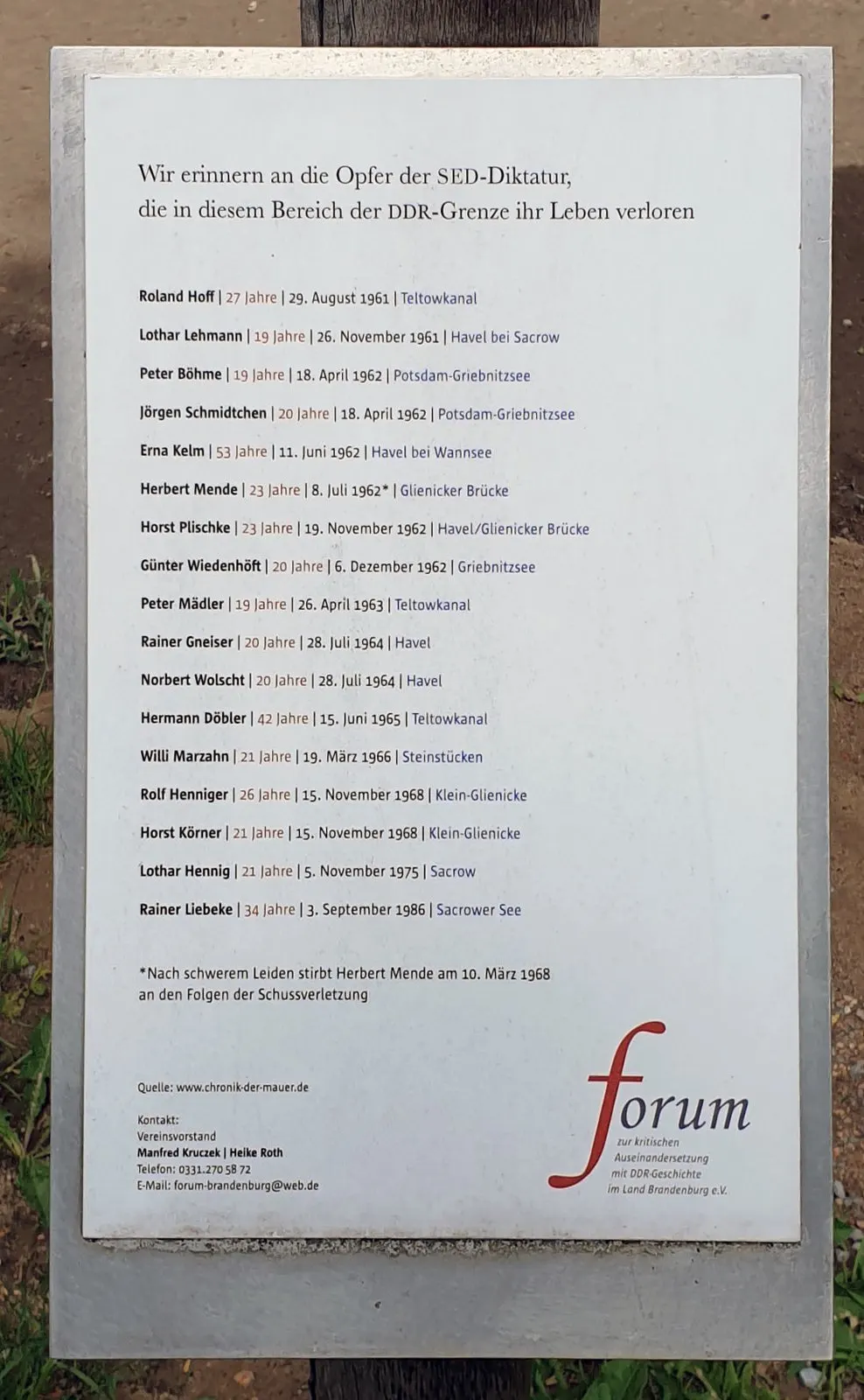
- Memorial plaque on Stubenrauchstraße in Babelsberg remembering the victims of the SED dictatorship who lost their lives on this section of the GDR border; the second entry is Lothar Lehmann, aged 19, 26 November 1961, Havel near Sacrow. Photographed in 2020.. OTFW, Berlin, CC BY-SA 3.0, Wikimedia Commons.
Cite this page
“Lothar Lehmann”, Victims of the Berlin Wall, Berlin Experiences. https://victimsofthewall.com/victims/lehmann-lothar/
Map
The pin position is based on the place of death described in source 1. Base map © OpenStreetMap contributors; course of the Wall in 1989 from Geoportal Berlin (dl-de/zero-2.0). Accessed 23 September 2026.