Who Was Peter Fechter? The 18-Year-Old Shot at the Berlin Wall
Peter Fechter, an 18-year-old bricklayer from East Berlin, was shot at the Wall near Checkpoint Charlie on 17 August 1962 and lay there wounded for 50 minutes.

Peter Fechter was an 18-year-old bricklayer from East Berlin who was shot while trying to climb the Berlin Wall on Zimmerstrasse, close to Checkpoint Charlie, on 17 August 1962. Hit by border guards’ bullets, he lay badly wounded at the foot of the Wall for 50 minutes, watched by many people on both sides. His calls for help had fallen silent by the time East German border troops carried him away, and he was declared dead shortly afterwards.
He was not the first person to die at the Wall: that was Ida Siekmann, on 22 August 1961, and the first to be shot dead was Günter Litfin, two days later (see the first victims of the Berlin Wall). But photographers and a television crew were present that afternoon, and the pictures of his death went around the world. Christoph Hamann, writing in the journal Zeithistorische Forschungen in 2005, observes that many people even think of him as the first person to die at the Wall. He connects that perception with the memorial on Zimmerstrasse, the wreaths laid there every year and the television documentaries shown in 1997, the year two of the guards who had fired on him were tried.
A quiet teenager from Weissensee
Peter Fechter was born in Berlin on 14 January 1944, during the war, the third of four children. He was his parents’ only son and grew up in a family of modest means in Weissensee; his father was a machine builder by trade, his mother a sales assistant. At 14 he left school and started training as a bricklayer. Bricklaying was a sought-after trade at the time, with the post-war rebuilding still under way. His eldest sister had married and lived in the western part of the city; before the Wall was built, the family reportedly visited her regularly. His biography describes him as a quiet, inconspicuous young man.
While he was still working towards his journeyman’s examination, he met Helmut K., who was training at the same firm. From the start of 1962 the two were part of the team rebuilding the former Kaiser-Wilhelm-Palais on Unter den Linden. Stasi files show that the firm’s personnel department had turned down his request to travel to West Germany; his biography suggests this may have been one of his reasons for wanting to leave. His work assessment was nevertheless faultless; it called him “a willing and hard-working skilled worker”. Helmut K. told the West Berlin police that Peter Fechter had been “a good colleague, sincere and honest”, although, he added, the two were not really friends.
The escape attempt on 17 August 1962
In the same statement, Helmut K. said that escape had been on both their minds for some time and that they had scouted the border for a good opportunity, though without a concrete plan or any particular preparations. A Stasi investigation after the shooting likewise found “no evidence of a prepared border breach”. The place they used was one they had come across while roaming the area, he said: a ruined building on Schützenstrasse with a carpentry workshop inside, whose rear windows gave onto Zimmerstrasse, almost at the Wall. Two days after finding it, they skipped the return to the building site after their lunch break and, without having planned it, went to look round the building instead.
Helmut K. described how they got through the workshop unnoticed to a storeroom at the back with a window that had not yet been bricked up, how voices heard after a while made them fear discovery, and how they jumped out and, having already taken off their shoes, ran the few metres to the Wall in their socks. They reached it on Zimmerstrasse between Charlottenstrasse and Markgrafenstrasse. The first report of shots reached the West Berlin police at 2.12 p.m.
Helmut K. said that Peter Fechter froze when the first shots were fired. He himself jumped up, squeezed through the barbed wire on top of the Wall and reached West Berlin. Peter Fechter did not follow him. Border troop files show that the guards opened fire without warning: four border guards fired 35 shots in all. According to the border troops’ report, Peter Fechter was hit as he jumped at the Wall, slid back and then stood behind a reinforcement of the Wall. The Chronik der Mauer concludes from this that he had already given up trying to escape by then. Although he was defenceless, it continues, the guards did not arrest him. They moved to a different position, and their fire stopped only when he collapsed.
Fifty minutes at the foot of the Wall
Badly wounded, he called loudly for help. The guards who had shot him took cover, ostensibly because they felt threatened by West Berlin police officers, who by then were aiming rifles at them from across the Wall, and for a long time there was no movement at all on the East Berlin side. In the West, police officers climbed a ladder, asked him his name over the top of the Wall and threw him bandages; none of them dared to climb over and help him. The American military police at nearby Checkpoint Charlie would not risk setting foot on East Berlin ground either, fearing a military conflict at a time when responsibilities in the divided city were still in political dispute. One of them is said to have remarked: “It’s not our problem.”
The Chronik der Mauer’s page on the memorial site adds context for both sides. For the West Berlin police and the Allied guards, it points to the tank standoff of ten months before and their fear of starting a military conflict. On the East German side, no guard could enter the border strip unless an officer on duty ordered it, and the officer responsible arrived only half an hour after the shooting.
Fifty minutes had passed, and he had fallen silent, when members of the East German border troops finally took him away under cover of an artificial smokescreen. East German radio announced his death that same evening, after it had been officially recorded at the People’s Police Hospital in East Berlin.
The photographs
Photographers and camera crews on the western side had recorded his dying, and their pictures were soon seen around the world. According to Hamann, a television team was filming a report on the border that day and several press photographers were present. In Hamann’s account, one photograph above all fixed his death in the minds of the western public. Taken by the photojournalist Wolfgang Bera, it shows East German border guards carrying Peter Fechter away; it appeared large on the front page of the Berliner Morgenpost on 18 August 1962. Pictures were also taken from the East Berlin side, but the Stasi confiscated them, and they became public only after 1989.
Hamann contrasts his case with that of the student Dieter Wohlfahrt, who was shot at Staaken in December 1961 while helping people escape. There were no photographs or film of that failed escape attempt, Hamann points out, and nothing like the reaction to Peter Fechter’s death followed. Peter Fechter’s own Chronik der Mauer biography says that the pictures made his death a symbol of the inhumanity of the East German border regime, and notes that no chronicle of the 20th century or history of the Cold War leaves out his name.
Protests in West Berlin
His death caused outrage in West Berlin, and protests began within hours. The Chronik der Mauer records rallies and riots through the night and on the days that followed, directed both at the Wall and at the American protecting power for doing nothing. According to Hamann, around 5,000 demonstrators tried to push through to Checkpoint Charlie and the Wall; he describes these as the first anti-American demonstrations since the Second World War. On 18 August the American city commandant, Major General Albert E. Watson, called what had happened “an act of barbaric inhumanity”. From 21 August an Allied ambulance was stationed at Checkpoint Charlie.
Some West Berliners laid flowers and wreaths at the Wall. Dieter Beilig, a young West Berliner who protested against the Wall, set up a wooden cross as close to the Wall as he could, its inscription “Wir klagen an” (“We accuse”) facing East Berlin. Beilig himself was later taken into custody in East Berlin and shot there, in 1971. A few days after Peter Fechter’s death, on 23 August 1962, the transport policeman Hans-Dieter Wesa was shot dead by a fellow transport policeman at Bornholmer Strasse, although he had already climbed the border fence into West Berlin, and in West Berlin there was concern that mass protests might break out again.
How East Germany responded
Mistakes were later conceded. A Stasi report dated 18 August 1962 called for ways of getting injured people out of the border area quickly in such cases, not least to deny the adversary arguments for its “agitation”. Official reports, however, went on blaming the West Berlin police, photographers and camera crews for delaying the recovery. The regime’s chief propagandist used the television programme Der schwarze Kanal to disparage the dead teenager, declaring that the life of each of the state’s young men in uniform mattered more than “the life of a lawbreaker”. That broadcast went out on the day Peter Fechter was buried in Weissensee, in the cemetery of the Resurrection congregation.
His death also had practical consequences at the border. Order 56/62, a response to his death, was meant to ensure that fugitives shot or injured at the Wall were taken out of sight of the western public as fast as possible. When Ernst Mundt was shot at the Sophien Cemetery on 4 September 1962, the border troop leadership counted it a success that he had been taken away before West Berlin police officers, reporters or cameramen got there. And when Anton Walzer was killed in the Spree in October 1962, boats were placed in front of the divers recovering his body to block the view from West Berlin.
The family and the trial
Beyond the loss itself, his relatives suffered reprisals from the East German authorities for decades. His gravestone was inscribed “Allen unvergessen” (“unforgotten by all”).
In July 1990 Peter Fechter’s sisters filed a criminal complaint. The investigation it started ended with two of the guards who had fired being convicted: on 5 March 1997 the Berlin Regional Court found them guilty of manslaughter and sentenced them to 20 and 21 months in prison; both sentences were suspended. His youngest sister, Ruth Fechter, took part in the trial as a joint plaintiff and spoke through her lawyer about how her brother’s death, the family’s helplessness as he was publicly defamed, and the silence imposed on them had shaped their lives. The researchers of the victims project quote her calling the experience of exclusion, and of living every day with images of an enemy forced on the family from outside, “a fundamental experience for the Fechter family”. She added that the legal view sometimes overlooked how, in this case, world history had fatally crossed the fate of one individual. The trials of this period are described in the Berlin Wall shooting trials.
The memorial on Zimmerstrasse
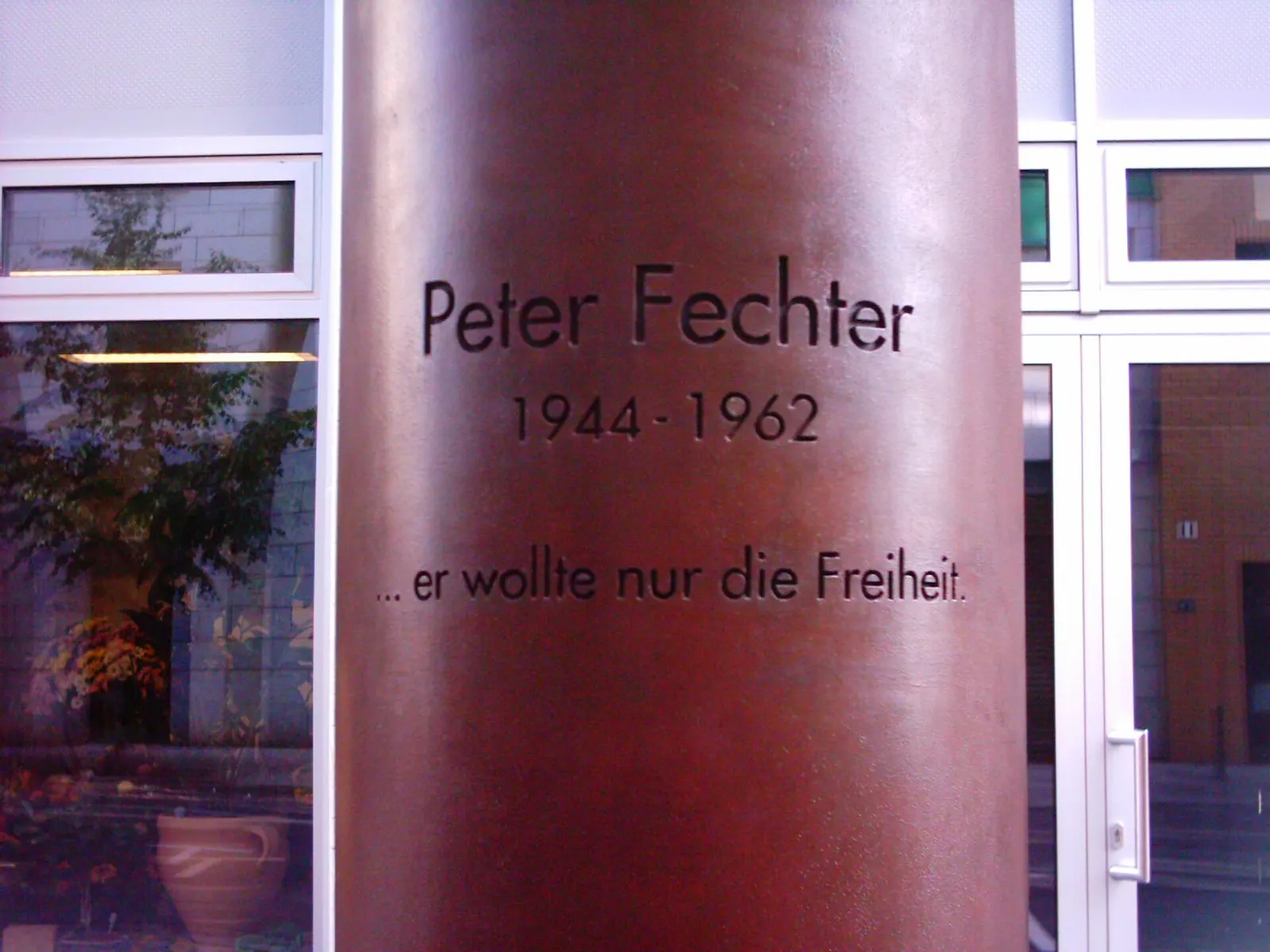
According to the Berlin Senate’s 2006 memorial concept, the memorial goes back to the spontaneous protest on the day he died, and it was tended and altered several times after that. A second wooden cross later took the place of Beilig’s; politicians from Germany and abroad came to see it, as did tourists and representatives of civic initiatives. The Axel Springer publishing house, which acquired the land in 1996, held a competition in 1998 to redesign the site, and the jury chose the design of the Berlin sculptor Karl Biedermann. His 2.60-metre steel column replaced the wooden cross on 13 August 1999. It stands on Zimmerstrasse in Berlin-Mitte, about 200 metres from the former Checkpoint Charlie, and bears the words “Peter Fechter 1944 – 1962 …er wollte nur die Freiheit” (“he only wanted freedom”). A granite slab in front of it marks the exact spot where he lay. Citizens and politicians gather there every year to remember the victims of the Wall.
According to the Chronik der Mauer, Biedermann’s hope that the column-and-slab form would be reused to remember other Wall victims around the city was not fulfilled. The Senate’s memorial concept does record one related design: the memorial column for Chris Gueffroy, the last refugee to be shot while trying to get across the border installations, was set up in 2003, its design deliberately modelled on the Fechter memorial and also by Biedermann. Other places of remembrance are described in Berlin Wall victims memorials, and the surviving pieces of the Wall itself are mapped at Where Is the Wall.
Questions and answers
- Who was Peter Fechter?
- Peter Fechter was an 18-year-old bricklayer from the East Berlin district of Weissensee. On 17 August 1962 he tried to climb the Wall on Zimmerstrasse, near Checkpoint Charlie, with a colleague from work. Border guards shot him, and he died after lying wounded at the foot of the Wall for 50 minutes.
- How long did Peter Fechter lie at the Wall before he was taken away?
- Fifty minutes. By the time East German border troops carried him away, his cries for help had stopped. He was declared dead shortly afterwards in the East Berlin People's Police Hospital.
- Why was Peter Fechter left lying at the Wall for so long?
- On the East German side, guards could only enter the border strip if an officer on duty ordered it, and the officer in charge arrived half an hour after the shooting. On the western side, neither the West Berlin police nor the American military police crossed the Wall, for fear of starting a military conflict.
- Were the guards who shot Peter Fechter ever punished?
- In July 1990 his sisters filed a criminal complaint. In 1997 the Berlin Regional Court found two of the guards who had fired guilty of manslaughter and sentenced them to 20 and 21 months in prison, suspended.
- Where is the Peter Fechter memorial?
- On Zimmerstrasse in Berlin-Mitte, about 200 metres from the former Checkpoint Charlie. A 2.60-metre steel column by the sculptor Karl Biedermann was unveiled there on 13 August 1999, and a granite slab in front of it marks the place where he lay.
Sources
- Chronik der Mauer: Peter Fechter (English)
- Chronik der Mauer: Peter Fechter (German)
- Hertle/Nooke, The Victims at the Berlin Wall, 1961–1989: Findings of a Research Project (2017)
- Chronik der Mauer: The Memorial Site for Peter Fechter
- Chronik der Mauer: Der Gedenkort für Peter Fechter
- Chronik der Mauer: Chronik August 1962
- Christoph Hamann, Schnappschuss und Ikone. Das Foto von Peter Fechters Fluchtversuch 1962, Zeithistorische Forschungen 2 (2005)
- bpb, Deutschland-Chronik: 17. August 1962
- Gesamtkonzept zur Erinnerung an die Berliner Mauer (Berlin Senate, 2006)
- Berlin Wall Foundation: Memorial Site for Peter Fechter
- Chronik der Mauer: Ernst Mundt
- Chronik der Mauer: Anton Walzer
- Chronik der Mauer: Hans-Dieter Wesa
- Chronik der Mauer: Dieter Beilig
Every fact in this article was checked against these sources. To report an error, email info@berlinexperiences.com.
Cite this page
“Who Was Peter Fechter? The 18-Year-Old Shot at the Berlin Wall”, Victims of the Berlin Wall, Berlin Experiences. https://victimsofthewall.com/articles/who-was-peter-fechter/
A Berlin Experiences project