Hans-Dieter Wesa
1943–1962
Hans-Dieter Wesa, a 19-year-old East German transport police officer, was shot dead by a fellow guard on 23 August 1962 after climbing the border fence at Bornholmer Strasse S-Bahn station into West Berlin.
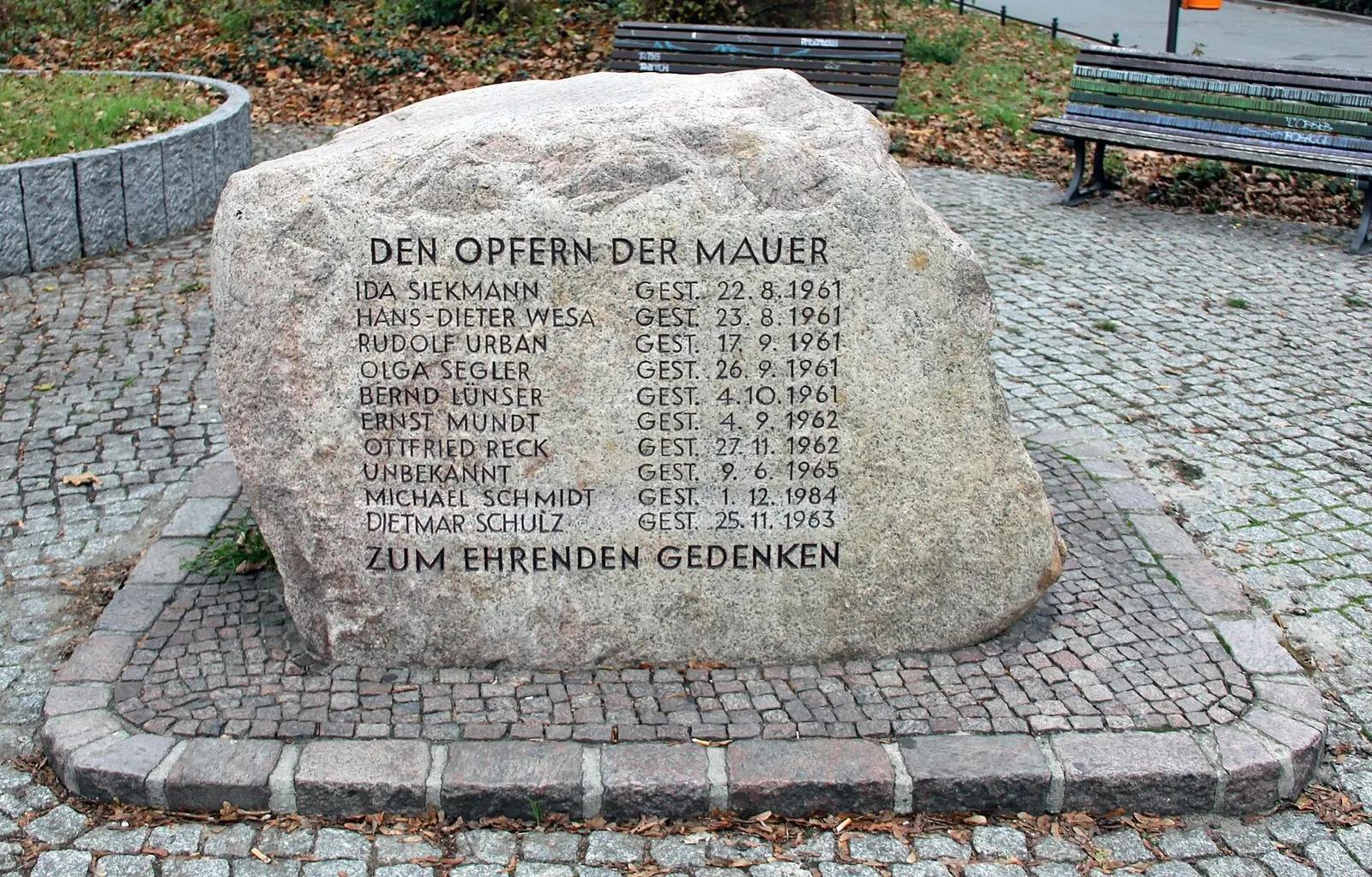

Hans-Dieter Wesa was born on 10 January 1943 in Schlewen, in the rural district of Gostingen, the youngest of four children. His parents came from Galicia; his father, a carpenter, had had his own workshop in his home town, in what is now Ukraine; under Nazi resettlement policy the family had been given a farm in the Warthegau after the Polish population there had been driven out. With his father a prisoner of war, his mother fled west with the children in 1945, and the family was assigned to Trebitz, near Wettin. His father returned in 1949 and the family stayed. Devout Protestants, his parents kept their distance from the regime, and they willingly let their eldest son go when he left for West Germany in 1954 and built a new life in Baden-Württemberg.
According to his brother, after school he completed a railway apprenticeship in Halle, and in September 1960 he signed up for five years with the transport police to advance his career. In April 1962 his unit was moved from Leipzig to Berlin to guard the border stations and railway facilities. His brother recalled that he could not refuse the transfer and personally rejected the idea of having to shoot at people; he believed this conflict may have been what led Dieter to desert. He left no explanation and gave no hint of his plans when he visited his parents a few days beforehand. His superiors regarded him as an exemplary officer.
On 23 August 1962 he was posted with another young officer he knew from Leipzig at the Bornholmer Strasse S-Bahn station, a "ghost station" beneath the Böse Bridge where trains no longer stopped. According to the other officer's later account, Hans-Dieter remarked, as if joking, that his sister in West Germany would be surprised to see him turn up; in fact it was his elder brother who lived in the West. After dark he disappeared, on the pretext that he had to switch on the lights on the other platform.
His fellow guard found that he had climbed the border fence and was already on West Berlin territory. When Hans-Dieter Wesa ignored his order to come back, the guard opened fire regardless. By the guard's own account, he fired a burst of about six shots, Wesa fell and lay still, and he then fired a second burst. West Berlin police and forensic examinations found that a shot in the thigh had brought him down before the guard came up to the fence from the other side and killed him with shots from very close range. According to the West Berlin police, he was still alive when officers reached him; a doctor at the Jewish Hospital, where the fire brigade took him, found that he had already died. The case was reopened after East Germany collapsed, and the former guard was charged with manslaughter in June 1994, but he took his own life in September 1994 before trial, without ever explaining why he had fired.
Coming only days after the death of Peter Fechter, the shooting caused deep revulsion in West Berlin. According to the press, the Governing Mayor, Willy Brandt, and Senator Klaus Schütz went to the place where he died that same evening. An official memorial service was held in Berlin on 25 August 1962, attended by many West Berlin police officers who wished to honour their East German colleague. His brother in Eybach, Baden-Württemberg, arranged for his body to be brought there for burial, and the deputy commander of the West Berlin uniformed police spoke at the funeral.
Read more
Sources
This profile is a summary written for this site from the biography in source 1, which also gives the full account with archival references. Facts taken from other sources are listed below with what they support.
- Christine Brecht, “Hans-Dieter Wesa”, biography in Chronik der Mauer, Federal Agency for Civic Education, Centre for Contemporary History Potsdam and Deutschlandradio. Accessed 23 September 2026. Read online. The biography from which this profile was written, and the source of the dates and place of death.
- German version of the same biography. Accessed 23 September 2026. Read online.
- MfS, Einzelinformation on the desertion of Oberwachtmeister Hans-Dieter Wesa on 23 August 1962, for Erich Honecker, 24 August 1962 (BStU, MfS, AP 20359/62, Bl. 7–9), transcript published on Chronik der Mauer. Accessed 5 October 2026. Read online. Source for: his police service from September 1960, his leave with his parents just before, his record as an exemplary officer, the pretext about the lights, and that he was already on West Berlin territory when ordered back.
- West Berlin police radio message (Funkspruch) on the border incident at Bornholmer Strasse, 23 August 1962 (Polizeihistorische Sammlung, Der Polizeipräsident in Berlin), transcript published on Chronik der Mauer. Accessed 5 October 2026. Read online. Source for: that he was found beneath the Böse Bridge about five metres inside West Berlin, still alive, and was taken to the Jewish Hospital.
- West Berlin Schutzpolizei, “Bericht über Lage an Sektoren- und Zonengrenze sowie auf S- und Reichsbahngelände für Monat August 1962”, 5 September 1962 (Polizeihistorische Sammlung, Der Polizeipräsident in Berlin), transcript published on Chronik der Mauer. Accessed 5 October 2026. Read online. Source for: that the 19-year-old, shot at about 8 p.m. on 23 August 1962 at Bornholmer Strasse station, was still alive when officers reached him, and that a doctor at the Jewish Hospital found he had already died.
- “Hans-Dieter Wesa” [removed memorial, Bornholmer Strasse], Gedenktafeln in Berlin (Aktives Museum Faschismus und Widerstand in Berlin / Gedenkstätte Deutscher Widerstand). Accessed 5 October 2026. Read online. Source for: that his colleague shot him when he was already on the West Berlin side.
- Hans-Hermann Hertle and Maria Nooke (eds.), The Victims at the Berlin Wall, 1961–1989: A Biographical Handbook. Centre for Contemporary History Potsdam and Berlin Wall Foundation, Berlin 2011. The printed handbook from which the online biography is taken.
- Hans-Hermann Hertle and Maria Nooke, “140 Victims at the Berlin Wall, 1961–1989” (list), Centre for Contemporary History Potsdam and Berlin Wall Foundation, August 2017. PDF. Used to cross-check names and dates.
- Hans-Hermann Hertle and Maria Nooke, “The Victims at the Berlin Wall, 1961–1989: Findings of a Research Project”, August 2017. PDF. Source of the classification into escapees, people with no intent to escape, and border soldiers.
Corrections
This profile was corrected on 28 September and 3 and 5 October 2026. Each round of corrections is described in the corrections log:
-
: All profiles and articles cross-checked against the German originals
- The shooting is now told from two attributed sources: the guard's own account, and the findings of the West Berlin police and forensic examinations that a shot in the thigh brought him down before he was killed from very close range.
- Corrected where Willy Brandt and Klaus Schütz went that evening: to the place where he died, which was on West Berlin territory, not “the death strip”.
- Corrected the attendance at the memorial service: many West Berlin police officers, not “a number”.
- : Every profile checked against all the sources
-
: Independent sources added for the other 88 profiles
- Corrected the statement that he probably died immediately: according to a West Berlin police radio message of 23 August 1962 and the police's monthly report for August 1962, he was still alive when officers reached him, and a doctor at the Jewish Hospital found that he had already died.
Further reading
Image credits
- Memorial stone "Den Opfern der Mauer" at Bernauer Strasse 69-70, Berlin-Gesundbrunnen, listing Hans-Dieter Wesa. OTFW, Berlin, CC BY-SA 3.0, Wikimedia Commons.
Cite this page
“Hans-Dieter Wesa”, Victims of the Berlin Wall, Berlin Experiences. https://victimsofthewall.com/victims/wesa-hans-dieter/
Map
The pin position is based on the place of death described in source 1. Base map © OpenStreetMap contributors; course of the Wall in 1989 from Geoportal Berlin (dl-de/zero-2.0). Accessed 23 September 2026.