Peter Fechter
1944–1962
Peter Fechter, an 18-year-old bricklayer from Weissensee, was shot on 17 August 1962 while trying to climb the Wall on Zimmerstrasse near Checkpoint Charlie. He lay at the foot of the Wall calling for help; when he was carried away 50 minutes later his cries had stopped, and he was declared dead soon afterwards.
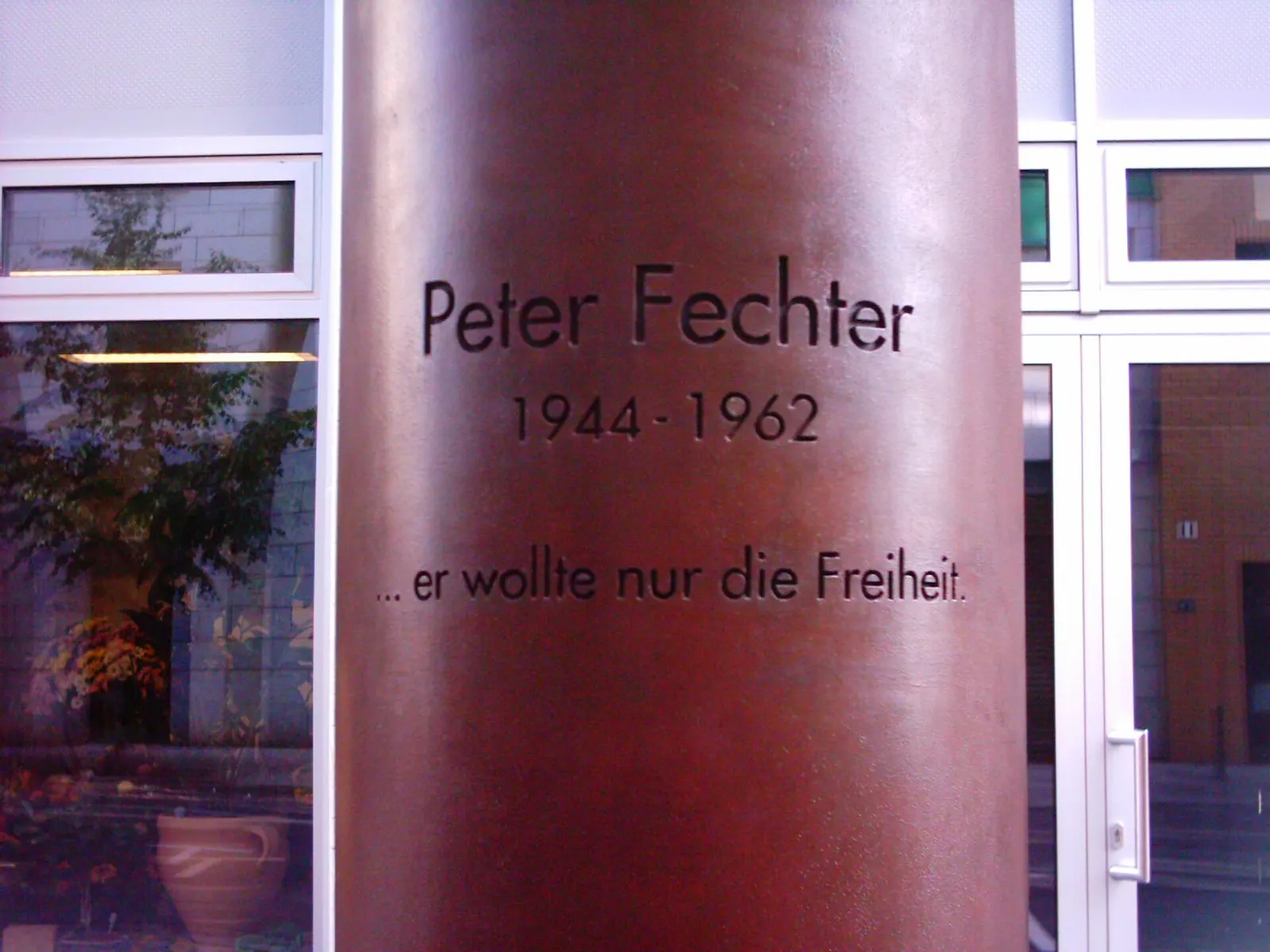

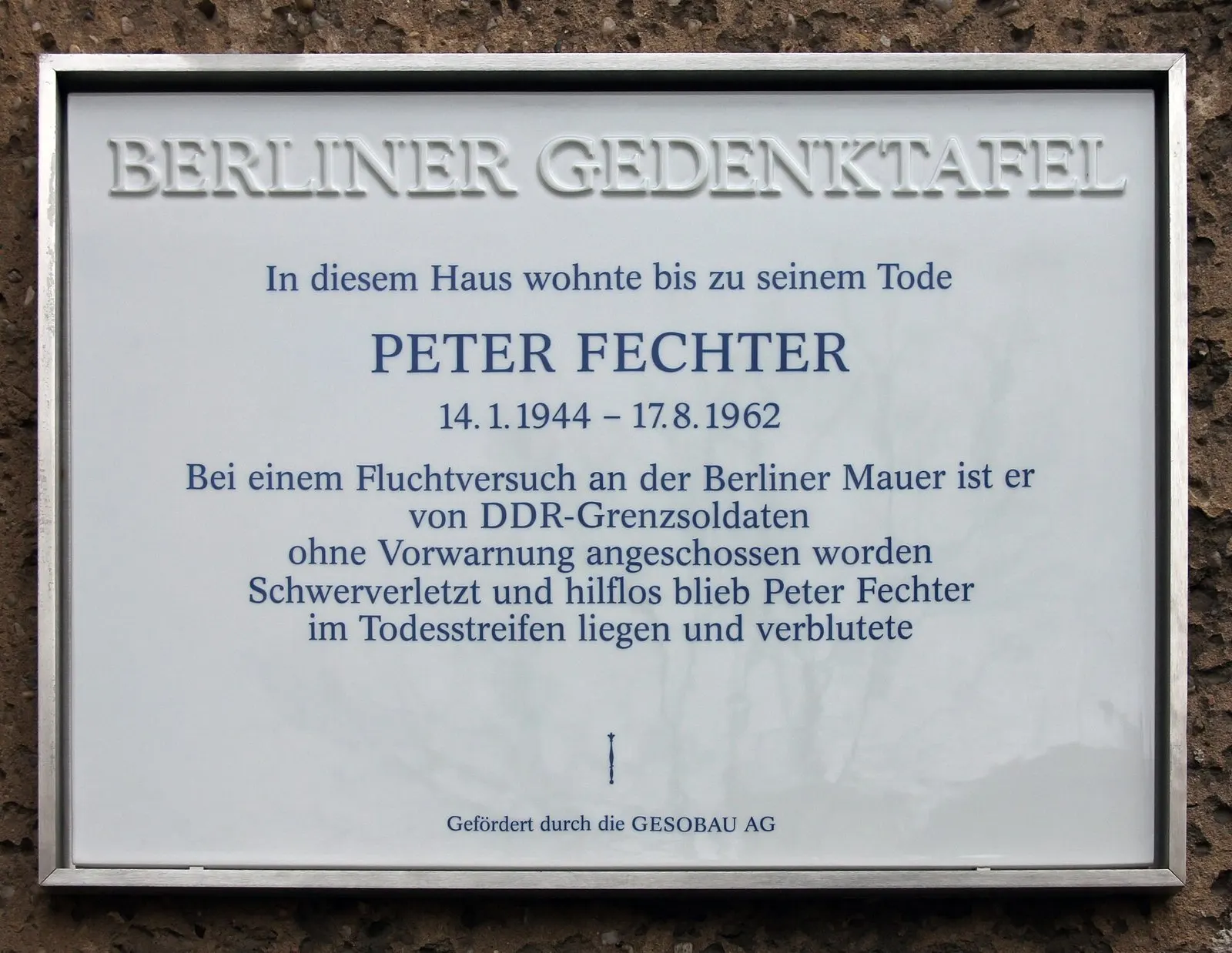
Peter Fechter was born in Berlin on 14 January 1944 and grew up in modest circumstances in Weissensee, the third of four children. His father was a machine builder and his mother a sales assistant. Their only son left school at 14 and trained as a bricklayer, a trade much in demand in the post-war rebuilding. His eldest sister was married and lived in the western part of the city, and before the Wall the family is said to have visited her regularly. He was described as a quiet, unassuming young man, and his work assessment called him willing and hard-working.
At work he met Helmut K., a fellow apprentice, and from the beginning of 1962 both worked on the rebuilding of the former Kaiser-Wilhelm-Palais on Unter den Linden. According to Helmut K., they had long been thinking of escape and had explored the border installations, but had no concrete plan. The two seem hardly to have discussed their reasons, though each probably knew that the other dreamed of a better life in the West. Even the Stasi later found no evidence of a prepared escape. A Stasi file shows that his employer had refused him a trip to West Germany, which may have played a part. Helmut K. told the West Berlin police he had been a good colleague, sincere and honest.
According to Helmut K., while exploring the area the two noticed a ruined building on Schützenstrasse that housed a carpentry workshop and whose rear windows faced Zimmerstrasse, almost at the Wall. Two days later, during their lunch break, they decided on the spur of the moment not to return to the building site but to explore it instead. They found a window that had not been bricked up; hearing voices and fearing discovery, they jumped out and ran in their socks towards the Wall a few metres away.
It was early afternoon on 17 August 1962; the West Berlin police received the first report of shots at 2:12 p.m. Four border guards had opened fire without warning, firing 35 shots in all. Helmut K. climbed the Wall and forced his way through the barbed wire into the West; he later said Peter Fechter seemed frozen with shock and did not move when he called to him. According to the border brigade commander's report, Peter Fechter was hit as he jumped at the Wall, slid back and then stood behind a reinforced section of the Wall. By this account he had already given up his escape, yet instead of arresting him the guards moved to another position and kept firing until he collapsed.
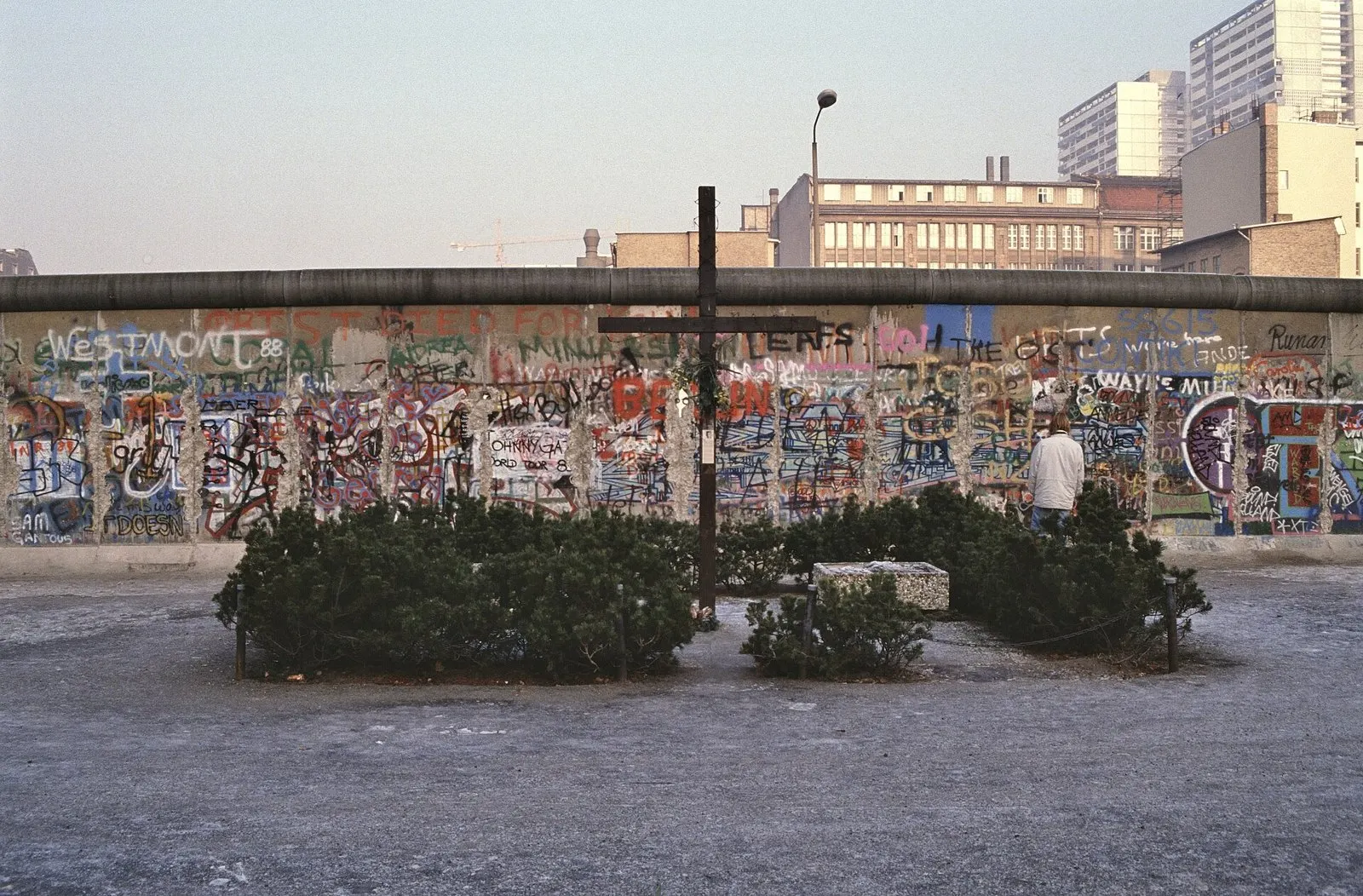
He lay badly wounded at the foot of the Wall, calling loudly for help, in view of many people on both sides. West Berlin police on ladders asked his name and threw bandages over, but did not dare to climb across; American military police from nearby Checkpoint Charlie feared that entering East Berlin territory might lead to a military clash. Fifty minutes passed, and his cries had already fallen silent by the time East German border troops carried him away behind a smokescreen; he was declared dead shortly afterwards at the People's Police Hospital.
Photographs of his dying were seen around the world, and his name became a lasting symbol of the border regime. In the East, officials blamed western police and photographers for the delay, and the chief state propagandist defended the guards on television on the same day that he was buried at the cemetery of the Resurrection Congregation in Weissensee. For decades his family suffered reprisals from the East German authorities.
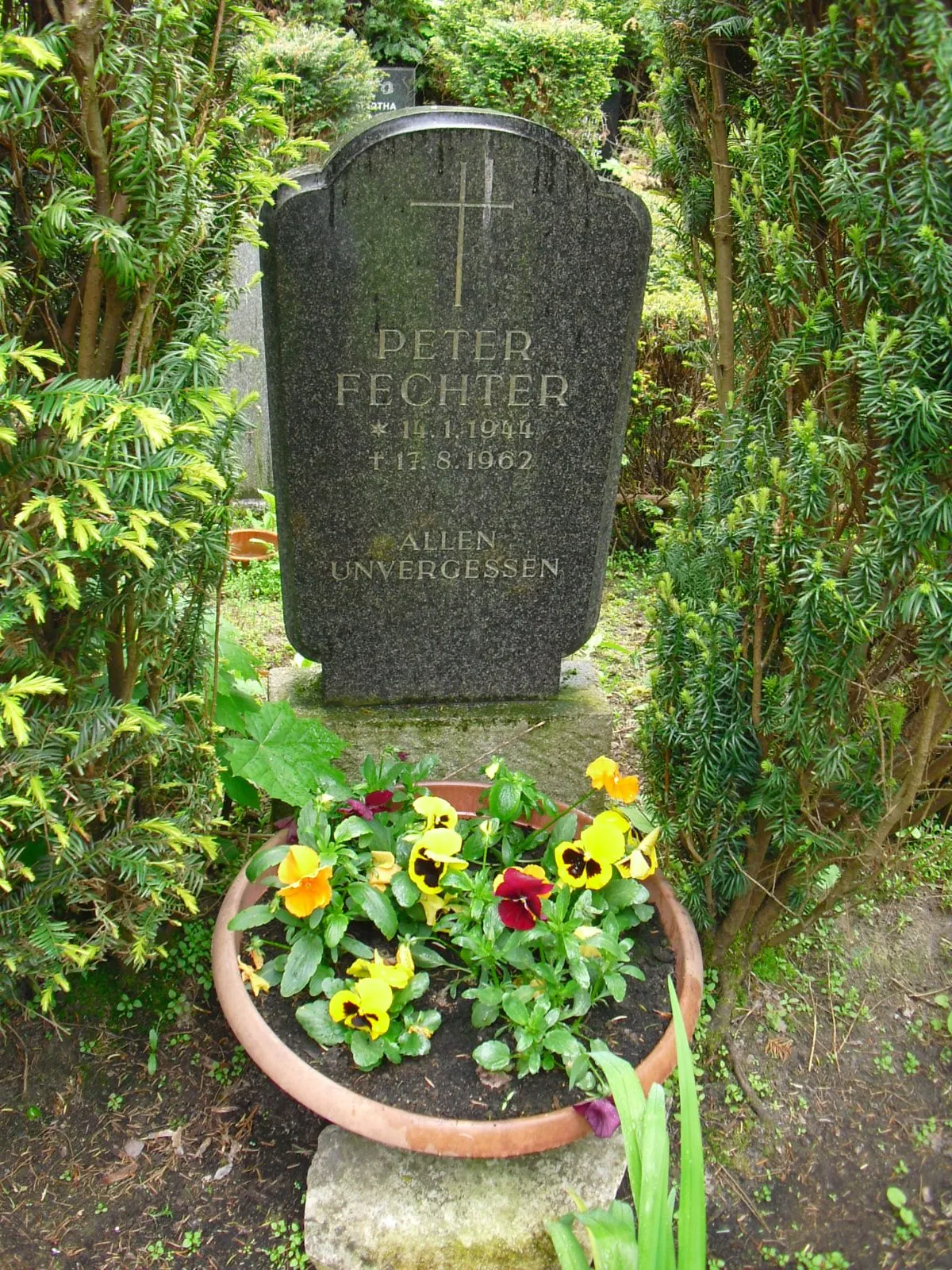
In July 1990 his sisters filed a criminal complaint, and two of the guards who had fired were eventually convicted of manslaughter and sentenced to 20 and 21 months in prison, suspended on probation. His youngest sister, Ruth, joined the trial as co-plaintiff and, in a statement made through her lawyer, spoke of the exclusion and enforced silence the family had endured. She added that a legal view could lose sight of the fact that in her brother's death world history had fatally crossed paths with an individual fate. The inscription on his gravestone reads "Allen unvergessen" ("unforgotten by all").
_Peter_Fechter.jpg)
_(14122042008).jpg)

Read more
Also died on the sector border between Berlin-Kreuzberg and Berlin-Mitte
- Klaus Brueske 18 April 1962
- Reinhold Huhn 18 June 1962
- Siegfried Noffke 28 June 1962
- Paul Schultz 25 December 1963
- Heinz Schöneberger 26 December 1965
- Johannes Lange 9 April 1969
- Burkhard Niering 5 January 1974
- Herbert Halli 3 April 1975
Sources
This profile is a summary written for this site. Every fact in it is taken from source 1, which also gives the full account with archival references.
- Christine Brecht, “Peter Fechter”, biography in Chronik der Mauer, Federal Agency for Civic Education, Centre for Contemporary History Potsdam and Deutschlandradio. Accessed 23 September 2026. Read online. Basis for every fact in this profile, including the dates and place of death.
- German version of the same biography. Accessed 23 September 2026. Read online.
- Hans-Hermann Hertle and Maria Nooke (eds.), The Victims at the Berlin Wall, 1961–1989: A Biographical Handbook. Centre for Contemporary History Potsdam and Berlin Wall Foundation, Berlin 2011. The printed handbook from which the online biography is taken.
- Hans-Hermann Hertle and Maria Nooke, “140 Victims at the Berlin Wall, 1961–1989” (list), Centre for Contemporary History Potsdam and Berlin Wall Foundation, August 2017. PDF. Used to cross-check names and dates.
- Hans-Hermann Hertle and Maria Nooke, “The Victims at the Berlin Wall, 1961–1989: Findings of a Research Project”, August 2017. PDF. Source of the classification into escapees, people with no intent to escape, and border soldiers.
Further reading
Image credits
- Peter Fechter memorial column on Zimmerstrasse near Checkpoint Charlie, photographed on 19 June 2005. Jens Lordan, CC BY-SA 3.0, Wikimedia Commons.
- Berlin memorial plaque for Peter Fechter at Behaimstrasse 11, Berlin-Weißensee, the house where he lived. OTFW, Berlin, CC BY-SA 3.0, Wikimedia Commons.
- Cross for Peter Fechter from 1962 at the Berlin Wall, photographed on 1 December 1989. Aad van der Drift, CC BY 2.0, Wikimedia Commons.
- Gravestone of Peter Fechter ("Allen unvergessen") at the Auferstehungsfriedhof, Berlin-Weißensee. Mutter Erde, CC BY-SA 4.0, Wikimedia Commons.
Cite this page
“Peter Fechter”, Victims of the Berlin Wall, Berlin Experiences. https://victimsofthewall.com/victims/fechter-peter/
Map
The pin position is based on the place of death described in source 1. Base map © OpenStreetMap contributors; course of the Wall in 1989 from Geoportal Berlin (dl-de/zero-2.0). Accessed 23 September 2026.