Burkhard Niering
1950–1974
Burkhard Niering, a 23-year-old conscript in the East German police from Halle, was shot on 5 January 1974 at the Checkpoint Charlie crossing while trying to reach West Berlin armed and with a hostage; he died shortly after 9 p.m.

Burkhard Niering was born on 1 September 1950 in Halle an der Saale. After his parents' divorce, when he was eight, his mother raised him and before long married again. He quit school early, in the 9th grade in 1966, and trained as a plumber and installer. He did not join the "Ernst Thälmann" pioneer organisation or the FDJ, which the Stasi later blamed on the influence of his parents' home. His interests, according to the files, lay in literature and the theatre.
In May 1973 he was called up for military service with the East German police and served in a mobile squad stationed in Basdorf, north of Berlin. His superiors found him unobtrusive and very fit for service, and he received two distinctions, but an informant reported that he considered the service a pointless waste of his youth. He is said to have told a fellow soldier that he would leave East Germany at the first opportunity. After Christmas leave in 1973, which he spent with his mother and stepfather, his room-mates said he seemed changed, avoided conversation and gave a depressed impression. According to a Stasi report, on 30 December he wrote to his birth father about the psychological problems of uniformity, its levelling effect on people and the resulting undermining of individuality.
On the evening of 5 January 1974 he was guarding his barracks alone, and left unnoticed with his weapon. How he reached the city centre so quickly is unclear; his food voucher was found on the F 109 highway, and the Stasi surmised that he had hitched a ride, but it is more likely that he had arranged a lift with someone who knew the area. At around 7.35 p.m. he appeared at the Friedrichstrasse crossing, Checkpoint Charlie, in winter uniform with a machine pistol, and forced a Stasi passport control sergeant to walk ahead of him towards West Berlin, firing into the air. One of the other passport officers, who had meanwhile raised the alarm and taken up position, fired at him from cover and missed.
He had about 150 metres to cover inside the crossing. The sergeant deliberately walked slowly and, by his own account, asked what Niering wanted and was told that he wanted to get across. At the lowered barrier of the exit post the guards lay down with their weapons ready. When Niering told the sergeant to crawl under the barrier, the sergeant dropped and rolled aside, and two guards fired from cover, hitting Niering in the lower back. Within three minutes he had been carried to the watchtower out of public view. He died in the People's Police Hospital shortly after 9 p.m. The Stasi officers involved received combat medals, and the Stasi later used film of the incident for training.
A West Berlin customs officer and two U.S. soldiers witnessed the events, and the West German government, the Berlin Senate and the Allied commanders condemned the guards' conduct. In January 1991 his mother filed a criminal complaint against Erich Honecker, Erich Mielke and the guards, arguing that it was not right to invoke the laws in force in a state without the rule of law. The Berlin prosecutors discontinued their investigation in September 1997, concluding that, because the violence had come from Burkhard Niering himself and hostage-taking and desertion are also crimes in the Federal Republic, the guards would have been entitled to arrest him and use their weapons under West German law as well. In legal terms, the family did not receive the justice they sought.
Read more
Also died on the sector border between Berlin-Kreuzberg and Berlin-Mitte
- Klaus Brueske 18 April 1962
- Reinhold Huhn 18 June 1962
- Siegfried Noffke 28 June 1962
- Peter Fechter 17 August 1962
- Paul Schultz 25 December 1963
- Heinz Schöneberger 26 December 1965
- Johannes Lange 9 April 1969
- Herbert Halli 3 April 1975
Sources
This profile is a summary written for this site. Every fact in it is taken from source 1, which also gives the full account with archival references.
- Martin Ahrends/Udo Baron/Hans-Hermann Hertle, “Burkhard Niering”, biography in Chronik der Mauer, Federal Agency for Civic Education, Centre for Contemporary History Potsdam and Deutschlandradio. Accessed 23 September 2026. Read online. Basis for every fact in this profile, including the dates and place of death.
- German version of the same biography. Accessed 23 September 2026. Read online.
- Hans-Hermann Hertle and Maria Nooke (eds.), The Victims at the Berlin Wall, 1961–1989: A Biographical Handbook. Centre for Contemporary History Potsdam and Berlin Wall Foundation, Berlin 2011. The printed handbook from which the online biography is taken.
- Hans-Hermann Hertle and Maria Nooke, “140 Victims at the Berlin Wall, 1961–1989” (list), Centre for Contemporary History Potsdam and Berlin Wall Foundation, August 2017. PDF. Used to cross-check names and dates.
- Hans-Hermann Hertle and Maria Nooke, “The Victims at the Berlin Wall, 1961–1989: Findings of a Research Project”, August 2017. PDF. Source of the classification into escapees, people with no intent to escape, and border soldiers.
Further reading
Image credits
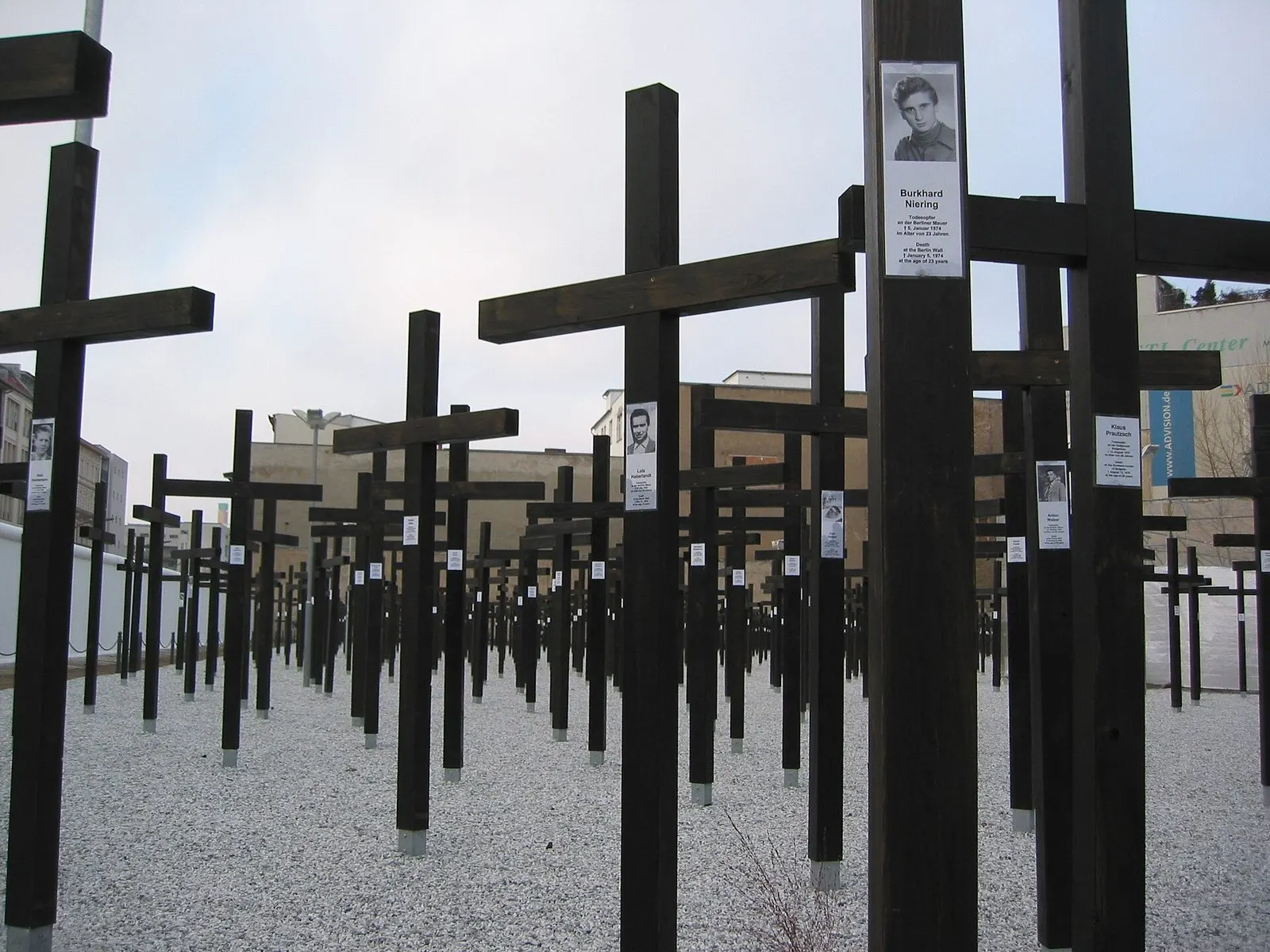
- Cross for Burkhard Niering in the field of black wooden crosses for the victims of the shoot-to-kill order at the Berlin Wall, set up at Checkpoint Charlie; photographed on 28 December 2004.. Magnus Manske, CC BY-SA 3.0, Wikimedia Commons.
Cite this page
“Burkhard Niering”, Victims of the Berlin Wall, Berlin Experiences. https://victimsofthewall.com/victims/niering-burkhard/
Map
The pin position is based on the place of death described in source 1. Base map © OpenStreetMap contributors; course of the Wall in 1989 from Geoportal Berlin (dl-de/zero-2.0). Accessed 23 September 2026.