Klaus Brueske
1938–1962
Klaus Brueske, a 23-year-old driver from Friedrichshain, drove a truck carrying two friends through the Heinrich-Heine-Strasse border crossing in the early hours of 18 April 1962. Shot while driving, he died after the truck came to rest in West Berlin.
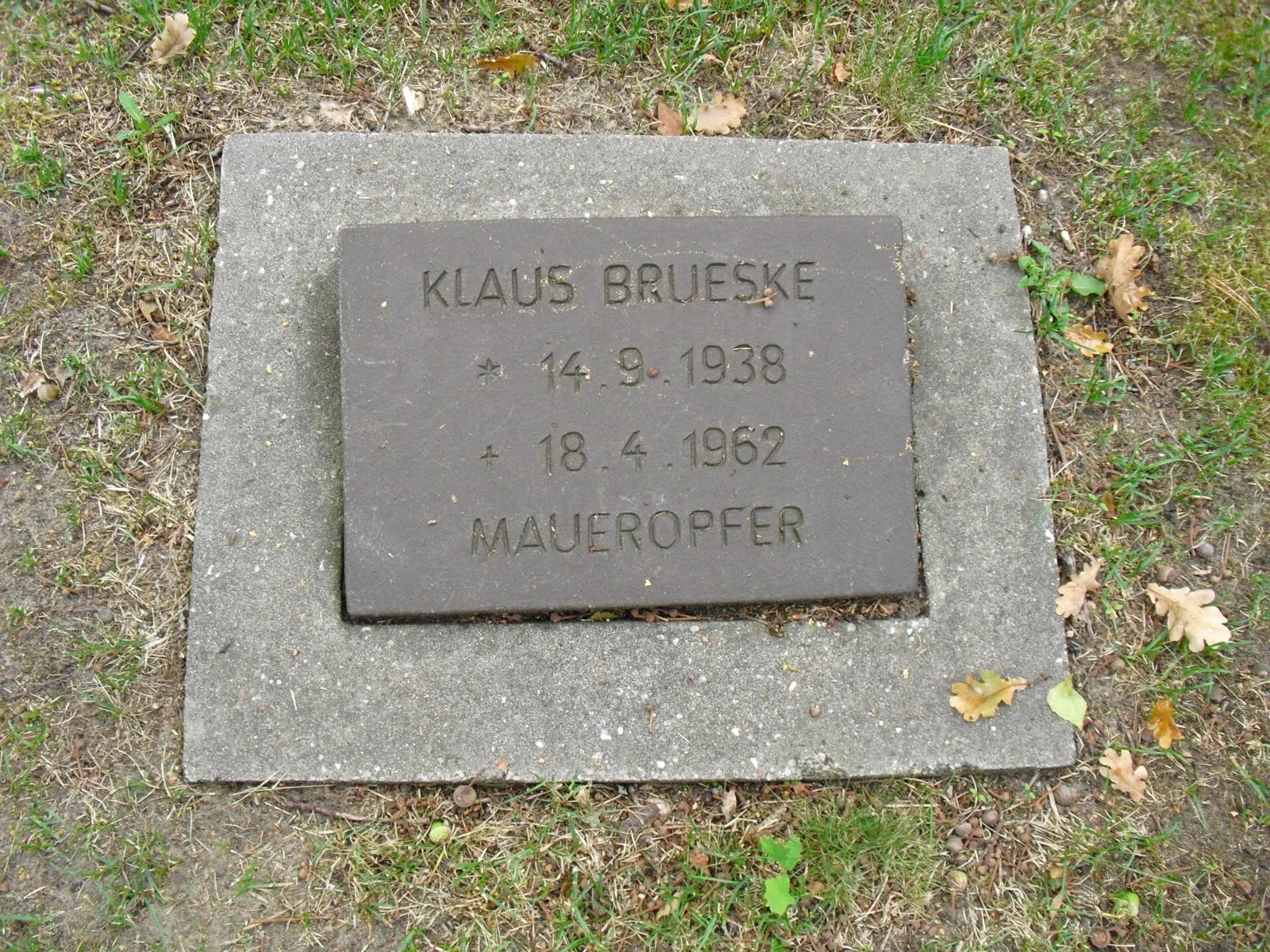

Klaus Brueske was born in Berlin on 14 September 1938, the fifth of eight children, and lived until his death in Friedrichshain, part of the Soviet sector since 1945. He left a masonry apprenticeship to become a driver, and from January 1961 worked for AEG in West Berlin, where his father also worked, crossing between the two halves of the city each day.
When the border was closed on 13 August 1961, his father stayed in West Berlin, but Klaus Brueske was reluctant to leave the surroundings he knew. He took a driving job in the East at the company where his older brother worked. In the months that followed, his friends grew more and more unhappy with life in East Germany. They explored the border area and made a plan to break through the Heinrich-Heine-Strasse crossing in a truck; in the end no fewer than seven young men wanted to take part.
On 17 April 1962 he borrowed a truck from his employer, saying he needed it for a move, and loaded it with sand and gravel so that it would break through the barriers more easily. That evening the friends met in a bar and spent the last of their East German money. When a policeman spoke to them outside, they separated to meet again later at the truck, but only three came back. Klaus Brueske took the wheel, Lothar M. sat beside him and Peter G. lay on the loaded platform behind.
After midnight they drove through the crossing at 70 km/h. A border guard fired two aimed bursts, 14 shots in all, as the truck broke through the first and second barriers. The vehicle was hit many times but kept going across the border line until it struck a wall on the West Berlin side. All three, with gunshot wounds and bruises, were taken to the nearby Urban Hospital, but for Klaus Brueske it was too late. According to the autopsy report, two shots through the back of his neck had not killed him at once but had made him lose control; in the collision he was buried in sand and suffocated. His two passengers survived with injuries.
A West Berlin newspaper's headline the next day said that, dying, he had driven his friends to freedom; the East German press said he had endangered the lives of the border guards. East German investigators expressly declared the shooting justified by the orders in force, criticised the layout of the barriers and decided that a slalom course should stop vehicles breaking through in future, with repair and conversion work in the following days and weeks; Stasi officers searched his flat, and his colleagues and siblings were interrogated. When it emerged that his older brother had known of the plan, he was held in pre-trial detention for four months on suspicion of having known about it. His mother and siblings were not allowed to attend his funeral at the municipal cemetery in Lübars, West Berlin.
In April 1994 the border guard who had fired was convicted of manslaughter together with attempted manslaughter and given a suspended sentence of one year and two months. In March 1966, after Heinz Schöneberger was also killed at Heinrich-Heine-Strasse, the West Berlin "Working Group 13th of August" put up a wooden cross there with photographs of both men, and memorial services are held there every year on the anniversary of the building of the Wall.
Read more
Also died on the sector border between Berlin-Kreuzberg and Berlin-Mitte
- Reinhold Huhn 18 June 1962
- Siegfried Noffke 28 June 1962
- Peter Fechter 17 August 1962
- Paul Schultz 25 December 1963
- Heinz Schöneberger 26 December 1965
- Johannes Lange 9 April 1969
- Burkhard Niering 5 January 1974
- Herbert Halli 3 April 1975
Sources
This profile is a summary written for this site. Every fact in it is taken from source 1, which also gives the full account with archival references.
- Christine Brecht, “Klaus Brueske”, biography in Chronik der Mauer, Federal Agency for Civic Education, Centre for Contemporary History Potsdam and Deutschlandradio. Accessed 23 September 2026. Read online. Basis for every fact in this profile, including the dates and place of death.
- German version of the same biography. Accessed 23 September 2026. Read online.
- Hans-Hermann Hertle and Maria Nooke (eds.), The Victims at the Berlin Wall, 1961–1989: A Biographical Handbook. Centre for Contemporary History Potsdam and Berlin Wall Foundation, Berlin 2011. The printed handbook from which the online biography is taken.
- Hans-Hermann Hertle and Maria Nooke, “140 Victims at the Berlin Wall, 1961–1989” (list), Centre for Contemporary History Potsdam and Berlin Wall Foundation, August 2017. PDF. Used to cross-check names and dates.
- Hans-Hermann Hertle and Maria Nooke, “The Victims at the Berlin Wall, 1961–1989: Findings of a Research Project”, August 2017. PDF. Source of the classification into escapees, people with no intent to escape, and border soldiers.
Further reading
Image credits
- Grave and memorial stone for Klaus Brueske at the Friedhof Reinickendorf. Mutter Erde, CC BY-SA 4.0, Wikimedia Commons.
Cite this page
“Klaus Brueske”, Victims of the Berlin Wall, Berlin Experiences. https://victimsofthewall.com/victims/brueske-klaus/
Map
The pin position is based on the place of death described in source 1. Base map © OpenStreetMap contributors; course of the Wall in 1989 from Geoportal Berlin (dl-de/zero-2.0). Accessed 23 September 2026.