Peter Böhme
1942–1962
Peter Böhme, a 19-year-old officer cadet from Karl-Marx-Stadt, deserted with a friend and was killed on 18 April 1962 in an exchange of fire at Gleisdreieck Griebnitzsee, in which the border guard Jörgen Schmidtchen also died.
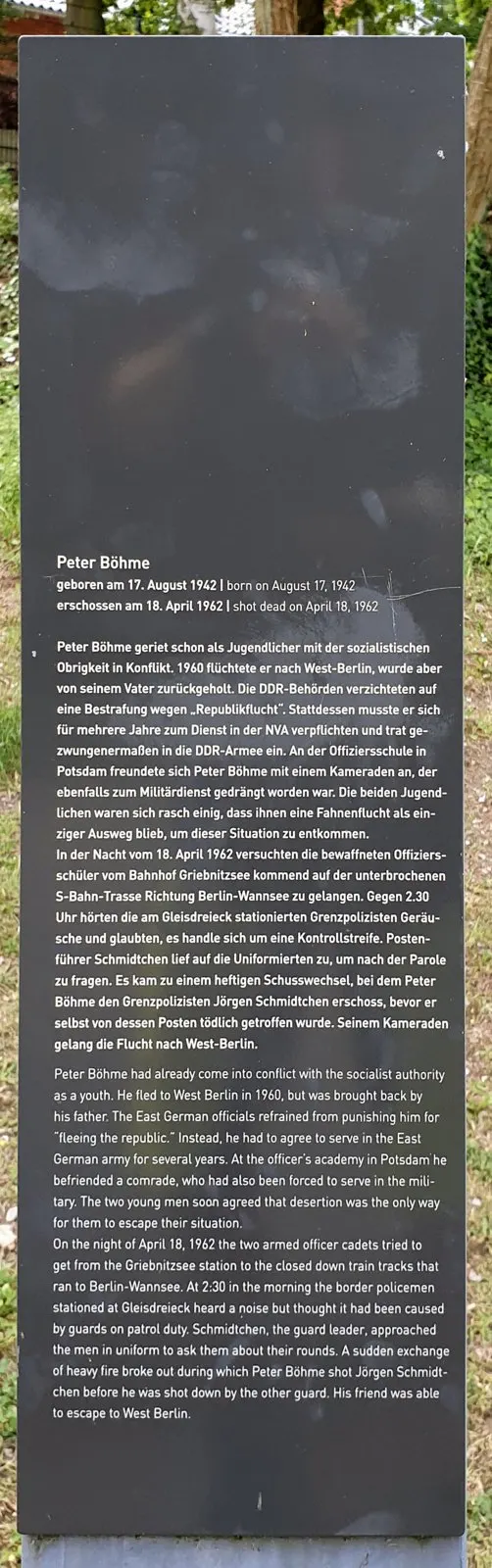
_Peter_B%C3%B6hme.jpg)
Peter Böhme was born on 17 August 1942 and grew up in Chemnitz, then called Karl-Marx-Stadt. Already at secondary school he came into conflict with the socialist authorities; at 16 he was threatened with expulsion because he and a friend had bought jeans, officially frowned upon, in West Berlin. He began training as a motor mechanic but had to give it up after crossing into West Berlin, still open at that time, from where his father brought him back. The authorities evidently chose not to punish him and instead required him to sign up with the National People's Army for several years. Joining under compulsion, he went, after a fashion, through basic training and the non-commissioned officers' course and on to applying as an officer cadet.
At the end of December 1961 he started at the army's Flak and Artillery Officer's School in Geltow near Potsdam, but soon regretted it. Within days he wrote to the school's leadership asking to be sent back to his old unit, saying he had no interest in becoming an officer. Called to account by his battery commander, he said he would rather study to become a sports teacher in Leipzig, but was pressed to reconsider and outwardly agreed to continue. Privately, he resolved not to give in this time and to leave for the West as soon as he could.
At the school he became friends with Wolfgang G., a cadet of the same age who also did not want to be an officer. Both were tired of being ordered about and apparently soon agreed that desertion was their only way out, beginning preparations in early April 1962.
On the night of 16 to 17 April 1962 the two took two pistols and ammunition from the school's weapons cabinet; Wolfgang G. later told West Berlin police that the weapons were meant for self-defence if it came to the worst. When, against their expectations, the missing weapons were noticed, they left the barracks and hid in Potsdam through the day. That evening they took a taxi to Babelsberg and, coming from Griebnitzsee station, followed the disused S-Bahn line towards the border with Kohlhasenbrück in West Berlin.
That night the border guard Jörgen Schmidtchen and a second guard were on duty; according to military files they were in a former railway keeper's hut when, at about 2:30 a.m., they heard noises and went out to look. According to Wolfgang G.'s later statement, Jörgen Schmidtchen, the leader of the two-man post, took the uniformed pair for an inspection patrol, went towards them and asked for the password; a heavy exchange of fire then followed, in which Peter Böhme and Jörgen Schmidtchen were both fatally wounded. Wolfgang G. was unhurt and reached West Berlin.
The two deaths became a political issue. The West Berlin press sided with the escapees, while East Germany labelled them common criminals and enemies of the state, and demanded Wolfgang G.'s extradition, which West Germany refused; the Stasi went on watching him for decades. In both East and West, Peter Böhme himself was largely forgotten.
In the 1990s his death was examined in preliminary proceedings that never reached trial. Investigators established that Peter Böhme had fired the shot that killed Jörgen Schmidtchen before he himself was fatally hit by the other guard. The proceedings against that guard were discontinued in August 1992 on the grounds of self-defence, and the public prosecutor concluded that Peter Böhme was guilty of the manslaughter of Jörgen Schmidtchen, since he had opened fire without being directly threatened.
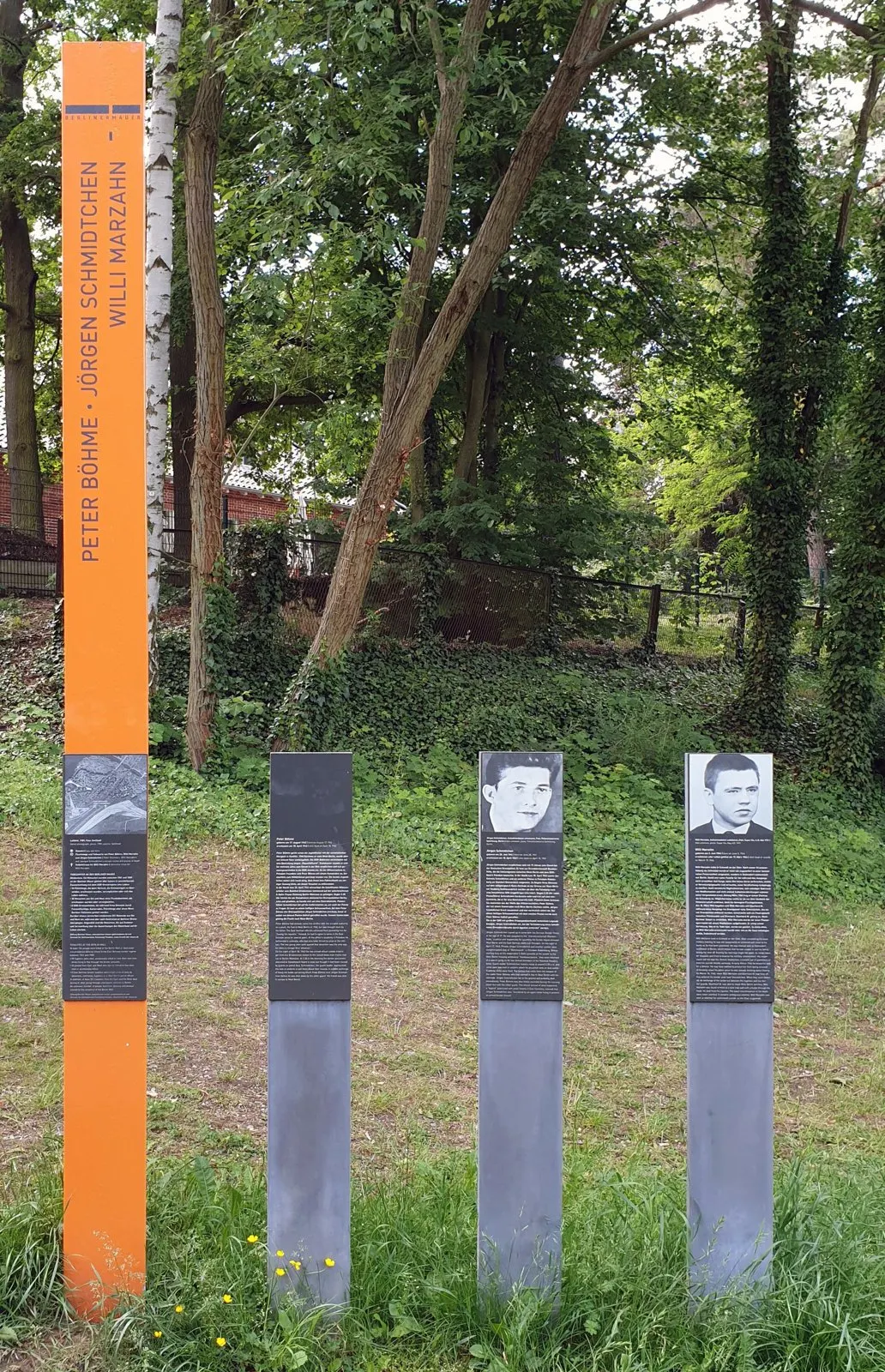
_B%C3%B6hme_Schmidtchen_Marzahn.jpg)
Read more
Also died on the outer ring between Berlin-Zehlendorf and Potsdam-Babelsberg
- Jörgen Schmidtchen 18 April 1962
- Günter Wiedenhöft Night of 5 to 6 December 1962
- Norbert Wolscht 28 July 1964
- Rainer Gneiser 28 July 1964
- Peter Hauptmann 3 May 1965
- Willi Marzahn 19 March 1966
- Horst Körner 15 November 1968
- Holger H. 22 January 1973
Sources
This profile is a summary written for this site. Every fact in it is taken from source 1, which also gives the full account with archival references.
- Christine Brecht, “Peter Böhme”, biography in Chronik der Mauer, Federal Agency for Civic Education, Centre for Contemporary History Potsdam and Deutschlandradio. Accessed 23 September 2026. Read online. Basis for every fact in this profile, including the dates and place of death.
- German version of the same biography. Accessed 23 September 2026. Read online.
- Hans-Hermann Hertle and Maria Nooke (eds.), The Victims at the Berlin Wall, 1961–1989: A Biographical Handbook. Centre for Contemporary History Potsdam and Berlin Wall Foundation, Berlin 2011. The printed handbook from which the online biography is taken.
- Hans-Hermann Hertle and Maria Nooke, “140 Victims at the Berlin Wall, 1961–1989” (list), Centre for Contemporary History Potsdam and Berlin Wall Foundation, August 2017. PDF. Used to cross-check names and dates.
- Hans-Hermann Hertle and Maria Nooke, “The Victims at the Berlin Wall, 1961–1989: Findings of a Research Project”, August 2017. PDF. Source of the classification into escapees, people with no intent to escape, and border soldiers.
Further reading
Image credits
- Memorial stele for Peter Böhme, Stubenrauchstrasse 35, Babelsberg. OTFW, Berlin, CC BY-SA 3.0, Wikimedia Commons.
- Memorial for Peter Böhme, Jörgen Schmidtchen and Willi Marzahn, Stubenrauchstrasse 35, Babelsberg. OTFW, Berlin, CC BY-SA 3.0, Wikimedia Commons.
Cite this page
“Peter Böhme”, Victims of the Berlin Wall, Berlin Experiences. https://victimsofthewall.com/victims/boehme-peter/
Map
The pin position is based on the place of death described in source 1. Base map © OpenStreetMap contributors; course of the Wall in 1989 from Geoportal Berlin (dl-de/zero-2.0). Accessed 23 September 2026.