Willi Marzahn
1944–1966
Willi Marzahn, a 21-year-old soldier and father from Jüterbog, died on 19 March 1966 after an armed escape attempt near Steinstücken/Kohlhasenbrück; whether he was shot or took his own life remained unclear.
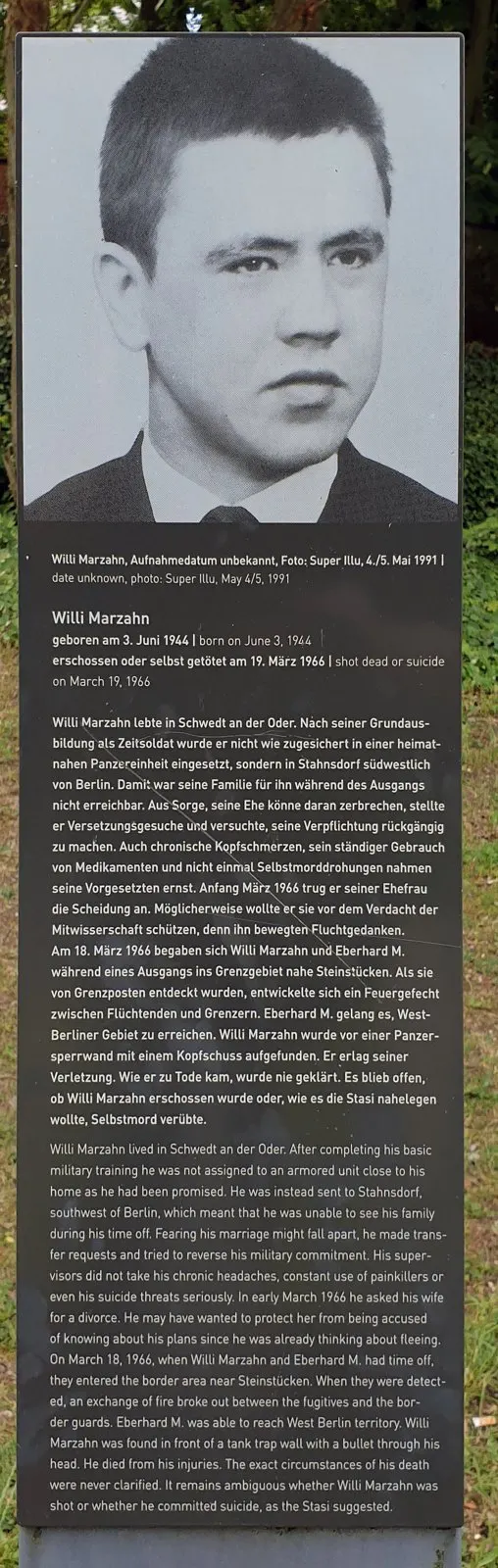
_Willi_Marzahn.jpg)
Willi Marzahn was born on 3 June 1944 in Jüterbog. After school he trained as a locomotive mechanic. From 1964 he lived with his wife and child in Schwedt an der Oder, where he worked as an engine fitter in the central workshop of the oil refinery. That same year he signed up for three years in the National People's Army, beginning his service on 3 November 1964. Politically he did not draw attention to himself, and his room-mates reportedly saw him as a loner.
He had been promised a post in an armoured unit near home, but the promise was not kept: he was posted to Stahnsdorf, south-west of Berlin, as weapons master in a motorised rifle unit. The journey to Schwedt took almost a day, so he could not reach his family during ordinary off-duty passes. Worried that his marriage would not survive, he asked repeatedly to be transferred, without success. In February 1966 he asked to be released from his three-year commitment, writing that his basic service would end in April, that his wife had said she would divorce him if he did not then come home, and that he was married with a child. The army dismissed his requests. His superiors also ignored his complaints of chronic headaches after a concussion and ear operation, his reliance on painkillers and sleeping pills, and even threats of suicide.
In early March 1966 he unexpectedly wrote to his wife asking for a divorce. He may have meant it; it may also have been meant to protect her from being accused of knowing his plans. By then, it appears, the 21-year-old was already thinking of escape.
He and another sergeant, Eberhard M., were off duty on 18 March 1966 with a pass until 6 o'clock the next morning. After an evening in a Potsdam bar they returned to the Stahnsdorf barracks at about 3 a.m. Only Willi Marzahn went inside. He had the armoury key handed to him, supposedly to carry out a check, and passed two Kalashnikov machine pistols, three Makarov pistols and ammunition out of the armoury window to Eberhard M., who carried them to the fence. After signing out again for the rest of their pass, the two collected the weapons at a gap in the barracks fence. They walked for several hours, partly through woodland and partly along the roadside, to the border strip near Kohlhasenbrück and Griebnitzsee.
At around 6 a.m. they crawled under a signal fence near Steinstücken. They set off an alarm, to which no guard at first reacted, and then a flare. Only when they ran from the cover of the woods across the death strip did the guards on duty spot them. Shots were exchanged. Eberhard M. got over the last obstacles into West Berlin. Willi Marzahn lay before a tank-trap wall, where he was found with a gunshot wound to the head. Taken to the nearby army hospital in Drewitz, he died at around 8 in the morning without regaining consciousness. Residents of Steinstücken and Kohlhasenbrück were startled by the early-morning gunfire; one heard a voice from the strip calling for help.
Who fired the fatal shot was never established. The pathologists at first also assumed that a long-range shot from a Kalashnikov had killed him; after a second examination requested by the Stasi, the pathologists arrived at what they called a reliable assumption that it had been a shot at point-blank range from the Makarov pistol lying beside him. Because the scene was never properly examined, it remained unclear whether he was shot or, as the Stasi wanted to suggest, possibly took his own life. After 1990 prosecutors could not determine with certainty who fired first, and in 1992 the case against the border soldiers was discontinued.
He was buried in Jüterbog on 23 March 1966, with his family present and the Stasi watching. A memorial cross bearing his name and the date 19 March 1966 was later erected in Zehlendorf.
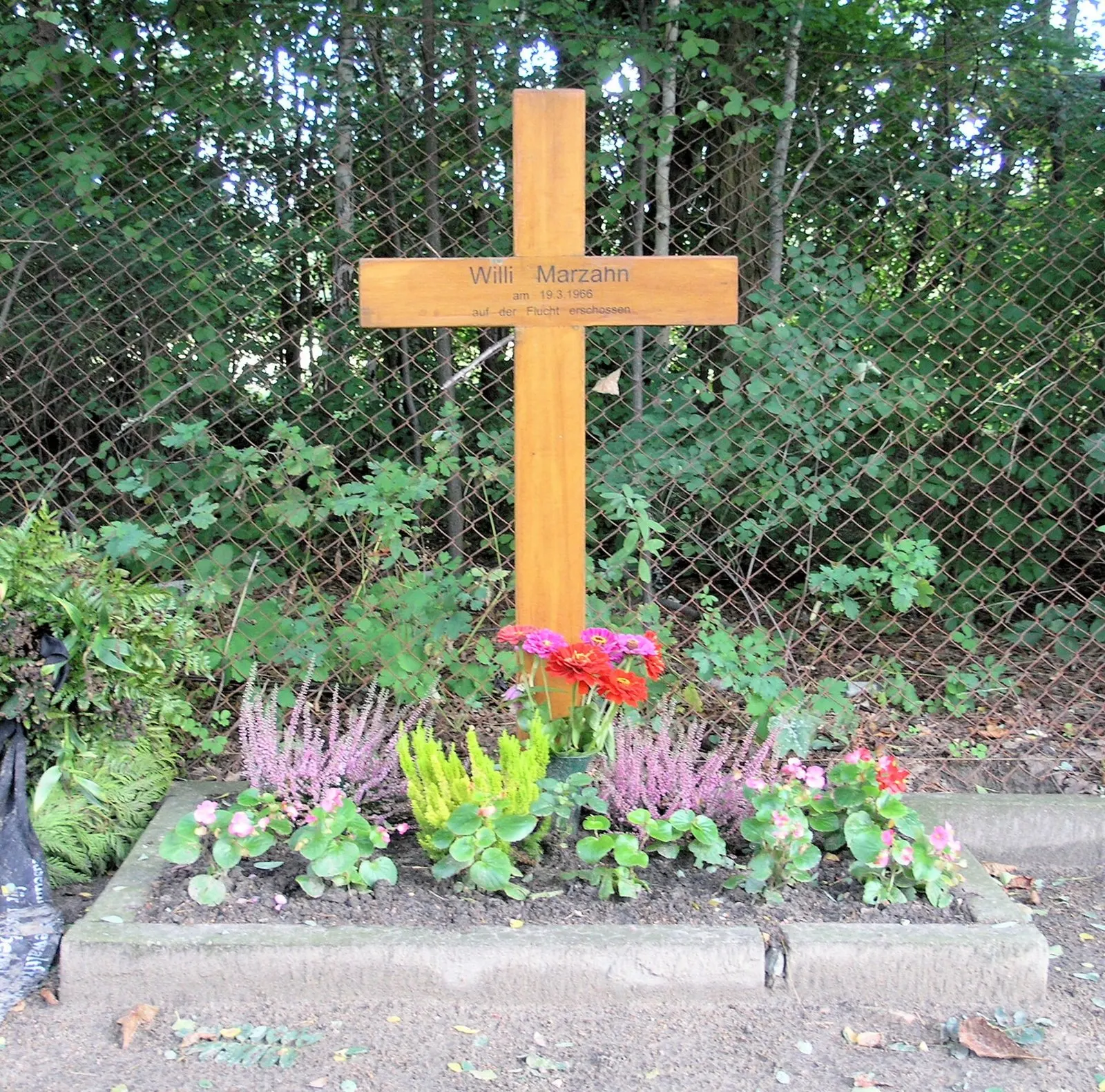
_Willi_Marzahn.jpg)
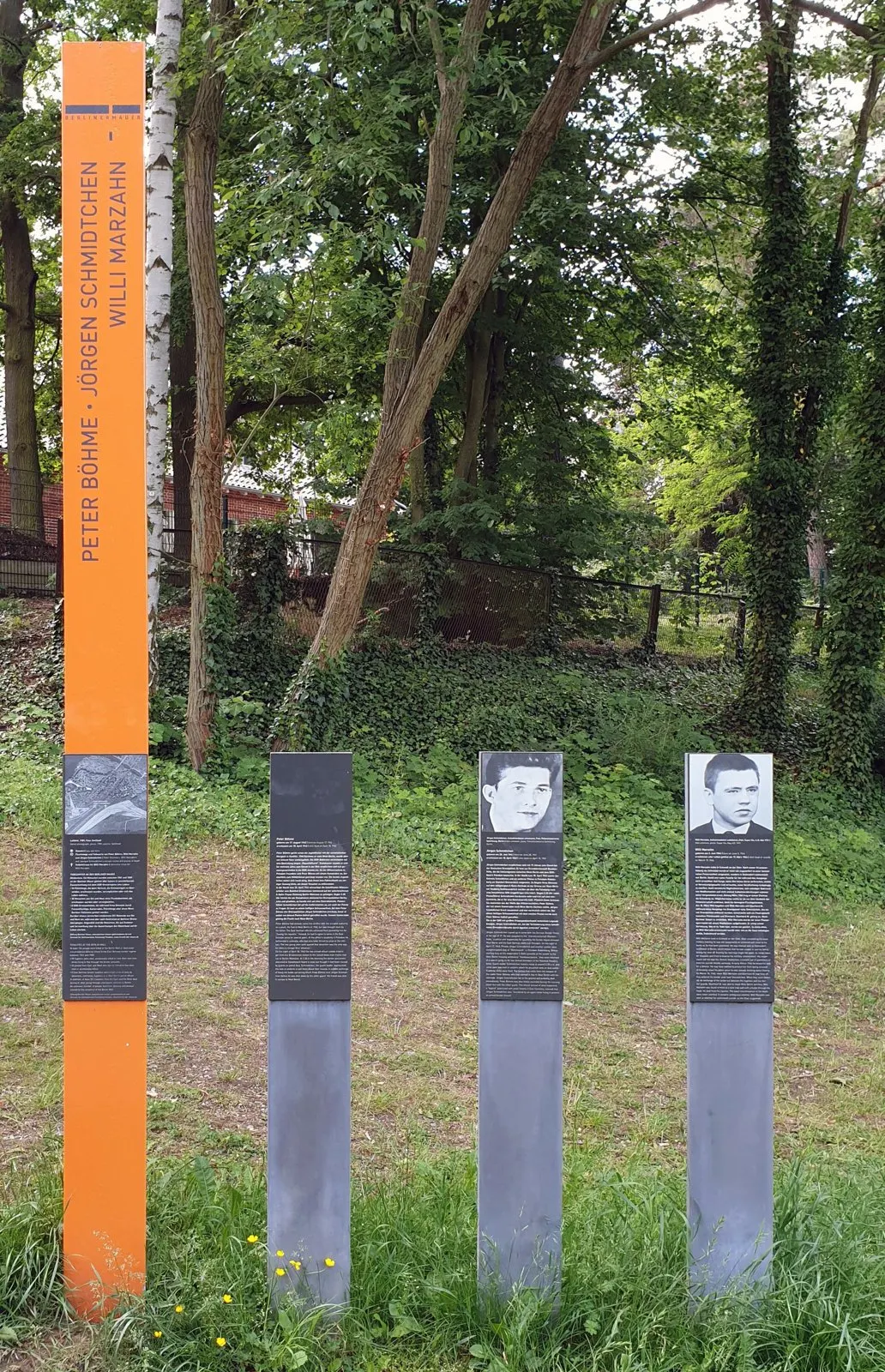
_B%C3%B6hme_Schmidtchen_Marzahn.jpg)
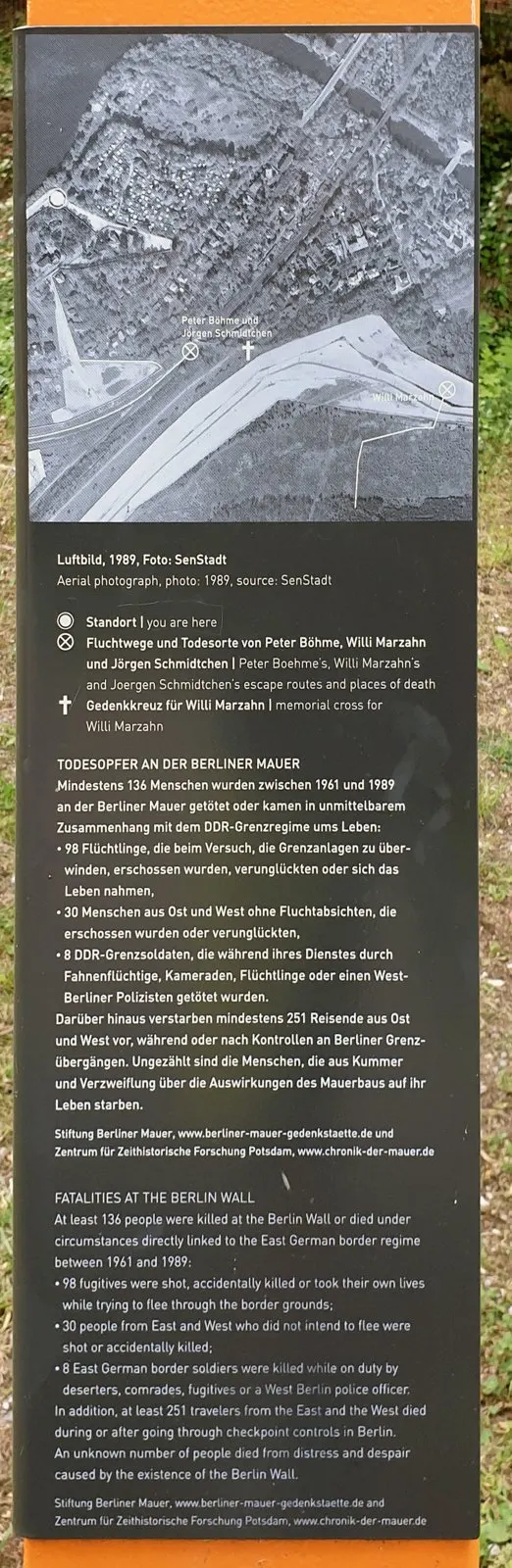
_B%C3%B6hme_Schmidtchen_Marzahn2.jpg)
Also died on the outer ring between Berlin-Zehlendorf and Potsdam-Babelsberg
- Jörgen Schmidtchen 18 April 1962
- Peter Böhme 18 April 1962
- Günter Wiedenhöft Night of 5 to 6 December 1962
- Norbert Wolscht 28 July 1964
- Rainer Gneiser 28 July 1964
- Peter Hauptmann 3 May 1965
- Horst Körner 15 November 1968
- Holger H. 22 January 1973
Sources
This profile is a summary written for this site. Every fact in it is taken from source 1, which also gives the full account with archival references.
- Udo Baron/Hans-Hermann Hertle, “Willi Marzahn”, biography in Chronik der Mauer, Federal Agency for Civic Education, Centre for Contemporary History Potsdam and Deutschlandradio. Accessed 23 September 2026. Read online. Basis for every fact in this profile, including the dates and place of death.
- German version of the same biography. Accessed 23 September 2026. Read online.
- Hans-Hermann Hertle and Maria Nooke (eds.), The Victims at the Berlin Wall, 1961–1989: A Biographical Handbook. Centre for Contemporary History Potsdam and Berlin Wall Foundation, Berlin 2011. The printed handbook from which the online biography is taken.
- Hans-Hermann Hertle and Maria Nooke, “140 Victims at the Berlin Wall, 1961–1989” (list), Centre for Contemporary History Potsdam and Berlin Wall Foundation, August 2017. PDF. Used to cross-check names and dates.
- Hans-Hermann Hertle and Maria Nooke, “The Victims at the Berlin Wall, 1961–1989: Findings of a Research Project”, August 2017. PDF. Source of the classification into escapees, people with no intent to escape, and border soldiers.
Further reading
Image credits
- Memorial panel for Willi Marzahn on Stubenrauchstraße in Babelsberg, with his portrait (photo: Super Illu, May 1991) and biography, photographed in 2020. OTFW, Berlin, CC BY-SA 3.0, Wikimedia Commons.
- Memorial cross for Willi Marzahn at Königsweg 326 in Berlin-Wannsee, photographed in 2010. OTFW, Berlin, CC BY-SA 3.0, Wikimedia Commons.
- Memorial site on Stubenrauchstraße in Babelsberg for Peter Böhme, Jörgen Schmidtchen and Willi Marzahn, photographed in 2020. OTFW, Berlin, CC BY-SA 3.0, Wikimedia Commons.
- Panel at the Babelsberg memorial with a 1989 aerial photograph marking the escape routes and places of death of Peter Böhme, Willi Marzahn and Jörgen Schmidtchen, and his memorial cross. OTFW, Berlin, CC BY-SA 3.0, Wikimedia Commons.
Cite this page
“Willi Marzahn”, Victims of the Berlin Wall, Berlin Experiences. https://victimsofthewall.com/victims/marzahn-willi/
Map
The pin position is based on the place of death described in source 1. Base map © OpenStreetMap contributors; course of the Wall in 1989 from Geoportal Berlin (dl-de/zero-2.0). Accessed 23 September 2026.