Holger H.
1971–1973
Holger H., a 15-month-old boy, suffocated on 22 January 1973 while hidden with his mother in a crate on a truck passing through the Drewitz border crossing, as his parents fled East Germany.
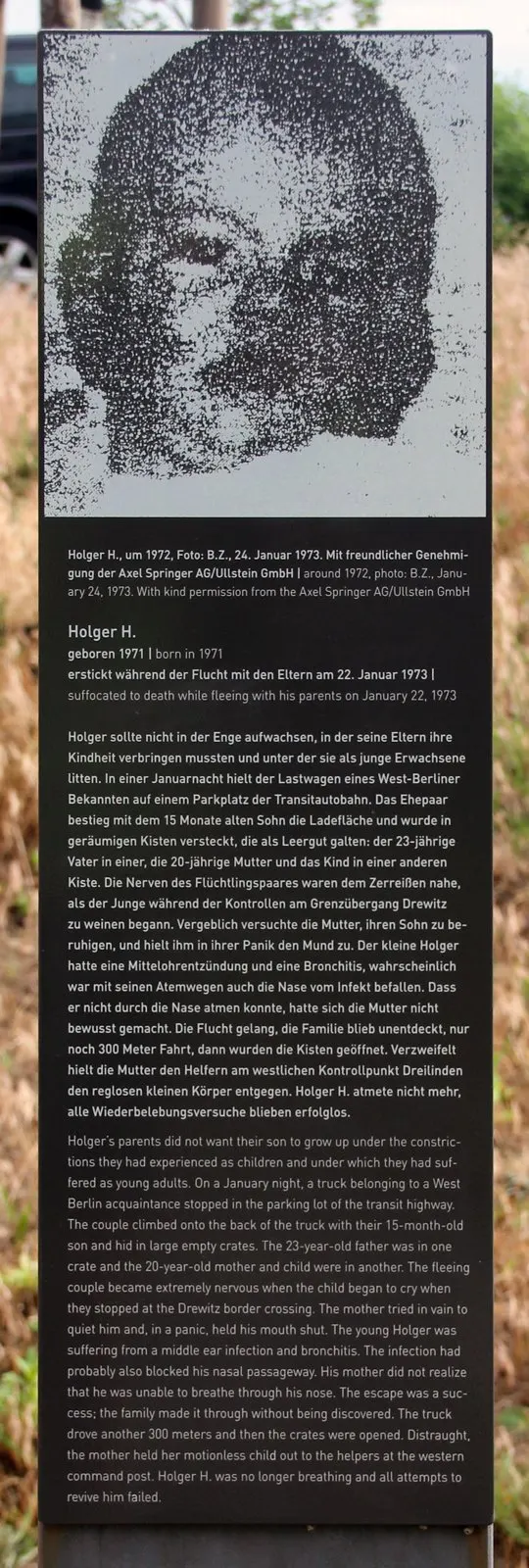

Holger H. was born in 1971. His parents, Ingrid and Klaus H., had met in Moscow on a youth travel programme. Little is known of why they wanted to leave East Germany, but after their son was born they were sure they did not want to spend their lives there. His father, who had tried to escape across the Baltic Sea at 17, had been branded a "republic fugitive" and had few career prospects. His mother, a young teacher, probably suffered under the political paternalism of the time. They wanted to leave for their own sake and for Holger's: they did not want him to grow up with the constraints they had known.
One night in January 1973 a truck belonging to a West Berlin acquaintance stopped at a car park on the transit motorway. The 23-year-old father climbed into one large empty crate on the back; the 20-year-old mother and 15-month-old Holger hid in another. At the Drewitz border crossing, the driver later told the West Berlin police, the inspection took longer than usual.
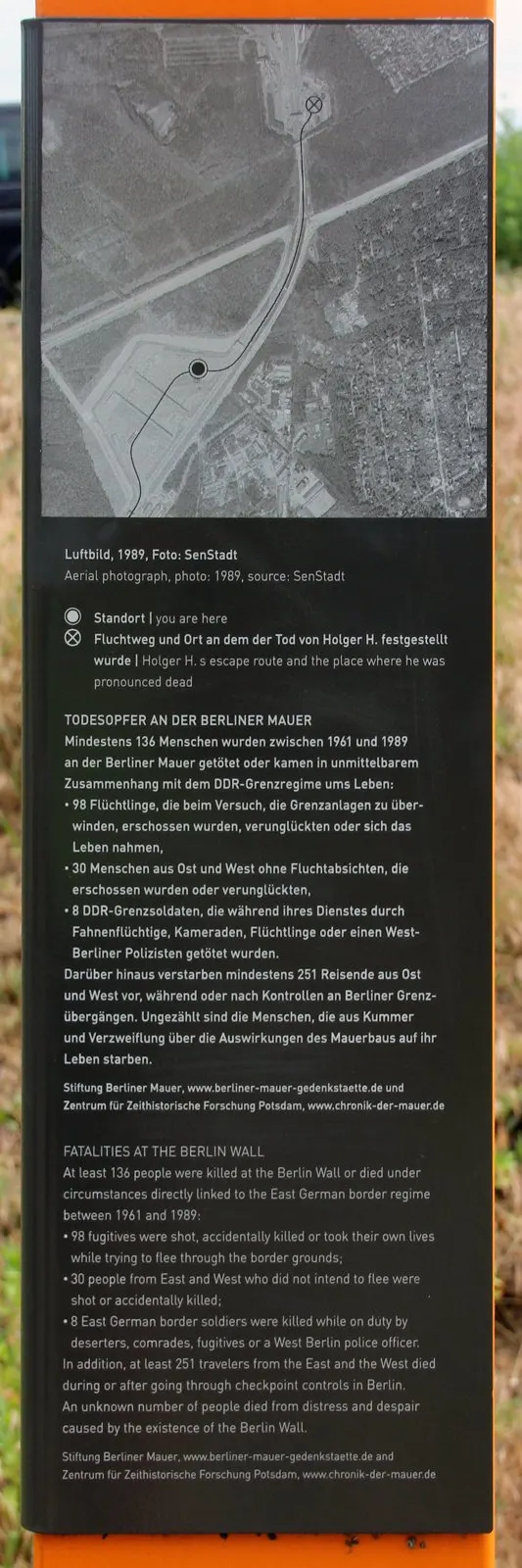
Holger was unwell, with a middle-ear infection and bronchitis, and his nose was probably blocked. When he began to cry, his frightened mother tried in vain to quieten him and, panicking, held his mouth shut, not realising that he could not breathe through his nose. The truck passed through undetected. About 300 metres further on the crates were opened, and his mother at once held her son out to the helpers at the western checkpoint. Holger was no longer breathing, and every attempt to revive him failed.
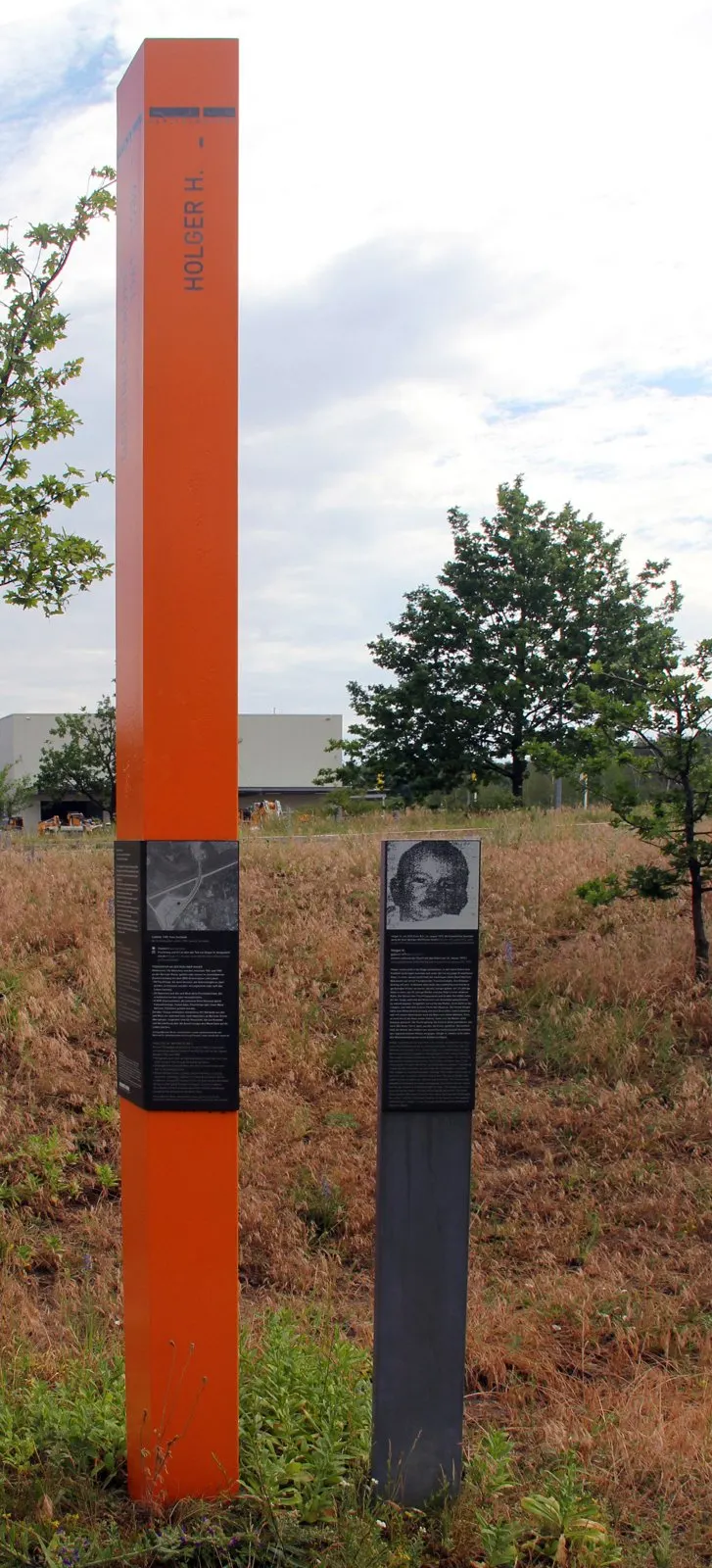
According to the B.Z. at the time, he was to be buried in a cemetery in Berlin-Marienfelde; the cemetery administration says that no grave for him exists there today. A commemorative column to him was put up near the Drewitz-Dreilinden Border Crossing memorial at Stahnsdorfer Damm/Europapark.


Read more
Also died on the outer ring between Berlin-Zehlendorf and Potsdam-Babelsberg
- Jörgen Schmidtchen 18 April 1962
- Peter Böhme 18 April 1962
- Günter Wiedenhöft Night of 5 to 6 December 1962
- Norbert Wolscht 28 July 1964
- Rainer Gneiser 28 July 1964
- Peter Hauptmann 3 May 1965
- Willi Marzahn 19 March 1966
- Horst Körner 15 November 1968
Sources
This profile is a summary written for this site from the biography in source 1, which also gives the full account with archival references. Facts taken from other sources are listed below with what they support.
- Martin Ahrends/Udo Baron, “Holger H.”, biography in Chronik der Mauer, Federal Agency for Civic Education, Centre for Contemporary History Potsdam and Deutschlandradio. Accessed 23 September 2026. Read online. The biography from which this profile was written, and the source of the dates and place of death.
- German version of the same biography. Accessed 23 September 2026. Read online.
- "Mauerweg: Von Lichterfelde Süd nach Griebnitzsee", Berliner Mauerweg route description, berlin.de. Accessed 5 October 2026. Read online. Source for: that an information column to him stands in the Kleinmachnow section of the Berlin Wall Trail.
- Stiftung Berliner Mauer, "Karte der Erinnerungsorte" (map of places of remembrance), entry "Erinnerungsstele für Holger H.". Accessed 5 October 2026. Read online. Source for: the place of his memorial column near the former Drewitz crossing.
- Hans-Hermann Hertle and Maria Nooke (eds.), The Victims at the Berlin Wall, 1961–1989: A Biographical Handbook. Centre for Contemporary History Potsdam and Berlin Wall Foundation, Berlin 2011. The printed handbook from which the online biography is taken.
- Hans-Hermann Hertle and Maria Nooke, “140 Victims at the Berlin Wall, 1961–1989” (list), Centre for Contemporary History Potsdam and Berlin Wall Foundation, August 2017. PDF. Used to cross-check names and dates.
- Hans-Hermann Hertle and Maria Nooke, “The Victims at the Berlin Wall, 1961–1989: Findings of a Research Project”, August 2017. PDF. Source of the classification into escapees, people with no intent to escape, and border soldiers.
Corrections
This profile was corrected on 28 September and 3 October 2026. Each round of corrections is described in the corrections log:
- : All profiles and articles cross-checked against the German originals
- : Every profile checked against all the sources
Further reading
Image credits
- Memorial stele for Holger H. at the Stahnsdorfer Damm in Kleinmachnow, with a newspaper photograph of him from around 1972, photographed in 2019. OTFW, Berlin, CC BY-SA 3.0, Wikimedia Commons.
- Memorial column and stele for Holger H. at the Stahnsdorfer Damm in Kleinmachnow, photographed in 2019. OTFW, Berlin, CC BY-SA 3.0, Wikimedia Commons.
- Panel with a 1989 aerial photograph marking Holger H.'s escape route and the place where he was pronounced dead. OTFW, Berlin, CC BY-SA 3.0, Wikimedia Commons.
Cite this page
“Holger H.”, Victims of the Berlin Wall, Berlin Experiences. https://victimsofthewall.com/victims/h-holger/
Map
The pin position is based on the place of death described in source 1. Base map © OpenStreetMap contributors; course of the Wall in 1989 from Geoportal Berlin (dl-de/zero-2.0). Accessed 23 September 2026.