Cengaver Katrancı
1964–1972
Cengaver Katrancı, an eight-year-old boy from Kreuzberg, fell into the Spree at the Gröbenufer near the Oberbaum Bridge on 30 October 1972 and drowned; the river there belonged to East Berlin, and West Berlin rescuers were never allowed to go in.
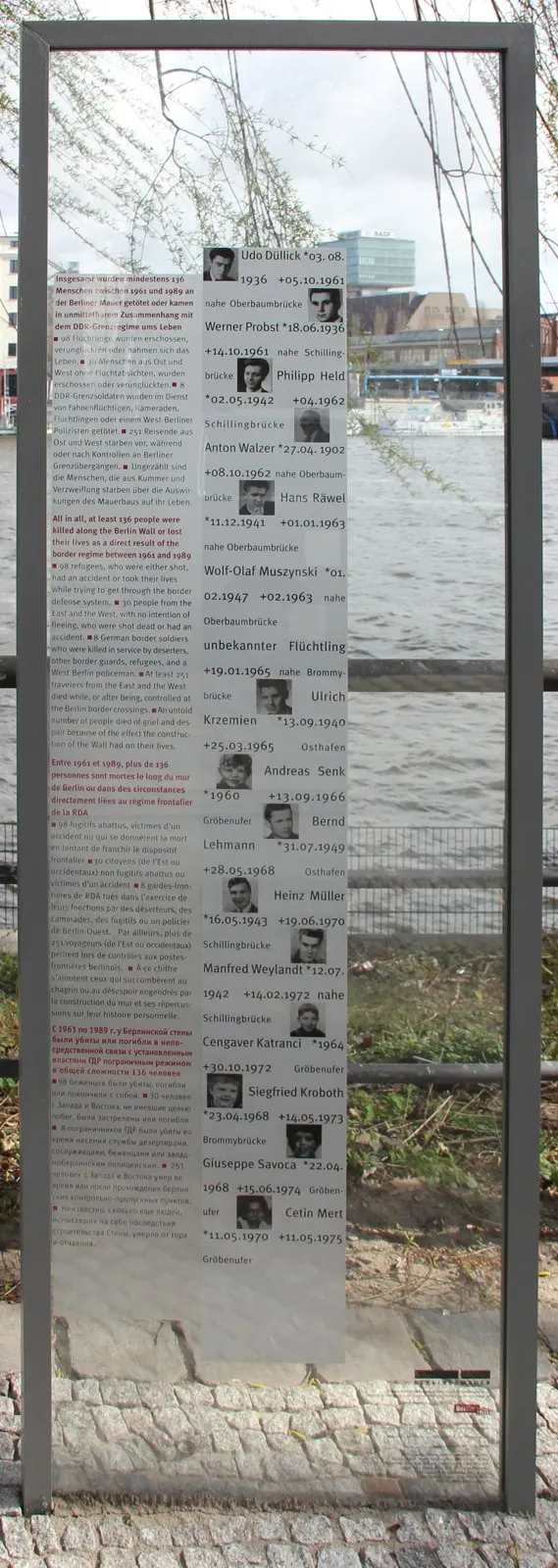
_Maueropfer.jpg)
Cengaver Katrancı was born in 1964. He lived in the West Berlin district of Kreuzberg with his mother, who came from Turkey, and his three siblings.
Shortly after 1 p.m. on 30 October 1972, eight-year-old Cengaver was playing with a friend on the Gröbenufer, the Spree embankment in Kreuzberg about 100 metres from the Oberbaum Bridge crossing. While the boys fed the swans from the narrow edge of the quay, Cengaver suddenly toppled into the cold river. Screaming, his friend rushed off to find help. A fisherman nearby, once he understood what the boy was telling him, sent him on to the nearby customs post for help, hurried to the spot and began to undress, but he realised that the whole width of the river here belonged to East Berlin and that he could be shot if he went in. He did not jump.
West Berlin customs officers alerted the police and fire brigade and came to the bank. They waved to the crew of an East German fire boat escorting a tanker, but it stopped only briefly and went on. From about 1.30 p.m. the West Berlin police negotiated with border troops on the Oberbaum Bridge, while two West Berlin divers stood ready on the quay, waiting in vain for permission to enter the water. An East Berlin water police boat, hailed and waved over from the western bank, hesitantly edged a little closer, then turned away and was at once caught up by a border troops' speedboat: it had crossed the middle of the river into a zone forbidden to it. A crowd that the police estimated at several hundred people gathered on the bank and could only watch.
An East Berlin lifeboat reached the scene at about 2.30 p.m., and a search began. Half an hour later a diver surfaced with the boy close to the bank. A stretcher stood ready and the boy could have been handed over, but the diver did not swim the two metres to the West Berlin bank; he swam back to the border troops' boat. Any move by the diver with the boy towards the western bank could have been treated by the guards as an escape attempt.
That evening his mother was allowed into East Berlin with two relatives to identify her son at the Charité, after which he was brought back to West Berlin. She asked for him to be buried in Ankara. After his death the Berlin Senate announced that it would seek an agreement with East Germany on help in accidents in the border waters; it took many rounds of talks, and the deaths of three more children in the Spree, before one was reached in 1975.
Read more
Also died on the sector border between Berlin-Friedrichshain and Berlin-Kreuzberg
- Udo Düllick 5 October 1961
- Werner Probst 14 October 1961
- Philipp Held April 1962
- Anton Walzer 8 October 1962
- Hans Räwel 1 January 1963
- Wolf-Olaf Muszynski February 1963
- Unidentified fugitive 19 January 1965
- Ulrich Krzemien 25 March 1965
- Andreas Senk 13 September 1966
- Heinz Müller 19 June 1970
- Hans-Joachim Zock Between 14 and 17 November 1970
- Manfred Weylandt 14 February 1972
- Siegfried Kroboth 14 May 1973
- Giuseppe Savoca 15 June 1974
- Çetin Mert 11 May 1975
- Peter Grohganz Between 10 December 1980 and 9 February 1981
Sources
This profile is a summary written for this site. Every fact in it is taken from source 1, which also gives the full account with archival references.
- Udo Baron, “Cengaver Katrancı”, biography in Chronik der Mauer, Federal Agency for Civic Education, Centre for Contemporary History Potsdam and Deutschlandradio. Accessed 23 September 2026. Read online. Basis for every fact in this profile, including the dates and place of death.
- German version of the same biography. Accessed 23 September 2026. Read online.
- Hans-Hermann Hertle and Maria Nooke (eds.), The Victims at the Berlin Wall, 1961–1989: A Biographical Handbook. Centre for Contemporary History Potsdam and Berlin Wall Foundation, Berlin 2011. The printed handbook from which the online biography is taken.
- Hans-Hermann Hertle and Maria Nooke, “140 Victims at the Berlin Wall, 1961–1989” (list), Centre for Contemporary History Potsdam and Berlin Wall Foundation, August 2017. PDF. Used to cross-check names and dates.
- Hans-Hermann Hertle and Maria Nooke, “The Victims at the Berlin Wall, 1961–1989: Findings of a Research Project”, August 2017. PDF. Source of the classification into escapees, people with no intent to escape, and border soldiers.
Further reading
Image credits
- Memorial panel on the May-Ayim-Ufer in Berlin-Kreuzberg listing victims of the Berlin Wall, among them Cengaver Katrancı, photographed in 2012. OTFW, Berlin, CC BY-SA 3.0, Wikimedia Commons.
Cite this page
“Cengaver Katrancı”, Victims of the Berlin Wall, Berlin Experiences. https://victimsofthewall.com/victims/katranc-cengaver/
Map
The pin position is based on the place of death described in source 1. Base map © OpenStreetMap contributors; course of the Wall in 1989 from Geoportal Berlin (dl-de/zero-2.0). Accessed 23 September 2026.