Giuseppe Savoca
1968–1974
Giuseppe Savoca, a six-year-old boy from Kreuzberg, fell into the Spree from the Gröbenufer bank near the Oberbaum Bridge on 15 June 1974 and drowned; the river there belonged to East Berlin and West Berlin rescuers were not allowed to help.
_Maueropfer.jpg)
Giuseppe Savoca was born in West Berlin on 22 April 1968. His parents were Italian immigrants, and he lived with them and his two younger sisters in Kreuzberg.
On Saturday 15 June 1974 the six-year-old was playing with a friend on the Gröbenufer, the riverbank in Kreuzberg. His friend, a Turkish boy, later said that they had only wanted to look at the fish. Shortly after 10 a.m. Giuseppe slipped under the railing and began poking a stick into the water below the quay wall, perhaps hoping to reach a toy. Stretching further and further out, he lost his balance and fell into the river. While he struggled in the water, his playmate ran off to find help.
In that area the water belonged entirely to East Berlin. From the Oberbaum Bridge, about 60 metres away, an East German border guard saw the boy fall through his binoculars and reported it to the command post of the border regiment's boat company. Soon afterwards, independently of that report, a border troop patrol boat passed close to the spot, and an adult brought by Giuseppe's friend called out that a child was in the water. The coxswain paused and then carried on. He later explained that he had seen no air bubbles and took the call to be a provocation. He added that he had not been allowed to cross the barrier line in the river without an explicit order from the regiment's commander and prior notice to the guards at the Oberbaum Bridge crossing.
Only after receiving that order did he turn back, beginning a search with a second boat at about 10:25 a.m. A number of West Berliners gathered on the bank, none of whom attempted a rescue, and West Berlin police and firemen arrived ten minutes later, but, as in earlier cases at the Gröbenufer, the border guards would not let them take part. His mother later told the West Berlin press that a woman had told her East German border guards had threatened with their guns a man who had wanted to rescue her son. Recovery work began only at around 10:45 a.m., when a team of divers from the East German border regiment arrived, and Giuseppe was brought out of the water about an hour after he fell, then taken to East Berlin.
That evening his parents were allowed into East Berlin to identify their son at the Charité forensic institute. His body was returned to West Berlin on 19 June 1974, and the East German government billed the parents 54.50 German marks for this. "Neues Deutschland" then claimed, falsely, that every necessary step had been taken at once; the West Berlin press accused the border guards of obstructing and delaying the rescue.
For months, talks between the West Berlin Senate and the East German government about emergency rescues on the border waters had produced no result. Only after the death of another child, Çetin Mert, did they sign an agreement on 29 October 1975 allowing rescue from the West Berlin side in an emergency, once rescue posts on the bank had signalled to the guards. Those posts were put up along the water border in the spring of 1976.
Read more
Also died on the sector border between Berlin-Friedrichshain and Berlin-Kreuzberg
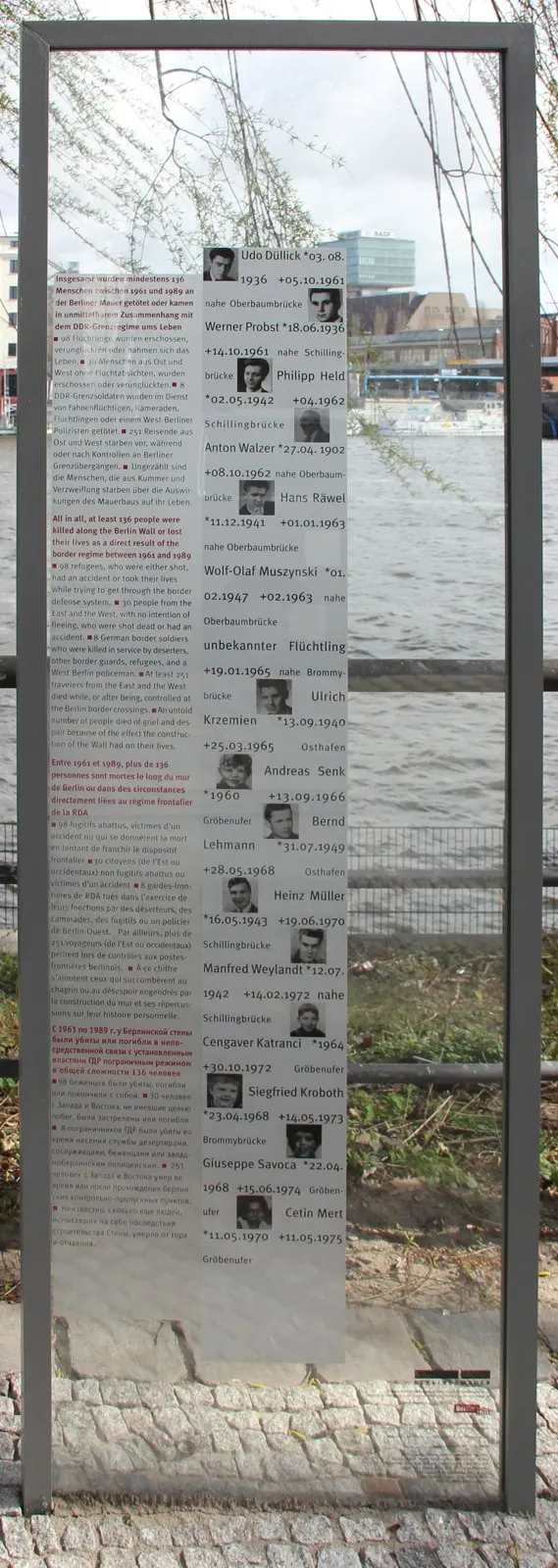
- Udo Düllick 5 October 1961
- Werner Probst 14 October 1961
- Philipp Held April 1962
- Anton Walzer 8 October 1962
- Hans Räwel 1 January 1963
- Wolf-Olaf Muszynski February 1963
- Unidentified fugitive 19 January 1965
- Ulrich Krzemien 25 March 1965
- Andreas Senk 13 September 1966
- Heinz Müller 19 June 1970
- Hans-Joachim Zock Between 14 and 17 November 1970
- Manfred Weylandt 14 February 1972
- Cengaver Katrancı 30 October 1972
- Siegfried Kroboth 14 May 1973
- Çetin Mert 11 May 1975
- Peter Grohganz Between 10 December 1980 and 9 February 1981
Sources
This profile is a summary written for this site. Every fact in it is taken from source 1, which also gives the full account with archival references.
- Udo Baron, “Giuseppe Savoca”, biography in Chronik der Mauer, Federal Agency for Civic Education, Centre for Contemporary History Potsdam and Deutschlandradio. Accessed 23 September 2026. Read online. Basis for every fact in this profile, including the dates and place of death.
- German version of the same biography. Accessed 23 September 2026. Read online.
- Hans-Hermann Hertle and Maria Nooke (eds.), The Victims at the Berlin Wall, 1961–1989: A Biographical Handbook. Centre for Contemporary History Potsdam and Berlin Wall Foundation, Berlin 2011. The printed handbook from which the online biography is taken.
- Hans-Hermann Hertle and Maria Nooke, “140 Victims at the Berlin Wall, 1961–1989” (list), Centre for Contemporary History Potsdam and Berlin Wall Foundation, August 2017. PDF. Used to cross-check names and dates.
- Hans-Hermann Hertle and Maria Nooke, “The Victims at the Berlin Wall, 1961–1989: Findings of a Research Project”, August 2017. PDF. Source of the classification into escapees, people with no intent to escape, and border soldiers.
Further reading
Image credits
- Glass memorial panel for the victims of the Berlin Wall on the May-Ayim-Ufer in Berlin-Kreuzberg; Giuseppe Savoca is named among them. OTFW, Berlin, CC BY-SA 3.0, Wikimedia Commons.
Cite this page
“Giuseppe Savoca”, Victims of the Berlin Wall, Berlin Experiences. https://victimsofthewall.com/victims/savoca-giuseppe/
Map
The pin position is based on the place of death described in source 1. Base map © OpenStreetMap contributors; course of the Wall in 1989 from Geoportal Berlin (dl-de/zero-2.0). Accessed 23 September 2026.