Manfred Weylandt
1942–1972
Manfred Weylandt, a 29-year-old stoker from East Berlin facing a prison term, was shot while swimming across the Spree towards West Berlin on 14 February 1972 and drowned; his body was recovered near the Schilling Bridge.
_Maueropfer.jpg)
Manfred Weylandt was born in Berlin on 12 July 1942; his mother raised him together with his two sisters. He finished only seven years of school and got by as an unskilled worker, and between 1957 and 1970 he served various prison sentences for different offences. His second marriage, in the autumn of 1970, seemed to bring some stability. He worked as an assistant stoker at a filter and carburettor factory beside the Wall near the Ostbahnhof in Friedrichshain, trained as a boiler attendant and, according to a Stasi report, did his job with discipline.
Then, however, the Friedrichshain district court sentenced him again, to two years for theft of socialist property. From then on he expected to be arrested any day; according to his wife's statements as recorded by Stasi officers, he turned to alcohol and took pills for his sleeplessness to master his fears. On 13 February 1972 a letter told him to report to Rummelsburg Penitentiary on 1 March. He did not want to return to prison; he had often talked with his wife about escaping, and it now seemed his only option. On the afternoon of 14 February he and his wife quarrelled because he had spent their last money on alcohol and a guitar, and at around 9.30 p.m., heavily drunk, he left their home in Adlershof. He was last seen at around 10.30 p.m. in a bar in Friedrichshain, which he reportedly left saying he was going to pull off something the world could only dream of.
He cycled to his workplace and, unseen by the night shift, climbed onto a shed roof and slid down a heating pipe into a dog run in the border area without any guard dog barking. The Stasi later found that employees of the plant had been feeding the border dogs, and he apparently knew he had nothing to fear from them. He took off his jacket and scarf, crossed the border area to the embankment wall of the Spree, slipped into the icy water and swam towards the West Berlin bank. At around 11:30 p.m., when he was halfway across, two border guards saw him and, when he did not respond to their shouts, fired until he disappeared from view. A bullet struck the back of his head, and he sank and drowned.
Divers found his body near the Schilling Bridge on the afternoon of the next day. It was taken away fastened to the underside of a boat, so that it could not be seen from the West Berlin bank. The guards were decorated and given a bonus. The Stasi identified him from his fingerprints two days after his death but did not tell his wife, instead investigating his family, friends and colleagues to make sure the truth stayed hidden. His wife tried to report him missing on 15 February 1972, but the People's Police accepted her report only six days later; she enquired at hospitals and prisons in vain, fearing he might have taken his own life.
His body was cremated on 13 March 1972. The next day his widow was told only that he had been recovered from the Spree near the Museum Island, which was not where he had been found, and already cremated; how he died was not mentioned. His urn was buried at the Baumschulenweg cemetery on 21 March 1972 without his relatives present. The family learned the truth only more than twenty years later. Twenty-one years after his death, the Berlin Regional Court convicted the two guards of joint manslaughter and gave them youth sentences of a year and ten months, suspended on probation.
Read more
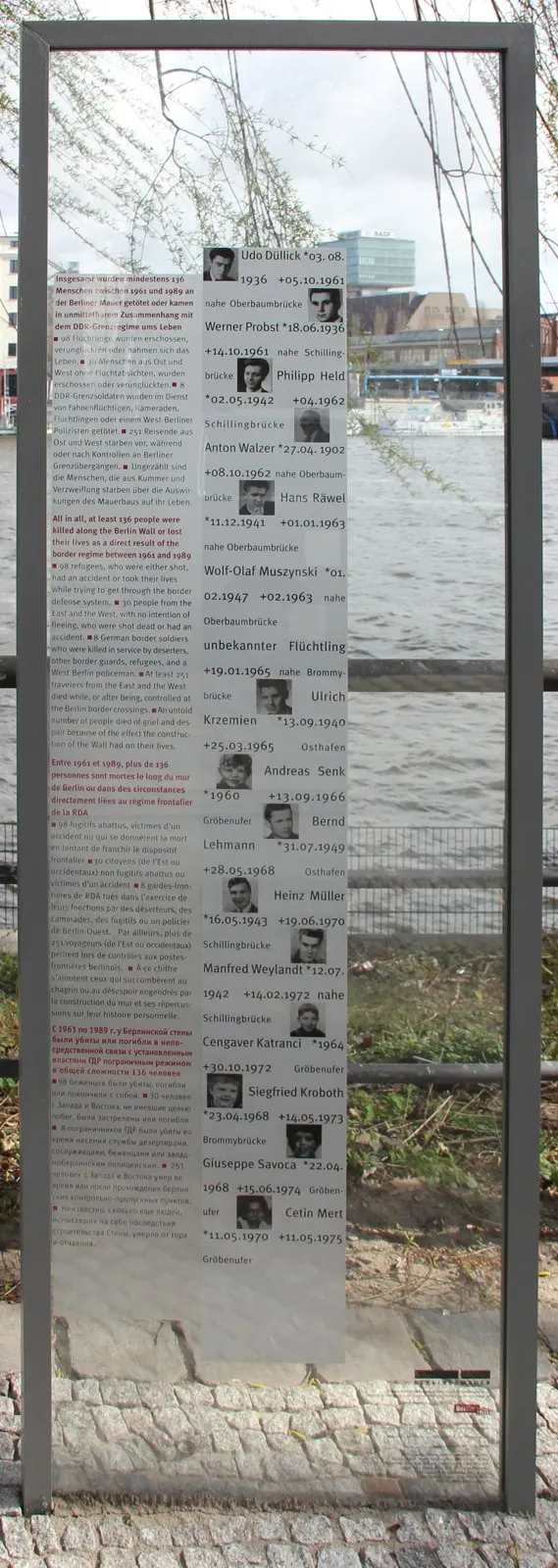
Also died on the sector border between Berlin-Friedrichshain and Berlin-Kreuzberg
- Udo Düllick 5 October 1961
- Werner Probst 14 October 1961
- Philipp Held April 1962
- Anton Walzer 8 October 1962
- Hans Räwel 1 January 1963
- Wolf-Olaf Muszynski February 1963
- Unidentified fugitive 19 January 1965
- Ulrich Krzemien 25 March 1965
- Andreas Senk 13 September 1966
- Heinz Müller 19 June 1970
- Hans-Joachim Zock Between 14 and 17 November 1970
- Cengaver Katrancı 30 October 1972
- Siegfried Kroboth 14 May 1973
- Giuseppe Savoca 15 June 1974
- Çetin Mert 11 May 1975
- Peter Grohganz Between 10 December 1980 and 9 February 1981
Sources
This profile is a summary written for this site. Every fact in it is taken from source 1, which also gives the full account with archival references.
- Martin Ahrends/Udo Baron, “Manfred Weylandt”, biography in Chronik der Mauer, Federal Agency for Civic Education, Centre for Contemporary History Potsdam and Deutschlandradio. Accessed 23 September 2026. Read online. Basis for every fact in this profile, including the dates and place of death.
- German version of the same biography. Accessed 23 September 2026. Read online.
- Hans-Hermann Hertle and Maria Nooke (eds.), The Victims at the Berlin Wall, 1961–1989: A Biographical Handbook. Centre for Contemporary History Potsdam and Berlin Wall Foundation, Berlin 2011. The printed handbook from which the online biography is taken.
- Hans-Hermann Hertle and Maria Nooke, “140 Victims at the Berlin Wall, 1961–1989” (list), Centre for Contemporary History Potsdam and Berlin Wall Foundation, August 2017. PDF. Used to cross-check names and dates.
- Hans-Hermann Hertle and Maria Nooke, “The Victims at the Berlin Wall, 1961–1989: Findings of a Research Project”, August 2017. PDF. Source of the classification into escapees, people with no intent to escape, and border soldiers.
Further reading
Image credits
- Memorial panel on the May-Ayim-Ufer in Berlin-Kreuzberg listing victims of the Berlin Wall, among them Manfred Weylandt, photographed in 2012. OTFW, Berlin, CC BY-SA 3.0, Wikimedia Commons.
Cite this page
“Manfred Weylandt”, Victims of the Berlin Wall, Berlin Experiences. https://victimsofthewall.com/victims/weylandt-manfred/
Map
The pin position is based on the place of death described in source 1. Base map © OpenStreetMap contributors; course of the Wall in 1989 from Geoportal Berlin (dl-de/zero-2.0). Accessed 23 September 2026.