Udo Düllick
1936–1961
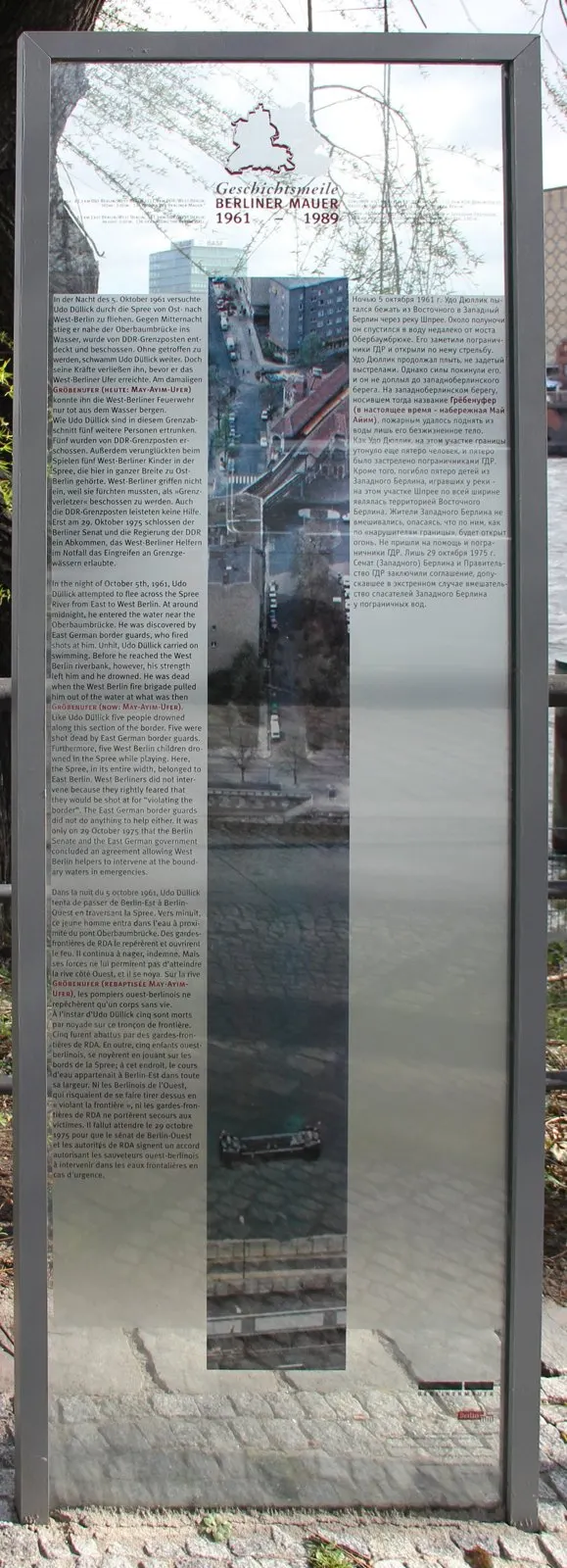
Udo Düllick, a 25-year-old railway engineer, tried to swim across the Spree near the Oberbaum Bridge on the night of 5 October 1961. Under fire and pursued by a police boat, he sank from exhaustion just short of the other bank and drowned.
_Udo_D%C3%BCllick.jpg)
Udo Düllick was born on 3 August 1936 in Werder near Strausberg, east of Berlin, and grew up there in a Catholic family. He was a lively child, truthful and rebellious. He had a brother six years older. After his mother's early death his father remarried, and a younger half-sister was born. He trained first as a bricklayer and then studied engineering in Dresden.
His brother left for the West in 1959, but he remained in East Germany, living with his parents. He was in West Berlin with his girlfriend over the weekend of 12 and 13 August 1961, and when they returned on 13 August they most likely did not realise that the newly sealed border would be permanent. He later told his stepmother he could always find a way to the West if he needed to. Working as an engineer for the Deutsche Reichsbahn in Lichtenberg, he had long been weary of the political pressure around him; his sister recalled how hard he found it to keep his critical thoughts to himself.
On the evening of 5 October 1961 he attended a compulsory works party ahead of the state anniversary. There he quarrelled with a superior and is said to have torn the epaulettes from the man's railway uniform. This was probably what finally made him decide to leave. That same night he took a taxi to Warschauer Strasse. Being a good swimmer may have encouraged him to risk crossing the Spree, a border waterway, near the Oberbaum Bridge. Shortly before midnight, on the grounds of the Osthafenmühle, he took off his jacket, trousers and shoes and went into the water.
Guards on the bridge saw him at once. After flares and warning shots they fired at him, and finally a water police boat set off after him. He dived again and again to avoid the bullets. West Berliners on the far bank wanted to help but could not go beyond the embankment wall, because the whole width of the river there belonged to East Berlin. He had almost reached the other side when he suddenly went under. His body was recovered from the West Berlin side an hour later.
His pursuers believed they had shot him, but his body bore no bullet wounds, and the post-mortem found that the chase had left him so exhausted that he drowned. Yet mistaken assumptions also found their way into West Berlin police and press reports: according to eyewitnesses, two or even three fugitives had been involved, and so it was claimed in the West for decades that a second fugitive had died that night. Only when the East German archives were opened was it established beyond doubt that he had been alone.
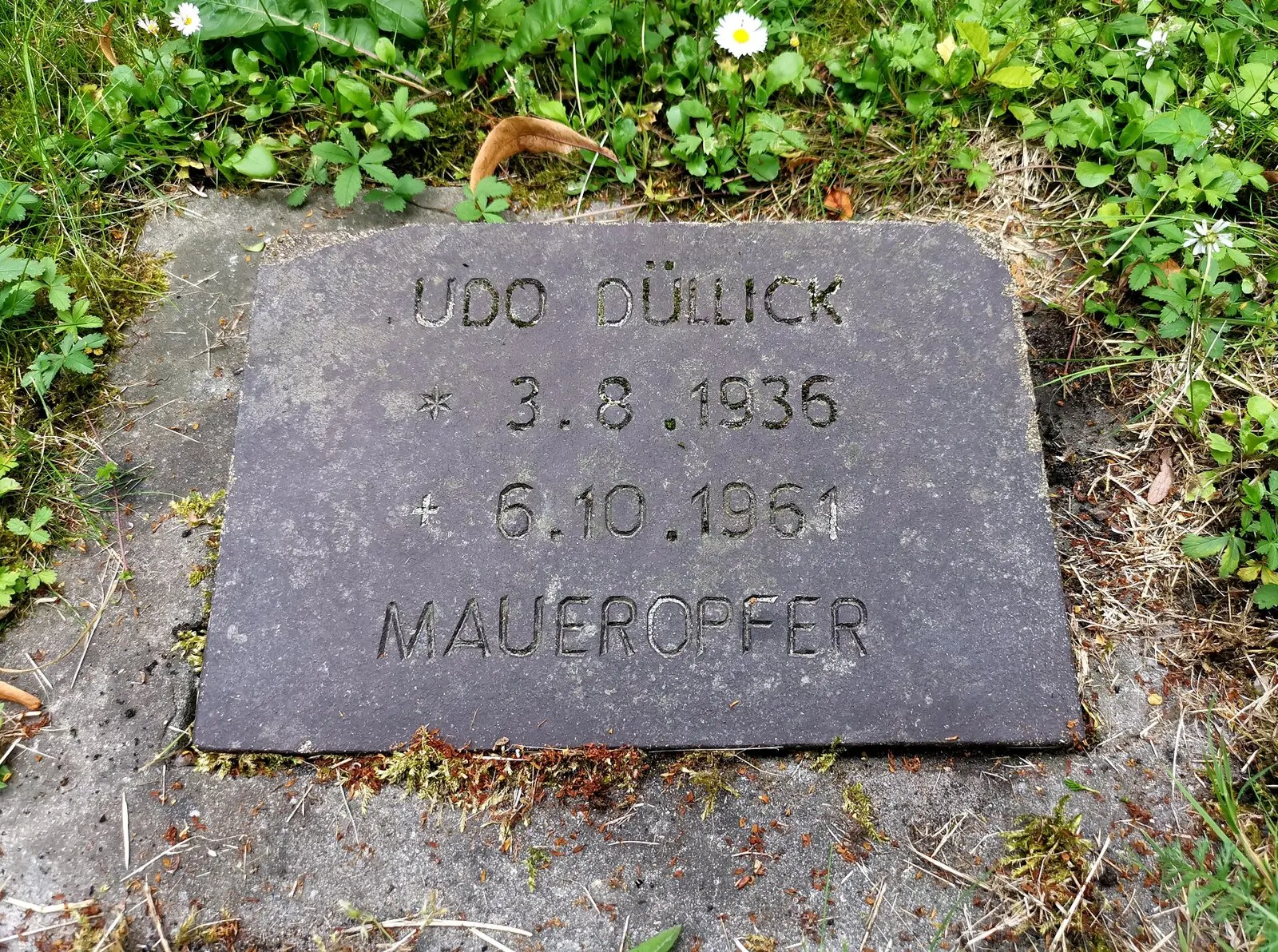
At first no one in West Berlin knew who he was. On 7 October 1961 at least 2,500 people gathered for a service on the Gröbenufer in Kreuzberg, and in the following days hundreds laid flowers and wreaths there, where a few weeks later a memorial stone inscribed "Dem unbekannten Flüchtling" (To the unknown fugitive) was set up. On 18 October a large crowd attended his burial in the Jerusalem Cemetery, Kreuzberg, with a Catholic and a Protestant clergyman leading the ceremony because his faith was not known.
His parents learned from Western media reports that a man had died at the Oberbaum Bridge and anxiously contacted the West Berlin authorities; it took weeks before they knew for certain that it was their son. Out of consideration for his relatives, who feared reprisals, the West Berlin authorities nevertheless did not make his name public. In November 1961 the Catholic parish in Rehfelde, the village next to his home village, held a requiem for him, while the Stasi insisted that the circumstances of his death not be mentioned.
_Maueropfer.jpg)

Read more
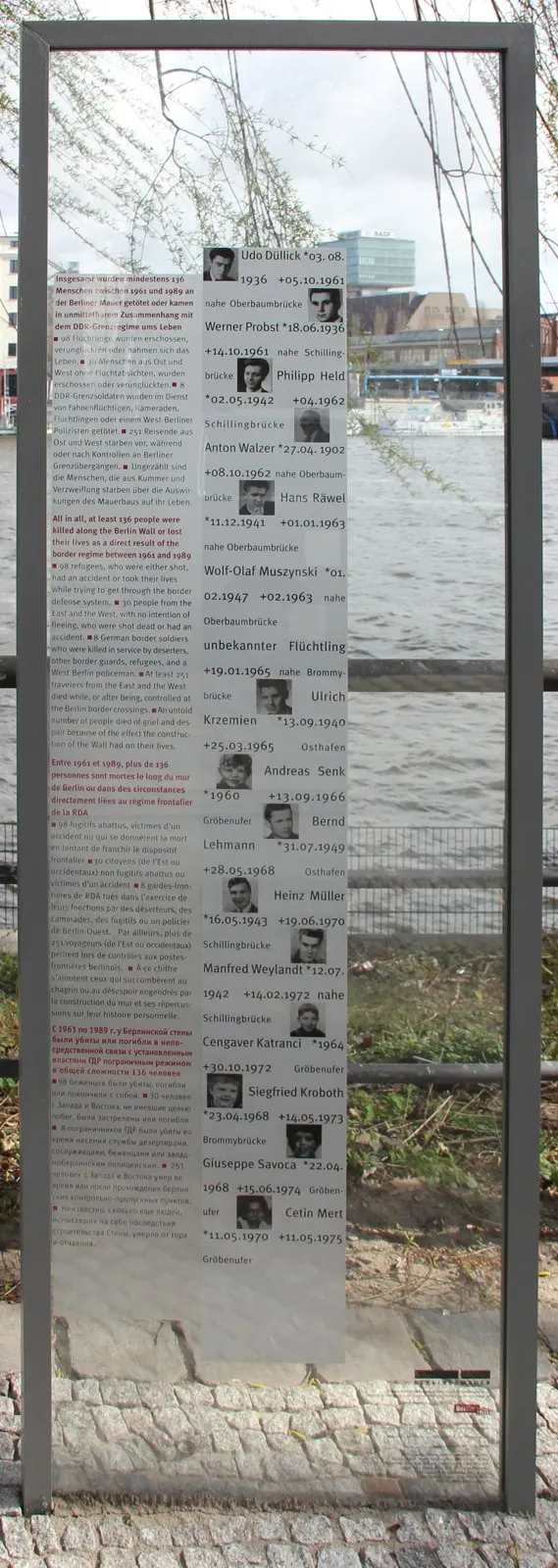
Also died on the sector border between Berlin-Friedrichshain and Berlin-Kreuzberg
- Werner Probst 14 October 1961
- Philipp Held April 1962
- Anton Walzer 8 October 1962
- Hans Räwel 1 January 1963
- Wolf-Olaf Muszynski February 1963
- Unidentified fugitive 19 January 1965
- Ulrich Krzemien 25 March 1965
- Andreas Senk 13 September 1966
- Heinz Müller 19 June 1970
- Hans-Joachim Zock Between 14 and 17 November 1970
- Manfred Weylandt 14 February 1972
- Cengaver Katrancı 30 October 1972
- Siegfried Kroboth 14 May 1973
- Giuseppe Savoca 15 June 1974
- Çetin Mert 11 May 1975
- Peter Grohganz Between 10 December 1980 and 9 February 1981
Sources
This profile is a summary written for this site. Every fact in it is taken from source 1, which also gives the full account with archival references.
- Christine Brecht, “Udo Düllick”, biography in Chronik der Mauer, Federal Agency for Civic Education, Centre for Contemporary History Potsdam and Deutschlandradio. Accessed 23 September 2026. Read online. Basis for every fact in this profile, including the dates and place of death.
- German version of the same biography. Accessed 23 September 2026. Read online.
- Hans-Hermann Hertle and Maria Nooke (eds.), The Victims at the Berlin Wall, 1961–1989: A Biographical Handbook. Centre for Contemporary History Potsdam and Berlin Wall Foundation, Berlin 2011. The printed handbook from which the online biography is taken.
- Hans-Hermann Hertle and Maria Nooke, “140 Victims at the Berlin Wall, 1961–1989” (list), Centre for Contemporary History Potsdam and Berlin Wall Foundation, August 2017. PDF. Used to cross-check names and dates.
- Hans-Hermann Hertle and Maria Nooke, “The Victims at the Berlin Wall, 1961–1989: Findings of a Research Project”, August 2017. PDF. Source of the classification into escapees, people with no intent to escape, and border soldiers.
Further reading
Image credits
- Memorial plaque for Udo Düllick on the May-Ayim-Ufer, Berlin-Kreuzberg. OTFW, Berlin, CC BY-SA 3.0, Wikimedia Commons.
- Memorial panel for Berlin Wall victims on the May-Ayim-Ufer, Kreuzberg, listing Udo Düllick. OTFW, Berlin, CC BY-SA 3.0, Wikimedia Commons.
- Grave of Udo Düllick, Friedhof IV der Gemeinde Jerusalems- und Neue Kirche. Georg Longino, CC BY-SA 4.0, Wikimedia Commons.
Cite this page
“Udo Düllick”, Victims of the Berlin Wall, Berlin Experiences. https://victimsofthewall.com/victims/duellick-udo/
Map
The pin position is based on the place of death described in source 1. Base map © OpenStreetMap contributors; course of the Wall in 1989 from Geoportal Berlin (dl-de/zero-2.0). Accessed 23 September 2026.