Andreas Senk
1960–1966
Andreas Senk, a six-year-old boy, fell into the Spree near the Oberbaum Bridge on 13 September 1966, where the whole river belonged to East Berlin; he was not recovered for hours and was declared dead in hospital.
_Maueropfer.jpg)
Andreas Senk was born in 1960, the only son of his mother, Renate Senk, who was 25 years old in 1966.
On the morning of 13 September 1966, a hazy late-summer day, the six-year-old fell into the Spree at the Gröbenufer in Kreuzberg, sometime between 10 and 12 o'clock. Although Andreas fell from the western bank, the whole width of the river here belonged to the Soviet sector, so he fell into East Berlin waters.
The guards in the watchtower on the Oberbaum Bridge, about 200 metres away, apparently either did not notice or did not take it seriously as a border violation, and the same was true of the East German boats patrolling mid-river. For hours no one tried to save him or bring him out of the water. According to a chief fire inspector's later report, when West Berlin firemen arrived, the soldiers on a patrol boat were called to and told that the firemen needed to search there; a soldier answered that they should not come too far out into the water. The guards stood on deck with their machine pistols ready and otherwise did nothing, and they did not help to find the boy. According to the East German boat's report, firemen began searching the river from the western bank with long poles, and at 2:30 p.m. a child of about five was recovered and taken away on the western side. Andreas was taken to the Bethanien Hospital, where he was declared dead.
The next day a West Berlin newspaper reported that the boy had died before the eyes of the border police, and a spokesman for the West Berlin Senate accused the patrol boat crew of not only hindering but preventing the recovery. Two days after the accident, once the firemen had been questioned, that accusation was toned down. It is not known whether the guards ever noticed that he had fallen; the files say nothing of it.
The late alarm to the fire brigade had nothing to do with politics, and he could only have survived if he had been brought out within eight minutes at most. But the chance of a quick rescue at this spot was very small because of the border: as one commentator wrote, there were no passers-by at the death strip who could have become rescuers, and anyone jumping into East Berlin waters would have had to reckon with being shot. Four more children fell into the Spree at the Gröbenufer and died between 1972 and 1975. Only in the autumn of 1975 was an agreement reached, and from the spring of 1976 illuminated rescue posts stood along a good six kilometres of the water border on the West Berlin side.
Read more
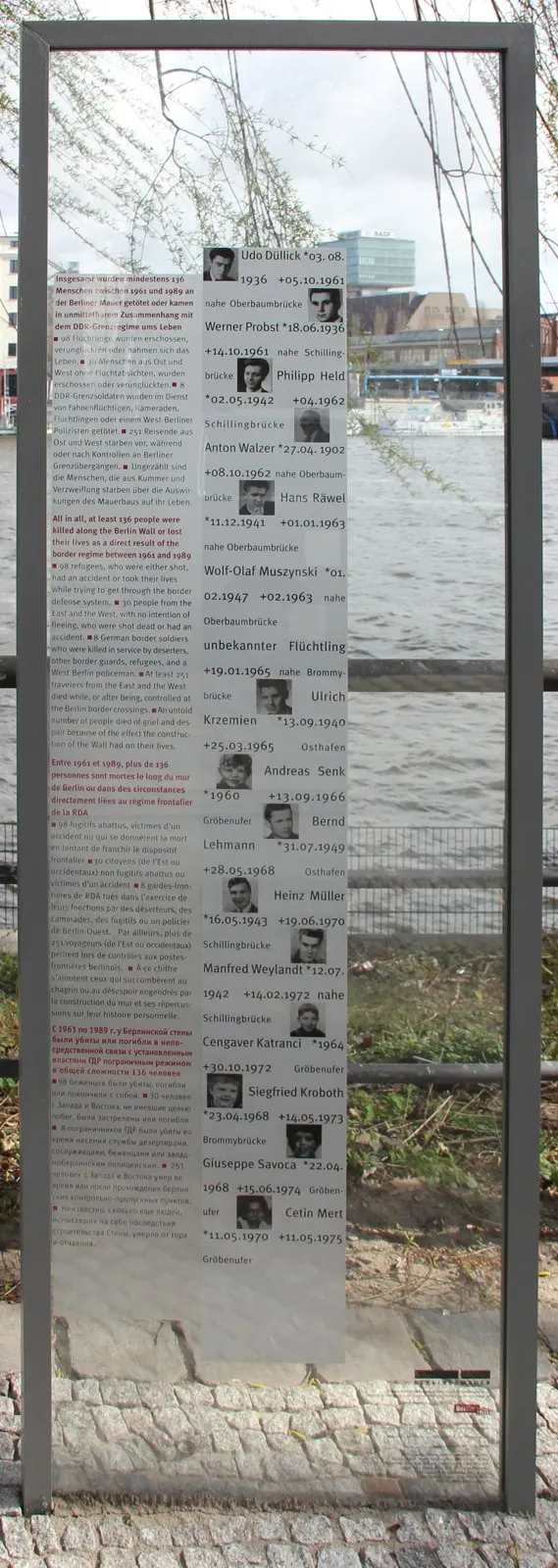
Also died on the sector border between Berlin-Friedrichshain and Berlin-Kreuzberg
- Udo Düllick 5 October 1961
- Werner Probst 14 October 1961
- Philipp Held April 1962
- Anton Walzer 8 October 1962
- Hans Räwel 1 January 1963
- Wolf-Olaf Muszynski February 1963
- Unidentified fugitive 19 January 1965
- Ulrich Krzemien 25 March 1965
- Heinz Müller 19 June 1970
- Hans-Joachim Zock Between 14 and 17 November 1970
- Manfred Weylandt 14 February 1972
- Cengaver Katrancı 30 October 1972
- Siegfried Kroboth 14 May 1973
- Giuseppe Savoca 15 June 1974
- Çetin Mert 11 May 1975
- Peter Grohganz Between 10 December 1980 and 9 February 1981
Sources
This profile is a summary written for this site. Every fact in it is taken from source 1, which also gives the full account with archival references.
- Martin Ahrends, “Andreas Senk”, biography in Chronik der Mauer, Federal Agency for Civic Education, Centre for Contemporary History Potsdam and Deutschlandradio. Accessed 23 September 2026. Read online. Basis for every fact in this profile, including the dates and place of death.
- German version of the same biography. Accessed 23 September 2026. Read online.
- Hans-Hermann Hertle and Maria Nooke (eds.), The Victims at the Berlin Wall, 1961–1989: A Biographical Handbook. Centre for Contemporary History Potsdam and Berlin Wall Foundation, Berlin 2011. The printed handbook from which the online biography is taken.
- Hans-Hermann Hertle and Maria Nooke, “140 Victims at the Berlin Wall, 1961–1989” (list), Centre for Contemporary History Potsdam and Berlin Wall Foundation, August 2017. PDF. Used to cross-check names and dates.
- Hans-Hermann Hertle and Maria Nooke, “The Victims at the Berlin Wall, 1961–1989: Findings of a Research Project”, August 2017. PDF. Source of the classification into escapees, people with no intent to escape, and border soldiers.
Further reading
Image credits
- Memorial panel on the May-Ayim-Ufer in Berlin-Kreuzberg with the names, dates and photographs of victims of the Berlin Wall, including Andreas Senk, photographed in 2012. OTFW, Berlin, CC BY-SA 3.0, Wikimedia Commons.
Cite this page
“Andreas Senk”, Victims of the Berlin Wall, Berlin Experiences. https://victimsofthewall.com/victims/senk-andreas/
Map
The pin position is based on the place of death described in source 1. Base map © OpenStreetMap contributors; course of the Wall in 1989 from Geoportal Berlin (dl-de/zero-2.0). Accessed 23 September 2026.