The Children Who Died at the Berlin Wall
Five West Berlin boys drowned in the Spree, where the whole river belonged to East Berlin; three East Berlin boys were killed by gunfire. Who they were.
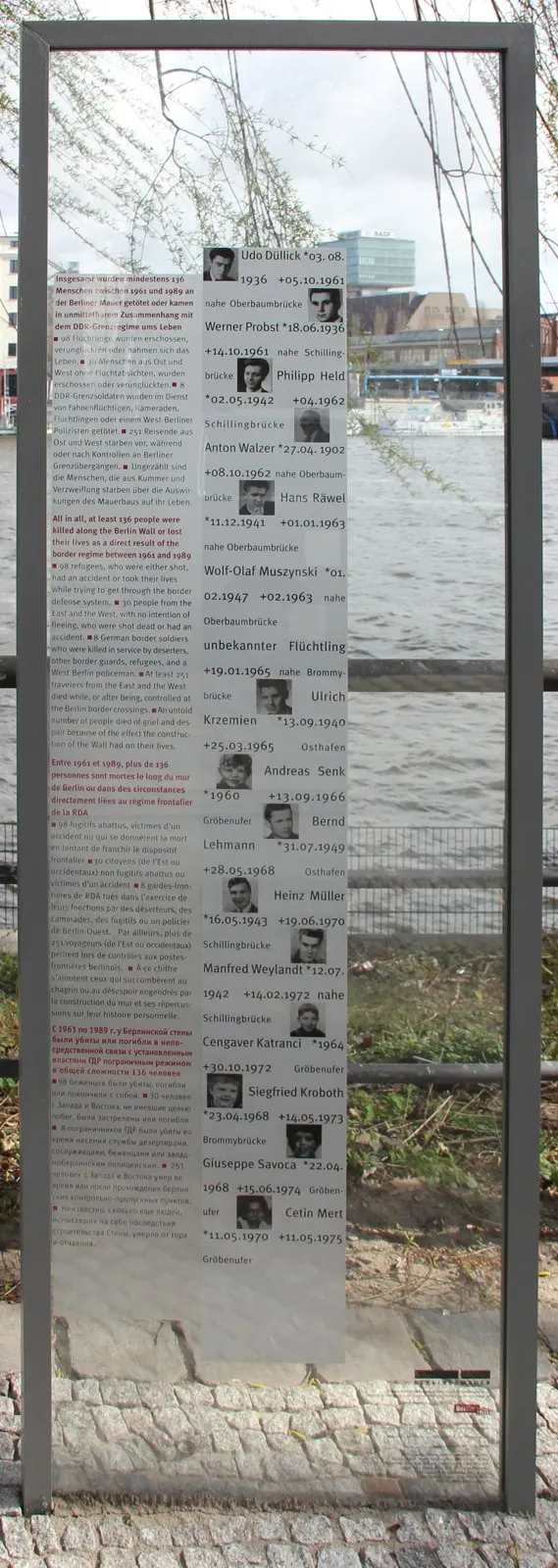
_Maueropfer.jpg)
Nine of the 140 people who died at the Berlin Wall were children. Five West Berlin boys, aged between five and eight, fell into the Spree in Kreuzberg between 1966 and 1975 and could not be rescued; two East Berlin boys, aged 10 and 13, were shot in 1966; a 13-year-old was killed by a border policeman’s gun in 1962; and a 15-month-old died during his parents’ escape in 1973. Where the five boys fell in, the whole width of the river belonged to East Berlin, and according to the researchers this border situation always played a part in why they could not be saved.
This article draws on the biographies from the joint research project of the Berlin Wall Foundation and the Centre for Contemporary History Potsdam. For the overall figures, see how many people died at the Berlin Wall.
The five boys of the Gröbenufer
The research project lists five children among the West Berliners who died in accidents at the border: Andreas Senk, Cengaver Katrancı, Siegfried Kroboth, Giuseppe Savoca and Çetin Mert. All five were playing by the Spree in Kreuzberg when they fell into the river, and none of them could be rescued.
The circumstances differed from case to case, but where the border ran always played a part. On this stretch of the Spree, the entire width of the river was part of East Berlin.
Andreas Senk, 13 September 1966
Andreas Senk was six, the only son of his 25-year-old mother, Renate Senk. On the morning of 13 September 1966 he fell into the Spree while playing with another child. For hours nothing was done to rescue him. His biography adds that the border guards may not even have seen him fall, and that the late alert to the fire brigade was not political. According to an East German border boat report, West Berlin firefighters searched from the bank with long poles, and at 2:30 p.m. a child was pulled out of the water. Andreas was declared dead at the Bethanien Hospital. His biography notes that there would have been a chance of rescuing him alive only within at most eight minutes of his fall, and that at this spot the chance was particularly small, for political reasons.
Cengaver Katrancı, 30 October 1972
Cengaver Katrancı was eight. He and his three siblings lived in Kreuzberg with their mother, who was from Turkey. Shortly after 1 p.m. on 30 October 1972 he was feeding the swans with a friend on the Gröbenufer when he lost his balance and fell in. A fisherman hurried over but, realising that the river there was East Berlin territory and that he could be shot, did not go in. West Berlin fire divers stood ready on the quay wall but were never given permission to go in. An East Berlin boat eventually recovered him. That evening his mother was allowed to travel to East Berlin to identify him, and she asked for him to be buried in Ankara.
Siegfried Kroboth, 14 May 1973
Siegfried Kroboth was born in West Berlin on 23 April 1968 and lived in Kreuzberg with his parents and his 13-year-old brother. On 14 May 1973, aged five, he fell into the Spree near the Brommy Bridge while playing with a friend. A 12-year-old girl ran to a fire alarm box to raise the alarm. Siegfried kept himself above water for a time. According to his biography, there might still have been a chance to save him, but the West Berlin police were not allowed into East Berlin’s water, and the fire brigade’s divers could only wait on the bank for permission. East German divers recovered him about four hours after the accident. His body was handed to his parents at the Oberbaum Bridge crossing on 16 May 1973.
Giuseppe Savoca, 15 June 1974
Giuseppe Savoca was born in West Berlin on 22 April 1968 and lived in Kreuzberg with his parents, who had come from Italy, and his two younger sisters. On Saturday 15 June 1974, aged six, he was playing on the Gröbenufer with a Turkish friend, who later said that they had only wanted to look at the fish. Reaching into the water with a stick, he leaned too far and fell in. An East German patrol boat stopped only briefly and went on; its crew returned only after an explicit order. Once again the West Berlin rescue teams were not allowed to take part. Giuseppe was brought out of the water about an hour after he fell in. His parents were allowed to identify him in East Berlin that evening, and his body was returned to West Berlin on 19 June 1974.
Çetin Mert, 11 May 1975
Çetin Mert was born on 11 May 1970 and lived in Kreuzberg with his Turkish parents and two brothers. 11 May 1975 was his fifth birthday, a Sunday, and the family was about to go on a picnic. Before they set off, he played ball with other children on the Gröbenufer. When the ball rolled into the Spree he tried to reach it with a stick and fell in. A fire officer asked the East German authorities at the Oberbaum Bridge crossing in vain for permission to begin a rescue, and no West Berliner dared to enter the guarded water. An East German border boat did not arrive until 1:10 p.m., and an hour later border troop divers recovered him, barely five metres from the western bank. Stasi files later showed that two border troop scouts had seen him fall but, with no means of communication, reported it only much later.
Around 2,000 members of West Berlin’s Turkish community protested against how the East German border guards had behaved, and his memorial service in West Berlin became a mass protest. Çetin Mert was buried in Düzce, his parents’ home town, and, according to his biography, his family has marked the day of his death with a religious ceremony every year since.
Why the children could not be rescued
West Berlin police and firefighters came to the bank, but because the water was East Berlin territory they could not go in without permission; in 1972 and in 1975 they asked the border troops at the Oberbaum Bridge for it in vain. East German crews were bound by their own rules: the East Berlin water police needed a special permit from the border guards to approach the western bank, and the coxswain of one border patrol boat later said that he had not been allowed to cross the red-and-white barrier line in the river without an explicit order from the commander of the border regiment. East German border guards were forbidden any contact with people on the western side.
Bystanders also feared for their own safety. The fisherman at the Gröbenufer in 1972 decided not to jump in because he feared being shot, and Giuseppe Savoca’s mother later told the West Berlin press that a woman had told her a man who wanted to rescue her son had been threatened by border guards with their guns.
The 1975 agreement and the rescue posts
After Cengaver Katrancı died in 1972, the West Berlin Senate announced that it would seek an agreement with East Germany on help in the event of accidents in the border waters. Siegfried Kroboth’s death in May 1973 added to the pressure; eight days later, representatives of the Senate and the East German government met for preliminary talks, and official talks followed on 6 June 1973. The negotiations stalled: East Germany’s draft was worded in a way that would have raised the sector border to the status of a state border, which the Senate and the Western Allies rejected.
After Çetin Mert’s death the West Berlin Senate had the four passages to the embankment welded shut and a wire-mesh fence put up in front of the quay wall, together with large warning signs in German and Turkish. East German border troops were secretly ordered to keep a boat opposite the Gröbenufer from 8 a.m. until sundown, ready to go to the scene of any accident at once and help.
On 29 October 1975 the Senate and the East German government finally signed an agreement on rescues after accidents in Berlin’s border waters. Under its terms, people who got into acute difficulty in the border waters from the West Berlin side could also be rescued from that side; this depended on rescue posts on the bank that would show the border guards an emergency was under way. In spring 1976 posts with a light visible on all sides, including from the East German watchtowers, were installed on the West Berlin bank along a total of just over six kilometres of the water border.
Jörg Hartmann and Lothar Schleusener, 14 March 1966
Jörg Hartmann was 10 and Lothar Schleusener was 13. Both were born in East Berlin, grew up in Friedrichshain and had known each other since they were small. Jörg lived with his grandmother and two younger siblings; his teacher remembered a quiet, shy boy who was very pleased when he was praised. His classmates said Jörg had told them he wanted to go to his father in West Berlin; his grandmother said he had never met his father. Lothar loved animals and, his sister remembered, wanted to be big and strong; shortly before he disappeared he told her that he and a friend wanted to visit relatives in West Berlin.
On the evening of 14 March 1966 the two boys entered the border area in Treptow near the “Sorgenfrei” garden colony; the 2017 study describes this as a joint escape attempt. Border guards fired at them. Jörg died at once; Lothar died in the People’s Police Hospital that night.
The GDR hid what had happened. Jörg’s grandmother was told he had drowned; Lothar’s mother was told he had died of an electric shock near Leipzig and was given a forged death certificate. The truth came to light in the 1990s. In November 1997 the Berlin Regional Court convicted a former border soldier of manslaughter and gave him a suspended sentence of 20 months. Jörg’s former teacher supported the efforts to create a monument to him; the memorial on Kiefholzstrasse, unveiled on 9 November 1999, names both boys.
Wolfgang Glöde, 11 June 1962
Wolfgang Glöde, 13, grew up in the “Sorgenfrei” garden settlement in Treptow, where his family had lived since 1930. On Whit Monday, 11 June 1962, he and two friends asked two border policemen on patrol to show them how their machine pistols worked. A shot went off by accident and Wolfgang was fatally injured. He had not been trying to escape. When the Western prosecuting authorities established in the following year that he had died in a firearms accident, his name was taken off the official lists of Wall victims; the 2017 study counts him among the 140, as one of those shot in the border area with no intention of escaping. His family buried him quietly at Baumschulenweg Cemetery.
Holger H., 22 January 1973
The youngest of the 140 victims was Holger H., who was 15 months old. His parents, a 20-year-old teacher and her 23-year-old husband, did not want him to grow up under the constraints they had known. On a January night in 1973 they hid in crates on a West Berlin acquaintance’s lorry. The driver later told the West Berlin police that they were held at the Drewitz checkpoint for longer than normal. Holger was ill with a middle-ear infection and bronchitis. When he began to cry, his mother tried in vain to calm him and, in her panic, covered his mouth, not realising that he could not breathe through his nose, which the infection had probably also affected. The family crossed undetected, but when the crates were opened on the western side Holger was no longer breathing, and he could not be revived.
Teenagers who died at the Wall
Teenagers also died at the Wall. Among the young people who died trying to escape are Peter Fechter, 18, shot on 17 August 1962; Axel Hannemann, 17, shot on 5 June 1962; Otfried Reck, 17, shot on 27 November 1962; Wolf-Olaf Muszynski, 16, who drowned in the Spree in February 1963, probably while trying to escape; Hans-Joachim Wolf, 17, shot on 26 November 1964; Karl-Heinz Kube, 17, shot on 16 December 1966; and Marienetta Jirkowsky, 18, shot on 22 November 1980. Their stories are told in their profiles; see also our article on the first victims of the Berlin Wall.
Questions and answers
- How many children drowned at the Berlin Wall?
- Five West Berlin boys, aged between five and eight, drowned in the Spree in Kreuzberg between 1966 and 1975: Andreas Senk, Cengaver Katrancı, Siegfried Kroboth, Giuseppe Savoca and Çetin Mert.
- Why could the children in the Spree not be rescued?
- The circumstances differed, but the border always played a part: on that stretch the whole width of the river belonged to East Berlin. West Berlin police, firefighters and divers were not allowed to enter the water, and a fisherman who wanted to help decided not to jump in because he feared being shot by East German border guards.
- What changed after the children drowned?
- On 29 October 1975 the West Berlin Senate and the East German government finally signed an agreement on rescues after accidents in Berlin's border waters. In spring 1976 rescue posts were installed on the West Berlin bank along a total of just over six kilometres of the water border.
- Who was the youngest person to die at the Berlin Wall?
- The youngest of the 140 victims was Holger H., a 15-month-old boy who died while hidden with his mother during his parents' escape in January 1973. Siegfried Kroboth and Çetin Mert were five.
- Were children shot at the Berlin Wall?
- Yes. On 14 March 1966 border guards shot Jörg Hartmann, aged 10, and Lothar Schleusener, aged 13, in Treptow. Their families were told false stories about how they died.
Sources
- Hertle/Nooke, The Victims at the Berlin Wall, 1961–1989: Findings (2017)
- Chronik der Mauer: Andreas Senk
- Chronik der Mauer: Cengaver Katrancı
- Chronik der Mauer: Siegfried Kroboth
- Chronik der Mauer: Giuseppe Savoca
- Chronik der Mauer: Çetin Mert
- Chronik der Mauer: Jörg Hartmann
- Chronik der Mauer: Lothar Schleusener
- Chronik der Mauer: Wolfgang Glöde
- Chronik der Mauer: Holger H.
Every fact in this article was checked against these sources. To report an error, email info@berlinexperiences.com.
Cite this page
“The Children Who Died at the Berlin Wall”, Victims of the Berlin Wall, Berlin Experiences. https://victimsofthewall.com/articles/children-who-died-at-the-berlin-wall/
A Berlin Experiences project