Heinz Müller
1943–1970
Heinz Müller, a 27-year-old commercial clerk living in West Berlin, was shot on 19 June 1970 after he ended up, intoxicated, inside the border grounds near the Schilling Bridge; what had happened to him became known only after reunification.
_Maueropfer.jpg)
Heinz Müller was born in Rostock on 16 May 1943 and grew up with foster parents in Medebach in the Sauerland region of West Germany. It has not been possible to establish when or how he came to the West. He trained as a commercial clerk and then took a temporary job at a department store in West Berlin. His foster father later told police that he liked to spend weekends in East Berlin, visiting acquaintances and often eating out.
On the afternoon of 18 June 1970 he stood for hours on a viewing platform by the Wall in Kreuzberg, a bottle in his hand, gesturing towards the East and calling out words that residents in Friedrichshain could not make out. The border soldiers took note of him. At about 1:50 a.m., intoxicated, he went over the Wall. Whether he fell, climbed over or was pushed by someone is not known. He probably realised where he was only when he found himself in the floodlights, and he wandered, disoriented, through the border grounds.
A guard in the nearby watchtower at the Schilling Bridge fired two bursts at him from about 200 metres and hit him in the hip. He cried out for help. Witnesses watching from their flat nearby in East Berlin called to the guards to help him. He was dragged to a bunker and given first aid, but another hour passed before an army vehicle took him to the People's Police Hospital. An immediate operation could not save him, and he died at about 4:50 a.m.
His body was cremated on 31 July 1970 and the urn buried in the Baumschulenweg Cemetery. The guard who fired was commended and decorated; the others received gifts and extra leave, and were not told that Heinz Müller had died. His East German death certificate gave an East German address; the Stasi presumably passed him off as an East German citizen so that enquiries from the West would lead nowhere.
In West Berlin no one knew what had happened. After missing three days of work he was dismissed, and on 3 July a colleague reported him missing; firemen opened his flat and found only a tidy room. His foster parents searched for him and his foster father kept asking the police for news, fearing he had been arrested in the East, but the East German authorities said nothing. Only after reunification did the truth emerge. The guard who fired was charged in November 1991, and the Berlin Regional Court gave him a suspended two-year youth sentence; after the Federal Court of Justice rejected an appeal, the verdict became final on 19 April 1994.
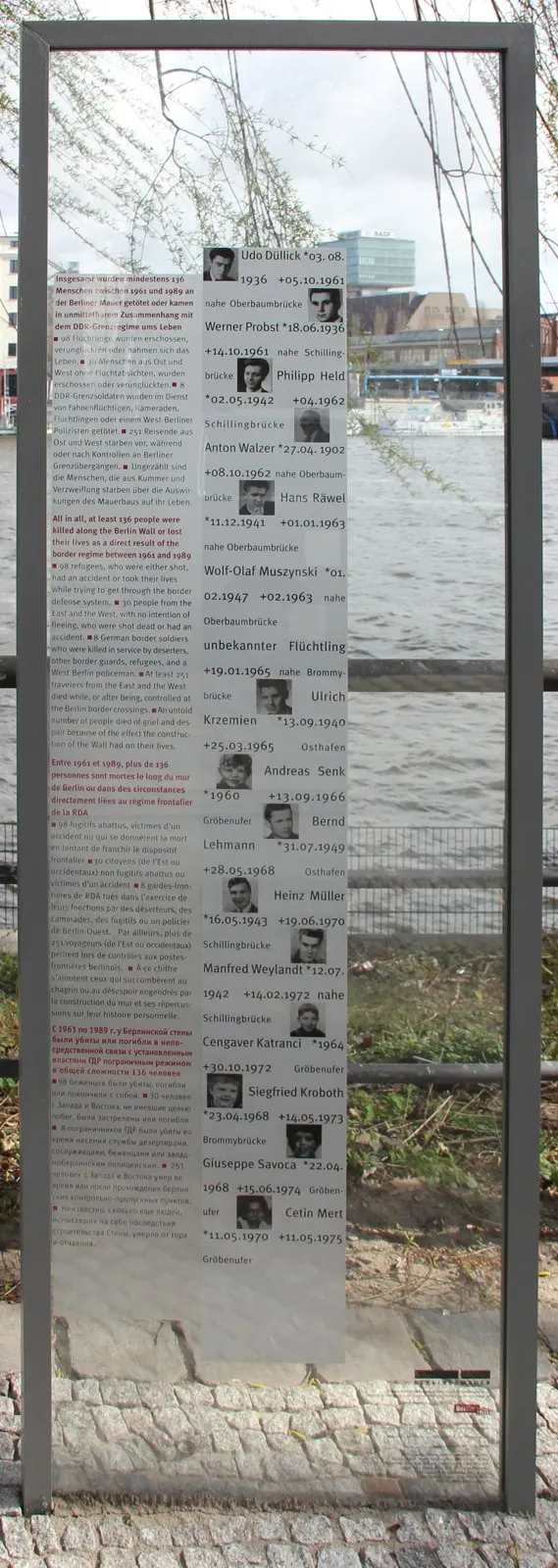
Also died on the sector border between Berlin-Friedrichshain and Berlin-Kreuzberg
- Udo Düllick 5 October 1961
- Werner Probst 14 October 1961
- Philipp Held April 1962
- Anton Walzer 8 October 1962
- Hans Räwel 1 January 1963
- Wolf-Olaf Muszynski February 1963
- Unidentified fugitive 19 January 1965
- Ulrich Krzemien 25 March 1965
- Andreas Senk 13 September 1966
- Hans-Joachim Zock Between 14 and 17 November 1970
- Manfred Weylandt 14 February 1972
- Cengaver Katrancı 30 October 1972
- Siegfried Kroboth 14 May 1973
- Giuseppe Savoca 15 June 1974
- Çetin Mert 11 May 1975
- Peter Grohganz Between 10 December 1980 and 9 February 1981
Sources
This profile is a summary written for this site. Every fact in it is taken from source 1, which also gives the full account with archival references.
- Udo Baron, “Heinz Müller”, biography in Chronik der Mauer, Federal Agency for Civic Education, Centre for Contemporary History Potsdam and Deutschlandradio. Accessed 23 September 2026. Read online. Basis for every fact in this profile, including the dates and place of death.
- German version of the same biography. Accessed 23 September 2026. Read online.
- Hans-Hermann Hertle and Maria Nooke (eds.), The Victims at the Berlin Wall, 1961–1989: A Biographical Handbook. Centre for Contemporary History Potsdam and Berlin Wall Foundation, Berlin 2011. The printed handbook from which the online biography is taken.
- Hans-Hermann Hertle and Maria Nooke, “140 Victims at the Berlin Wall, 1961–1989” (list), Centre for Contemporary History Potsdam and Berlin Wall Foundation, August 2017. PDF. Used to cross-check names and dates.
- Hans-Hermann Hertle and Maria Nooke, “The Victims at the Berlin Wall, 1961–1989: Findings of a Research Project”, August 2017. PDF. Source of the classification into escapees, people with no intent to escape, and border soldiers.
Further reading
Image credits
- Memorial panel on the May-Ayim-Ufer in Berlin-Kreuzberg listing victims of the Berlin Wall, among them Heinz Müller, photographed in 2012. OTFW, Berlin, CC BY-SA 3.0, Wikimedia Commons.
Cite this page
“Heinz Müller”, Victims of the Berlin Wall, Berlin Experiences. https://victimsofthewall.com/victims/mueller-heinz/
Map
The pin position is based on the place of death described in source 1. Base map © OpenStreetMap contributors; course of the Wall in 1989 from Geoportal Berlin (dl-de/zero-2.0). Accessed 23 September 2026.