Horst Kullack
1948–1972
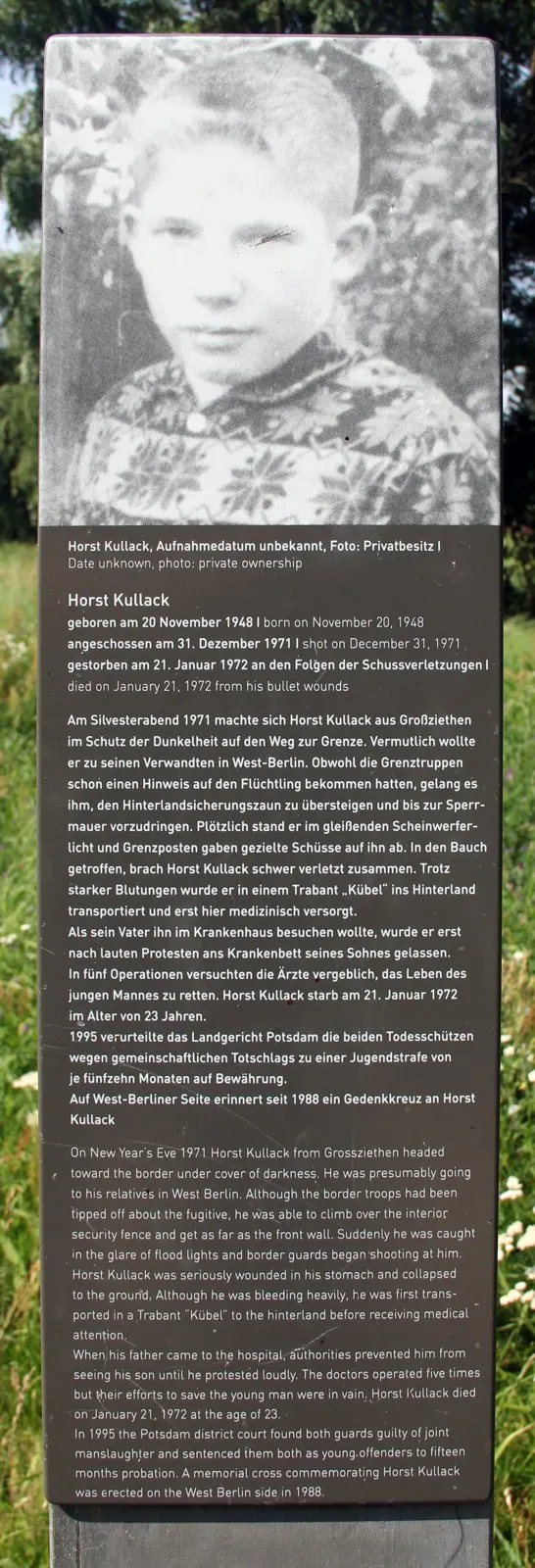
Horst Kullack, a 23-year-old transport worker from Grossziethen, was shot on New Year's Eve 1971 while trying to reach West Berlin and died of his injuries on 21 January 1972.
_Horst_Kullack2.jpg)
Horst Kullack was born on 20 November 1948, the eldest of five children, and grew up in Grossziethen, a village near the border south-east of Berlin. He struggled at school and left after eighth grade. Without vocational training, he found work as a transport worker in Zeesen and helped on the family's small farm, caring for the cattle and the garden. An uncle and his grandmother lived in West Berlin.
His childhood was hard. According to a Stasi report, villagers said he had been beaten more than he was fed, and his mother believed the beatings explained his slowness and his isolation. He had few friends, and people in the village did not take him seriously. After speaking with his mother, the Stasi noted that he was said to suffer from depression and occasionally spoke of suicide.
He had tried to escape once before and, according to his father, had been fined for it. In 1968 he was investigated for slandering the state after allegedly insulting border soldiers, and after saying in a bar, while drunk, that he wanted to flee to his grandmother in West Berlin, he was dragged off by soldiers to their barracks. A psychiatric report found that he could not be held criminally responsible, and so he was spared imprisonment.
On 31 December 1971 he set off towards the border after dark; his father later thought he may have meant to visit relatives in Neukölln. At about 10 p.m. he knocked at the window of a house inside the security area and asked whether he had reached the border, saying he was going to West Berlin. The resident, an SED member, reported him to the local People's Police officer, who informed the border guards. Horst Kullack nevertheless climbed the inner fence and, bent low, got as far as the wall, when a searchlight was suddenly turned on him. Without first calling out to him, the two guards each fired two aimed shots at him; hit in the stomach by one of the bullets, he collapsed, badly wounded.
Before giving first aid, the guards hid him, bleeding heavily, in the anti-vehicle trench; he was then taken in a Trabant jeep to the rear area and only there given medical care. The New Year's fireworks had apparently drowned out the shots, and the aim was to keep the events from being seen from West Berlin. When his father came to the hospital, the staff at first denied that his son was there; only after he protested loudly was he allowed to see him. One doctor quietly expressed disgust at the shooting. Despite five operations at the Königs Wusterhausen District Hospital, Horst Kullack died on 21 January 1972.
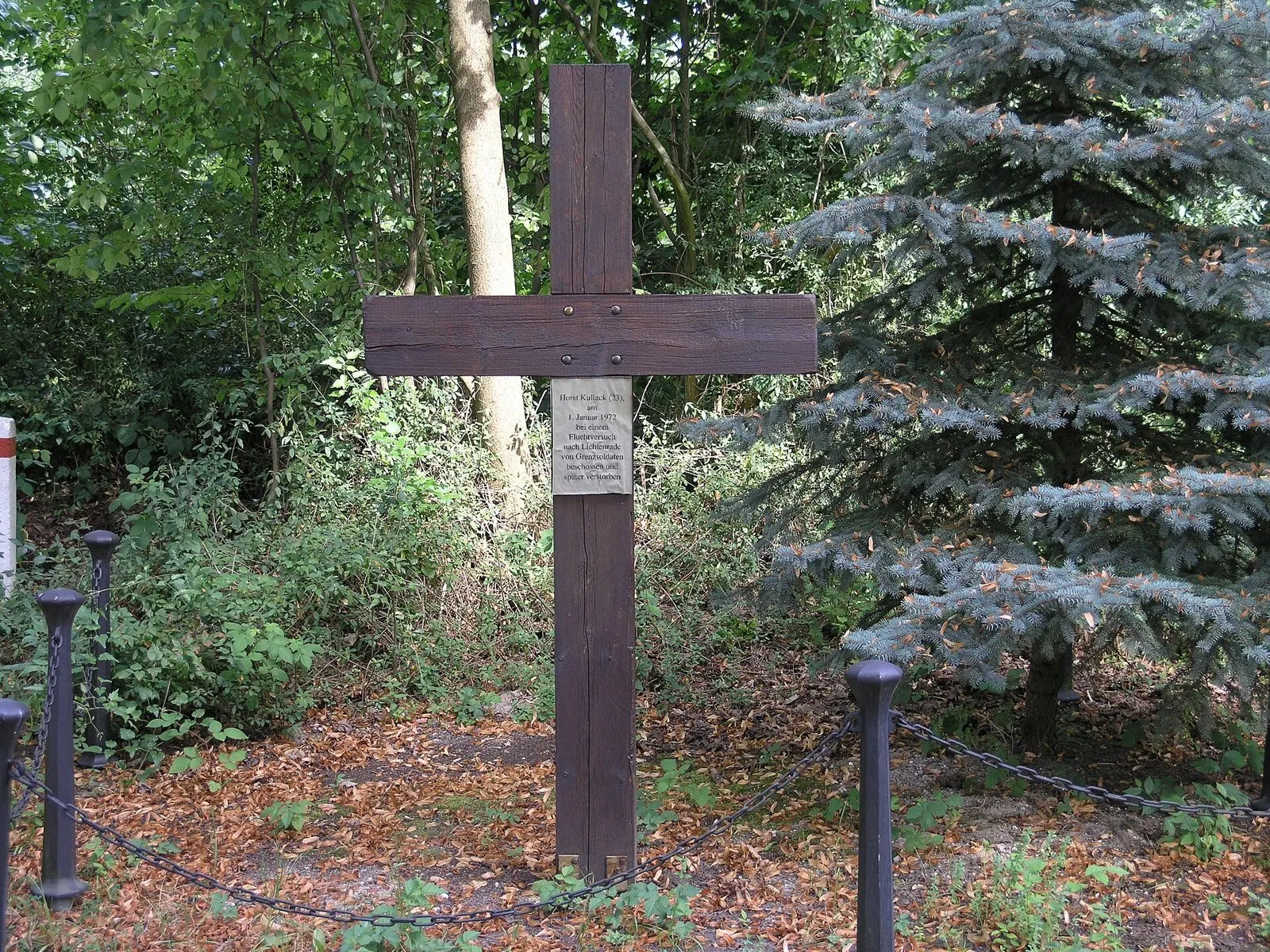
He was buried in the family grave in Grossziethen on 29 January 1972; his relatives in the West were not given permission to enter East Germany. His death became known in the West when his uncle filed a criminal complaint. On 1 November 1995 the Potsdam Regional Court convicted the two guards of joint manslaughter and gave each of them a suspended youth sentence of a year and three months, and one of them apologised to his father. A memorial cross on Wittelsbacher Strasse in Lichtenrade, on the western side, has long remembered him.
_Horst_Kullack.jpg)
_Horst_Kullack.JPG)
Read more
Sources
This profile is a summary written for this site. Every fact in it is taken from source 1, which also gives the full account with archival references.
- Martin Ahrends/Udo Baron/Hans-Hermann Hertle, “Horst Kullack”, biography in Chronik der Mauer, Federal Agency for Civic Education, Centre for Contemporary History Potsdam and Deutschlandradio. Accessed 23 September 2026. Read online. Basis for every fact in this profile, including the dates and place of death.
- German version of the same biography. Accessed 23 September 2026. Read online.
- Hans-Hermann Hertle and Maria Nooke (eds.), The Victims at the Berlin Wall, 1961–1989: A Biographical Handbook. Centre for Contemporary History Potsdam and Berlin Wall Foundation, Berlin 2011. The printed handbook from which the online biography is taken.
- Hans-Hermann Hertle and Maria Nooke, “140 Victims at the Berlin Wall, 1961–1989” (list), Centre for Contemporary History Potsdam and Berlin Wall Foundation, August 2017. PDF. Used to cross-check names and dates.
- Hans-Hermann Hertle and Maria Nooke, “The Victims at the Berlin Wall, 1961–1989: Findings of a Research Project”, August 2017. PDF. Source of the classification into escapees, people with no intent to escape, and border soldiers.
Image credits
- Memorial stele for Horst Kullack on the Lichtenrader Chaussee in Großziethen, with his photograph (date unknown, private ownership), photographed in 2017. OTFW, Berlin, CC BY-SA 3.0, Wikimedia Commons.
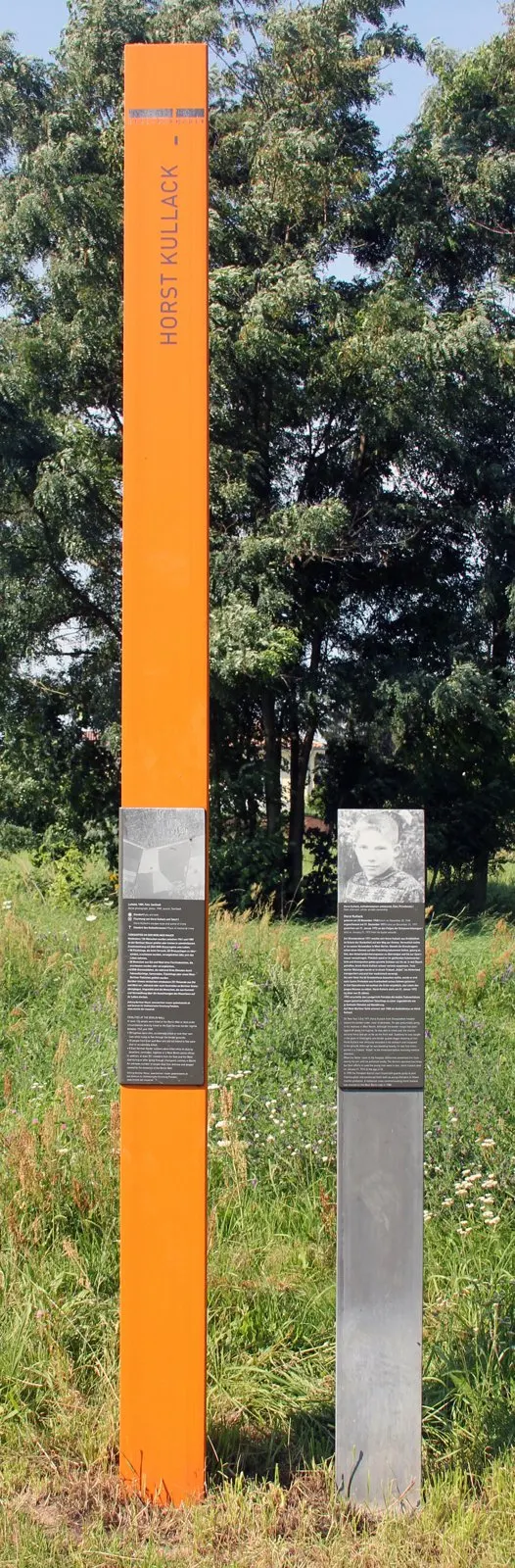
- Memorial column and stele for Horst Kullack on the Lichtenrader Chaussee in Großziethen, photographed in 2017. OTFW, Berlin, CC BY-SA 3.0, Wikimedia Commons.
- Memorial cross for Horst Kullack at Wittelsbacherstraße 92 in Berlin-Lichtenrade, photographed in 2009. OTFW, Berlin, CC BY-SA 3.0, Wikimedia Commons.
Cite this page
“Horst Kullack”, Victims of the Berlin Wall, Berlin Experiences. https://victimsofthewall.com/victims/kullack-horst/
Map
The pin position is based on the place of death described in source 1. Base map © OpenStreetMap contributors; course of the Wall in 1989 from Geoportal Berlin (dl-de/zero-2.0). Accessed 23 September 2026.