Dieter Beilig
1941–1971
A West Berlin worker who had protested against the Wall in the early 1960s, Dieter Beilig climbed the Wall at the Brandenburg Gate on 2 October 1971, was arrested on the eastern side and shot inside a border troop command post.

Dieter Beilig was born in Berlin on 5 September 1941 and grew up in Kreuzberg, in the American sector. He came from a modest background. His father had been killed as a soldier in the Second World War, and he never knew him; his mother did not find him easy as he grew up, but for her only son she remained an important figure throughout his life. He left a baker's apprenticeship, later worked as an unskilled labourer at the federal printing office, and lived in a flat on Köpenicker Strasse near the Spree.
He was 20 when the sector borders were closed in August 1961, and he refused to accept the division of his city. He protested on the streets throughout the early 1960s; in July 1962 he was briefly arrested for throwing smoke bombs over the Wall. In August 1962, at the demonstrations marking the first anniversary of the Wall and following the death of Peter Fechter, he was photographed in the front row carrying a large wooden cross. He later wrote that he was a worker who despised every kind of totalitarian dictatorship, and that he loved freedom and human dignity.
In April 1964, in circumstances that remain unexplained, he fell into the hands of the Stasi. In the West it was suspected at the time that he had been abducted to East Berlin; the Stasi files, however, claim that on 29 April 1964 he arrived drunk at the Friedrichstrasse crossing and asked to contact the Stasi. After endless interrogations and months in pre-trial detention, he was charged over his activities against the Wall, and in December 1964 the East Berlin city court sentenced him to twelve years in a penitentiary. He was held in Brandenburg Penitentiary, at times in solitary confinement. In 1966 the Federal Republic bought his freedom, and he was released to the West that September, long before his sentence was due to end.
Back in Kreuzberg he kept a low profile, though he probably held on to his convictions. On the morning of Saturday 2 October 1971, a month after the Four Power Agreement of September 1971, he climbed onto the Wall at the Brandenburg Gate. Whether he meant to support or oppose the new policy towards the East is not known. West Berlin police told him to come down; instead he jumped to the eastern side, calling out for freedom for Germany.
No one in the West could see what followed. According to border troop and Stasi reports, he was arrested at once and taken to the border regiment's command post in the Academy of Arts building on Pariser Platz, trying on the way to break free. There he was made to wait in a small room under the guard of two soldiers. The border guards' account states that he tried to escape through the window at about 9:43 a.m. and was shot in the upper body from close range, without warning. He probably died immediately.
The Stasi then placed his fingerprints on the weapon so that the shooting would look like self-defence. Once it was clear there had been no outside witnesses, they concealed his death entirely. A lawyer engaged by his mother tried in vain to reach the East German authorities, and she died in 1988 never having found out what became of him.
After the end of the GDR, investigations into the man who had fired the shot uncovered the killing and its cover-up; he turned out to be a former border troop officer who had since died, so he was never charged. Three former Stasi members charged with shielding him by falsifying evidence were acquitted by the Berlin Regional Court in June 1999 because the charge could not be proved with the necessary certainty. His fate became widely known in 2003, when the Academy of Arts was being renovated, and markings on the floor of the reopened building now show where the command post stood. His body was cremated at the Baumschulenweg Crematorium in Treptow; where his remains were buried is still not known.
Read more
Also died on the sector border between Berlin-Mitte and Berlin-Tiergarten
- Günter Litfin 24 August 1961
- Ingo Krüger 11 December 1961
- Peter Göring 23 May 1962
- Lutz Haberlandt 27 May 1962
- Axel Hannemann 5 June 1962
- Klaus Schröter 4 November 1963
- Walter Heike 22 June 1964
- Heinz Sokolowski 25 November 1965
- Paul Stretz 29 April 1966
- Heinz Schmidt 29 August 1966
- Elke Weckeiser 18 February 1968
- Dieter Weckeiser 19 February 1968
- Siegfried Krug 6 July 1968
- Manfred Gertzki 27 April 1973
- Henri Weise Probably May 1977
Sources
This profile is a summary written for this site. Every fact in it is taken from source 1, which also gives the full account with archival references.
- Christine Brecht, “Dieter Beilig”, biography in Chronik der Mauer, Federal Agency for Civic Education, Centre for Contemporary History Potsdam and Deutschlandradio. Accessed 23 September 2026. Read online. Basis for every fact in this profile, including the dates and place of death.
- German version of the same biography. Accessed 23 September 2026. Read online.
- Hans-Hermann Hertle and Maria Nooke (eds.), The Victims at the Berlin Wall, 1961–1989: A Biographical Handbook. Centre for Contemporary History Potsdam and Berlin Wall Foundation, Berlin 2011. The printed handbook from which the online biography is taken.
- Hans-Hermann Hertle and Maria Nooke, “140 Victims at the Berlin Wall, 1961–1989” (list), Centre for Contemporary History Potsdam and Berlin Wall Foundation, August 2017. PDF. Used to cross-check names and dates.
- Hans-Hermann Hertle and Maria Nooke, “The Victims at the Berlin Wall, 1961–1989: Findings of a Research Project”, August 2017. PDF. Source of the classification into escapees, people with no intent to escape, and border soldiers.
Further reading
Image credits
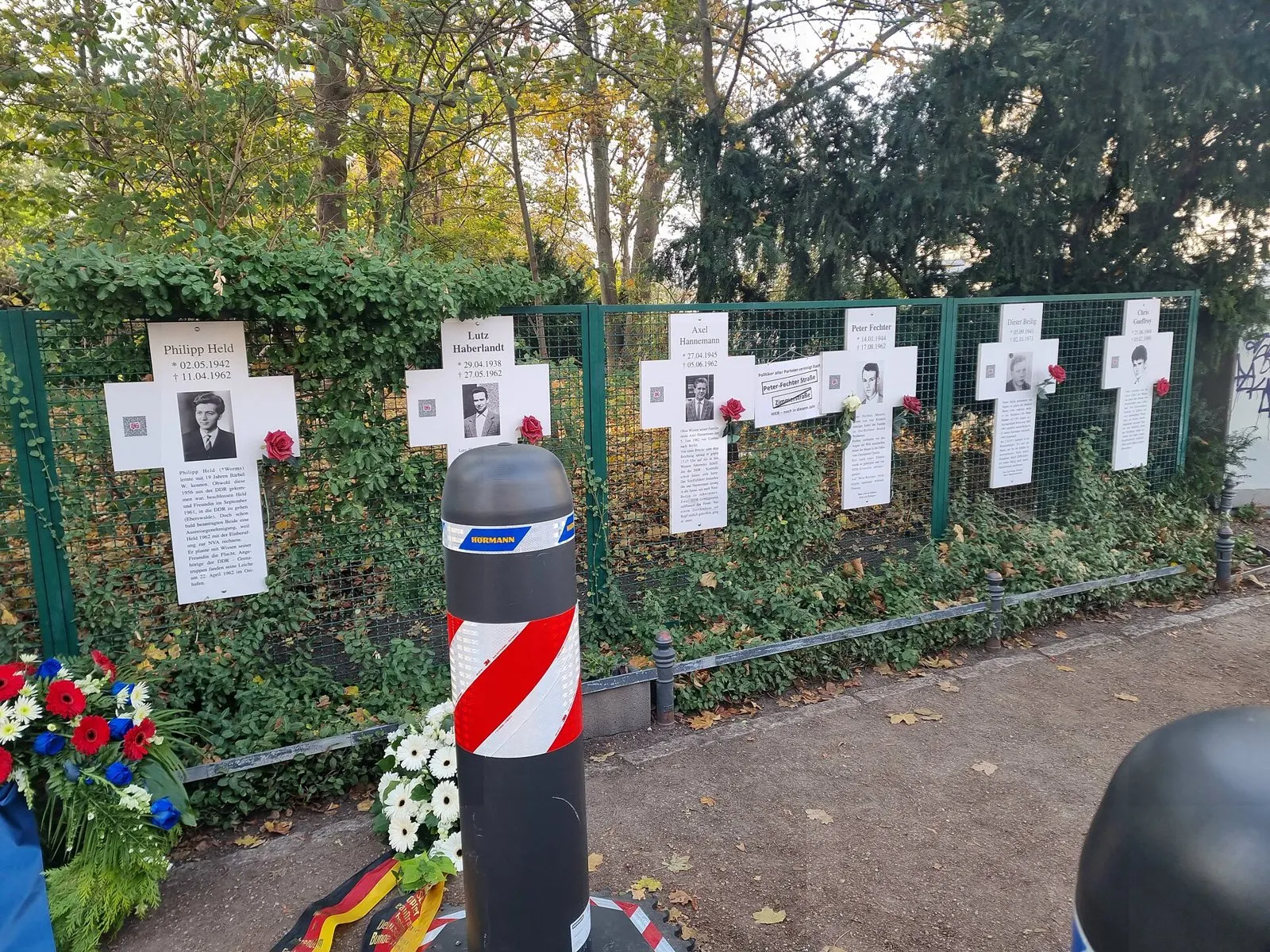
- Several of the White Crosses on Ebertstraße, photographed on 9 November 2024, the 35th anniversary of the fall of the Wall; the cross for Dieter Beilig is second from the right. C.Suthorn / cc-by-sa-4.0 / commons.wikimedia.org, CC BY-SA 4.0, Wikimedia Commons.
Cite this page
“Dieter Beilig”, Victims of the Berlin Wall, Berlin Experiences. https://victimsofthewall.com/victims/beilig-dieter/
Map
The pin position is based on the place of death described in source 1. Base map © OpenStreetMap contributors; course of the Wall in 1989 from Geoportal Berlin (dl-de/zero-2.0). Accessed 23 September 2026.