Günter Litfin
1937–1961
A 24-year-old tailor from Berlin-Weissensee who worked in West Berlin, Günter Litfin was shot by transport police on 24 August 1961 after jumping into the Humboldt Harbour, just short of the West Berlin bank.
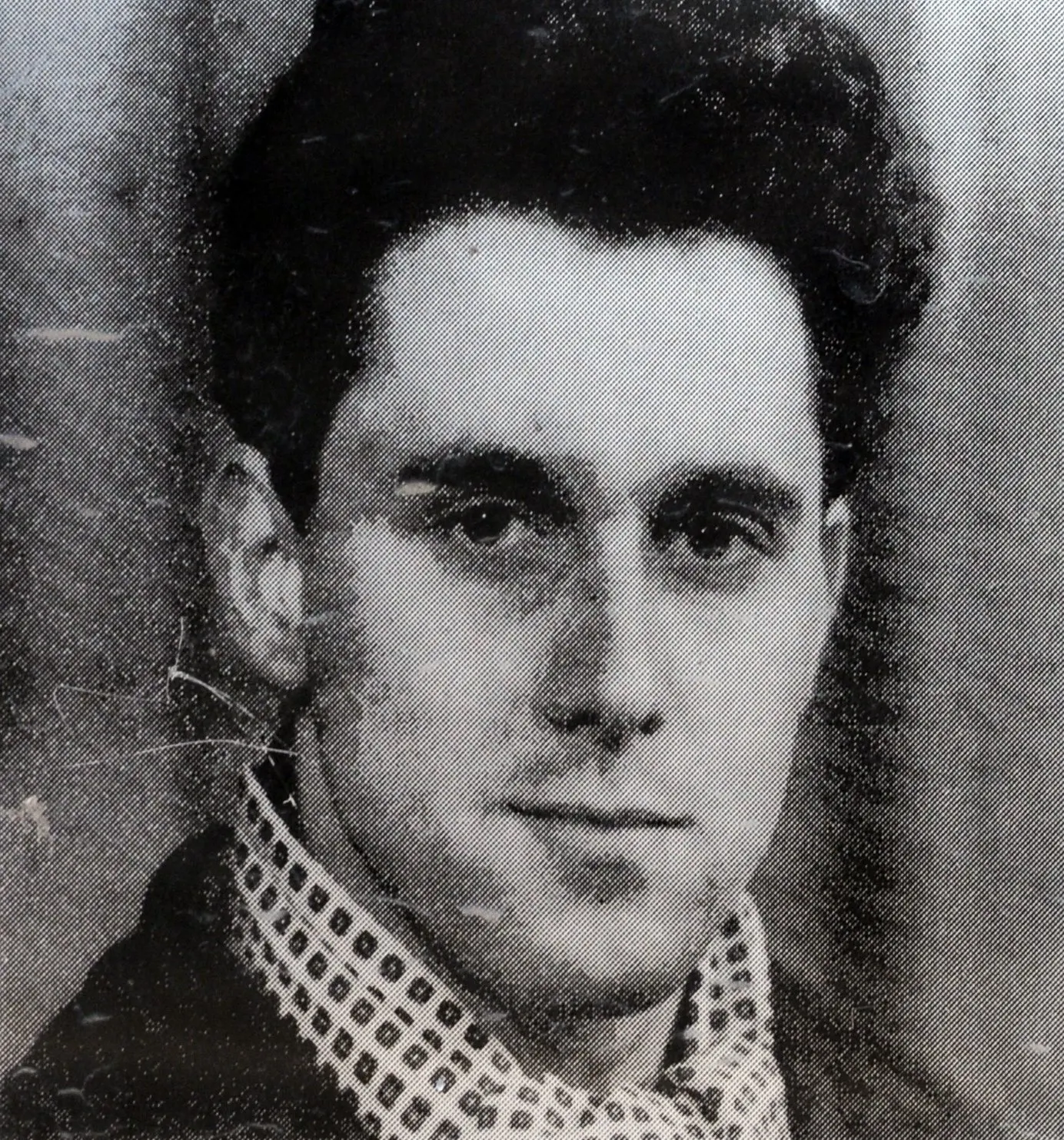

Günter Litfin was born in Berlin on 19 January 1937 and lived in the Weissensee district; he was one of four sons. According to his brother Jürgen, his twin, Alois, died in 1943 at the age of six. His father Albert, a butcher, had helped found the local CDU chapter in 1945, and his mother Margarete also joined. The boys were baptised Catholic and attended the St. Joseph School in Weissensee. In 1957 Günter and his younger brother Jürgen became members of the West Berlin CDU, which, in contrast to the East German bloc party of the same name, was still active illegally in the eastern half of the city.
After training as a tailor he found work in a West Berlin tailoring workshop near Bahnhof Zoo. He dressed with care and hoped one day to make costumes for the theatre. As pressure grew on so-called border-crossers, he found a flat in Charlottenburg but did not register it, since that would have made him a 'republic fugitive' and cut him off from his family in the East. His brother remembered him as the calm one in the family, the person everyone confided in. Their father died in May 1961, and according to his brother, Günter then felt bound to stay close to their mother, so he kept postponing his final move to the West.
On Saturday 12 August 1961 he spent the day with his mother and brother visiting relatives in the West, returning to Weissensee late that evening. The next morning the radio reported that the sector border had been sealed overnight. Unable to accept it, Günter began looking for a way out.
Shortly after 4 p.m. on 24 August 1961 he tried to get from East to West Berlin between the Friedrichstrasse and Lehrter stations. According to East Berlin police reports, he made his way from the grounds of Charité Hospital over a boundary wall to the bank of the Spree, where transport police spotted him. From a railway bridge they ordered him to stop and fired warning shots, then shot at him as he jumped into the Humboldt Harbour. He was still in the water, short of the western bank, when he was fatally wounded. According to the research project a bullet hit him in the back of the head; the post-mortem findings, as recorded in a Stasi report a week later and quoted in later press accounts, describe a shot that entered at the nape of his neck and came out at his chin, and record that he drowned. East Berlin firemen recovered his body three hours later. It was the first time the deadly consequences of the new border regime had been seen.
Hundreds of West Berliners watched from their side of the harbour as his body was taken away, and his death prompted outrage and protests in the West; a year later a memorial stone was placed there. The East Berlin press portrayed him as a criminal. According to his brother, the transport policeman who had fired was awarded the Volkspolizei badge of honour. Stasi staff harassed and intimidated the family. His brother, who did not know what had happened, was arrested on 25 August and questioned for hours, and on the same day his mother's flat was searched without explanation. Neither was told what had happened; they learned of his death from the West Berlin programme 'Abendschau' on 26 August.
The family was ordered to keep silent, and so in the death notice they wrote, ambiguously, that he had died suddenly and unexpectedly in an accident. He was buried on 31 August at the St. Hedwig Cemetery in Weissensee, with Stasi personnel present. According to his brother Jürgen, the funeral became a farce because most of the mourners knew it had not been an accident.
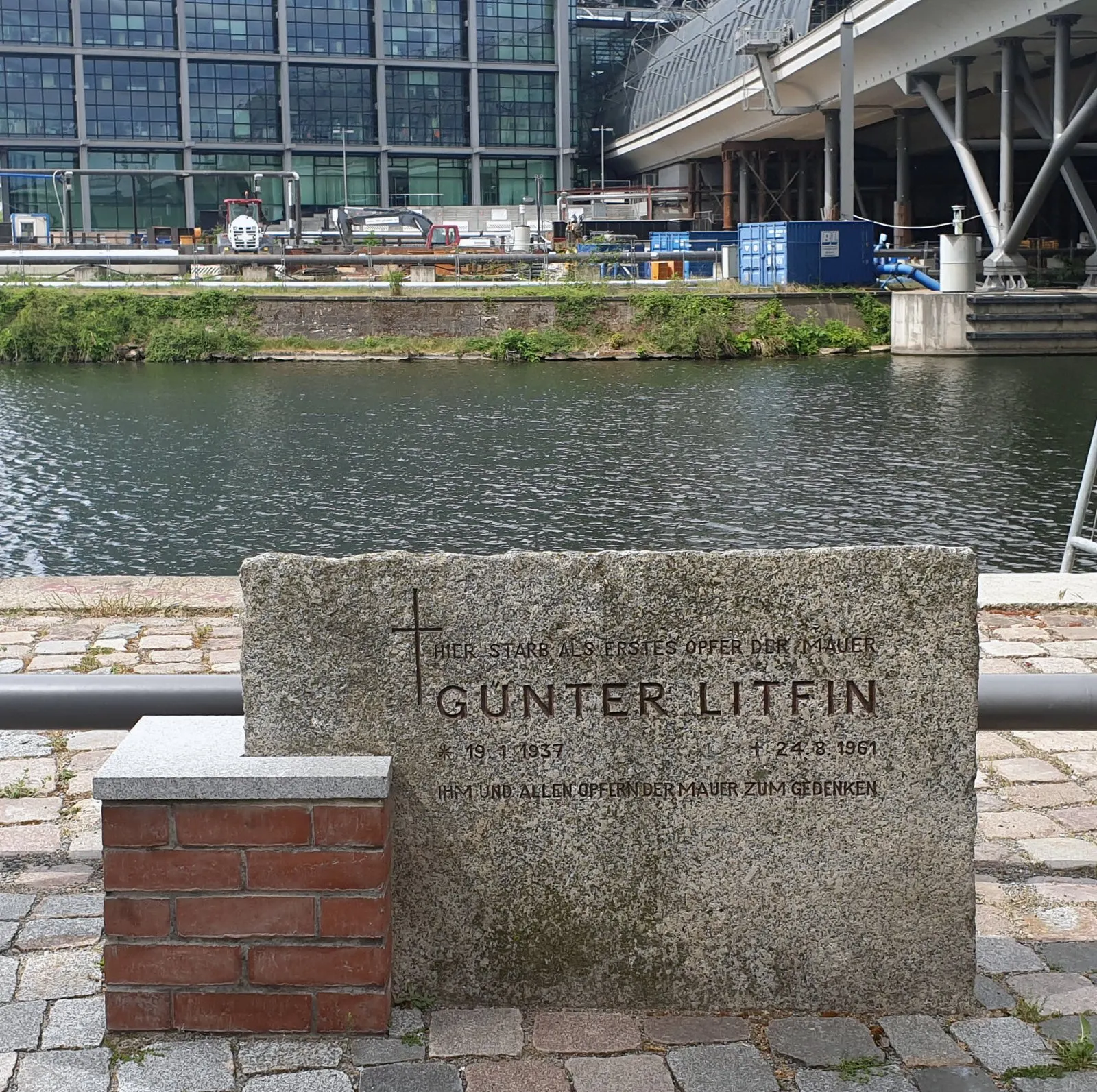
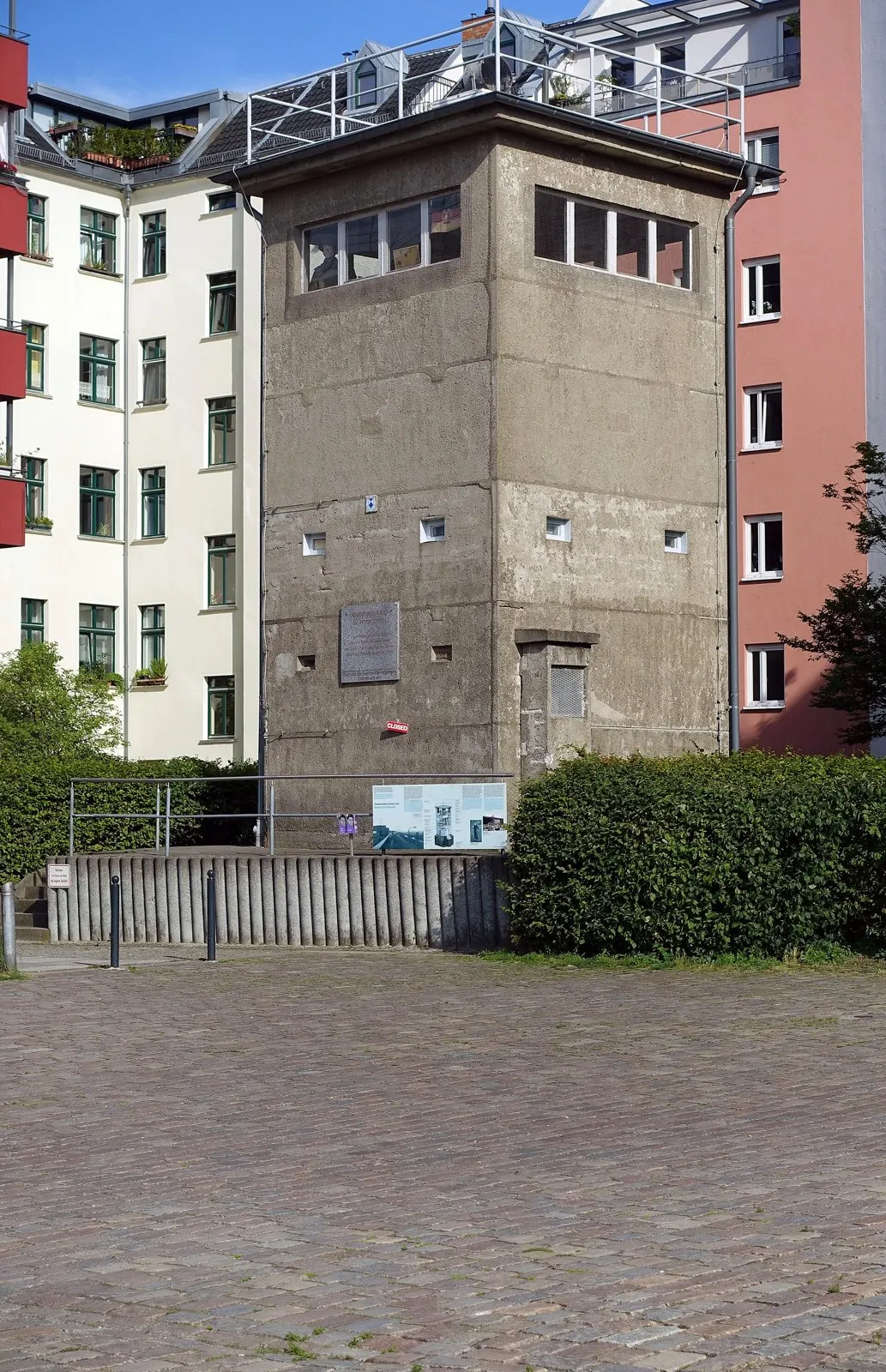
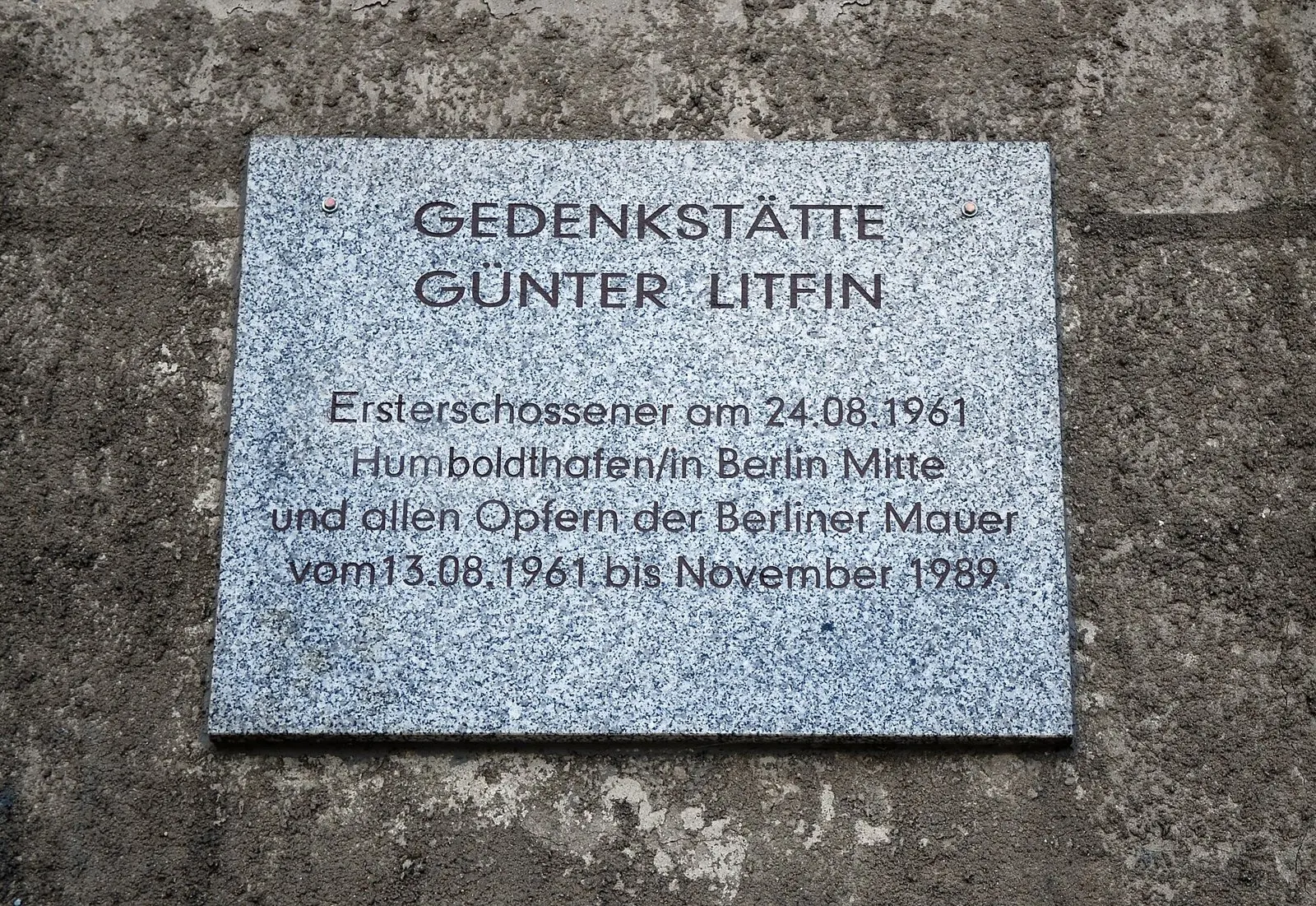
In 1997 two of the men who had fired at him were convicted of joint manslaughter by the Berlin Regional Court and sentenced to one year and to one year and six months respectively, both suspended on probation. At his brother's initiative, a former border command post on the Spandau shipping canal became a memorial to Günter Litfin; the watchtower passed to the Berlin Wall Foundation in 2017. In 2000 a street in Weissensee was named after him. According to a 2009 newspaper report, the memorial stone first put up in 1962 went missing in 1995, probably during building work, and was found five years later, after which his brother had it put up again. In 2015 it was moved to the place near the Humboldt Harbour where he was killed; it remembers him as the first person in Berlin to die under the order to shoot.



Read more
Also died on the sector border between Berlin-Mitte and Berlin-Tiergarten
- Ingo Krüger 11 December 1961
- Peter Göring 23 May 1962
- Lutz Haberlandt 27 May 1962
- Axel Hannemann 5 June 1962
- Klaus Schröter 4 November 1963
- Walter Heike 22 June 1964
- Heinz Sokolowski 25 November 1965
- Paul Stretz 29 April 1966
- Heinz Schmidt 29 August 1966
- Elke Weckeiser 18 February 1968
- Dieter Weckeiser 19 February 1968
- Siegfried Krug 6 July 1968
- Dieter Beilig 2 October 1971
- Manfred Gertzki 27 April 1973
- Henri Weise Probably May 1977
Sources
This profile is a summary written for this site from the biography in source 1, which also gives the full account with archival references. Facts taken from other sources are listed below with what they support.
- Christine Brecht, “Günter Litfin”, biography in Chronik der Mauer, Federal Agency for Civic Education, Centre for Contemporary History Potsdam and Deutschlandradio. Accessed 23 September 2026. Read online. The biography from which this profile was written, and the source of the dates and place of death.
- German version of the same biography. Accessed 23 September 2026. Read online.
- “Die Gedenkstätte: Entstehungsgeschichte”, Günter Litfin Memorial, Berlin Wall Foundation (Stiftung Berliner Mauer). Accessed 27 September 2026. Read online. Source for: that the memorial stone of 1962 was moved in 2015 to the place where he was killed.
- Barbara Hans, “Das erste Maueropfer: ‚Tod durch fremde Hand‘”, Spiegel Online, 2 September 2007. Accessed 3 October 2026. Read online. Source for: his twin's death in 1943, and the forensic diagnosis of a shot through the neck combined with drowning.
- Jürgen Litfin, “Erstes Maueropfer: ‚Was hatte mein Bruder eigentlich verbrochen?‘”, Spiegel Online einestages, 12 August 2011. Accessed 3 October 2026. Read online. Source for: his brother's account of the twin's death and of being questioned until midnight.
- Carolin Pirich, “Zur Erinnerung verdonnert”, taz, 22 August 2009. Accessed 3 October 2026. Read online. Source for: the badge of honour awarded to the man who fired, and the loss and recovery of the memorial stone.
- Stasi (MfS, ZAIG) Einzel-Information Nr. 499/61 on the shooting of two people at the border on 24 and 29 August 1961, 31 August 1961, in the edition “Die DDR im Blick der Stasi 1961”, Stasi Records Archive. Accessed 3 October 2026. Read online. Source for: the post-mortem findings: entry wound at the nape of the neck, exit at the chin, and drowning.
- Susanne Messmer, 'Mahnmal für den zweiten Mauertoten', taz, 24 Aug 2017 Read online. Source for: the criminal proceedings after the death.
- Hans-Hermann Hertle and Maria Nooke (eds.), The Victims at the Berlin Wall, 1961–1989: A Biographical Handbook. Centre for Contemporary History Potsdam and Berlin Wall Foundation, Berlin 2011. The printed handbook from which the online biography is taken.
- Hans-Hermann Hertle and Maria Nooke, “140 Victims at the Berlin Wall, 1961–1989” (list), Centre for Contemporary History Potsdam and Berlin Wall Foundation, August 2017. PDF. Used to cross-check names and dates.
- Hans-Hermann Hertle and Maria Nooke, “The Victims at the Berlin Wall, 1961–1989: Findings of a Research Project”, August 2017. PDF. Source of the classification into escapees, people with no intent to escape, and border soldiers.
Corrections
This profile was corrected on 24 and 28 September and 3 October 2026. Each round of corrections is described in the corrections log:
-
: Court outcomes checked against the German originals
- Corrected the name of the court: the Berlin Regional Court (Landgericht Berlin), not the “Berlin district court”.
- Corrected the sentences of one year and of one year and six months: both were suspended on probation; the guards were not “then released on probation”.
- : All profiles and articles cross-checked against the German originals
- : Every profile checked against all the sources
- : Independent sources researched for 18 profiles
Further reading
- Wikipedia (English)
- Wikipedia (Deutsch)
- The day Günter Litfin was killed trying to escape to West Berlin (article, Berlin Experiences)
Image credits
- Portrait of Günter Litfin, photographed from an information board at the former Wall on the Humboldthafen. Ralf Roletschek (talk) - Fahrradtechnik auf fahrradmonteur.de, Public domain, Wikimedia Commons.
- Memorial stone for Günter Litfin at Alexanderufer 7 on the Humboldthafen, Berlin-Mitte. OTFW, Berlin, CC BY-SA 3.0, Wikimedia Commons.
- Günter Litfin Memorial in the former watchtower at Kieler Strasse 2, Berlin-Mitte. Neuköllner, CC BY 4.0, Wikimedia Commons.
- Plaque "Gedenkstätte Günter Litfin" at the former watchtower on Kieler Strasse. André Karwath aka Aka, CC BY-SA 2.5, Wikimedia Commons.
Cite this page
“Günter Litfin”, Victims of the Berlin Wall, Berlin Experiences. https://victimsofthewall.com/victims/litfin-guenter/
Map
The pin position is based on the place of death described in source 1. Base map © OpenStreetMap contributors; course of the Wall in 1989 from Geoportal Berlin (dl-de/zero-2.0). Accessed 23 September 2026.