Roland Hoff
1934–1961
Roland Hoff, a 27-year-old pipe-layer from Hanover who had moved to East Germany shortly before the Wall was built, was shot dead on 29 August 1961 while swimming across the Teltow Canal from Teltow towards Berlin-Lichterfelde.
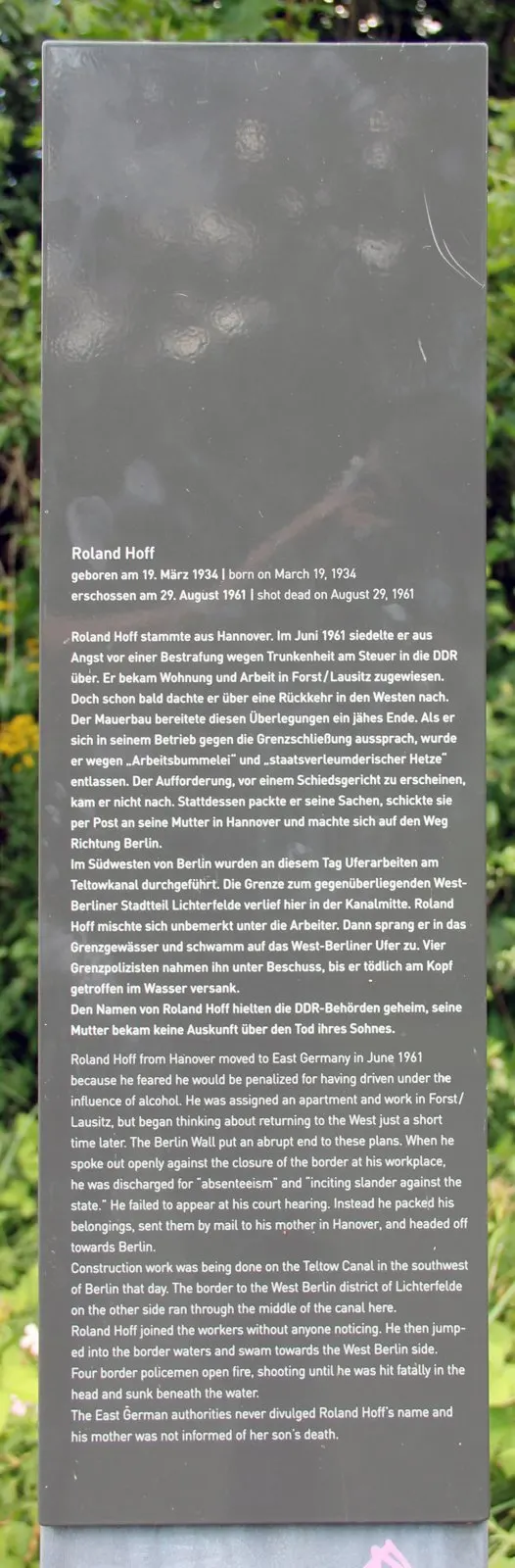

Roland Hoff was born in Hanover on 19 March 1934 and grew up there with three sisters. One of them remembered that, as the only son, he was their mother's favourite. He trained as a pipe-layer and went on living at home until June 1961, when at 27 he moved to East Germany. Like many West Germans who moved east, he was not driven by political conviction; his mother believed that, fearing punishment for drink-driving, he rode his moped to the inner-German border one night and asked to be admitted to East Germany.
After passing through the reception camp at Barby near Magdeburg, he was given a flat and a job in Lusatia. Soon he wrote to his mother that he was already thinking of returning west, but the building of the Wall put an abrupt end to these thoughts. Ten days later he is said to have spoken out openly against the border closure at work, and he was dismissed. Instead of answering a summons to an arbitration hearing, he posted his belongings from Forst to his mother in Hanover and on 29 August set off for Berlin.
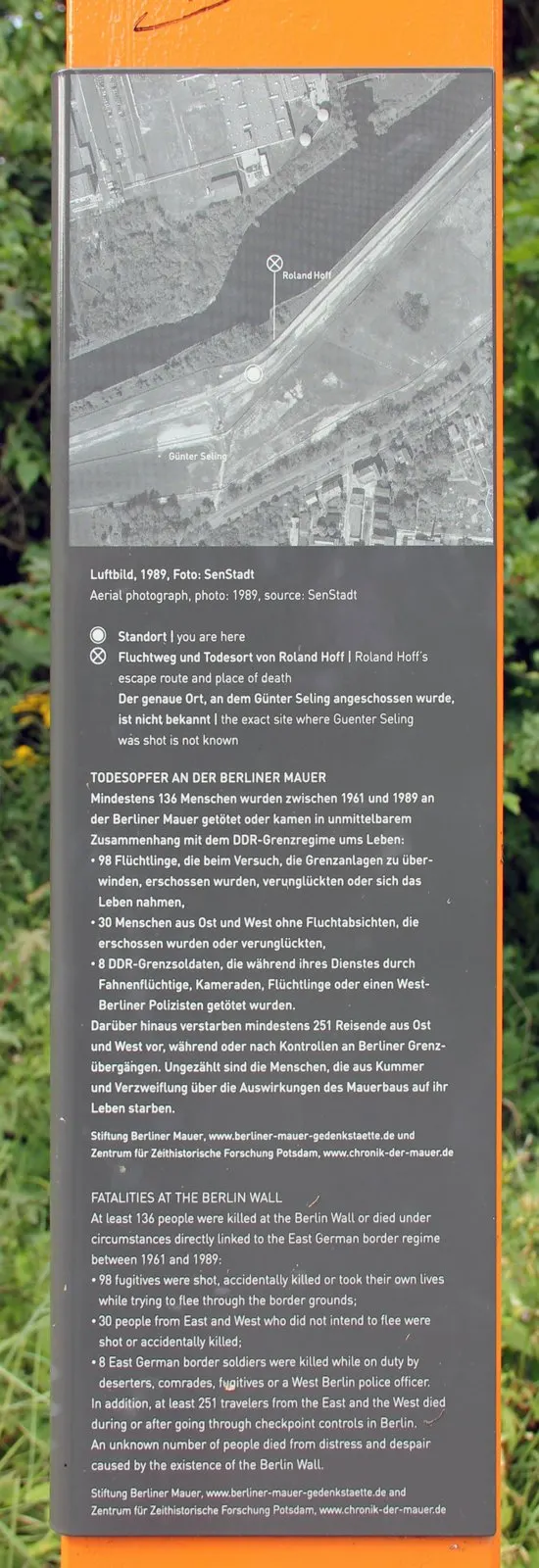
That day in Teltow, a group of forty construction workers were clearing the canal bank under guard; the border with Lichterfelde ran down the middle of the canal. According to a Potsdam police report, he must have managed to mingle with the workers and so reach the bank. At around 2 p.m. he jumped into the water with a briefcase under his arm and swam towards the West Berlin side. When the first shots came he cried out, "Nicht schießen! Bitte nicht schießen!" ("Don't shoot! Please don't shoot!") Four border guards kept firing until he was hit in the head and went under.
The workers who saw it were outraged and spontaneously downed tools; one who called the guards murderers was briefly detained and questioned. East German propaganda denounced the dead man as a criminal. In West Berlin the shooting was condemned, and the authorities opened an investigation, offering a reward of 10,000 German marks and posting a wanted poster of one of the gunmen along the Wall. After the Wall fell, three former border policemen were tried before the Potsdam Regional Court in 1996, but the court could not establish who had fired the fatal shot.
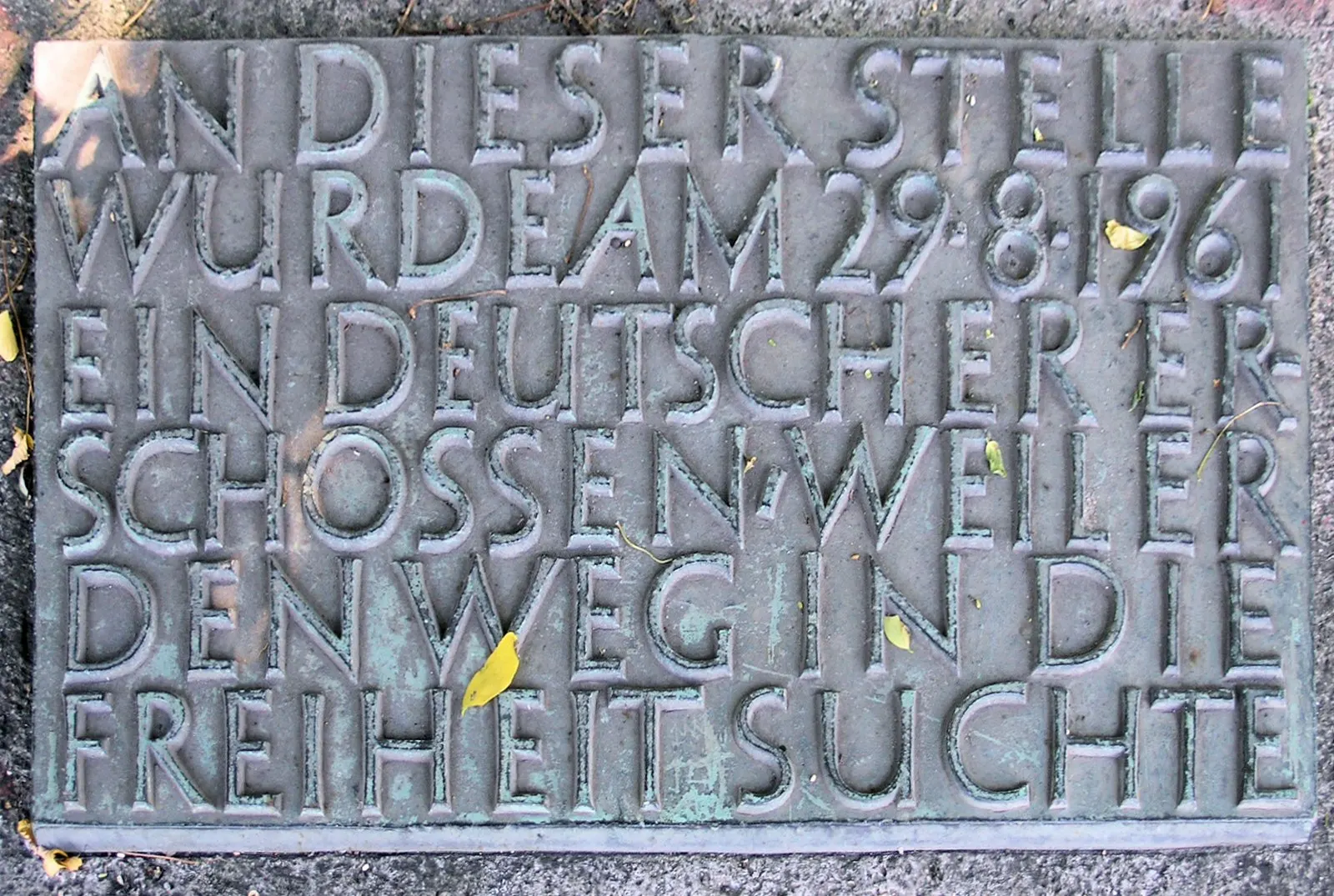
The East German authorities knew who he was but never revealed his name, not even to his family. His mother, following reports in the Western media, was convinced the dead man was her son and informed the West German authorities, but her lifelong efforts to learn more from the East came to nothing. According to a Stasi report, East German firefighters recovered his body unnoticed at about 5.45 p.m., while West Berlin firefighters were still searching, and it was taken to Potsdam; he had already been identified from the work book in his briefcase, which was pulled from the canal shortly after the shooting. Only after the East German archives were opened was his identity confirmed. What became of his body has never been established: the research project counts him among the victims whose remains disappeared without trace, and one of its historians has attributed the failure to clear this up to the silence that those responsible in the Stasi, and the officials and staff who had cooperated with them, kept after 1990. A year after his death, a stone commemorating the then unnamed fugitive was dedicated on the West Berlin bank he had tried to reach, and it remains there today.


Read more
Also died on the outer ring between Berlin-Steglitz and Teltow
- Klaus Garten 18 August 1965
Sources
This profile is a summary written for this site from the biography in source 1, which also gives the full account with archival references. Facts taken from other sources are listed below with what they support.
- Christine Brecht, “Roland Hoff”, biography in Chronik der Mauer, Federal Agency for Civic Education, Centre for Contemporary History Potsdam and Deutschlandradio. Accessed 23 September 2026. Read online. The biography from which this profile was written, and the source of the dates and place of death.
- German version of the same biography. Accessed 23 September 2026. Read online.
- Hans-Hermann Hertle and Maria Nooke, “Die Todesopfer an der Berliner Mauer 1961–1989. Bilanz eines Forschungsprojekts”, Centre for Contemporary History Potsdam and Berlin Wall Foundation, August 2017. Accessed 27 September 2026. PDF. Source for: that his body disappeared without trace.
- Stasi (MfS, ZAIG) Einzel-Information Nr. 499/61 on the shootings at the border on 24 and 29 August 1961, 31 August 1961, passage on his shooting (BStU, MfS, ZAIG 510, Bl. 4-6; the Chronik der Mauer document page is headed with the date of the shooting, 29 August 1961), extracts, transcript in Chronik der Mauer. Accessed 3 October 2026. Read online. Source for: the secret recovery of his body and its transfer to Potsdam, his identification from his work book, and the place of the attempt.
- Hans-Hermann Hertle, “Für viele war die Mauer das Ende ihres Lebens”, Der Tagesspiegel, 6 August 2011. Accessed 3 October 2026. Read online. Source for: why the disappearance of his body could never be cleared up: the silence kept after 1990.
- Kirsten Garulich, “Wo die Flucht endete”, Potsdamer Neueste Nachrichten, 28 May 2011. Accessed 3 October 2026. Read online. Source for: that he tried to swim across opposite Wupperstrasse in Lichterfelde.
- Hans-Hermann Hertle and Maria Nooke (eds.), The Victims at the Berlin Wall, 1961–1989: A Biographical Handbook. Centre for Contemporary History Potsdam and Berlin Wall Foundation, Berlin 2011. The printed handbook from which the online biography is taken.
- Hans-Hermann Hertle and Maria Nooke, “140 Victims at the Berlin Wall, 1961–1989” (list), Centre for Contemporary History Potsdam and Berlin Wall Foundation, August 2017. PDF. Used to cross-check names and dates.
- Hans-Hermann Hertle and Maria Nooke, “The Victims at the Berlin Wall, 1961–1989: Findings of a Research Project”, August 2017. PDF. Source of the classification into escapees, people with no intent to escape, and border soldiers.
Corrections
This profile was corrected on 28 September and 3 October 2026. Each round of corrections is described in the corrections log:
-
: All profiles and articles cross-checked against the German originals
- Corrected how he reached the bank: according to a police report he must have mingled with the workers (German: sich unter die Arbeiter zu mischen), not “disguised himself” as one.
- Corrected the workers' reaction: they were outraged (German: empört), not “horrified”.
- Corrected the date of the memorial stone: it was unveiled a year after his death, not “a year to the day”.
-
: Every profile checked against all the sources
- Added that what became of his body has never been established; the research project counts him among the victims whose remains disappeared without trace.
-
: Independent sources researched for 18 profiles
- Added, from a Stasi report, that East German firefighters recovered his body unnoticed at about 5.45 p.m. while the West Berlin fire brigade was still searching, that it was taken to Potsdam, and that he had been identified from the work book in his briefcase.
Further reading
Image credits
- Memorial stele for Roland Hoff on Lichterfelder Allee, Teltow. OTFW, Berlin, CC BY-SA 3.0, Wikimedia Commons.
- Memorial plaque at the Knesebeckbrücke, Berlin-Zehlendorf, for a German shot here on 29 August 1961. OTFW, Berlin, CC BY-SA 3.0, Wikimedia Commons.
- Information stele at Lichterfelder Allee, Teltow, with an aerial photograph marking Roland Hoff's escape route and place of death in the Teltow Canal. OTFW, Berlin, CC BY-SA 3.0, Wikimedia Commons.
Cite this page
“Roland Hoff”, Victims of the Berlin Wall, Berlin Experiences. https://victimsofthewall.com/victims/hoff-roland/
Map
The pin position is based on the place of death described in source 1. Base map © OpenStreetMap contributors; course of the Wall in 1989 from Geoportal Berlin (dl-de/zero-2.0). Accessed 23 September 2026.