Klaus Garten
1941–1965
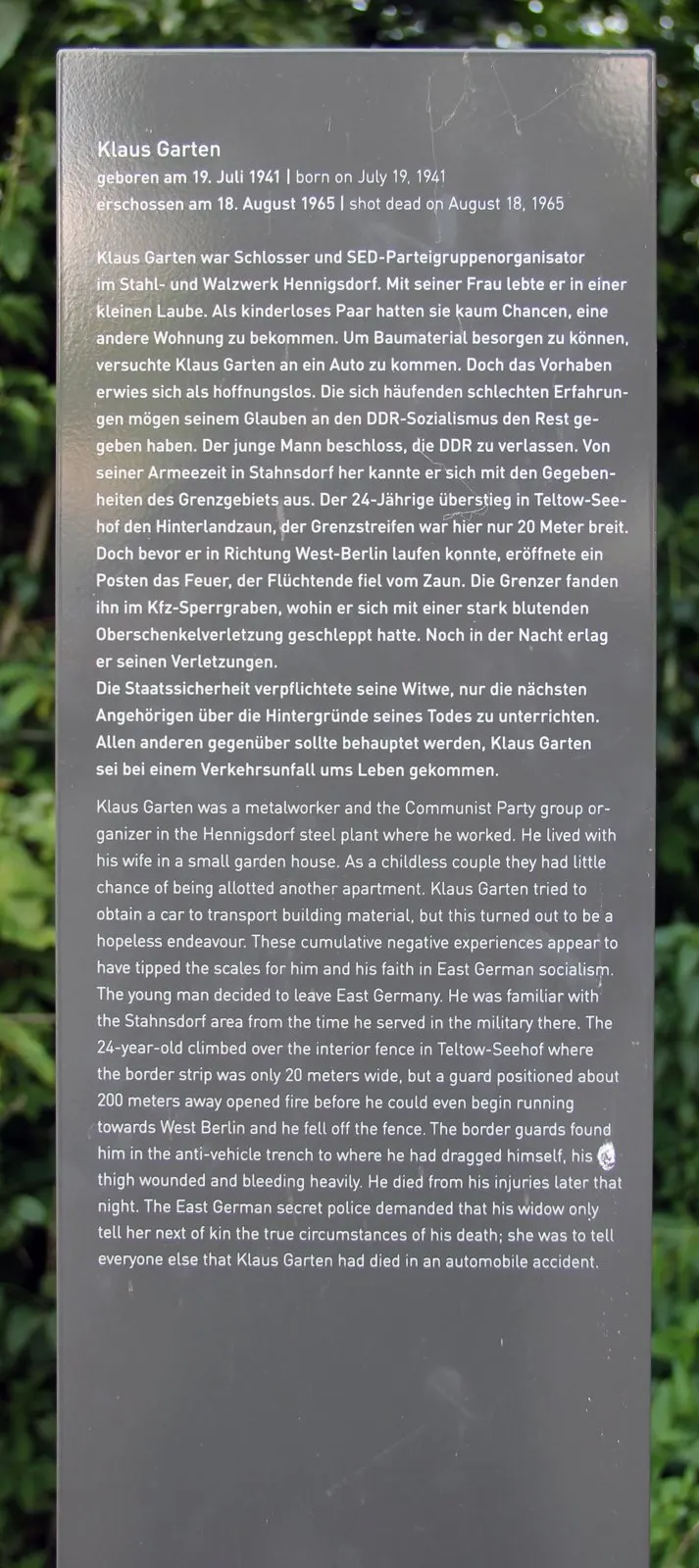
Klaus Garten, a 24-year-old metalworker and SED member from Saxony, was shot while climbing a fence at the border in Teltow-Seehof on 17 August 1965. Left for almost an hour without medical help, he died of his wounds that night.
_Klaus_Garten4.jpg)
Klaus Garten was born on 19 July 1941 in Radeberg, Saxony. He was three when he lost his father in the Second World War, and he grew up in his home town with his mother and his stepfather, an official of the SED, the ruling party. A trained body repair technician, he did his military service with the National People's Army in Stahnsdorf, on the south-western edge of Berlin, from 1959 to 1962.
He met his wife during reserve training in Oranienburg, and after his military service they moved into a garden house in her home village of Schmachtenhagen. He worked as a metalworker at the local branch of the Hennigsdorf steel and rolling mill and took on extra tasks to help meet the plan. As a party member he was made his division's party group organiser, a role that increasingly troubled him: few of his 50 colleagues belonged to the party, and he felt they looked down on him for it.
Growing isolated at work, he thought of giving up his job and taking over a restaurant, but also of leaving for the West, and in July 1965 he spoke to his wife about it. For a year and a half the couple had lived in their one-room garden house, hoping to make it a proper home, but building materials were impossible to obtain, and as a childless couple they had little chance of another flat. He tried to buy a car, probably to transport materials, but used cars were extremely expensive, so he looked for a damaged one he could repair himself.
On 17 August 1965, during his holiday, the couple went to East Berlin in search of a car. Sent on to a trade office in Teltow, he made the long journey there alone while his wife went home. There too, the waiting lists were endless; whether he actually called at the office that day is not known. That year may have been what finally destroyed his faith in East German socialism; by this point at the latest, he decided to leave East Germany. He knew the area from his time in the army.
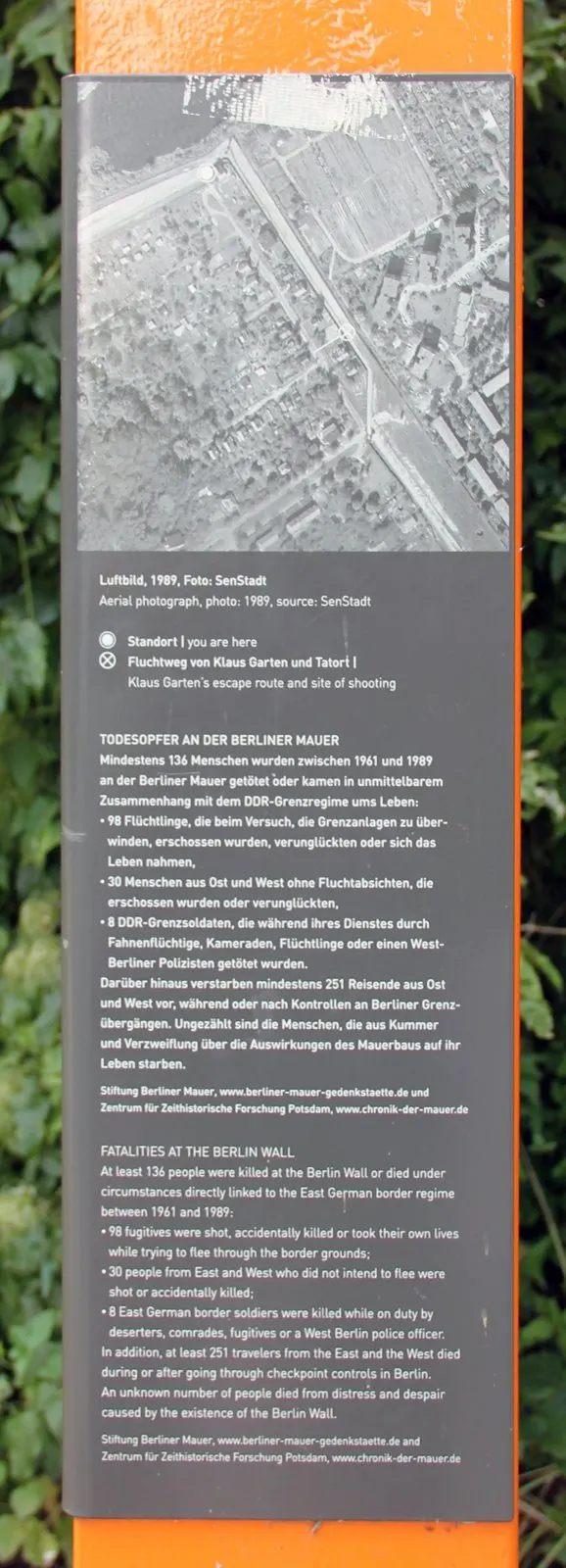
At around 9 p.m. a guard saw him climb over a wire mesh fence on a plot on Paul-Gerhard-Strasse in Teltow-Seehof, where the border strip was only 20 metres wide. A guard about 200 metres away fired three shots, and he fell from the fence. He was found in the anti-vehicle trench, where he had dragged himself, bleeding heavily from a thigh wound. Instead of bandaging him, the guards took cover in the trench, as West Berlin police searched the area with lamps and residents gathered. West Berlin police recorded that at about 9:50 p.m. six guards carried away an injured man in a tarpaulin.
To avoid being seen from the West, the guards took a long detour through the trench to carry him to an observation tower (one of them reported that they crawled, carrying him on their backs), where he was hastily bandaged. Almost an hour had passed before he received any medical help. He had lost a great deal of blood, yet he was taken not to the church hospital a kilometre away but to the Stasi prison hospital in Hohenschönhausen, at least an hour's drive. He died of his injuries later that night.
The next morning the Stasi took his wife to Oranienburg for questioning; she was told only days later that he had died trying to flee, and learned more from a newspaper cutting from the "BZ" that a relative in West Berlin sent her. She was told to reveal the truth only to her next of kin and to tell everyone else that he had died in a motorcycle or car accident. He was cremated on 20 August 1965 and buried in Schmachtenhagen. An investigation decades later was discontinued in 1995, as the suspected gunman said he had fired only a warning shot and this could not be disproved.
_Klaus_Garten.jpg)
_Klaus_Garten2.jpg)
Also died on the outer ring between Berlin-Steglitz and Teltow
- Roland Hoff 29 August 1961
Sources
This profile is a summary written for this site. Every fact in it is taken from source 1, which also gives the full account with archival references.
- Martin Ahrends/Udo Baron, “Klaus Garten”, biography in Chronik der Mauer, Federal Agency for Civic Education, Centre for Contemporary History Potsdam and Deutschlandradio. Accessed 23 September 2026. Read online. Basis for every fact in this profile, including the dates and place of death.
- German version of the same biography. Accessed 23 September 2026. Read online.
- Hans-Hermann Hertle and Maria Nooke (eds.), The Victims at the Berlin Wall, 1961–1989: A Biographical Handbook. Centre for Contemporary History Potsdam and Berlin Wall Foundation, Berlin 2011. The printed handbook from which the online biography is taken.
- Hans-Hermann Hertle and Maria Nooke, “140 Victims at the Berlin Wall, 1961–1989” (list), Centre for Contemporary History Potsdam and Berlin Wall Foundation, August 2017. PDF. Used to cross-check names and dates.
- Hans-Hermann Hertle and Maria Nooke, “The Victims at the Berlin Wall, 1961–1989: Findings of a Research Project”, August 2017. PDF. Source of the classification into escapees, people with no intent to escape, and border soldiers.
Further reading
Image credits
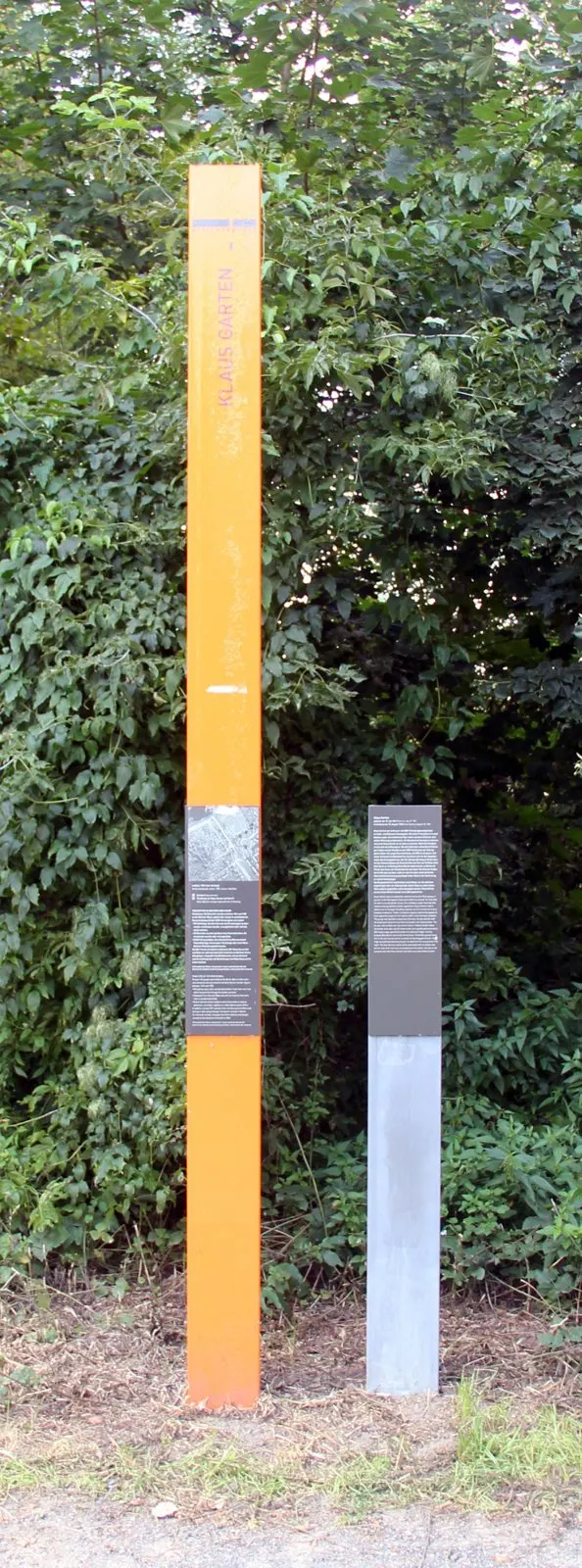
- Memorial column for Klaus Garten on Paul-Gerhardt-Straße in Teltow, photographed in 2017. OTFW, Berlin, CC BY-SA 3.0, Wikimedia Commons.
- Memorial panel for Klaus Garten in Teltow with his biography in German and English, photographed in 2017. OTFW, Berlin, CC BY-SA 3.0, Wikimedia Commons.
- Panel on the Klaus Garten memorial column in Teltow with a 1989 aerial photograph marking his escape route and the site of the shooting, photographed in 2017. OTFW, Berlin, CC BY-SA 3.0, Wikimedia Commons.
Cite this page
“Klaus Garten”, Victims of the Berlin Wall, Berlin Experiences. https://victimsofthewall.com/victims/garten-klaus/
Map
The pin position is based on the place of death described in source 1. Base map © OpenStreetMap contributors; course of the Wall in 1989 from Geoportal Berlin (dl-de/zero-2.0). Accessed 23 September 2026.