Walter Kittel
1942–1965
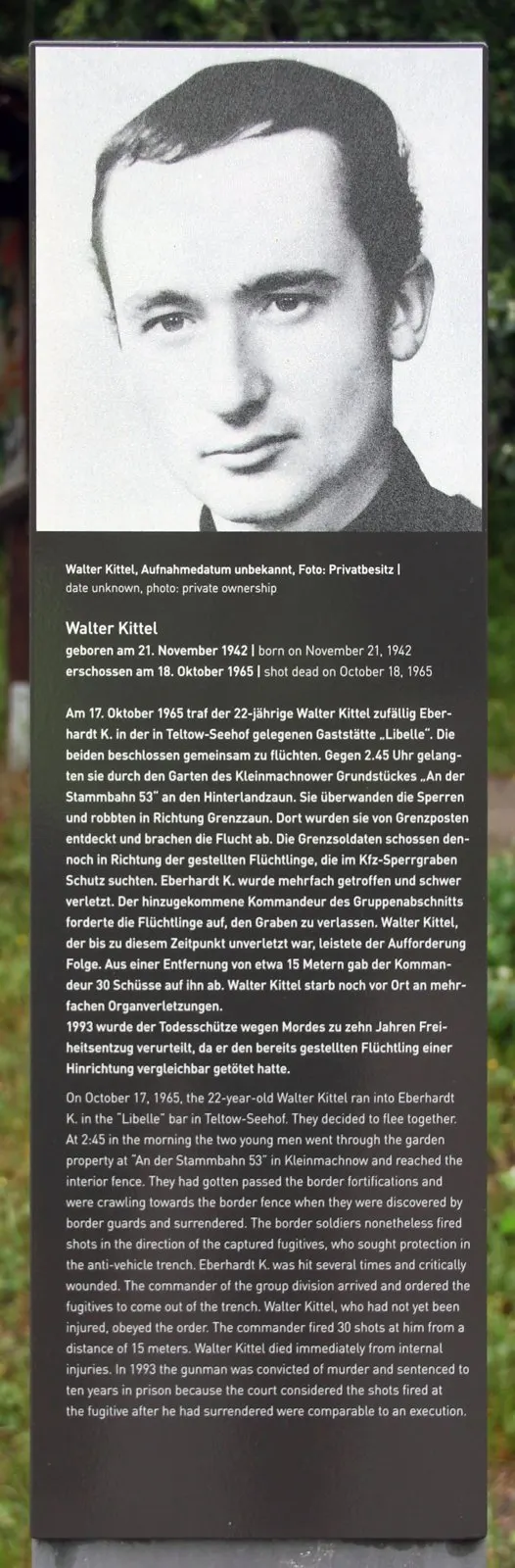
Walter Kittel, 22, was shot dead in Kleinmachnow on 18 October 1965 by the commander of a border guard unit after he had already given himself up during an escape attempt at An der Stammbahn 53.
_Walter_Kittel.jpg)
Walter Kittel grew up in Kölleda in Thuringia and went to school there. In 1957 he started training as a car mechanic in nearby Gutmannshausen. In September 1959 he fled to West Berlin and had to stay in a refugee camp, but after three months his father came to collect him and took him back. Why he returned to East Germany is not known.
Back in the East he appears to have become politically active. He founded a marching band in his local FDJ youth group, joined a circle of worker-writers and worked for the FDJ district leadership, first in Jüterbog and later in Nauen. He volunteered for the National People's Army but was turned down on health grounds. While at the FDJ district school in Schwante he got to know a young woman, and the two later had a child together. He worked for a milk production company in the Nauen district and, until 1964, for the Melioration Construction Company in Potsdam.
From 1964 at the latest his political commitment fell away rapidly. While drunk he spoke out against Walter Ulbricht to a police officer and likened the methods of the police, and his father's way of raising him, to those of the SS. In May 1964 he was convicted of criminal intoxication combined with slander against the state and given nine months in prison, suspended with two years' probation. His second attempt to leave probably had both political and personal reasons. After several close relatives had died within a few years, he, his father and his two siblings had moved from Kölleda to Kleinmachnow.
On the evening of 17 October 1965, the 22-year-old met Eberhardt K., an acquaintance two years his junior, in a bar in Teltow-Seehof. They found they both wanted to go to West Berlin, and Walter Kittel proposed going that same night. He lived close to the border, had for some time been able to watch its layout and the guards' movements, and knew exactly where to make the attempt; at his flat a sketch of the escape plan and tools for getting through the barriers lay ready. At around 2.45 a.m. the two reached the garden at An der Stammbahn 53 in Kleinmachnow. They got through the inner fence, crossed the patrol route and the anti-vehicle trench, and crawled to within a few steps of the last fence before two guards spotted them.
The two young men obeyed the order to come to the patrol path with their hands raised. An argument followed, and one guard fired three aimed shots towards the feet of the two men, hitting Eberhardt K. in the foot. The pair took cover in the trench, but the guards kept firing and Eberhardt K. was hit again and seriously wounded. The commander of the group section then arrived and ordered them out. Walter Kittel, still unhurt, complied. The commander fired 30 shots at him from about 15 metres. Hit in the chest and stomach, he died at once. His body was taken away quickly so that it could not be seen from the West.
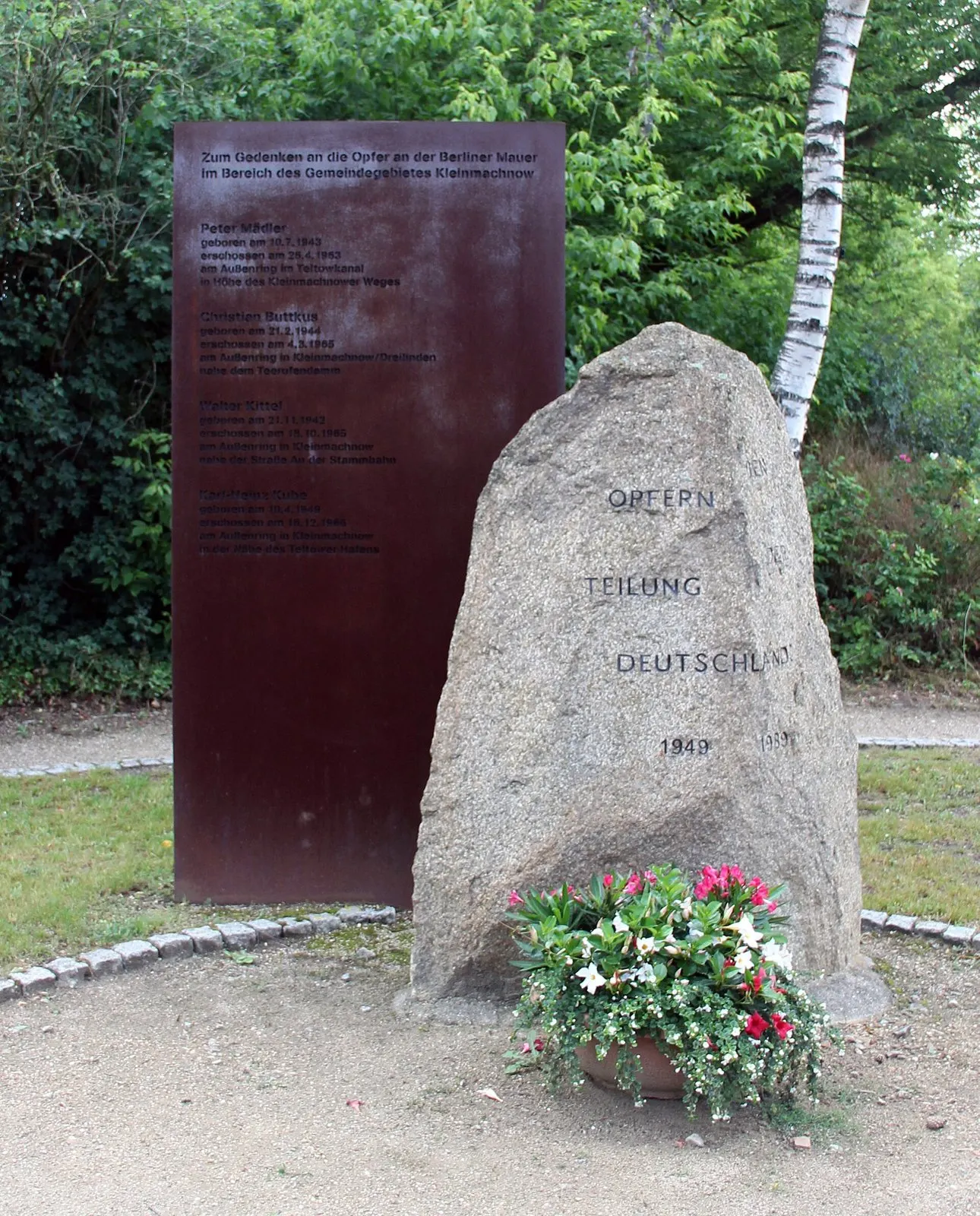
The next day the Stasi told his father, who had to sign an undertaking to keep silent and to let the state arrange the burial. The commander was honoured and promoted. Eberhardt K. was sentenced to two years in prison; fellow prisoners who later reached West Berlin confirmed the West Berlin police's suspicion that a man had died that night. In December 1992 the Potsdam district court convicted the former commander of manslaughter; the following year the Federal Court of Justice raised his sentence to ten years for murder, likening the shots to an execution. Since 1999 a memorial stone on Adam-Kuckhoff-Platz in Kleinmachnow has honoured those who died at the border there.
_Walter_Kittel3.jpg)
_Todesopfer_an_der_Berliner_Mauer.jpg)
_Walter_Kittel2.jpg)
Read more
Also died on the outer ring between Berlin-Zehlendorf and Kleinmachnow
- Peter Mädler 26 April 1963
- Christian Buttkus 4 March 1965
- Karl-Heinz Kube 16 December 1966
Sources
This profile is a summary written for this site. Every fact in it is taken from source 1, which also gives the full account with archival references.
- Lydia Dollmann, “Walter Kittel”, biography in Chronik der Mauer, Federal Agency for Civic Education, Centre for Contemporary History Potsdam and Deutschlandradio. Accessed 23 September 2026. Read online. Basis for every fact in this profile, including the dates and place of death.
- German version of the same biography. Accessed 23 September 2026. Read online.
- Hans-Hermann Hertle and Maria Nooke (eds.), The Victims at the Berlin Wall, 1961–1989: A Biographical Handbook. Centre for Contemporary History Potsdam and Berlin Wall Foundation, Berlin 2011. The printed handbook from which the online biography is taken.
- Hans-Hermann Hertle and Maria Nooke, “140 Victims at the Berlin Wall, 1961–1989” (list), Centre for Contemporary History Potsdam and Berlin Wall Foundation, August 2017. PDF. Used to cross-check names and dates.
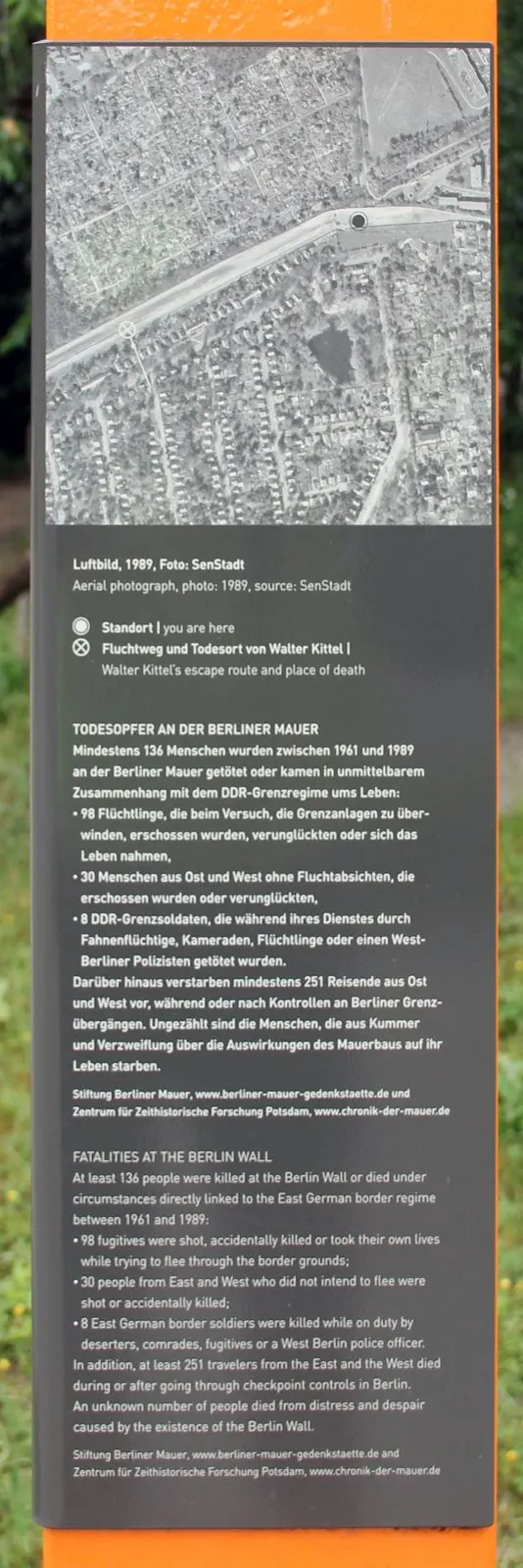
- Hans-Hermann Hertle and Maria Nooke, “The Victims at the Berlin Wall, 1961–1989: Findings of a Research Project”, August 2017. PDF. Source of the classification into escapees, people with no intent to escape, and border soldiers.
Further reading
Image credits
- Memorial panel for Walter Kittel at Berlepschstraße/Karl-Marx-Straße on the Berlin–Kleinmachnow boundary, with his portrait (photo: private ownership) and biography, photographed in 2019. OTFW, Berlin, CC BY-SA 3.0, Wikimedia Commons.
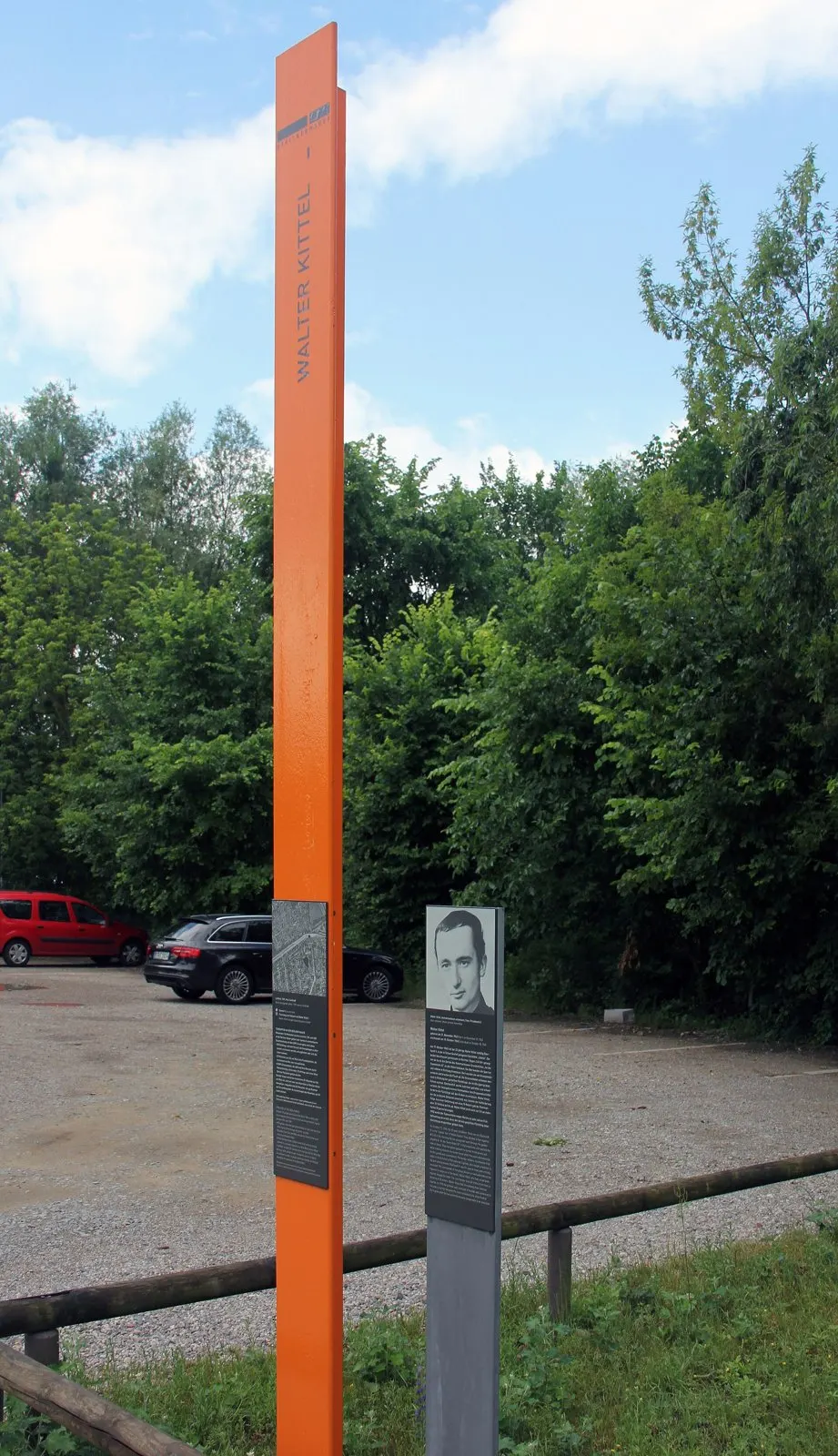
- Memorial column and panel for Walter Kittel at Berlepschstraße/Karl-Marx-Straße, Kleinmachnow, photographed in 2019. OTFW, Berlin, CC BY-SA 3.0, Wikimedia Commons.
- Memorial stone for the victims of the division of Germany and a steel plaque in memory of the victims of the Berlin Wall in Kleinmachnow, which names Walter Kittel, photographed in 2019. OTFW, Berlin, CC BY-SA 3.0, Wikimedia Commons.
- Panel on the Walter Kittel memorial column with a 1989 aerial photograph marking his escape route and place of death, photographed in 2019. OTFW, Berlin, CC BY-SA 3.0, Wikimedia Commons.
Cite this page
“Walter Kittel”, Victims of the Berlin Wall, Berlin Experiences. https://victimsofthewall.com/victims/kittel-walter/
Map
The pin position is based on the place of death described in source 1. Base map © OpenStreetMap contributors; course of the Wall in 1989 from Geoportal Berlin (dl-de/zero-2.0). Accessed 23 September 2026.