Christian Buttkus
1944–1965
Christian Buttkus, a 21-year-old from Berlin-Niederschönhausen who worked at a chemical plant, was shot dead in the early hours of 4 March 1965 while trying to escape with his fiancée through the border fence near Stahnsdorfer Damm in Kleinmachnow.
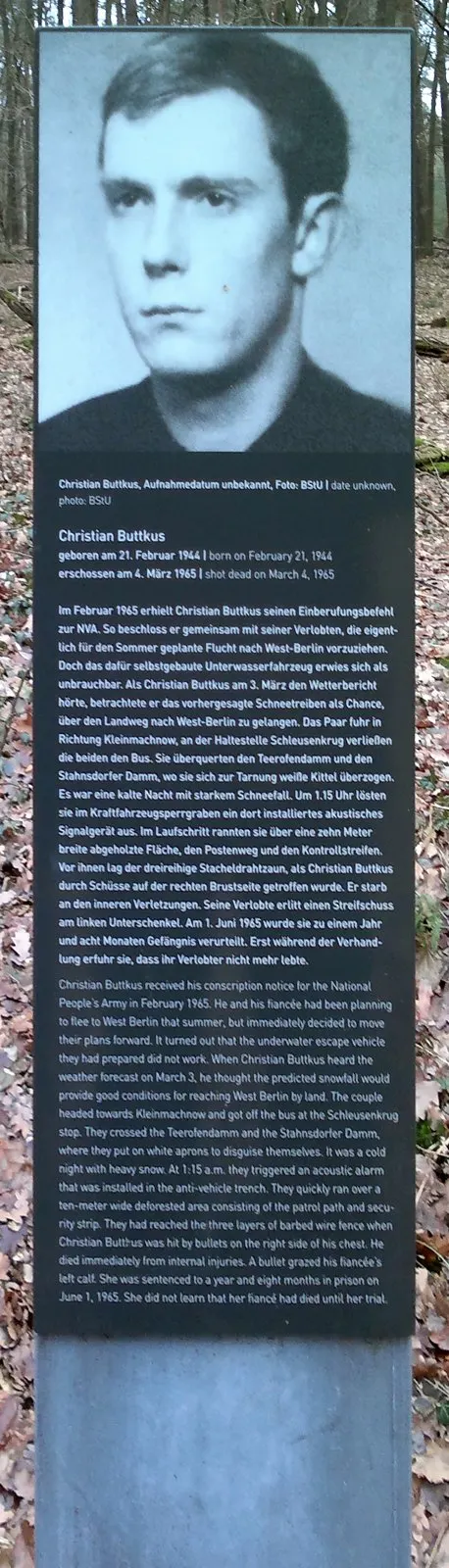
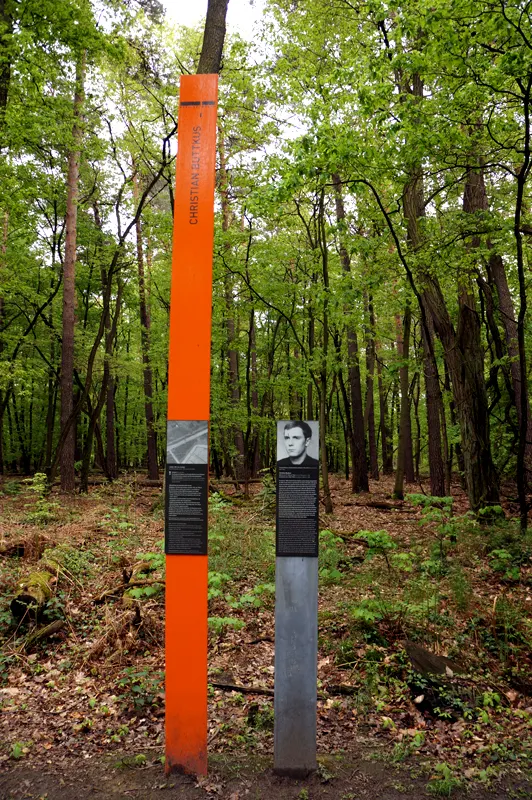
_Christian_Buttkus.jpg)
Christian Buttkus was born in Tilsit on 21 February 1944, and knew flight from early childhood: Tilsit was heavily bombed during the war, declared a front-line town in autumn 1944 and largely evacuated, and after the war the city passed to the Soviet Union. His family settled in Berlin-Niederschönhausen. His parents had divorced in 1945 and his father died in 1950, so he, the younger of two children, grew up with his mother. After finishing secondary school in 1960 he trained as a skilled chemical worker at the state-owned chemical plant in Adlershof, which then employed him.
He had relatives and friends in West Berlin, and he had been thinking of escape since the closing of the border in August 1961 at the latest. His fiancée later told the Stasi that he opposed the closure because it restricted his freedom; he hoped to study chemical engineering in West Berlin and build a life there with her. He and Ilse P. became engaged in April 1964 and planned their escape together.
Their first plan was to cross the Teltow Canal at Kleinmachnow in summer 1965. He built diving equipment and an underwater vehicle, which failed its tests. But at the end of February 1965 he was called up to the National People's Army for 1 May. He did not want to swear allegiance to a state he did not see as his own, and the couple decided to bring their escape forward and abandon the water route.
On 3 March 1965 the forecast promised snow and strong wind, and that evening they decided to cross that night in Kleinmachnow, where Ilse P. had grown up. They travelled by S-Bahn and bus to the Schleusenkrug stop, took their money and papers out of the briefcase, buried it in the snow, put on white coats as camouflage and approached the border through the woods. At 1:15 a.m. they set off an alarm at the anti-vehicle trench, ran across the patrol path and strip, leaving only the three-row barbed wire fence to cross.
Guards at Stahnsdorfer Damm near the transit motorway had been alerted. The two sentries fired warning shots; the soldiers of a nearby patrol aimed at the couple. Before they could cut through the fence, Christian Buttkus was struck in the right side of his chest and died at once. One of the 199 shots fired grazed Ilse P.'s calf. The soldiers carried his body back to the trench so that it could not be seen from the West, and were later decorated and in some cases promoted.
Ilse P. was sentenced on 1 June 1965 to a year and eight months in prison; only during the proceedings did she learn that her fiancé was dead. On 11 November 1965, at the prosecution's request, the court suspended the rest of her sentence. Four days after the escape attempt the Stasi told his mother, Ruth Buttkus, that he had died of injuries sustained in a border breach for which he himself was to blame, and urged her to speak of his death only as an accident. His body was cremated at the Baumschulenweg Crematorium on 10 March 1965. News of the shooting still spread among neighbours and colleagues. His mother fell mentally ill, came to believe that he had survived and been taken by the Stasi, and died in 1967.
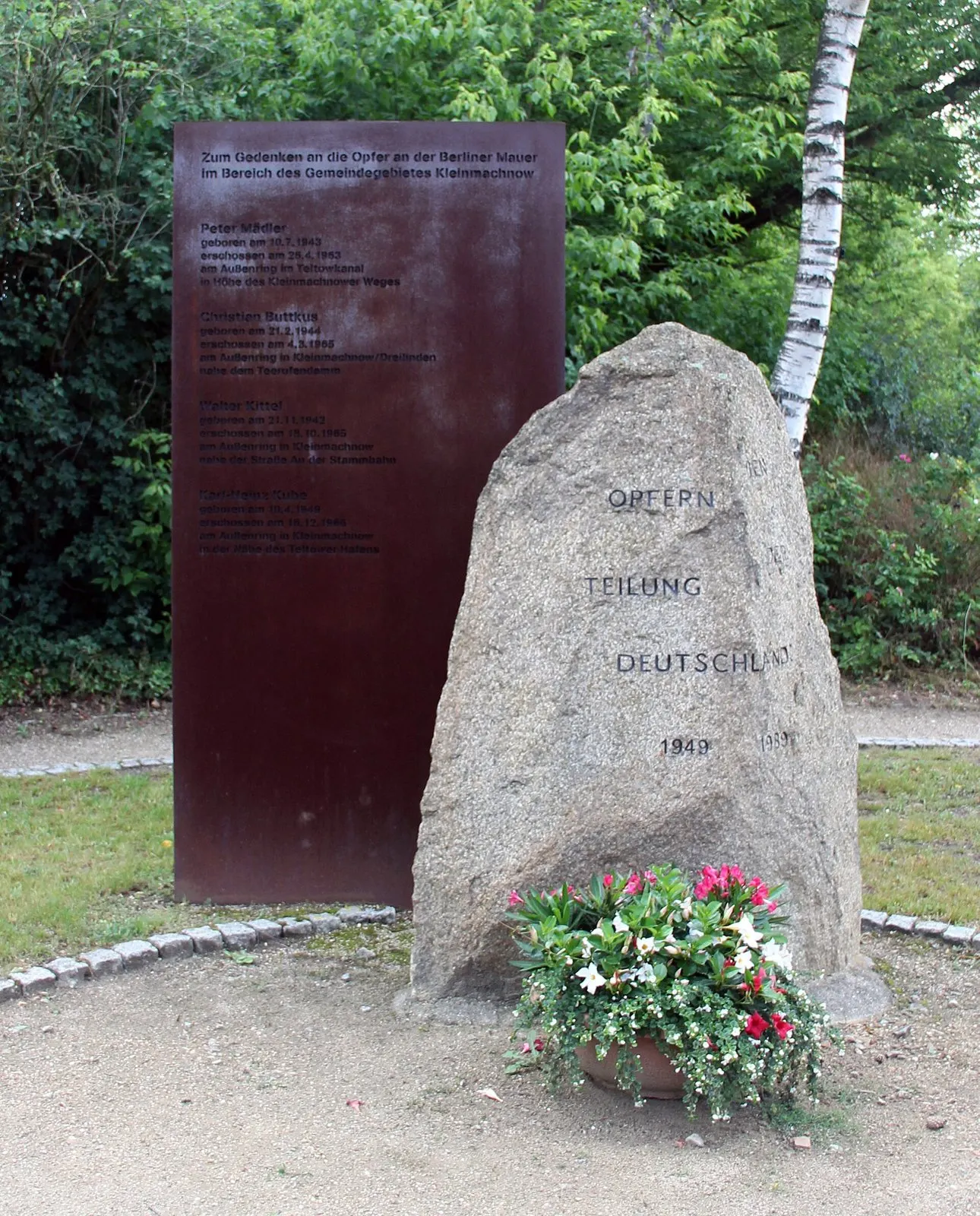
Relatives in West Berlin made his death known there and in July 1965 turned to the "Liberal Jurists Board of Inquiry" in the hope of learning how he had really died. On 22 December 1994 the Potsdam Regional Court convicted the former patrol guard who had fired the fatal shots of manslaughter together with attempted manslaughter and gave him a suspended sentence of one year and six months. A memorial stone to the victims of Germany's division was placed in Kleinmachnow in 1999; a wooden cross in his memory on Berlepschstrasse in Zehlendorf was removed that year and has been missing ever since.

_Todesopfer_an_der_Berliner_Mauer.jpg)
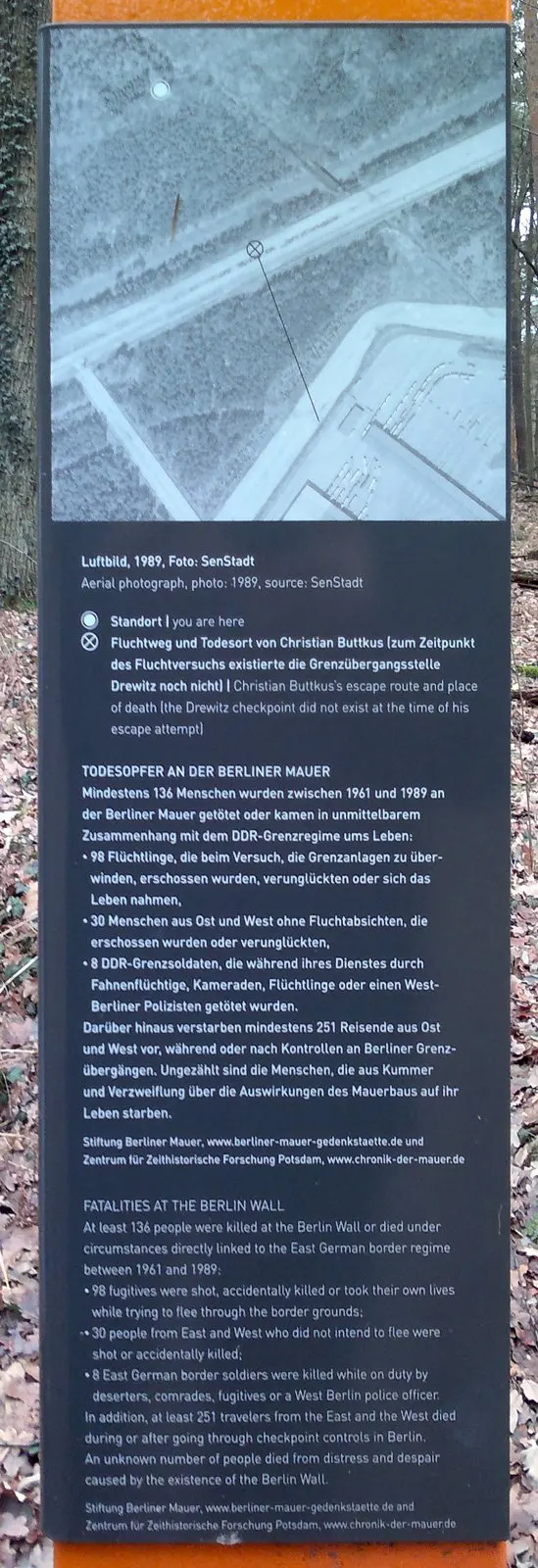
_Christian_Buttkus2.jpg)
Also died on the outer ring between Berlin-Zehlendorf and Kleinmachnow
- Peter Mädler 26 April 1963
- Walter Kittel 18 October 1965
- Karl-Heinz Kube 16 December 1966
Sources
This profile is a summary written for this site. Every fact in it is taken from source 1, which also gives the full account with archival references.
- Lydia Dollmann, “Christian Buttkus”, biography in Chronik der Mauer, Federal Agency for Civic Education, Centre for Contemporary History Potsdam and Deutschlandradio. Accessed 23 September 2026. Read online. Basis for every fact in this profile, including the dates and place of death.
- German version of the same biography. Accessed 23 September 2026. Read online.
- Hans-Hermann Hertle and Maria Nooke (eds.), The Victims at the Berlin Wall, 1961–1989: A Biographical Handbook. Centre for Contemporary History Potsdam and Berlin Wall Foundation, Berlin 2011. The printed handbook from which the online biography is taken.
- Hans-Hermann Hertle and Maria Nooke, “140 Victims at the Berlin Wall, 1961–1989” (list), Centre for Contemporary History Potsdam and Berlin Wall Foundation, August 2017. PDF. Used to cross-check names and dates.
- Hans-Hermann Hertle and Maria Nooke, “The Victims at the Berlin Wall, 1961–1989: Findings of a Research Project”, August 2017. PDF. Source of the classification into escapees, people with no intent to escape, and border soldiers.
Further reading
Image credits
- Memorial panel for Christian Buttkus on the Stahnsdorfer Damm, photographed in 2013. OTFW, Berlin, CC BY-SA 3.0, Wikimedia Commons.
- Memorial column for Christian Buttkus near Kleinmachnow, photographed in 2012. Anszu, CC BY-SA 3.0, Wikimedia Commons.
- Memorial to the victims of German division at Berlepschstraße / Karl-Marx-Straße on the Zehlendorf–Kleinmachnow border, whose plaque names Christian Buttkus, photographed in 2019. OTFW, Berlin, CC BY-SA 3.0, Wikimedia Commons.
- Map panel on the Stahnsdorfer Damm marking Christian Buttkus's escape route and place of death. OTFW, Berlin, CC BY-SA 3.0, Wikimedia Commons.
Cite this page
“Christian Buttkus”, Victims of the Berlin Wall, Berlin Experiences. https://victimsofthewall.com/victims/buttkus-christian/
Map
The pin position is based on the place of death described in source 1. Base map © OpenStreetMap contributors; course of the Wall in 1989 from Geoportal Berlin (dl-de/zero-2.0). Accessed 23 September 2026.