Peter Mädler
1943–1963
Peter Mädler, a 19-year-old electrician, was shot on 26 April 1963 while swimming through the Teltow Canal at Kleinmachnow towards West Berlin, only metres from the border in the waterway.
_Kube_M%C3%A4dler3.jpg)
Peter Mädler was born on 10 July 1943 in Opperau near Breslau, today's Wrocław. It is presumed that he was separated from his birth parents in the confusion of the war when he was very young. Around 1950 he was adopted by the Mädlers, a couple in Hoyerswerda; his adoptive father was a storekeeper and his adoptive mother kept house. He went to school in Hoyerswerda up to the 8th grade.
In 1958 he began training as an electrician at the company school of the Lauta power station, finishing on 30 August 1961. A childhood friend recalled that his looks stood out: during his apprenticeship he was the first to wear his hair platinum blond. He did well in his training, cared more about girls than politics, and stayed out of the FDJ youth association while an apprentice. Immediately after the Wall went up, the power station's apprentices were expected to pledge themselves to serve in the army; like other apprentices, he refused to sign. After a spell at the Lübbenau power station he moved in December 1961 to the 'Teltower Geräte und Reglerwerk', from whose roof he could see the border grounds at the Teltow Canal in Kleinmachnow.
According to his childhood friend, in the early 1960s Peter learned that blood relatives of his were living in West Germany. This was probably why he began planning an escape, which he meant to carry out once his training was over; the Wall got in the way, and for a time he set the idea aside. It is not known whether he moved to Teltow deliberately to prepare his escape. He told neither his colleagues nor his foster parents what he intended, but by April 1963 he was ready.
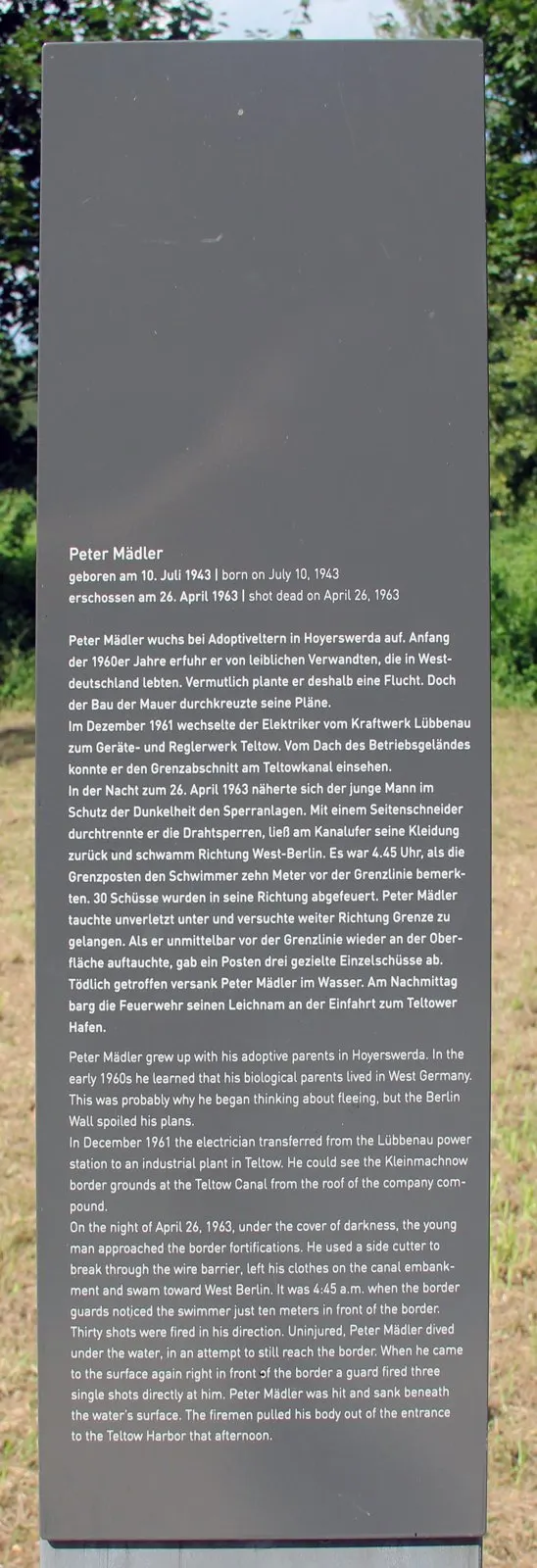
In the darkness of the night of 26 April 1963 he approached the border near the Erlenweg, cut through the fence, left his clothes on the bank and swam into the canal with his papers tied to a belt. He worked his way along the northern bank towards the harbour entrance, near a watchtower. At 4:45 a.m. the guards saw him. About ten metres from the border he was ordered out; he called to the two guards not to shoot and swam on. One guard fired 30 rounds without a warning shot and missed; he dived. When he surfaced just short of the border line, a guard fired three single shots straight at him; he was hit and sank. After an extensive search, firemen recovered his body at the entrance to Teltow harbour at about 4:46 p.m. that afternoon.
The same day the commander of the border unit praised the guards' conduct in his report, and they were awarded the 'Medal for Exemplary Service at the Border'. Across the canal, residents of the Teltow dockyard heard the shots; one thought the body wore a uniform, so the West Berlin police and press assumed that the dead man was a border soldier. The press criticised the West Berlin police for their inaction, the Berlin CDU raised the matter in parliament, and patrols at the Teltow dockyard were increased and disciplinary proceedings were opened against the police officers concerned.
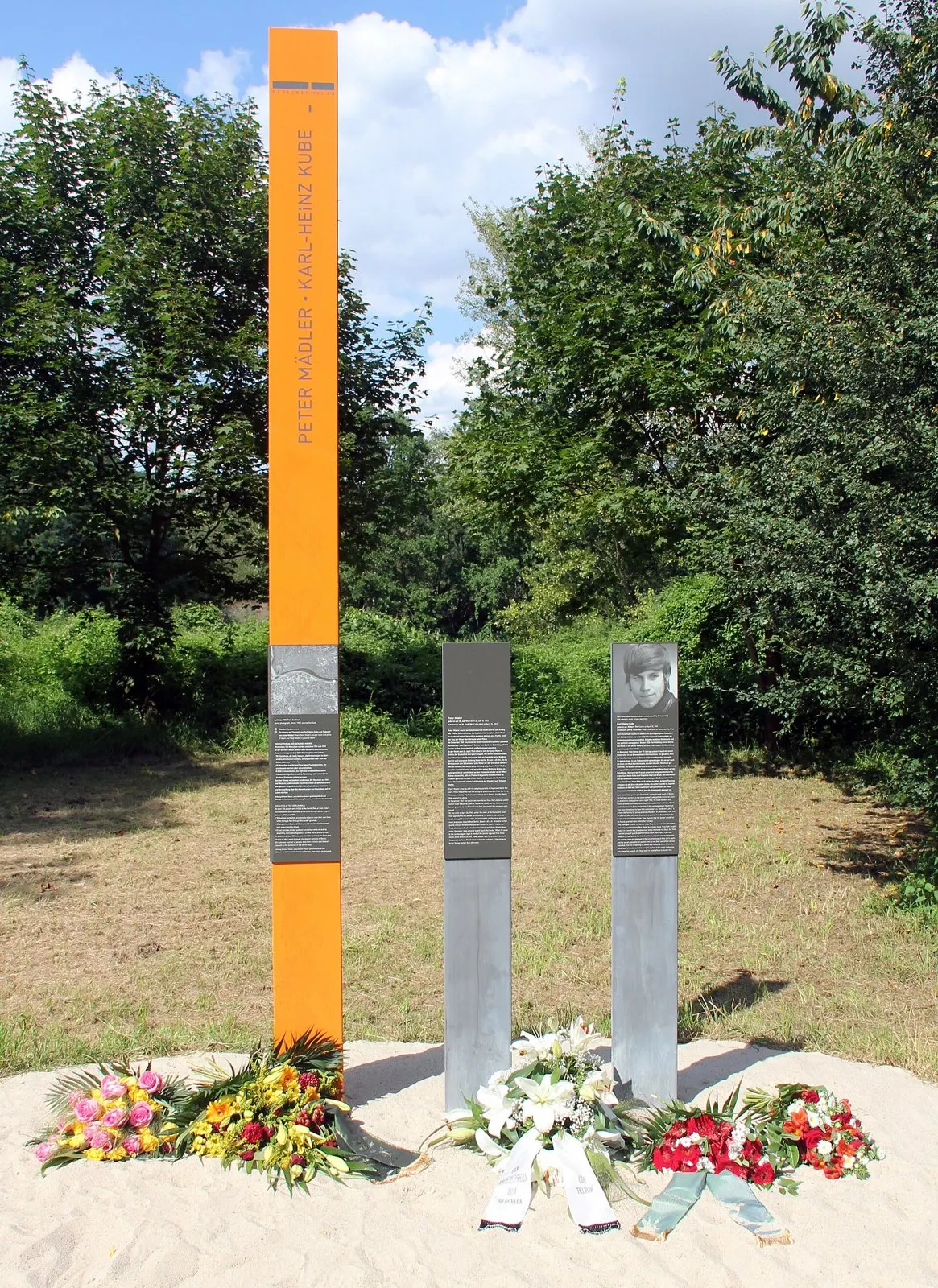
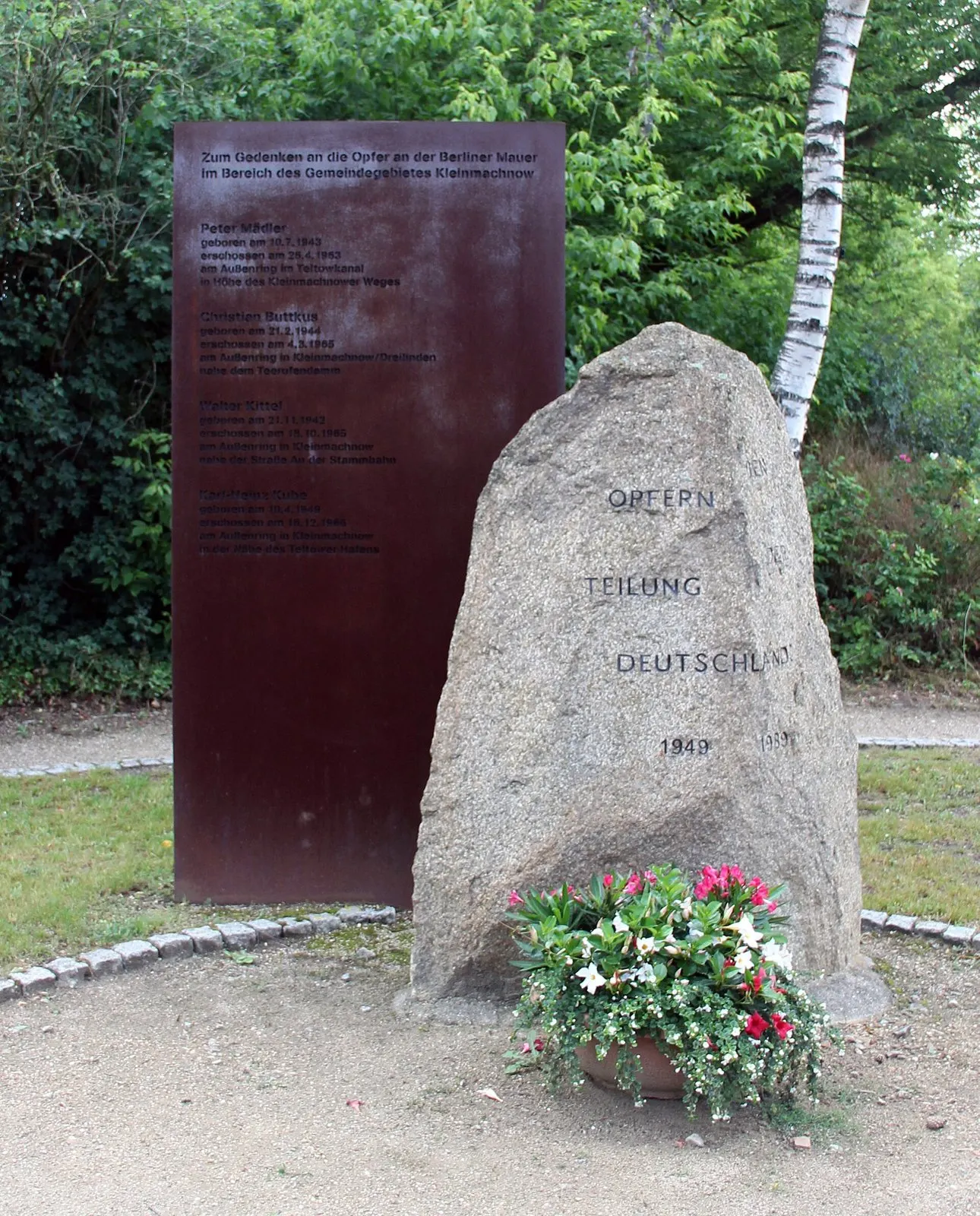
The guards were not prosecuted until 32 years later; the Potsdam Regional Court convicted both of them of manslaughter and gave them suspended prison sentences of a year and three months, holding that the guard whose shots missed had also accepted the fugitive's death. A childhood friend said that his urn was interred at the Waldfriedhof in Hoyerswerda; the grave was later levelled and no longer exists. In West Berlin a cross was raised for the unknown fugitive at the Steinstücken triangle on the Wall's tenth anniversary. Today a memorial stone in Kleinmachnow for the victims of Germany's division recalls in particular those who, like him, died at the border there, and every 13 August people gather at the Knesebeck Bridge in Teltow to lay flowers at columns dedicated to him and Karl-Heinz Kube.
_Peter_M%C3%A4dler.jpg)
_Todesopfer_an_der_Berliner_Mauer.jpg)
Read more
Also died on the outer ring between Berlin-Zehlendorf and Kleinmachnow
- Christian Buttkus 4 March 1965
- Walter Kittel 18 October 1965
- Karl-Heinz Kube 16 December 1966
Sources
This profile is a summary written for this site. Every fact in it is taken from source 1, which also gives the full account with archival references.
- Lydia Dollmann, “Peter Mädler”, biography in Chronik der Mauer, Federal Agency for Civic Education, Centre for Contemporary History Potsdam and Deutschlandradio. Accessed 23 September 2026. Read online. Basis for every fact in this profile, including the dates and place of death.
- German version of the same biography. Accessed 23 September 2026. Read online.
- Hans-Hermann Hertle and Maria Nooke (eds.), The Victims at the Berlin Wall, 1961–1989: A Biographical Handbook. Centre for Contemporary History Potsdam and Berlin Wall Foundation, Berlin 2011. The printed handbook from which the online biography is taken.
- Hans-Hermann Hertle and Maria Nooke, “140 Victims at the Berlin Wall, 1961–1989” (list), Centre for Contemporary History Potsdam and Berlin Wall Foundation, August 2017. PDF. Used to cross-check names and dates.
- Hans-Hermann Hertle and Maria Nooke, “The Victims at the Berlin Wall, 1961–1989: Findings of a Research Project”, August 2017. PDF. Source of the classification into escapees, people with no intent to escape, and border soldiers.
Further reading
Image credits
- Memorial for Peter Mädler and Karl-Heinz Kube on Zehlendorfer Straße in Teltow, with flowers laid at its foot, photographed in 2017. OTFW, Berlin, CC BY-SA 3.0, Wikimedia Commons.
- Memorial panel for Peter Mädler on Zehlendorfer Straße in Teltow, photographed in 2017. OTFW, Berlin, CC BY-SA 3.0, Wikimedia Commons.
- Memorial to the victims of German division at Berlepschstraße / Karl-Marx-Straße on the Zehlendorf–Kleinmachnow border, whose plaque names Peter Mädler first, photographed in 2019. OTFW, Berlin, CC BY-SA 3.0, Wikimedia Commons.
Cite this page
“Peter Mädler”, Victims of the Berlin Wall, Berlin Experiences. https://victimsofthewall.com/victims/maedler-peter/
Map
The pin position is based on the place of death described in source 1. Base map © OpenStreetMap contributors; course of the Wall in 1989 from Geoportal Berlin (dl-de/zero-2.0). Accessed 23 September 2026.